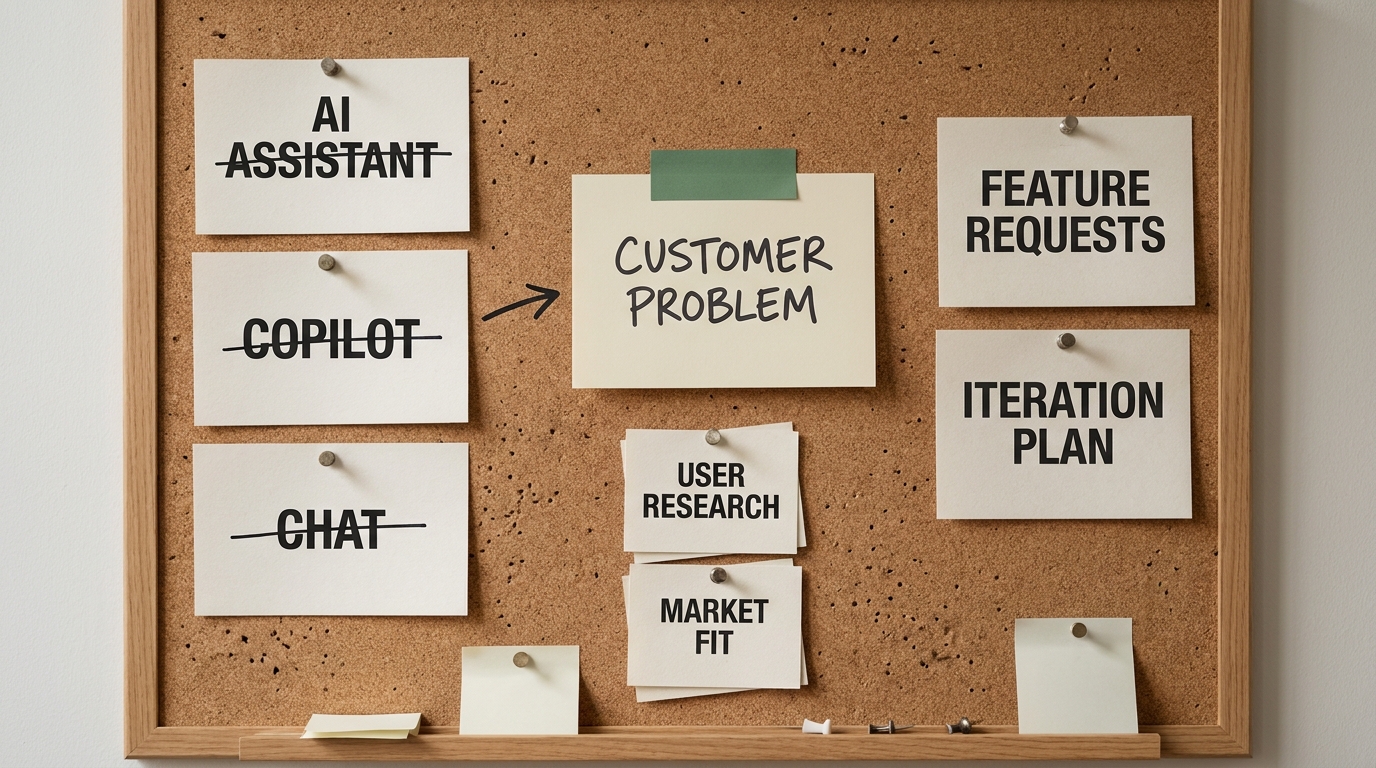

The deck was beautiful. Forty-two slides, a maturity curve, a freshly minted "Head of AI," and a steering committee that met every other Thursday. Six months on, not one process in the business ran any differently.
The strategy wasn't wrong. The company had just confused agreeing about AI with changing because of it. That gap is the single most expensive thing in enterprise AI right now. Every quarter you spend perfecting the plan is a quarter a competitor spends putting a working system into production. Alignment feels like progress. It isn't.
The short answer
AI strategy aligns your people. Shipped AI workflows change your business. The companies pulling ahead aren't the ones with the sharpest decks. They're the ones who got a working, AI-assisted workflow into production fastest, then did it again.
Here's the honest test, and most executives fail it. Name one workflow that runs differently this quarter because of AI . If you can answer with a specific process, a specific team, and a specific before-and-after, you're shipping. If all you can point to is a strategy, a pilot, or a budget line, you have a shipping problem. Not a strategy problem.
The trap: alignment feels like progress
Strategy work is satisfying in a way delivery rarely is. The offsite produces consensus. The framework gets nods around the table. The org chart gains a confident new box. All of it reads as momentum, and none of it touches a cost line, a cycle time, or a revenue number.

That's why so much AI investment stalls. Spend keeps climbing while production deployment lags behind. Deloitte's State of AI in the Enterprise research has repeatedly found that the share of organizations actually moving generative AI from pilot into scaled production is far smaller than the share funding it, and KPMG's quarterly AI surveys keep showing the same thing: enthusiasm running well ahead of operational change. Microsoft put it bluntly in 2026 - execution, not strategy, is now the differentiator.
The mechanism is simple. A strategy is a plan about the work. It can be excellent and still leave the work untouched. A shipped workflow is the work, changed.
Why shipping creates change and strategy doesn't
Picture two companies with identical AI strategies. One spends the next quarter refining governance, building a center of excellence, socializing the roadmap. The other picks a single painful workflow and puts an AI-assisted version of it into production. At quarter's end, only the second company can measure anything. The first has a better deck. The second has a faster process.
The model worth holding in your head has three moves: Align, Ship, Compound.
Alignment is table stakes. You need enough shared understanding to point in the same direction. But alignment alone produces no change, and it's where most companies overspend.
Shipping is the unlock. A workflow in production is the first moment AI shows up in an operational metric instead of on a slide.
Compounding is the moat. Each shipped workflow makes the next one faster, because the team has now learned the patterns, the plumbing, and the failure modes. Strategy doesn't compound. Shipped systems do.
That's the whole framework, and it exists for one reason: to set up the proof.
Proof: three workflows we shipped
Strategy is abstract. Shipped work is specific. Each example below follows the same shape - the broken process, the workflow we put into production, and what changed. Where a result hasn't been formally cleared for publication as a hard number, we describe it as an observed improvement rather than a precise figure.

1. Proposal and document turnaround. Before: a team assembling client-facing proposals by hand, copying boilerplate, hunting for the latest figures, waiting on internal review. Turnaround stretched across days, and quality drifted with whoever was on deadline. What we shipped was an AI-assisted drafting workflow that pulls approved content, assembles a first draft, and routes it for human sign-off. What changed was a sharp, observed drop in turnaround time and far less variance in the output, because the workflow now sets the floor on quality instead of the individual.
2. Inbound lead triage and routing. Before: inbound interest landing in a shared queue and getting sorted by hand, the best leads sometimes sitting untouched while someone worked the pile in order. What we shipped was an AI-assisted triage workflow that reads each inbound message, classifies intent, and routes it to the right owner with a suggested next action. What changed was a meaningful, observed drop in time-to-first-response and fewer high-value leads going cold, because routing no longer depended on who happened to be watching the queue.
3. Internal knowledge retrieval. Before: staff losing hours to a familiar tax - asking colleagues where a document lived, re-deriving answers that already existed somewhere, interrupting senior people for context. What we shipped was a retrieval workflow over the company's own approved materials , so a plain-language question returns a sourced answer in seconds. What changed was an observed recovery of time across the team and fewer interruptions to the people whose time costs the most.
None of these started life as an enterprise-wide platform. Each was one workflow, shipped, then improved. That's the pattern that compounds. If you want to pressure-test which of your own workflows is the right first one, book a free 30-min readiness call .
Why most companies still don't ship
If shipping is so clearly the unlock, why is it still rare? Four failure patterns explain most of it.
Over-scoping. Teams wait for the enterprise-wide platform instead of shipping one workflow. The platform is always six months out, so nothing ever lands. The fix is to pick a single workflow narrow enough to put into production this quarter . A focused Discovery Sprint exists for exactly this - turning a vague ambition into one concrete, shippable first move.
Org design without delivery muscle. A strategy or center-of-excellence function can analyze, advise, and govern. But if no one's actual job is to build and operate the workflow, it stays a center of experimentation. Deloitte has flagged this trap directly: the center of excellence that never graduates from experiment to operation .
The talent gap. Plenty of organizations have no one whose job is to build the workflow and then keep it running in production. Strategy hires are not delivery hires. That's the specific gap an embedded agentic team is built to close - people who ship the workflow and operate it, not just recommend it.
Fear of imperfect. A workflow that handles 80 percent of cases and hands the rest to a human is a win. Treat that as a failure because it isn't fully autonomous, and you keep perfectly useful systems off the floor. Ship the 80 percent. Then improve it.
When planning is actually the right call
An argument for shipping is only credible if it names the cases where planning wins, and there are three.
When the constraint is legal, not technical. If a workflow touches regulated data, a decision that carries liability, or a jurisdiction with rules you have not read, the cheap move is to find out before you build. A system that ships and then has to be switched off is more expensive than the four weeks you spent checking.
When the sequence genuinely matters. Some workflows only work after another one exists. If the automation you want depends on data that is not yet collected, or an integration nobody has built, shipping the dependent thing first produces a demo that cannot be adopted. Planning here is not delay, it is ordering.
When nobody agrees what "better" means. A workflow with no agreed success metric cannot be shipped in any meaningful sense, because there is no way to tell afterwards whether it worked. That is a half-day conversation, not a strategy program, but it has to happen before the build rather than after.
What all three have in common is that they are bounded. Each one ends with a decision and a date. The failure mode this piece argues against is not planning - it is planning that has no terminal condition, where the deliverable is another document and the next milestone is another workshop.
What "shipped" has to mean
Shipping is only a better standard than planning if the word means something specific. Otherwise "we shipped" becomes the same theatre as "we aligned," just with a deployment attached.
A workflow is shipped when all of these are true:
- A real user does real work with it. Not a pilot cohort clicking through a script. Someone whose job it is, on a case that matters, without a member of the build team sitting next to them.
- It survives the exceptions. The happy path was never the hard part. Shipped means the ten percent of cases that do not fit have a defined route: who sees them, how fast, and what they do.
- Somebody owns it on Monday. Named, with the authority to change how the work is done. A system whose owner is "the project" is not shipped, it is parked.
- The number moved, measured against a baseline captured before. Cycle time, cost per item, error rate, backlog. Any one of them, agreed in advance. Without a before-figure there is no after-claim, only a story.
- It keeps running without the people who built it. Monitoring exists, a runbook exists, and the first failure will be noticed by someone other than a user complaining.
Miss the last two and you have a demo with better distribution. That is worth saying plainly, because the gap between "in production" and "genuinely shipped" is where most of the AI-delivery credibility in this market gets spent.
The smallest thing worth shipping
The reason planning wins arguments is that shipping sounds enormous. It is not, if the unit is chosen properly.
One workflow. Not a function, not a platform, not a transformation. One recurring, expensive, measurable piece of work with a named owner who wants it changed. Baseline it in a week, build against the exceptions rather than the demo, put a human checkpoint where a wrong answer costs something, and let it run on real volume for one full cycle before deciding anything.
That unit is small enough to finish and large enough to prove. Finishing it does two things a strategy document cannot: it produces a number you can defend at the next budget review, and it teaches the organization what its own constraints actually are - which data was dirtier than anyone admitted, which integration was harder, which team was more willing than expected. Those lessons are only available on the other side of a shipped system, and they are what makes the second workflow cheaper than the first.
The compounding is the whole point. A plan for twelve workflows gets stale in a quarter. One shipped workflow makes the next eleven easier to scope, and it does it with evidence rather than assumption.
Key takeaways
- Alignment is not change. Agreeing that AI matters produces no business result on its own.
- Strategy is a plan about the work. A shipped workflow is the work, changed. Only the second one shows up in a metric.
- Shipping compounds, strategy doesn't. Each workflow in production makes the next one faster.
- Most stalls are shipping problems, not strategy problems. Over-scoping, no delivery muscle, no operators, and fear of imperfect are the usual suspects.
- The action is singular. Pick one workflow and ship it this quarter.
If you can't yet name a workflow that changed this quarter, that's the whole problem - and it's fixable. Pick one process, ship an AI-assisted version of it, and let the result speak louder than any deck. When you want help choosing the first one, book a free 30-min readiness call .
- Planning wins in three bounded cases: a legal or regulatory constraint, a genuine dependency order, and no agreed definition of better. Each ends with a decision and a date - the failure mode is planning with no terminal condition.
- "Shipped" is a five-part standard, not a deployment: a real user doing real work, exceptions routed, a named owner with authority, a number moved against a baseline captured before, and operation that survives the build team leaving.
- Choose one recurring, expensive, measurable workflow. It is small enough to finish and large enough to prove, and finishing it makes the next one cheaper - which a twelve-workflow plan never does.