A bigger pile of candidates is not the same as the right candidates, faster
Our recruiters were stuck at the top of the hiring funnel.
Sourcing — finding candidates worth reviewing — consumed 15 to 20 hours of every researcher's week. A researcher generated about 200 candidates per week for a single opening, working manually through searches, profiles, and fragmented recruitment inputs.
The work was slow, repetitive, and inconsistent.
Two recruiters looking at the same profile could reach different conclusions. Useful role-fit signals were easy to miss. Candidate information had to be turned into sourcing lists by hand.
None of this looked like a dramatic operational failure. It showed up as drift:
- open roles stayed open longer than necessary;
- recruiters spent too much time on search mechanics;
- candidate matching depended too heavily on individual interpretation;
- outreach often started from incomplete context;
- sourcing coverage was limited by how much manual research the team could perform.
So we did not add an AI tool on top of manual sourcing.
We rebuilt the workflow around structured intake, recruiter-validated criteria, AI-assisted ranking, written reasoning, and ATS-ready outputs.
Starting point vs. what changed
- Sourcing consumed 15–20 hours per researcher per week. Recruiters were stuck upstream; strategic recruiting work stayed compressed. → Sourcing per role dropped from roughly 1 week to 1–2 hours.
- Around 200 candidates per researcher per week, manually sourced. Throughput was capped by hand-search. → Around 500 ranked, AI-assisted candidate recommendations per day per researcher.
- Matching was subjective. Two recruiters could reach different calls on the same profile. → Candidates are reviewed against the same structured, weighted criteria.
- Prioritization was manual. Recruiters had to infer fit and outreach priority by hand. → The platform helps surface candidates worth reviewing first.
- Candidate information was fragmented. No consistent workflow from sourcing inputs to ATS-ready outputs. → Recruiters work from a more structured, governed sourcing workflow.
What changed in the business
You do not buy a sourcing tool. You buy throughput, capacity, consistency, and better use of recruiter time.
The business impact came from five levers.
- Throughput. From around 200 candidates per researcher per week to around 500 ranked candidate recommendations per day per researcher.
- Team capacity. 15–20 hours per week of mechanical sourcing was reallocated toward review, engagement, and recruiter judgment.
- Cycle time. Sourcing moved from roughly one week of manual research to one to two hours per role, from setup to a ranked sourcing list.
- Quality and consistency. Candidates are reviewed against the same structured criteria, with relevance scoring, written reasoning, confidence indicators, and prioritization context.
- Cost-to-serve. The internal run cost is materially lower than a single senior agency placement fee, while reducing manual work and increasing sourcing capacity.
The platform does not replace recruiters. It removes the bottleneck that kept them upstream of the work they are best at.
Recruiter feedback
Feedback collected during evaluation and UAT showed that the platform has genuine promise for standard technology-stack and delivery-role searches, especially where role requirements are well-defined and candidate profiles contain enough structured signal.
The strongest early fit was for common IT and digital-delivery roles where requirements are usually explicit — for example, Java/.NET/JavaScript engineering, Salesforce roles, QA, Business Analysis, Project Management, DevOps, Data Engineering, and Product or UI/UX roles.
The strongest value showed up in three areas:
- Pool size. Recruiters could generate a broader initial candidate longlist faster than through manual sourcing.
- Speed. The platform significantly reduced the time needed to move from an open role to a usable sourcing list.
- Relevance threshold. The 70%+ relevance threshold became a useful operating lever when calibrated correctly, helping recruiters focus first on candidates most likely to match the role.
The clearest results came from general, well-defined roles such as Java Developer, .NET Developer, Salesforce Developer, QA Engineer, Business Analyst, and Project Manager, where the generated candidate lists were largely usable with minimal manual intervention.
The feedback also helped define where the platform needs stronger calibration: niche roles, ambiguous job descriptions, hybrid roles with unclear seniority expectations, and searches where the required skills are not expressed clearly in candidate profiles.
What the platform does
The recruiter-facing surface is a single web application. Underneath it is a structured workflow across three phases.
Phase 1 — Job setup
Recruiters bulk-import open positions from the ATS as a CSV.
The AI extracts structured requirements from each job description, including:
- title;
- experience;
- skills;
- languages;
- certifications;
- seniority;
- role-specific requirements.
The recruiter reviews and edits the extracted requirements before the position is published.
A live matching-candidate count updates as criteria change, helping recruiters understand whether the role definition is too broad, too narrow, or misaligned with available sourcing coverage.
A position only publishes after passing structural validation. This prevents downstream evaluation from running on weak or incomplete criteria.
Phase 2 — Candidate selection
Recruiters narrow the available sourcing pool with filters.
They can use a position-based auto-filter that applies the job's own requirements as search criteria, then adjust the candidate list manually.
The system can also exclude candidates already listed for the same role, reducing duplicate outreach and keeping recruiter effort focused.
Phase 3 — AI evaluation and outreach support
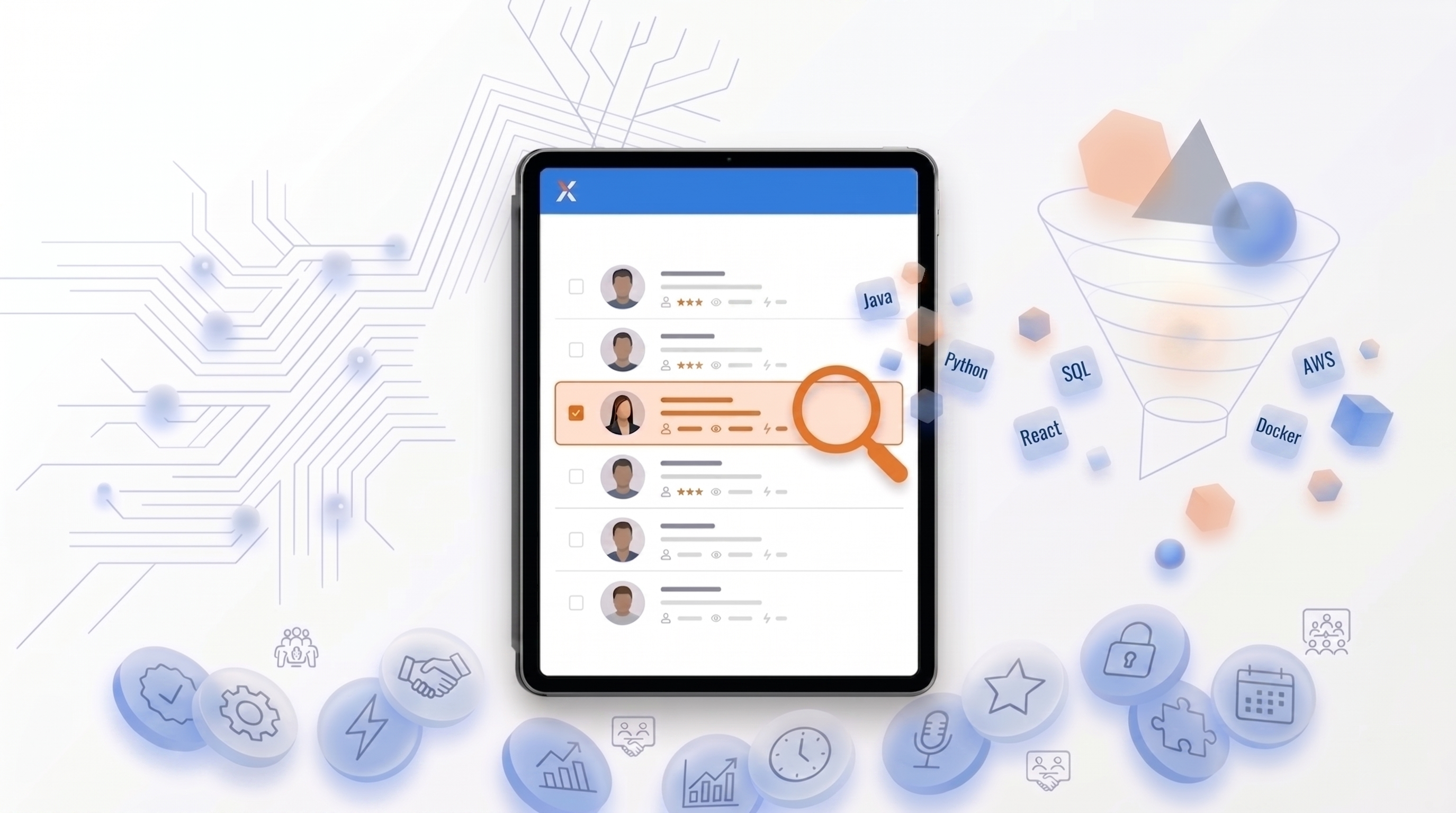
The AI evaluates candidates against the job's weighted criteria.
For every candidate, the system produces:
- a relevance score;
- written reasoning;
- role-fit indicators;
- confidence indicators;
- recruiter-visible explanation of why the candidate was ranked.
Results sort by relevance and prioritization context, with visual badges to make review faster.
The final list can be exported to CSV and imported back into the ATS, where custom fields carry the AI reasoning into recruiter review and personalized outreach.
The prioritization layer helps recruiters start with candidates most worth reviewing first. It does not decide who should be contacted, rejected, or hired.
Built for recruiter control
The platform was designed as decision support, not automated hiring.
Recruiters review job requirements before a role is published, adjust criteria before candidate evaluation, and review ranked recommendations before outreach.
The AI score is a prioritization signal, not a final decision.
Every recommendation includes written reasoning, confidence indicators, and the criteria considered, so recruiters can understand why a candidate was surfaced and decide what to do next.
The ATS remains the system of record, and recruiter-reviewed outputs flow back into the existing recruitment workflow.
Under the hood — proof for the technical buyer
The platform integrates five application modules behind a single web application:
- API;
- frontend;
- end-to-end tests;
- ETL workflows;
- database.
Performance
Candidate-page load stays under 2 seconds at production-scale data volume, which platform users confirmed as acceptable.
AI evaluation runs 20 candidates in about six minutes, which fits how recruiters work through sourcing lists.
The point is not only speed. The real value is consistency: candidates are reviewed against the same structured requirements instead of relying on uneven manual screening.
Model choice
We migrated the AI orchestration layer mid-project from GPT-5 mini to Gemini 3 Flash.
The reason was practical: better output quality on our extraction and qualification prompts, plus better cost economics for the workload at scale.
The system is not vendor-locked. The provider can be swapped at the output layer without redesigning the architecture.
Quality evaluation
The quality approach combined:
- structured job requirement extraction;
- recruiter validation before publishing;
- AI-generated reasoning for each candidate;
- confidence indicators based on profile completeness;
- QA review on demand;
- sampled automated evaluation at launch.
The next improvement is to re-enable automated evaluation at higher coverage and connect it more directly to production monitoring.
Run-cost economics
The system was designed to be economically efficient at scale.
Its internal annual run cost is materially below a single senior agency placement fee, while supporting AI-assisted sourcing workflows for recruiters.
Exact run cost depends on data sources, refresh frequency, evaluation volume, observability coverage, hosting model, and operational requirements.
The important point is not that the infrastructure is cheap. The important point is that the operating model changes the economics of sourcing: recruiters can cover more roles, review broader candidate lists, and start from ranked, explainable recommendations instead of manual search.
How we built it — and why it is repeatable
The platform was built in about four calendar months by a fractional six-person team:
- two developers;
- QA engineer;
- business analyst;
- project manager;
- solution architect.
Direct product-delivery effort came to roughly 1,000 hours.
Twenty-two features shipped through a full specification process, including left-shift testing, with test cases authored from requirements before implementation.
The delivery model matters because this was not a one-off automation script. It was a production workflow with data pipelines, recruiter-facing UI, ATS integration, scoring logic, auditability, and operating ownership.
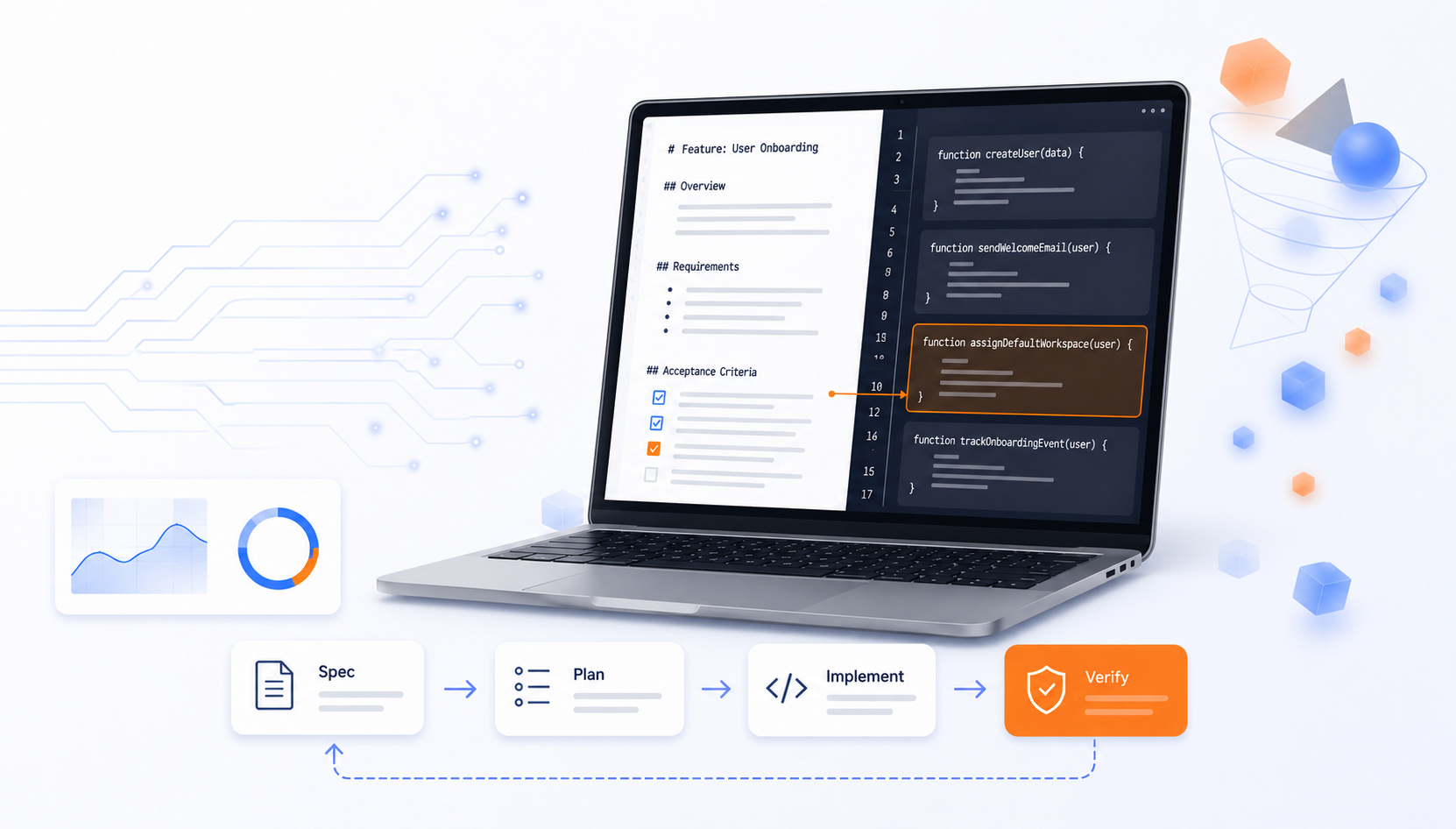
Four-month delivery was possible because the team used an AI-enabled development methodology underneath:
- structured requirements;
- specification-first delivery;
- AI-assisted implementation;
- left-shift QA;
- reusable architecture patterns;
- controlled human review;
- production-minded evaluation.
Production AI in months, not quarters — without the technical-debt tax
The same pattern works beyond recruitment
The pattern is not recruitment-specific.
The reusable shape is:
bulk intake → structured AI extraction → human-validated criteria → AI evaluation with weighted reasoning → human review → push back into the system of record
That same pattern applies to any sourcing- or screening-heavy function:
- sales prospecting;
- partner qualification;
- customer-support triage;
- support-case routing;
- vendor screening;
- account research;
- RFP or tender qualification;
- internal knowledge intake;
- lead prioritization.
These workflows share the same underlying problem: a large pool, inconsistent manual review, weak prioritization, and a system of record waiting for structured output.
The goal is not to make the old manual process faster.
The goal is to redesign the workflow so the highest-signal items reach human judgment first.
The result we would aim for in your operation
If sourcing is where your recruiters are stuck upstream of the work they are best at, the target result is clear:
roles covered in hours instead of a week, candidates ranked consistently with written reasoning, and the highest-signal people surfaced first for recruiter review.
A Pulse Check is where we would start — free, 30 minutes, no slide deck.
We will tell you honestly whether this result is reachable for your team, what would need to be true, and what we would measure to prove it.