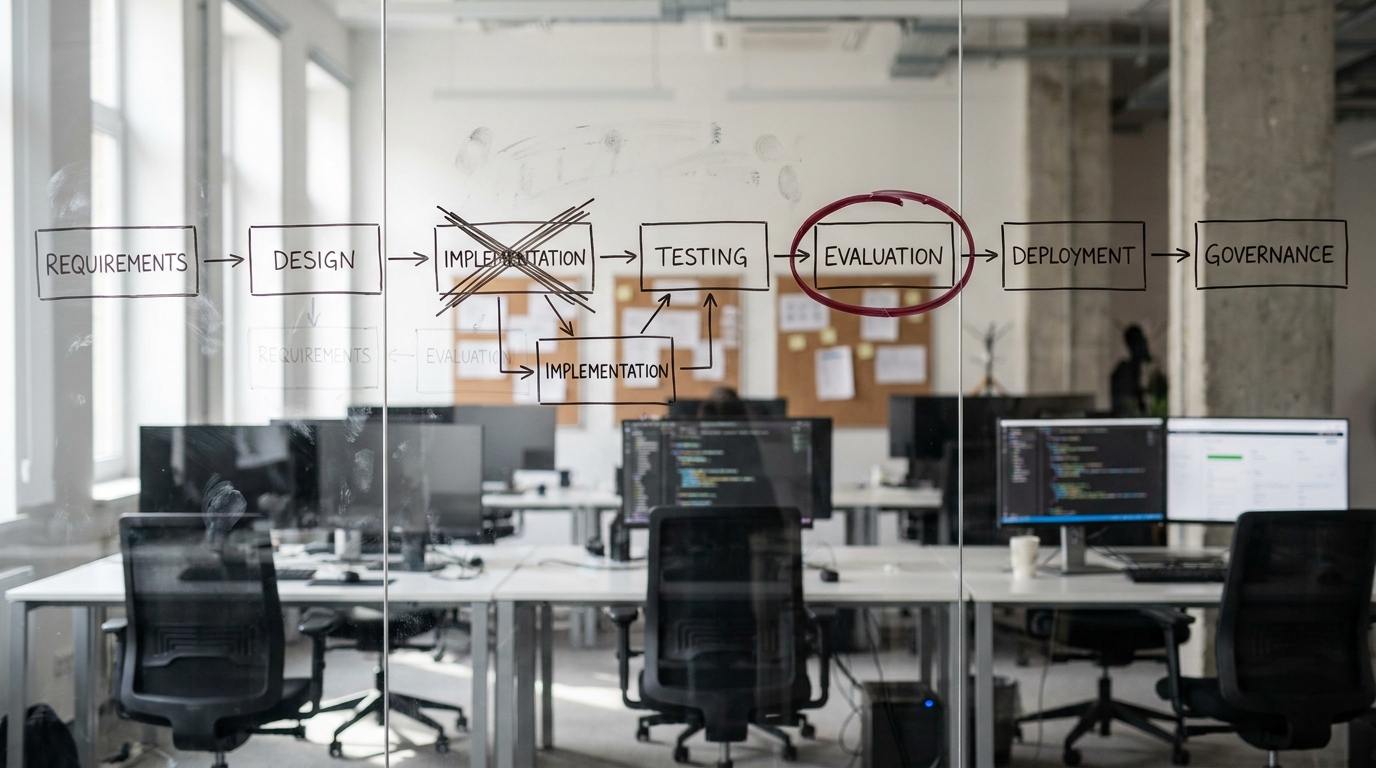
Five people answer the same job ad. A researcher who fine-tunes vision models. An engineer who has shipped three retrieval systems into production. A data scientist who lives in notebooks. A backend developer who added an API call to a chat endpoint. Someone whose entire portfolio is agent frameworks. All five read the requisition correctly. That is the problem.
The title said "AI engineer." It was carrying five jobs.
That confusion is not a hiring inconvenience. It is the first visible symptom of a modelling error that shows up again in the org chart, in the interview loop, in the performance review, and eventually in a pilot that stalls for four months while nobody can name what is actually missing.
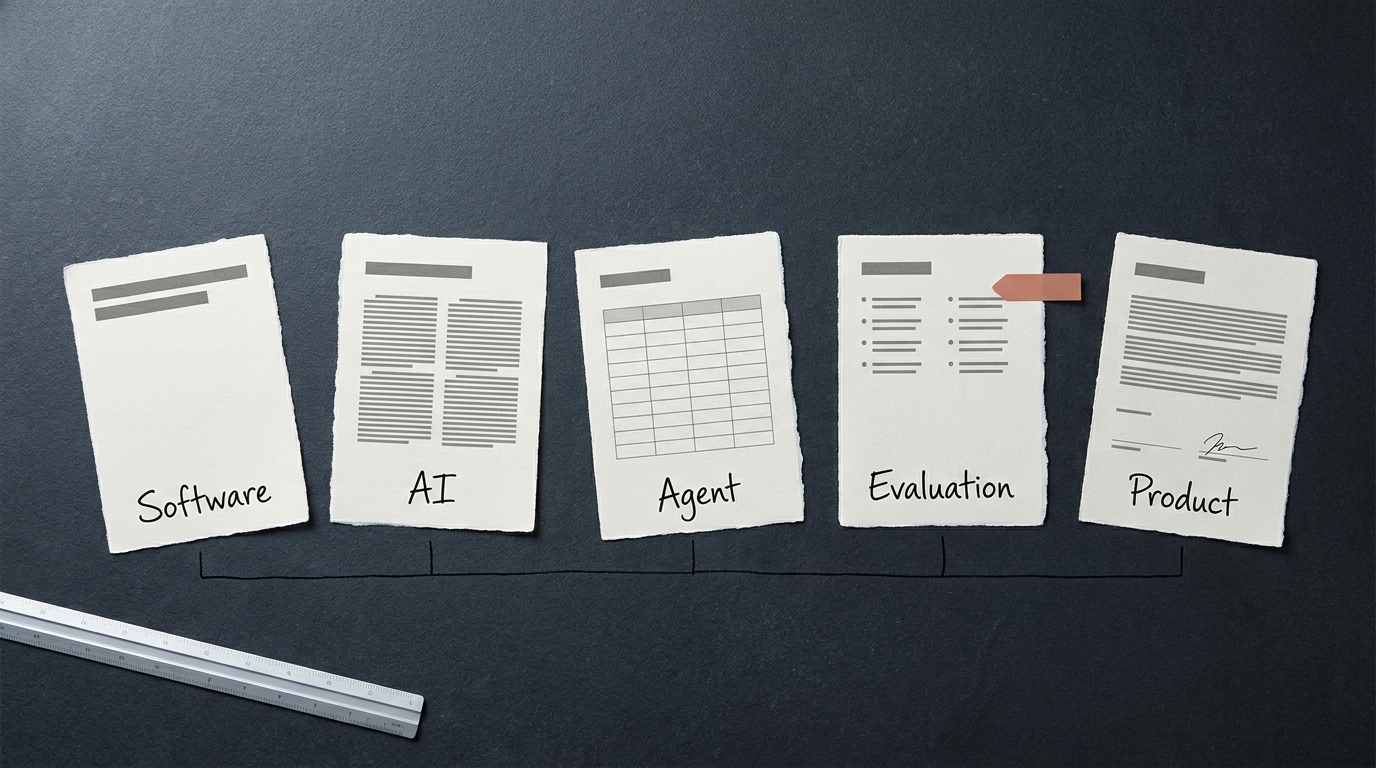
AI delivery in 2026 is not one skill set. It decomposes into five distinct disciplines, each with its own scope of ownership, its own artifacts, and its own characteristic failure when nobody is doing it. A team can be genuinely strong in three of them and still not ship. The two that go missing most often are the two that almost nobody writes job descriptions for.
Why "AI engineer" is not a job title
The title collapses five different scopes into one word, which is why the candidate pool comes back incoherent and the interview loop cannot tell the candidates apart. Ask three engineering leaders what an AI engineer does and you get three answers. One describes model training. One describes building product features on top of foundation models. One describes the platform work that makes either possible .
None of them is wrong. The term is just carrying too much.
The mechanism is mundane. When the requisition is vague, the interview loop defaults to whatever the panel already knows how to assess, which is usually general software engineering plus a machine learning trivia round. Teams then hire someone strong on both counts and discover, two months in, that the gap was somewhere else entirely: nobody can say whether the feature is behaving correctly in production, or nobody has designed what happens when the agent's third tool call returns something implausible.
Carnegie Mellon's Software Engineering Institute has been arguing since well before the current wave that AI engineering needs to mature into a professional discipline in its own right, rather than remain a set of practices borrowed from research (Carnegie Mellon SEI, 2021). That framing is right and it does not go far enough. What has happened since is that the work split again, into disciplines that need different people, different interviews, and different definitions of done.
Here are the five, by name: traditional software engineering, AI engineering, agent engineering, evaluation engineering, and AI product management. Each one is defined below by what it owns and by what breaks in its absence. The second test is the useful one. It is the only one you can run against the team you already have.
The five disciplines, side by side
The whole taxonomy on one screen, before the deep dives. Read the last column first. Find the row where your team has nobody sitting.
| Discipline | What it owns | Primary artifact | What breaks when it is missing |
|---|---|---|---|
| Software engineering | The system around the model: state, data flow, permissions, deploys, rollback | A service that stays up and can be changed safely | The demo is impressive and there is no path to production |
| AI engineering | The model-facing layer: context and prompt design, retrieval, tool schemas, structured output, model choice, cost and latency per task | A bounded, measurable, portable model call | Unbounded cost, output nobody can reproduce, total lock-in to one provider |
| Agent engineering | Multi-step autonomy: task decomposition, orchestration, memory, failure recovery, human checkpoints, blast radius | An agent that fails safely, not just one that succeeds | The agent works on the happy path, then acts confidently on bad input with real permissions |
| Evaluation engineering | Whether it is still correct: eval sets, regression suites, grader design, online monitoring, drift | A test suite for a system with no expected-output column | Nobody can answer "is it still working", so every change becomes a gamble and the team freezes |
| AI product management | Scoping to what a probabilistic system can promise: use-case selection, acceptance criteria, review boundaries, cost per outcome | A spec whose success criteria are statistical | Something technically fine ships into a workflow that cannot tolerate its error rate |
Two things are worth noticing. Only one of the five rows is about models. And the two rows most teams have never staffed are agent engineering and evaluation engineering, which are also the two rows whose failure modes are invisible from a status report. A team missing either of them will report green for months.
Software engineering is still most of the work
The most expensive assumption in AI staffing is that AI work displaces software engineering. It does not. It adds a component that behaves probabilistically to a system that still has to behave predictably about everything else.
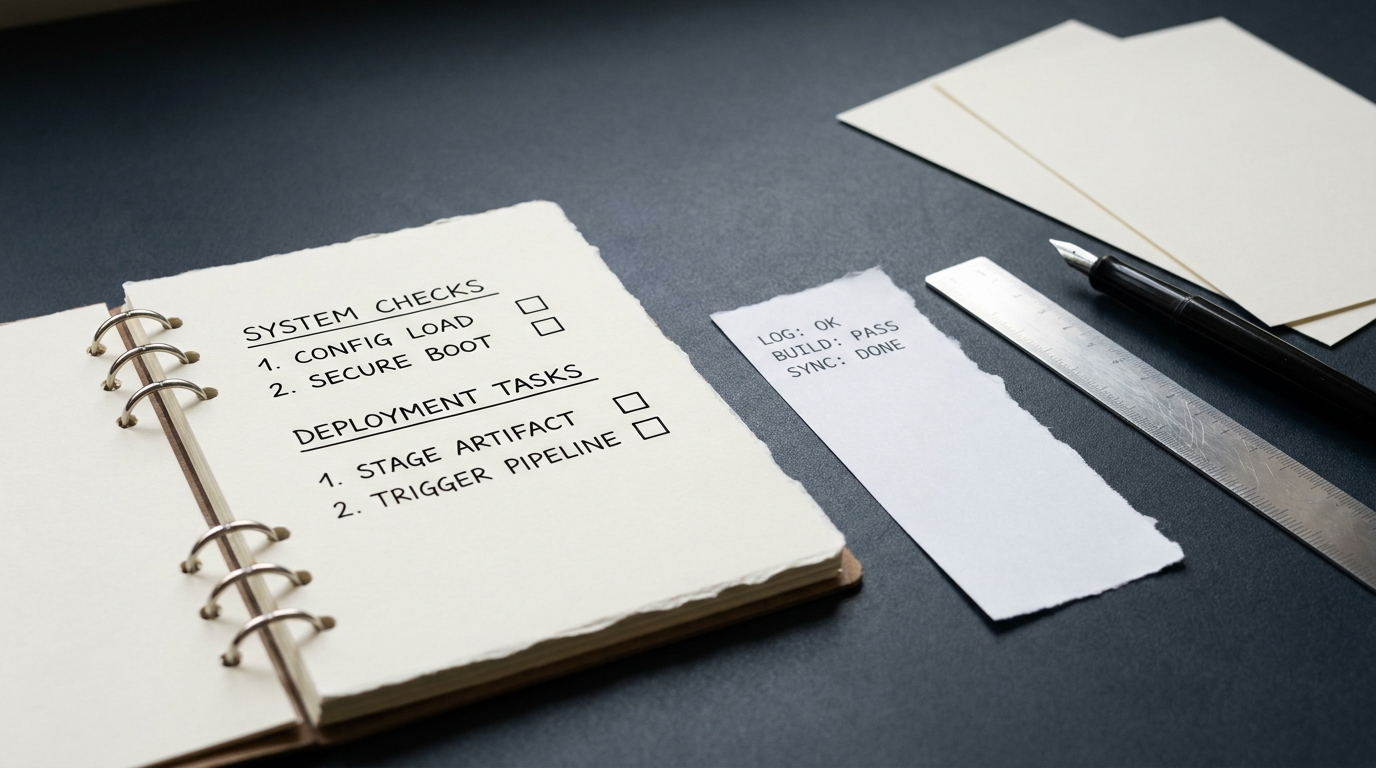
Reliability lives in the system around the model. Someone has to own request lifecycle and idempotency, so a retried generation does not double-charge a customer. Someone has to own state, so a conversation spanning three services does not lose half of itself. Someone has to own permissions, so a retrieval layer does not surface a document the requesting user was never allowed to see. Someone has to own deploys and rollback, so a prompt change that degrades quality can be reverted in minutes rather than argued about for a week. (The prompt is code. Most teams learn that during the incident, not before it.)
None of that is glamorous and all of it is load-bearing. AI features fail for ordinary distributed-systems reasons at least as often as they fail for model reasons: a timeout nobody configured, a queue that backs up under real traffic, a schema change that never propagated. The model gets blamed because the model is the new thing.
Gergely Orosz has made a related argument from the other direction, looking at what happens to software engineering as AI writes an increasing share of code (The Pragmatic Engineer, 2026). The short version is that the judgment layer does not go away. Someone still has to decide what the system should do and be accountable when it does something else.
Failure mode when missing: an impressive demo with no path to production. The prototype works on a laptop and cannot survive contact with authentication, concurrency, or a customer who clicks the button twice.
Interview signal: ask how they would roll back a bad prompt change in production. A strong answer treats the prompt as a versioned artifact under the same deployment discipline as code. A weak answer treats it as a string someone edits.
AI engineering, the model-facing layer
Of the five, this is the one the industry actively argues about. So it needs a precise definition, and a clean separation from its two nearest neighbours.
AI engineering owns everything at the boundary between your system and a model you did not train. Context and prompt design as an engineering activity rather than a craft hobby. Retrieval: what goes into the context window, how it is chunked, ranked, and cited, and how you know retrieval is the thing that failed. Tool schemas and structured output, so the model's response is parseable rather than merely plausible. Model selection and fallback, so a provider outage or a deprecation is a config change rather than a rewrite. And the two numbers that decide whether a feature survives its own success: cost per task and latency per task.
The clean separation from the neighbouring roles:
- A machine learning engineer trains, tunes, and serves models. The object of the work is the model itself.
- A data scientist answers questions with data and builds the analysis that informs a decision. The object of the work is the inference about the world.
- An AI engineer builds products on top of models they mostly did not train. The object of the work is the system's behaviour.
The core skill is not making the model do something impressive once. It is bounding what the model can do, so the behaviour is repeatable and the cost is predictable. That is a different mental habit from research, and it is why a strong ML background is neither necessary nor sufficient for this role. It is also why this is the discipline most worth retraining for rather than buying, a point the last section comes back to.
Failure mode when missing: cost that scales in the wrong direction, output nobody can reproduce two weeks later, and a codebase welded to one provider's quirks. Teams usually discover this at the invoice.
Interview signal: ask how they would cut cost per task in half without degrading quality. Listen for measurement. A strong answer starts by asking what quality currently is and how it is measured, then talks about routing, caching, context pruning, and smaller models for sub-tasks. A weak answer jumps straight to a cheaper model.
Agent engineering, where autonomy gets designed
Search the top-ranking articles on AI team composition and agent engineering does not appear as a discipline. Agents appear as a tool, something that writes pull requests or answers tickets. The skill of designing the thing does not appear at all.
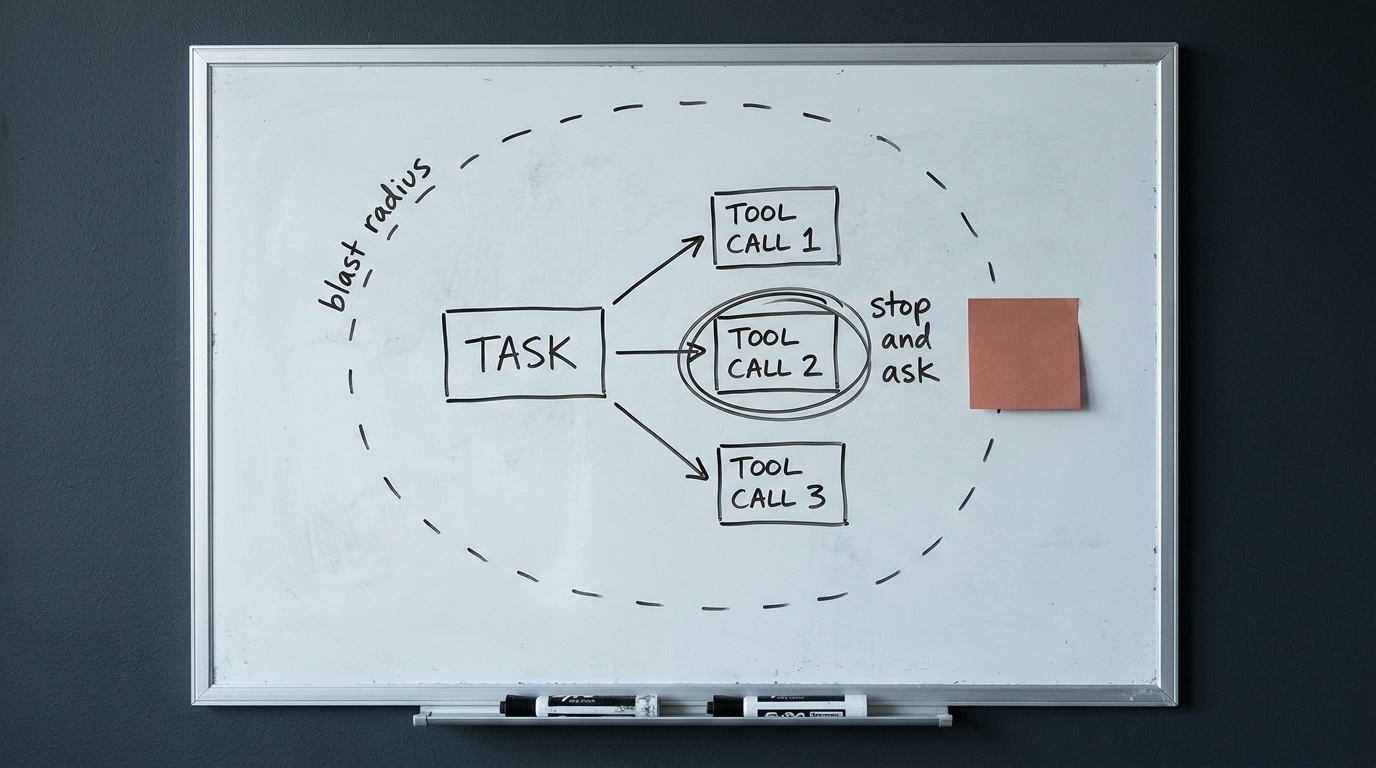
That gap matters because an agent is not a bigger prompt. It is a distributed system with a non-deterministic scheduler, and the competencies it demands look far more like systems engineering than like prompting. Alex Ewerlöf's collection of AI systems engineering patterns makes this point at length, mapping conventional systems-engineering techniques onto AI work (Ewerlöf, 2026), and the mapping holds.
Agent engineering owns:
- Task decomposition. What is one step, what is a sub-agent, and where does the boundary sit so that a failure is contained rather than propagated.
- Tool orchestration. Which tools exist, what their contracts are, what happens on partial success, and how the agent knows a tool result is untrustworthy.
- Memory and context lifecycle. What persists across steps, what is deliberately forgotten, and how context is prevented from growing until it becomes both expensive and confusing.
- Failure recovery. Retries that are not infinite loops, escalation paths, and the ability to abandon a task cleanly.
- Human checkpoints. Where a person is in the loop, on the loop, or absent, and what information they get at the moment they are asked to decide.
- Blast radius. What permissions the agent holds, what it can do irreversibly, and what requires a second signal.
That last one is the discipline's centre of gravity. An agent with read access that gets confused wastes tokens. An agent with write access that gets confused changes your data with complete confidence.
Failure mode when missing: the agent works beautifully in the demo, then acts decisively on a bad input in production. The characteristic incident is not the agent refusing to work. It is the agent working enthusiastically on the wrong thing.
Interview signal: ask what the agent should do when its third tool call returns something implausible. A strong answer distinguishes between "implausible" and "an error", proposes a way to detect the difference, and has an opinion about when to stop and ask a human. A weak answer adds a retry.
Evaluation engineering, the discipline nobody staffs
Across the top-ranking articles on AI engineering skills, evaluation shows up as a bullet inside a section about MLOps, if it shows up at all. In production, it is the discipline that decides whether an AI feature can stay shipped.

Evaluation engineering owns the question "is it still correct", and that question is hard in a way borrowed practices do not cover.
It cannot come from QA, because there is no expected-output column . A traditional test asserts that a function returns 7. An eval has to assert something about a paragraph that could be phrased fifty acceptable ways and two unacceptable ones, and the boundary between those sets is a judgment call somebody has to encode.
It cannot come from data science either. Data science evaluates a model, usually against a fixed benchmark, usually offline. Evaluation engineering evaluates a shipped product under continuous change: new prompts, new retrieval sources, a provider silently updating the model underneath, and real user inputs that look nothing like the eval set built three months ago.
The scope of the discipline:
- Building eval sets from real traffic, not from imagination, and keeping them current as usage shifts.
- Offline regression suites that run on every prompt or model change, so a quality drop is caught before release rather than reported by a customer.
- Grader design, including the pitfalls of using a model as a judge: graders drift, they can be gamed by verbosity, and they need their own validation against human labels.
- Online monitoring, because offline evals cannot see the inputs you did not anticipate. This is where drift is caught.
- Defining correct for tasks with many acceptable answers, which is closer to specification writing than to testing.
The economics here are unusual. Evaluation is the only one of the five whose absence is invisible while everything is going well, and catastrophic the moment anything changes. A team without it does not notice a problem. It notices, four or five months later, that nobody is willing to change the prompt.
Failure mode when missing: the team freezes. Every model change, prompt change, or retrieval tweak becomes a gamble with no way to score it, so the rational move is to change nothing. The feature ossifies while the underlying models keep moving.
Interview signal: ask how they would decide whether a prompt change was an improvement. A strong answer wants a dataset, a metric, and a baseline before touching anything. A weak answer describes trying it and seeing how it feels.
AI product management for probabilistic systems
The fifth discipline is the one most likely to be assumed rather than staffed, on the theory that a good product manager is a good product manager. Most of that is true. The part that is not true is the part that decides whether the product ships.
AI product management owns the choice of where a wrong answer is survivable. That is a product decision before it is a technical one, and it is the call that constrains every other one. A summarization feature with a five percent error rate is a rough edge. The same error rate in a system that files regulatory paperwork is a liability. Same model, same quality, opposite verdict, and the difference is where the feature was pointed.
The rest of the scope follows from that:
- Acceptance criteria that are statistical. Not "the feature works" but "the feature is acceptable on this distribution of inputs at this rate, measured this way". This forces a working relationship with evaluation engineering, which is why the two disciplines tend to arrive together or not at all.
- The human review boundary. What gets reviewed, by whom, at what cost, and what the review is catching. Review nobody has time to do is not a safeguard, it is a formality.
- Sequencing from pilot to production. Choosing a first use case for its evaluability, not just its visibility. Demos pick the flashiest workflow. Production is easier to reach from a workflow you can measure.
- Cost per outcome. Not cost per token or cost per call, but cost per resolved ticket, per drafted document, per closed case, held against what the previous process cost.
Failure mode when missing: the team builds something technically fine and points it at a workflow that cannot tolerate its error rate. The engineering was never the problem. The scoping was.
Diagnosing and sourcing the team you have
A taxonomy that does not turn into a staffing decision is just vocabulary. Here is the decision.
Start by finding the empty row. Go back to the table and ask, for each discipline, who owns it by name. Not who could do it. Who is accountable when it goes wrong. In most teams that have stalled, one or two rows come back empty, and the empty rows are usually evaluation engineering and agent engineering.
Then separate what can be absorbed from what needs an owner. These are not equally learnable:
- Software engineering you already have. This is the discipline nobody needs to acquire.
- AI engineering is learnable by strong senior engineers, typically over a few months of real project work. The prerequisites are engineering judgment and a habit of measurement, both of which transfer. Give this to people who already ship.
- Agent engineering is learnable by engineers with distributed-systems instincts, but the learning curve runs through incidents. Teams underestimate it because the demo is easy and the failure modes are subtle.
- Evaluation engineering is the one that rarely gets absorbed. Not because it is harder, but because it has no natural home. It falls between QA, data science, and product, and work that belongs to three teams belongs to none. It needs a named owner more than it needs a specialist.
- AI product management can be grown from an existing product manager willing to get specific about error rates, provided they are not also carrying three other products.
Match the team shape to the stage, not to an aspiration. A first pilot needs software engineering plus AI engineering plus somebody accountable for scoping, which is three people, possibly two if one is unusually broad. A first production feature is where evaluation engineering stops being optional, because that is the moment the thing has to keep working without supervision. Multiple product lines is where agent engineering and platform concerns justify dedicated ownership rather than shared attention. Staffing all five before the first pilot is a common and expensive mistake.
Then decide how to fill the gap honestly. Four options, and the right one depends on what the gap is:
- Hire when the discipline will be permanently central to your product and you can describe the role well enough to interview for it. That second condition is why the taxonomy matters. A requisition for "evaluation engineer" that names the artifacts and the failure modes will attract better candidates than one for "AI engineer".
- Retrain when the discipline is adjacent to what your people already do and you can afford the learning curve. AI engineering is the strongest candidate here.
- Contract when the need is a bounded piece of work with a clear finish line.
- Go fractional when you need the discipline in the room now, at less than one full-time person's worth of demand, while you learn enough to decide whether to hire permanently. Evaluation engineering in particular often needs concentrated expert attention to establish, and far less to maintain.
That last option is the one we built AdvantageWorks around. A fractional AI team puts the missing disciplines, most often evaluation and agent engineering, alongside your existing engineers, so the practice gets established inside your codebase rather than delivered as a document. It is not a replacement for hiring. It is how you find out what you are actually hiring for, before you post the requisition that brings five different jobs to the same interview loop.
Key takeaways
- "AI engineer" is not a job title. It is five disciplines wearing one requisition: software engineering, AI engineering, agent engineering, evaluation engineering, and AI product management.
- Diagnose by failure mode, not by skill list. The useful question is not "what do they know" but "what breaks if nobody owns this".
- Evaluation engineering is the most commonly missing discipline and the one whose absence is invisible until the team stops being willing to change anything.
- Agent engineering is systems engineering with a non-deterministic scheduler. Blast radius is the design problem, not prompting.
- Most of the work is still ordinary software engineering. AI adds a probabilistic component to a system that still has to be predictable about everything else.
- Team shape should follow the stage. Three disciplines get you to a pilot. Evaluation is what gets you to production.