
The company with eighty percent weekly AI usage cannot ship an AI feature. The company with four engineers, a retrieval pipeline, and an evaluation suite that fails twice a week can.
Both say they are doing AI. Only one of them has built anything, and the first will not find that out until it tries.
The gap between those two organisations is not a gap in maturity. The first one is not standing at an earlier point on a path the second one already walked. They are on different paths, and the tool-adoption path does not lead to the building path no matter how far anyone walks it.
That matters because budgets get approved against the wrong number. An adoption dashboard is easy to produce and easy to believe. It is also not evidence that anything can be built. If your board signed off an AI roadmap because usage was strong, the roadmap was funded against a metric that never measured the capability the roadmap needs.
The two capabilities, side by side
Using AI at work means getting more out of a system somebody else built, operated, and made safe. Building AI solutions means being the somebody else.
Written down, the distinction sounds obvious. It stops being obvious the moment a budget conversation starts, because both activities get filed under the same word. Here is what differs.
| Using AI at work | Building AI solutions | |
|---|---|---|
| What it optimises | Individual throughput on existing tasks | A system that produces a repeatable business outcome |
| Who owns the outcome | The person at the keyboard | A named team, accountable when it is wrong |
| Core skills | Prompting, context framing, judging output quality | Data engineering, evaluation design, architecture, operations |
| Unit of work | One task, one session | One workflow, run thousands of times unattended |
| Time to value | Days | One to two quarters, realistically |
| Dominant failure mode | A bad answer someone notices and discards | A wrong answer nobody notices, at scale, in front of a customer |
| What "done" means | The task is finished | The system holds up under load, drift, and a dependency upgrade |
The right-hand column is a different job. Not a harder version of the left-hand one.
What tool fluency actually buys you
Real things. People stop writing first drafts from a blank page. Analysts stop reformatting spreadsheets by hand. Support agents answer faster. Those gains are real and they compound across headcount.
What they do not do is accumulate into a system. A thousand people each saving forty minutes a week produces a thousand separate private improvements. It does not produce a product, a pipeline, or anything a customer can buy.
What build capability actually buys you
One thing your competitors cannot copy by purchasing the same licence. An AI solution that works inside your data, your workflow, and your constraints is an asset. An assistant subscription is a cost line that every company in your market can match by Friday.
Tool fluency compounds across people. Build capability compounds across time. Only the second one shows up on a balance sheet.
Why one does not turn into the other
"They will pick it up as they go" is the assumption that quietly funds most stalled AI roadmaps. It is worth knowing exactly why it fails.
When someone uses an AI tool at work, they operate inside guardrails that other people built. Reliability was handled upstream. Evaluation was handled upstream. Security boundaries, rate limits, content filtering, fallback behaviour when the model returns nonsense, the decision about what happens at three in the morning when nobody is watching - all of it was somebody else's engineering problem, solved before the tool reached the desk.
Using the tool well teaches two things: how to frame a request, and how to judge whether the output is any good. Both are valuable. Neither transfers to the problem of owning the guardrails yourself.
Now look at what changes when you build. You decide what the system does when it is uncertain. You decide what counts as a correct answer, and you have to write that definition down precisely enough that a test can check it. You decide where the data comes from, who is allowed to see it, and what happens when the source schema changes without warning. (It will, and nobody will tell you.) You decide how much a wrong answer costs and who finds out.
None of those questions appear anywhere in the experience of being a heavy AI user . That is not a criticism of heavy AI users. It is a description of what a well-built tool does for the person holding it. Which leaves the question the next section answers.
The eight questions that tell you which one you have
Most maturity models are unfalsifiable. Every organisation can locate itself somewhere flattering on a five-stage ladder. This is not that. These are questions with answers you either have or do not have, and collecting the honest ones takes about ten minutes.

Run them against a specific AI capability you believe you have, not against the organisation in general:
- Can you name the individual who is accountable when an AI output is wrong in front of a customer? A name, not a team.
- Do you have an evaluation set, or do you have three prompts that a person types by hand before each release?
- Is the AI work in version control, with the prompts, the retrieval configuration, and the evaluation cases all versioned together?
- Has anything AI-related in your stack survived a model version change or a dependency upgrade without a scramble?
- Can you state the current cost per completed task, and did anyone look at it this month?
- If the primary model provider had a four-hour outage tomorrow, what happens? Is there an answer, or is there a shrug?
- Do you know how often the system is wrong? Not roughly. A number, measured against a held-out set.
- Has anyone deliberately tried to break it, and is there a record of what happened?
Scoring is blunt on purpose. Six or more clear answers means you have build capability and should be planning accordingly. Three to five means you have a prototype and a hope. Two or fewer means you have AI usage, which is worth having, and no build capability at all.
The middle result is the dangerous one, because it is the only one that looks like progress from the outside. If you landed there, the next section is where the work starts.
Prerequisites before you build anything
Every build guide on the internet starts at step one of the lifecycle. They assume the decision to build was correct and the organisation was ready. Both assumptions deserve a check first, and the check is cheap.
Five things should be true before anyone writes code:
- A named problem with a measured current cost. Not "improve customer support" but "agents spend eleven minutes per ticket on research, and we handle four hundred tickets a day." If the current cost is not measured, the improvement cannot be either.
- Data you can reach. Legally, technically, and without a six-week procurement conversation. The most common reason an AI project dies in month two is that the data everyone assumed was available turned out to be in a system nobody has credentials for.
- An owner with authority. Someone who can make a call about acceptable error rates and have that call stick. A project with a sponsor but no owner produces a demo and stops.
- A decision on the path. Use, configure, or build. Making this decision late is how teams end up constructing something they could have bought.
- A stated tolerance for wrong answers. Say the number out loud before you start. "We will accept a five percent error rate if a human reviews anything the system flags as uncertain" is a specification. "It has to be accurate" is not.
If any of these is missing, fix it before the build. Fixing it during the build costs three times as much and usually produces a compromise nobody likes. The fourth prerequisite is the one most often skipped, so take it first.
Pick your path first: use, configure, or build
Three legitimate paths exist, and the industry conversation collapses them into one because the vendors selling each path have an interest in the collapse.
Use a tool as it ships. An assistant, a copilot, a product with AI features already inside it. Cost is a per-seat subscription. Time to value is days. You get no differentiation and you have no control over the roadmap. This is correct for anything that is not core to your business, which is most things.
Best for: general productivity, drafting, summarisation, research. Not for: anything a customer touches directly, anything involving data you cannot send to a third party, anything you want to be better at than your competitors.
Configure a platform. Copilot Studio, an agent builder, a low-code orchestration layer. Cost sits between a subscription and a project: Copilot Studio, for example, bills at $0.01 per credit or $200 a month for a 25,000-credit pack, with no per-seat fee, plus implementation (CloudZero, 2026). Time to value is weeks. You get meaningful customisation, and you inherit the platform's limits, its pricing changes, and its ceiling.
Best for: internal workflows with clear rules, a defined data boundary, and a process owner who can maintain it. Not for: anything needing custom retrieval logic, unusual latency requirements, or a data pipeline the platform does not support.
Build custom. Your own architecture, your own evaluation, your own operations. Cost is a real project: 2026 cost guides put simple custom builds at $50,000 to $150,000 and mid-complexity systems at $150,000 to $500,000 (Kellton, 2026). Three-year total ownership typically runs 1.5 to 2 times the build (Kellton, 2026). Time to value is one to two quarters. You get an asset nobody can buy.
Best for: the thing your business is good at. Not for: your first AI project, if you can possibly avoid it.
Treat these as ranges rather than quotes. Costs vary by scope, region, and how much of the work is already done. If the third path is the right one, the sequence below is what it involves.
The build steps, in order
The lifecycle itself is not contested. The competent guides all describe roughly the same sequence, and so does this one. What is worth adding is what changes about how your organisation works at each step, because that is the part tool fluency has not prepared anyone for.

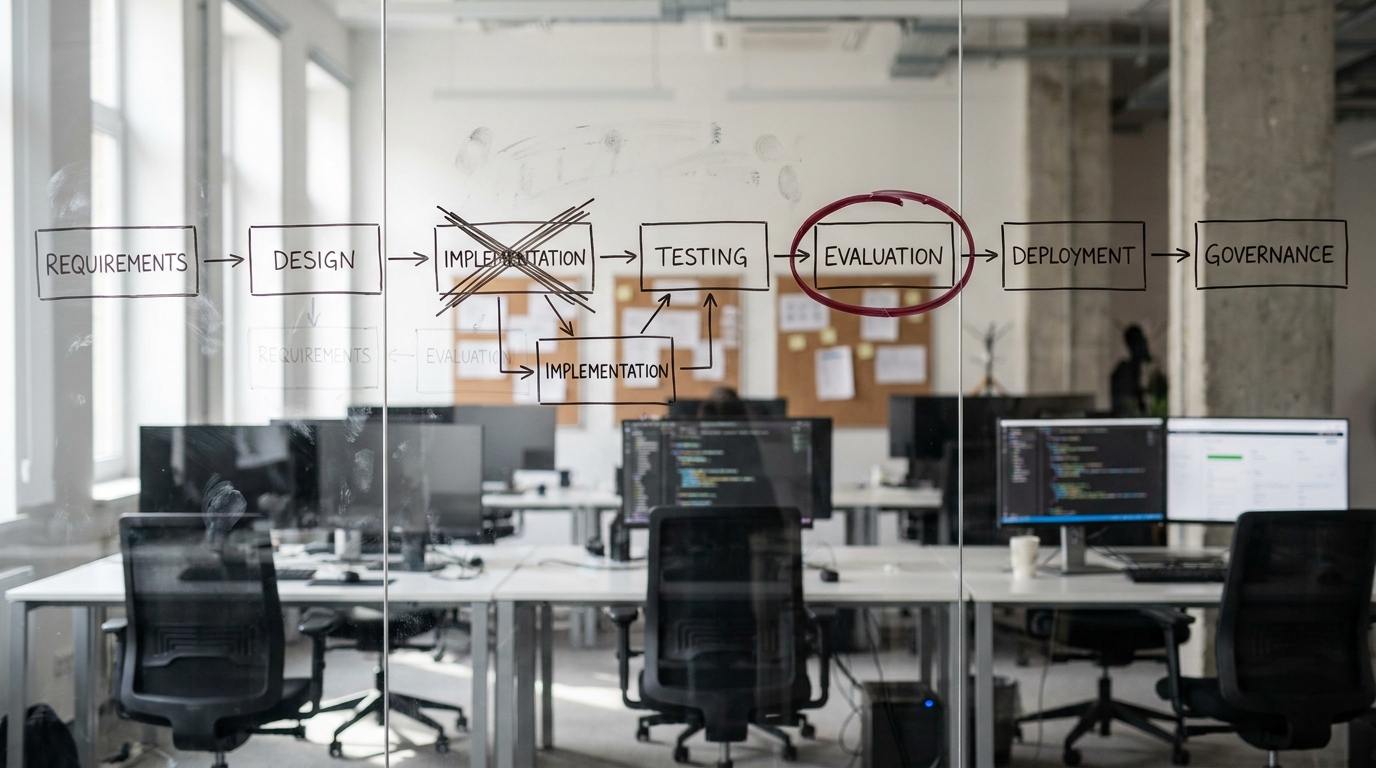
- Define the problem as a measurable outcome. Write the current number and the target number. "Reduce average research time per ticket from eleven minutes to four." Capabilities are not outcomes. If the sentence contains the phrase "leverage AI to," start again.
- Check data readiness honestly. Where does it live, who owns it, what shape is it in, how often does it change, and who is allowed to see it. Expect this step to be slower and more political than anyone budgeted. Data preparation routinely consumes 60% to 80% of total AI project time (instinctools, 2026, citing IBM 2024 research).
- Decide build, configure, or buy for this specific problem. Not for the company. For this problem. A company can correctly buy for one workflow and build for another in the same quarter.
- Design around failure, not the happy path. The architecture question that matters is not how the system works when the model behaves. It is what happens when it does not: what the fallback is, where a human enters, what gets logged, and who gets paged. Architecture decisions here are among the hardest to reverse later.
- Build the thinnest thing that works end to end. All the way through, from real input to real output, with real data. A thin complete path surfaces the integration problems that a polished component never will. Resist building the impressive part first.
- Build the evaluation set before you tune anything. This is the step most teams skip, and skipping it is what separates an AI project from an AI product. Without a held-out set of cases with known-good answers, "it seems better now" is the only quality signal you have, and it is not one.
- Deploy behind a boundary with a human fallback. A limited user group, a defined scope, an obvious way for a person to take over. Gradual release buys you the only honest look at what real usage does to a system that behaves differently on every input.
- Instrument cost, latency, and quality from day one. All three, from the first deployment. Cost surprises in AI systems arrive fast and are almost always caused by something nobody modelled, such as retries or a context window that grew.
- Name the owner who reviews failures weekly. Not a committee. A person, with time allocated, who looks at what went wrong and decides what changes. A system with no failure review does not improve. It drifts.
Nine steps done is still not a result. The result is whatever happens to the number you wrote down in step one.
How to check it worked
"The model performs well" and "the business changed" are different claims, and only one of them justifies the spend. Validate at three levels, in this order.
Does the system do the task correctly? Measure against the held-out evaluation set from step six, not against the examples used during development. Record a pass rate. Record it again after every material change, including model version upgrades, because a provider updating their model is a change to your system whether or not you asked for it.
Does it hold up in production? Watch the error rate on real traffic, the fallback rate, and the cost per completed task. Watch the shape of the failures, not just the count. Ten failures clustered on one input type is a fixable bug. Ten scattered failures is a capability limit.
Did the original number move? Go back to step one. You wrote down eleven minutes and a target of four. What is it now, measured the same way, on the same population? If nobody can answer that, the project has not been validated regardless of how good the demo looks.
One discipline worth borrowing: book the ninety-day measurement at the same time you write the step-one target. Projects that do not schedule the measurement in advance rarely take it afterwards.
Where this goes wrong
The damage from mistaking one capability for the other is not abstract. It shows up in five recognisable shapes.

Funding a build against an adoption metric. The business case cites weekly active users of an assistant and requests budget for a custom system. These are unrelated quantities. The usage number tells you people find the tool helpful. It says nothing about whether your organisation can operate a production AI system.
Staffing the build from the heaviest tool users. They volunteer, they are enthusiastic, and they are the wrong people unless they also happen to have the engineering skills. Prompt fluency is a real skill and it is not data engineering, evaluation design, or operations.
Treating the working demo as nearly finished. The demo took an afternoon. The production system takes a quarter or two , and most of that work is invisible from the demo: the error handling, the evaluation, the monitoring, the access controls, the cost management. Nobody who has only seen the demo believes this, which is why the schedule slips in a predictable way.
Shipping without an evaluation set. The system goes live, it seems fine, and six weeks later somebody discovers it has been quietly wrong about a specific category of input since launch. Nobody knew because nobody was measuring.
No named owner for wrong answers. Ownership diffuses, failures accumulate without review, trust erodes, and usage drops. The system is then judged a failure of the technology.
Troubleshooting the in-between state
Most organisations reading this are not cleanly at one end or the other. They are stuck in the middle with a prototype and an argument. Four common positions, with what to do about each.
The stalled pilot. It works, it has been "nearly ready" for two months, and nobody can say what is missing. The missing thing is almost always evaluation or ownership. Ask what the pass rate is and who is accountable. If neither has an answer, that is the blocker, not the remaining engineering.
The prototype nobody will adopt. Someone built something good and no team will take it into their process. This is an ownership problem wearing a technical disguise. Find the process owner whose measured number the system would improve, and if there is no such person, the prototype should be retired rather than rehomed.
The team that can prompt but cannot ship. Real capability, wrong shape for the task. The options are to hire the missing skills , bring in a partner who has them, or reduce scope until the problem fits the team you have. Reducing scope is underrated and usually correct for a first project.
The vendor conversation you are not ready for. You are being quoted for something you cannot specify. Stop and write down the measured problem and the acceptable error rate first. A vendor cannot scope what you have not defined, and a proposal written against a vague brief will be priced for the vague version.
What your existing AI usage is actually worth
None of this makes tool adoption worthless. It is worth a great deal, just not as evidence of build readiness.
An organisation where people use AI daily arrives at a build project with advantages a cold-start organisation does not have. Expectations are calibrated. Nobody in the room thinks the model is magic, and nobody thinks it is useless, because they have watched it succeed and fail all week. People already know what the model is bad at in your specific domain, which is expensive knowledge to acquire any other way.
Change resistance is lower too. The hardest part of deploying an internal AI system is often the adoption rather than the engineering, and an organisation already comfortable with AI output clears that hurdle faster.
Then there is the backlog. The use cases worth building have usually already surfaced, and you can find them by looking at what people are doing manually in a chat window, repeatedly, with copy and paste. That list was discovered by the people who do the work rather than guessed at in a strategy session. Deloitte's research on AI adaptation makes a related point about workplace behaviour: what matters is not whether people use AI but whether their judgment and working patterns change (Deloitte, 2026).
So the honest summary is not "your AI usage means nothing." It is "your AI usage is a good starting position for a project you have not started yet."
If you want an outside read on which of the two capabilities you actually have, and what the gap would cost to close, the AI Readiness Snapshot is a free thirty-minute call that maps exactly that.
Key takeaways
- Using AI at work and building AI solutions are different capabilities, not two points on one path. Neither converts into the other by itself.
- Tool adoption metrics are not evidence of build readiness. A business case built on weekly active users is funded against the wrong number.
- Run the eight questions before the roadmap. The one that separates the two capabilities fastest: can you name the person accountable when an AI output is wrong in front of a customer?
- Choose use, configure, or build per problem rather than per company, and make the choice before the project starts rather than during it.
- Existing AI usage is a real advantage for a build project. It calibrates expectations, lowers resistance, and surfaces the backlog. It is a starting position, not a finish line.