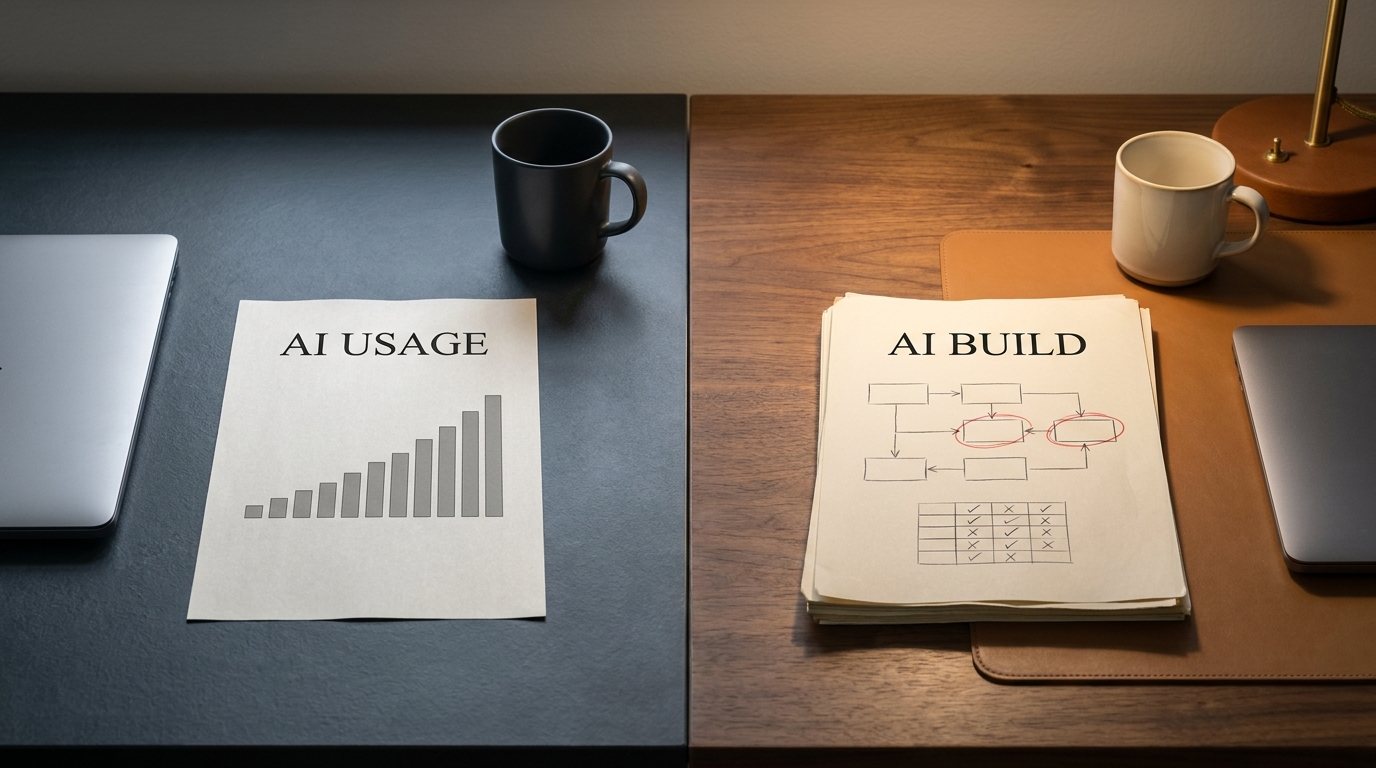
A demo and a production workflow look identical for about ten minutes. One earns applause in a conference room and then goes back in the drawer. The other quietly runs a slice of the business at 3 a.m. on a Tuesday, with an owner, a log, and a rollback plan, and nobody claps, because nobody needs to watch it anymore. The gap between those two outcomes is where most corporate AI money goes to disappear.
If you sit in the COO, CTO, or CIO seat, you have probably funded the first kind more than once. The budget was approved. The demos landed. Dashboards lit up with pilots launched and licenses activated. And yet, when the board asks you to name one workflow that AI now runs end to end, the answer comes harder than the spend would suggest. That motion without shipment has a name. It is AI theatre, and it keeps happening for a reason that has nothing to do with picking the wrong model or being oversold on the technology. The work had no cadence.
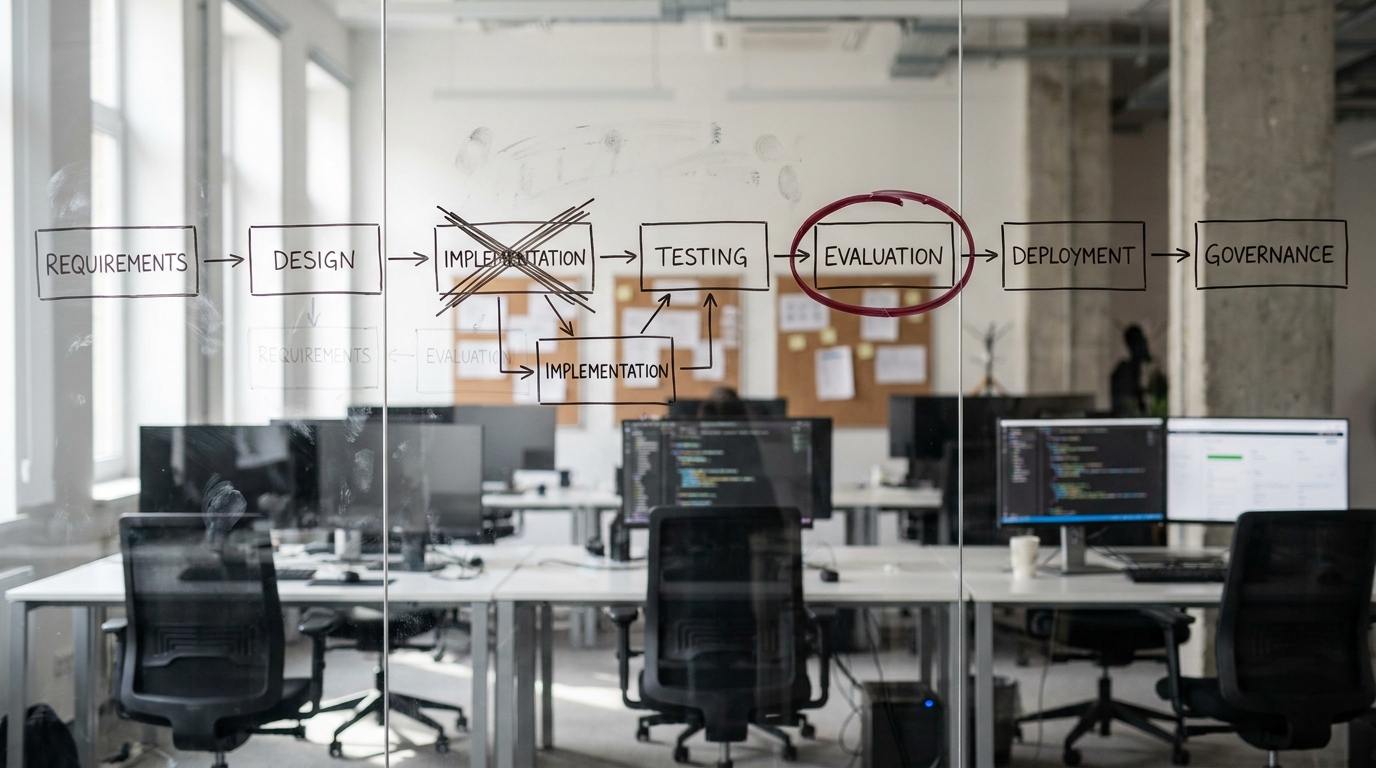
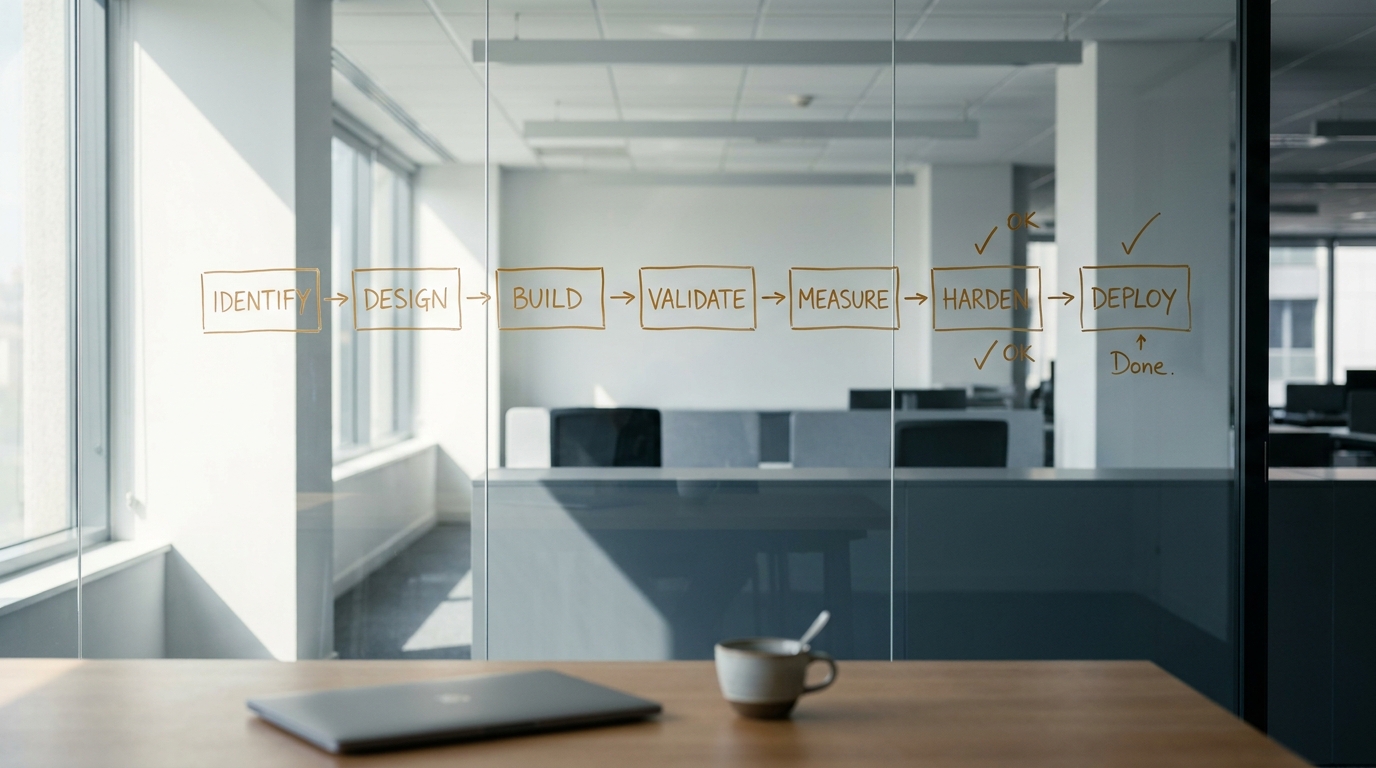
The argument here is narrow and specific: the difference between AI theatre and AI delivery is not intelligence, budget, or ambition. It is a fixed operating rhythm. Seven stages carry an idea from a hunch to a shipped workflow - identify, design, build, validate, measure, harden, deploy - each with a clear gate for what "done" means. This is the cadence we run at AdvantageWorks, and the rest of this article walks through how it works, week by week, so you can hold it up against how AI actually gets done inside your own organization.
AI theatre vs AI delivery: what the difference actually is
Start with the definitions, because the whole diagnosis turns on them.
AI theatre is activity that looks like progress. It gets measured in inputs: pilots kicked off, proofs of concept demoed, seats provisioned, hours of enablement delivered. Theatre produces the artifacts a leadership deck loves - screenshots, adoption percentages, a slide titled "AI momentum." What it does not produce is a workflow that a business unit now depends on. When the pilot team disbands, the motion stops.
AI delivery is the opposite posture. It gets measured in outputs: a specific workflow that used to require human effort now runs in production, is monitored, has an owner, and moves a number the business already cares about. Delivery is less photogenic. There is no launch moment, because the whole point of delivery is that the thing keeps working after everyone stops looking at it.
The two are dangerously easy to confuse from the executive altitude. Both generate updates. Both consume budget. Both involve real AI. The tell is not in the demo. It is in what still exists three months later.
| AI theatre | AI delivery | |
|---|---|---|
| What gets measured | Pilots launched, licenses used, demos given | A workflow running in production, monitored |
| What "done" means | The demo worked in a controlled setting | The workflow runs unattended and is owned |
| What leadership sees | Activity dashboards and momentum slides | A number on an existing business metric moving |
| What the board gets | "We are investing in AI" | "This process now runs with AI, here is the impact" |
| What happens when the team leaves | The pilot goes quiet | The workflow keeps running |
The industry data suggests theatre is the norm, not the exception. Analyses of enterprise AI over the past two years have found again and again that most initiatives never scale past the pilot stage, with widely cited estimates putting the failure-to-scale rate somewhere between 70 and 88 percent, depending on the study and how you define "scale." BCG reported in October 2024 that roughly 74 percent of companies struggle to achieve and scale value from AI (BCG, 2024). The precise figure matters less than the shape of it: a large majority of AI work produces theatre, and only a minority reaches delivery.
Why most AI ideas never ship
If the technology works in the demo, why does it so rarely survive contact with production? Three blockers do most of the damage, and not one of them is about model quality.
The first is that every AI project gets treated as bespoke. A team assembles, solves one problem heroically, and disbands. Nothing about how they worked gets captured, so the next idea starts from zero. Without a repeatable rhythm, nothing compounds. You end up with a portfolio of one-off wins and one-off failures and no way to tell in advance which is which.
The second is the people-and-process reality behind the widely cited 10-20-70 split: roughly 10 percent of the value of an AI effort comes from the algorithm, about 20 percent from the technology and data plumbing, and around 70 percent from the people and process changes it takes to actually adopt it. The framing is commonly attributed through BCG and echoed by IBM and others. Whatever the exact attribution, the operational lesson is blunt. Most of what determines whether AI ships has nothing to do with the model, and most AI programs spend most of their attention on the model.
The third is that governance, security, reliability, and observability get bolted on at the end, if they get added at all. A pilot skips them by design, because a pilot only has to work once, in a friendly setting. Production has to work every time, safely, and be debuggable when it does not. Treat reliability as a launch-day checklist instead of a built-in stage and the workflow either never ships or ships and quietly breaks.
This is where the familiar language of "AI adoption frameworks" shows up, and it is worth locating our argument against it. The top-ranking analyst and vendor models - the maturity ladders and phase diagrams from the large consultancies and cloud providers - are not wrong. Assess, prioritize, build foundations, govern, scale is a reasonable way to describe an organization's multi-quarter journey. The problem is altitude. Those frameworks describe where an organization is going over years. They do not tell a delivery team what to do on Monday. Cadence is the operational layer underneath the adoption framework: the same destination, expressed as a weekly rhythm a team can actually run.
The operating cadence: seven stages from idea to shipped workflow
Here is the rhythm itself. Seven stages move an idea from "someone thinks AI could help here" to "this workflow now runs in production." Each stage answers one question, takes a defined input, produces a specific artifact, and has a gate that has to be cleared before the work advances. The gates are the whole point. They make theatre visible early, and they make delivery repeatable.
Identify: is this worth solving?
The first stage is a filter, and it is the cheapest place to kill a bad idea. The question is whether the problem is worth solving with AI at all - frequent enough, painful enough, and bounded enough to justify the work. The input is a raw idea or complaint from the business. The output is a scoped problem statement paired with a value hypothesis: if this workflow ran, here is the number it would move and roughly by how much. The done gate is simple. If you cannot state the value hypothesis in one sentence, the idea does not advance. The failure mode this prevents is the most expensive one in AI: building something impressive that no one needed.
Design: what does success look like, and how will we build it?
Design turns a scoped problem into a plan. The question is what "working" concretely means and what shape the solution takes. The input is the identified problem and its value hypothesis. The output is a solution design and a single success metric - the one number that will tell you whether this worked. The done gate is agreement on that metric before any building starts. The failure mode it prevents is the moving goalpost, where a workflow gets declared a success after the fact against whatever number happened to look good.
Build: stand up the working workflow
Build is where a functioning version of the workflow comes to life in a safe environment. The question is whether the design actually holds together once it is implemented. The input is the design and success metric. The output is a working draft of the workflow, running on real logic against representative data but sandboxed away from production systems and customers. The done gate is a workflow that executes end to end at least once. The failure mode it prevents is the endless prototype that demos beautifully on one hand-picked example and falls apart on the second.
Validate: does it actually work, and is it sound?
Validation is the adversarial stage. The question is whether the workflow works reliably across the range of real inputs, not just the happy path, and whether it is technically sound. The input is the working draft. The output is a set of test results measured against the success metric, including the cases where it fails. The done gate is evidence that the workflow performs against the metric on inputs it was never tuned for. The failure mode it prevents is mistaking a good demo for a working system.
Measure: is it moving the number that matters?
Measure connects the workflow to reality. The question is whether it actually moves the business metric agreed on in design, measured against a real baseline . The input is the validated workflow and the pre-work baseline. The output is observed impact set against that baseline - the honest before-and-after. The done gate is a measured effect, positive or not. A workflow that validates technically but does not move the number goes back or gets killed. The failure mode it prevents is shipping something that works perfectly and changes nothing.
Harden: is it reliable, secure, observable, and governed?
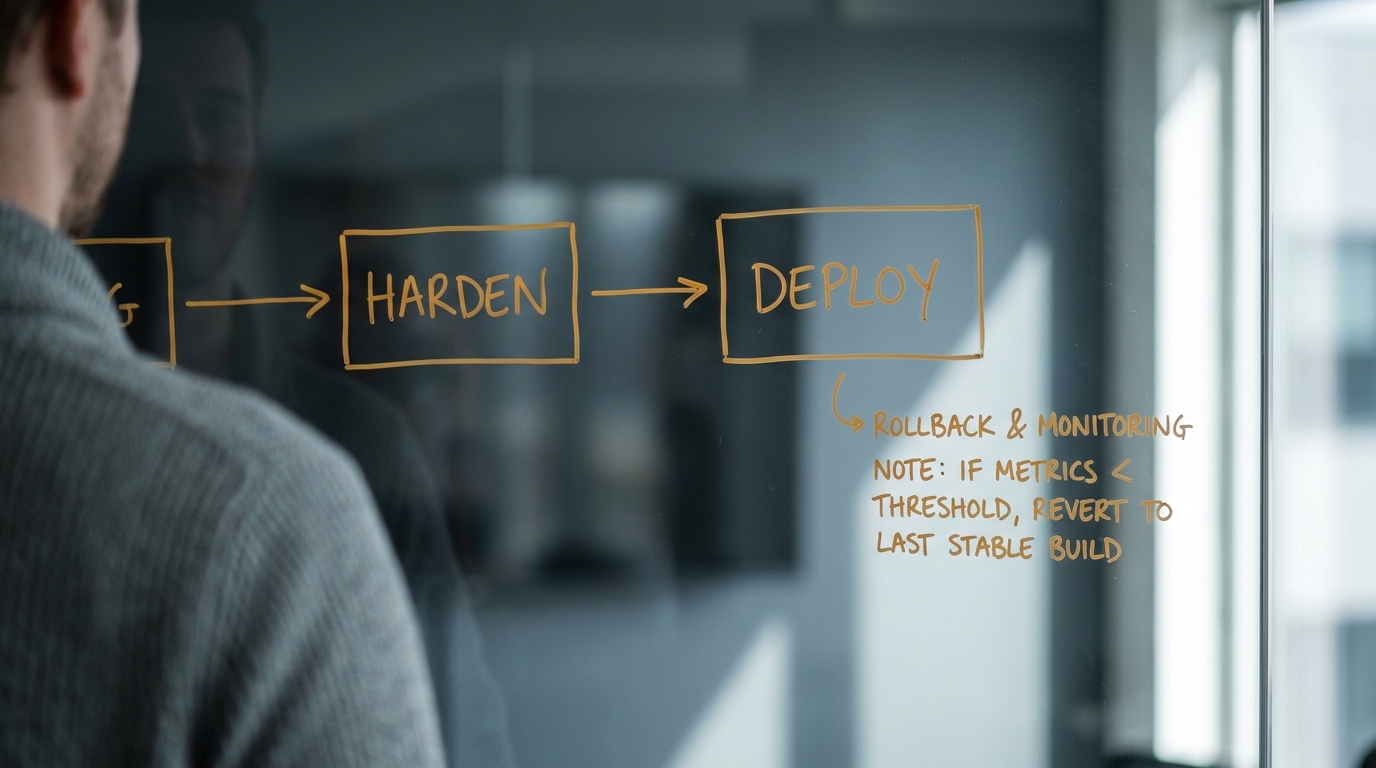
Harden is the stage almost every competing framework leaves out, and it is where theatre most often dies quietly after launch. The question is whether the workflow is ready to run unattended: reliable under load, secure, monitored, permissioned, and reversible. The input is the measured workflow. The output is production-grade guardrails - error handling, monitoring and alerting, access controls, an audit trail, and a rollback path. The done gate is that the workflow can fail safely and be observed doing it. Naming harden as its own stage, instead of a launch checklist, is deliberate. It is the difference between a workflow that survives its first bad day and one that takes a business process down with it.
Deploy: run it in production and hand off ownership
Deploy is the quietest stage and the one that actually defines delivery. The question is whether the workflow can run in production owned by someone other than the team that built it. The input is the hardened workflow. The output is a live workflow with a named owner and a runbook that tells that owner how to operate it, monitor it, and roll it back. The done gate is a successful handoff: the build team walks away and the workflow keeps running. The failure mode it prevents is the "shipped" system that only works while its original builders babysit it.
| Stage | Core question | Input | Output artifact | "Done" gate |
|---|---|---|---|---|
| Identify | Is this worth solving? | A raw business idea | Scoped problem + value hypothesis | Value stated in one sentence |
| Design | What is success and how do we build it? | Scoped problem | Solution design + success metric | Metric agreed before building |
| Build | Can we stand it up? | Design + metric | Working draft in a safe environment | Runs end to end once |
| Validate | Does it work and is it sound? | Working draft | Test results vs the metric | Performs on untuned inputs |
| Measure | Is it moving the number? | Validated workflow + baseline | Observed impact vs baseline | A measured effect exists |
| Harden | Is it reliable and governed? | Measured workflow | Guardrails, monitoring, rollback | Fails safely and is observable |
| Deploy | Can someone else run it? | Hardened workflow | Live workflow + owner + runbook | Handoff succeeds |
What this looks like week by week
Stages are not the same as weeks, and the honest version of this rhythm is that some stages compress into days while others overlap. But mapping the cadence onto a delivery calendar is what turns it from a diagram into a practice, so here is the shape a typical engagement takes.

A useful anchor is to ask, every Friday, one question: what artifact exists now that did not exist on Monday? That single question is the entire difference between a week of delivery and a week of theatre.
In an early week, identify and design run close together. The artifact that lands by Friday is a one-page scoped problem with a value hypothesis and a single success metric that the business sponsor has signed off on. Nothing has been built, and that is correct. The most common way AI money gets wasted is building before this page exists.
In the middle weeks, build and validate take over, and this is where the calendar finds its own rhythm. Each week produces a more complete, more tested version of the workflow, run against a widening set of real inputs. The Friday artifact is a working draft plus the current test results, failures included, so the sponsor sees the honest state instead of a curated demo.
As the workflow stabilizes, measure and harden run in parallel. One week's artifact is the observed impact against the baseline. The next is the guardrail set: monitoring live, access scoped, a rollback tested. Deploy is often the shortest step on the calendar, because the seven-stage discipline already front-loaded the hard parts. The final artifact is the live workflow, its owner named, and the runbook in their hands.
Consider two anonymized shapes this takes in practice. In one, an idea to automate a slow internal review process cleared identify in days because the value hypothesis was obvious, then spent most of its weeks in validate, because the real inputs were far messier than anyone had admitted - which is exactly what validate exists to surface before production, not after. In another, a customer-facing workflow sailed through build and validate but stalled at harden for an extra week while access controls and an audit trail were added, because a customer-facing system that cannot be observed or rolled back is not ready no matter how well it performs. In both, the cadence did its job. It made the real risk visible at the stage designed to catch it, instead of at 3 a.m. in production.
If you want the roadmap for your own workflows scoped before you commit to a build, that is what an AI Transformation Discovery is for. It runs the identify and design stages against your actual processes.
How the cadence prevents AI theatre
The gates are not bureaucracy. Each one catches a specific way that theatre masquerades as delivery, which is why the rhythm is both repeatable and, just as important, reportable to a board.
An idea that cannot state its value in one sentence never clears identify, so you stop funding impressive solutions to problems no one has. A workflow with no agreed success metric never clears design, so no one can sell you a win after the fact against a number invented to fit. A prototype that only works on the happy path never clears validate, so a good demo cannot pass for a working system. A workflow that does not move its metric never clears measure, so effort that changes nothing gets caught before anyone calls it a success. And a workflow that cannot fail safely never clears harden, so the reliability debt that sinks most "launched" AI gets paid up front instead of discovered in an incident.
Notice what this gives an executive. Instead of an activity dashboard, you get a pipeline you can read at a glance: here is what is in identify, here is what cleared validate, here is what is live in production with its measured impact. That is a report a board can act on, because it separates motion from shipment - the exact distinction theatre is designed to blur.
Who runs the cadence, and what you actually need to hire
The rhythm needs a handful of distinct capabilities, and they do not all live in one person. Someone has to frame problems and pressure-test value hypotheses, so identify does not wave everything through. Someone has to design solutions and pin down success metrics. Someone has to build the workflow, and someone else has to validate it adversarially rather than lovingly. Someone has to own hardening - the reliability, security, and observability work that is a discipline of its own. And someone has to run operations after the handoff.

Read that list and the honest conclusion is that most organizations do not need to hire all of it permanently. The cadence is busiest in the middle stages and lighter at the edges, and the skills it demands - problem framing, adversarial validation, production hardening - are exactly the ones that are hardest to recruit and most wasteful to keep idle between projects. What most teams actually need is a group that already runs this rhythm and can embed alongside their people, transfer the cadence, and scale down as internal ownership grows.
That is the model we built AdvantageWorks around. A Fractional Agentic Team runs this seven-stage cadence with you, embedding the roles that carry an idea from identify to deploy without asking you to build a standing AI department before you have shipped a single workflow. You get the rhythm, and the workflows it produces, without carrying the full team on your payroll through the quiet stages.
Key takeaways
- The difference between AI theatre and AI delivery is cadence, not model quality, budget, or ambition.
- Seven stages - identify, design, build, validate, measure, harden, deploy - each with a "done" gate, move an idea from concept to a shipped, owned workflow.
- Harden is a first-class stage, not a launch-day checklist. Reliability, security, and observability are built into the rhythm, not bolted on at the end.
- A weekly cadence makes AI delivery repeatable and board-reportable, because every Friday there is a concrete artifact that did not exist on Monday.
- You do not need to hire every role permanently. A fractional, embedded team can run the cadence with you and hand off ownership as you scale.
The theatre is optional. The demos, the momentum slides, the pilots that go quiet - none of it is required, and all of it is expensive. What replaces it is a rhythm anyone on your leadership team can inspect: ideas entering at identify, workflows leaving at deploy, and a measured number moving in between. If your organization already has that cadence, run it. If it does not, the fastest way to get it is to bring in a team that already does, and let the Fractional Agentic Team run the first workflow to production with you.