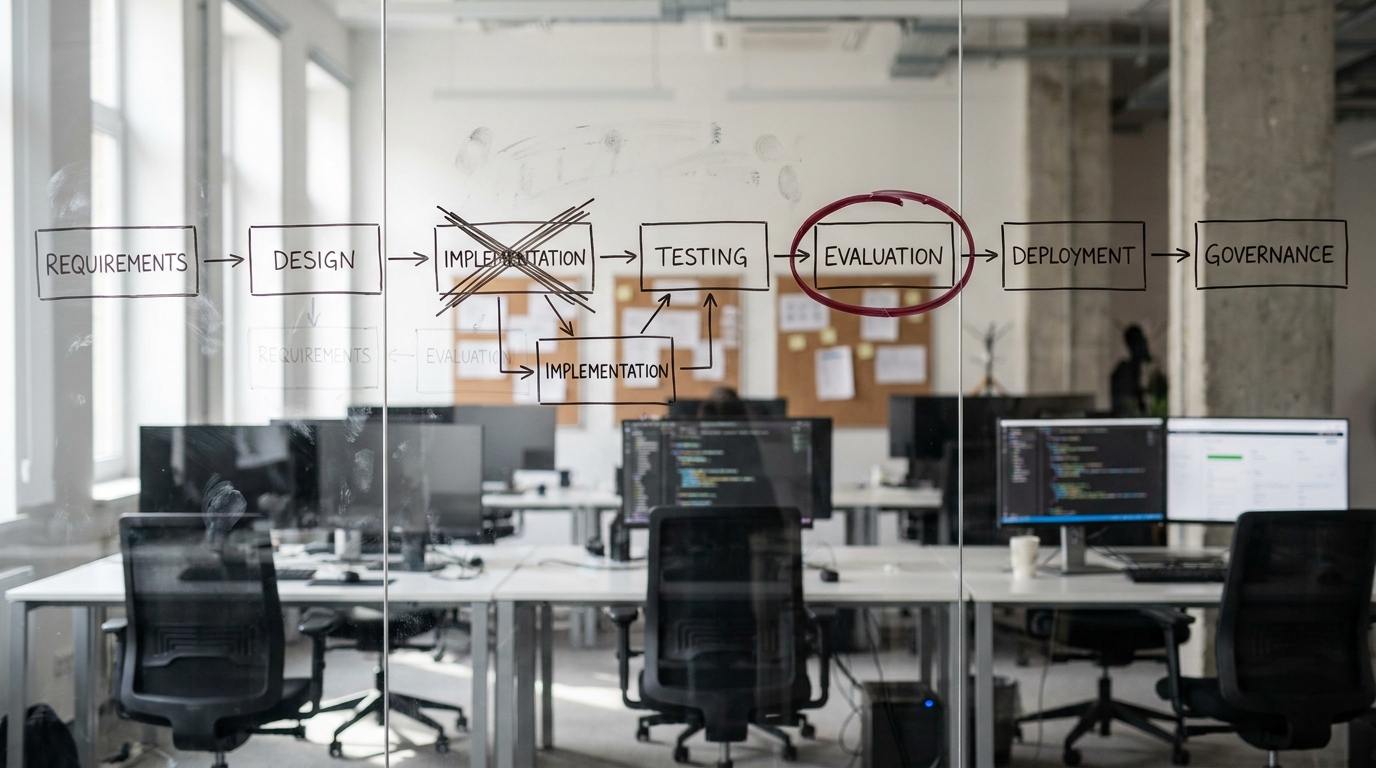

The phrase "AI transformation playbook" has a specific origin. Andrew Ng published a short document by that name through Landing AI back in 2018, and it laid out five steps for moving a company from AI curiosity to AI capability. It assumed a world of predictive models and a central data-science team. That world is mostly gone now. The binding constraint in 2026 is not whether the models work. It is whether an organization can govern autonomous agents, wire them into real workflows, and staff the whole effort when the people who can do all three are scarce.
A playbook still helps. It just has to be a different playbook. This page is that playbook, written for the leader who owns AI outcomes and is tired of watching pilots pile up without changing how the business actually runs. It is vendor-neutral, it is complete, and you can act on it phase by phase without downloading anything. The idea underneath all of it is simple: AI transformation is an operating-model change delivered in stages, not a technology project you fund once and hope scales.
Why most AI transformations stall before production
The stall is rarely about model quality. It is about the operating model around the model. Five patterns show up again and again in organizations that have real budget and still cannot get a single system past the pilot stage.
- Pilot theater. Teams build impressive demos that were never designed to graduate. There is no path from the notebook to a system a real user touches, so the pilot lives and dies as a slide.
- Vague ownership. Nobody can say who is accountable for the outcome. A data team owns the model, IT owns the infrastructure, a business unit owns the problem, and the seam between them is where the work dies.
- Governance bolted on late. Risk, legal, and security arrive after the build instead of during it. What could have been a design constraint becomes a veto, and the project restarts or stops.
- No value tracking. The pilot has no before-and-after numbers, so when budget season comes there is no case to renew it.
- A talent gap nobody names. The mix of skills to strategize, build, and operate agentic systems is hard to hire and harder to keep, so the work stretches across people who are already full.
Ng's 2018 framework named some of this early, and it is still where the term started. The 2026 reframe is that the hardest parts are no longer data pipelines and model training . They are governance you can move fast inside, agent orchestration across systems of record, and a way to run the effort when you cannot staff it the old way. A playbook fixes the operating model first. The tooling is the easy part.
What's in an AI transformation playbook
A useful playbook is not a strategy essay. It is a set of concrete deliverables you can hold up and check off. When it is doing its job, you walk away from each phase with an artifact rather than a feeling. At minimum, a complete playbook produces six of them:
- A readiness baseline - an honest read on where AI will pay off first, and where your data, skills, and processes are strong enough to support it.
- A prioritized use-case backlog - candidate workflows ranked by feasibility and measurable value, with the flashy-but-fragile ideas cut.
- A phased roadmap - the sequence from first production use case to scaled capability, each phase gated by a real outcome.
- A governance model - decision rights, human-in-the-loop points, and scope-of-action limits defined before agents act, not after.
- An ROI and value scorecard - the specific before-and-after metrics that prove the work is moving the business.
- An adoption plan - who changes how they work, how they are supported, and how success is reinforced.
Six artifacts, one coherent document. The reason competitors rarely deliver all six is that each one lives with a different function. Pulling them into a single playbook is most of the value, and it is the part almost nobody does.
The playbook, phase by phase
This is the core of the framework. Six phases take an organization from scattered experiments to a repeatable operating capability . Every phase has a named deliverable, so you always know whether you have actually finished it or only talked about it.
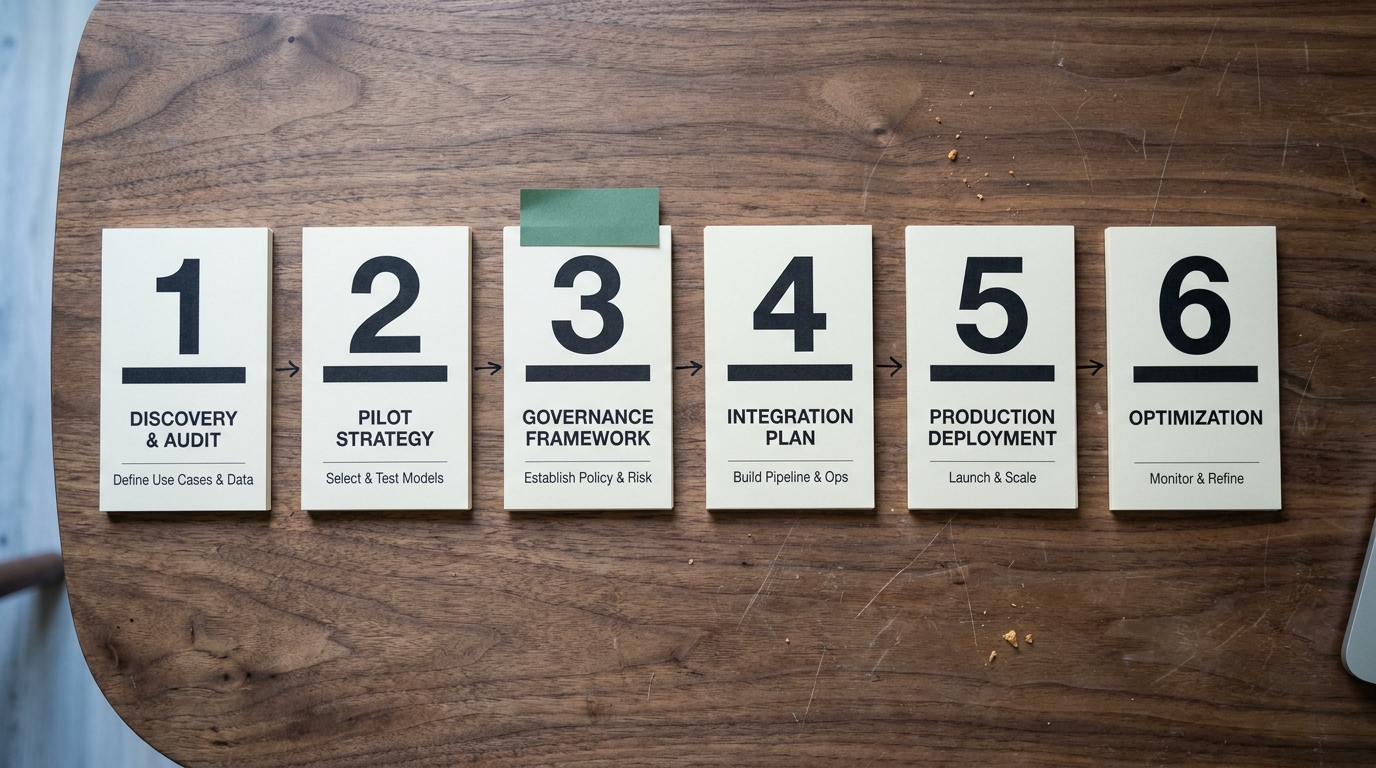
- Readiness baseline. Map where AI can create value against where you are actually ready. Be honest about data access, skills, and process maturity. Deliverable: a readiness assessment that ranks opportunity areas and flags the gaps that would sink them.
- Prioritize use cases. Score candidate workflows on feasibility and measurable value. Keep the boring, high-volume, well-bounded ones. Kill the demo-friendly ideas that cannot be measured. Deliverable: a ranked use-case backlog with a clear first pick.
- Pilot with a production path. Design the first pilot so it can graduate. Decide up front what "in production" means, who the real users are, and what has to be true to ship. No orphan pilots. Deliverable: one working use case on a path to real users, with a graduation checklist.
- Govern as you build. Set decision rights, human-in-the-loop checkpoints, and kill-switch criteria while the system is being built. Responsible AI is a design input here, not a compliance review at the end. Deliverable: a scope-of-action charter for each agent or model.
- Measure value. Instrument the workflow so you can see unit economics and before-and-after performance. Track leading indicators early, lagging ones as they mature. Deliverable: a value scorecard with baseline and current numbers.
- Scale and embed. Turn one shipped workflow into a repeatable delivery pattern. Fix the operating model, the talent model, and the reusable components so the second and third use cases are faster than the first. Deliverable: an operating model and a backlog moving under it.
The order is the whole point. Governance sits in the middle of the build, not at the end. Measurement starts before you scale, not after. Most stalled programs invert both. They scale before they can measure and govern after they have already shipped, and then they wonder why the wheels come off.
If you want a team that runs this framework with you rather than handing you a deck, the AI Transformation Discovery sprint scopes your first production use case and the roadmap around it in one week. Book a Discovery Sprint when you are ready to move from reading the playbook to running it.
Governance and responsible AI, built into the phases
Late governance is one of the most reliable ways to kill a transformation. When risk and security review a finished system, they can only say yes or no, and under uncertainty the safe answer is always no. The fix is to make governance a phase-four design constraint, so the hard questions get answered while the system is still cheap to change.
Governed by design looks practical, not legalistic:
- Scope-of-action charters. Each agent has a written boundary - what it may read, what it may change, and what it must escalate. The expensive mistakes come from agents acting outside a boundary nobody bothered to write down.
- Decision rights. For each workflow, name who approves, who can override, and who is accountable when the system is wrong.
- Human-in-the-loop points. Decide which actions require a person in the path and which run unattended, and make that explicit rather than accidental.
- Audit and rollback. Every consequential action leaves a log, and there is a defined way to reverse it.
None of this slows a well-run program down. It removes the late-stage veto that is the actual cause of the delay everyone likes to blame on the technology.
AI transformation versus digital transformation
If there is one distinction worth repeating to a leadership team, it is this one. The two are related, but they are not the same job, and blurring them is how budgets get misallocated.
- Scope. Digital transformation connects and digitizes existing processes. AI transformation redesigns what those processes are and who performs them.
- What changes. Digital transformation changes the medium of the work, paper to pixels, manual to automated handoffs. AI transformation changes the nature of the work, moving judgment and execution from people to systems with people supervising.
- Where the value comes from. Digital transformation creates value through efficiency and visibility. AI transformation creates value through capability the business did not have before: decisions made faster than people could make them, work done at a scale people could not reach, exceptions handled without a queue.
- Who is involved. Digital transformation was largely an IT and operations program. AI transformation pulls in data governance, risk, legal, HR, and the frontline workers whose roles change, because the operating-model change reaches all of them.
The part that surprises most leaders: you can be far along in digital transformation, fully cloud-native and integrated with real-time dashboards everywhere, and have done essentially zero AI transformation. The first is a precondition that makes the second easier. It is not a substitute for it.
The operating model, not the tech stack
The most common way a transformation stalls is buying tools and calling it a program. An operating model re-wires four things, and tools sit underneath all of them: necessary, never sufficient.
- Scope. Which workflows are being rewired, in what order, and which are deliberately left alone.
- Ownership. Who owns each rewired workflow, who reviews the AI's output, and who decides when autonomy widens.
- Measurement. The baseline captured before the change and the number that says it worked.
- Scale path. How a proven workflow spreads to the next team without starting from scratch.
The tech stack answers what we can do. The operating model answers what we will now do differently, who is responsible, and how it spreads. Get the second wrong and the first is just inventory.
A demo is not proof. An adoption number is.
A demo proves the model works. It proves nothing about whether the work changed. The only honest scorecard for production AI is an adoption metric tied to an outcome.
The signals that actually predict value stay consistent: weekly active use of a redesigned workflow rather than total seats sold; cycle time on the targeted task, measured before and after; and the share of pilots that crossed into production rather than ending as a slide. Where the operating model is set up well, a clear majority of the target team is in weekly active use within the first quarter, with a measured drop in cycle time on the one workflow chosen to rewire first. Where only tools were bought, those same numbers stay flat. The tools are identical. The result is not.
How you prove it's working
A transformation that cannot show its numbers does not get renewed. The discipline here is measuring the right things and refusing to invent precision you do not have.
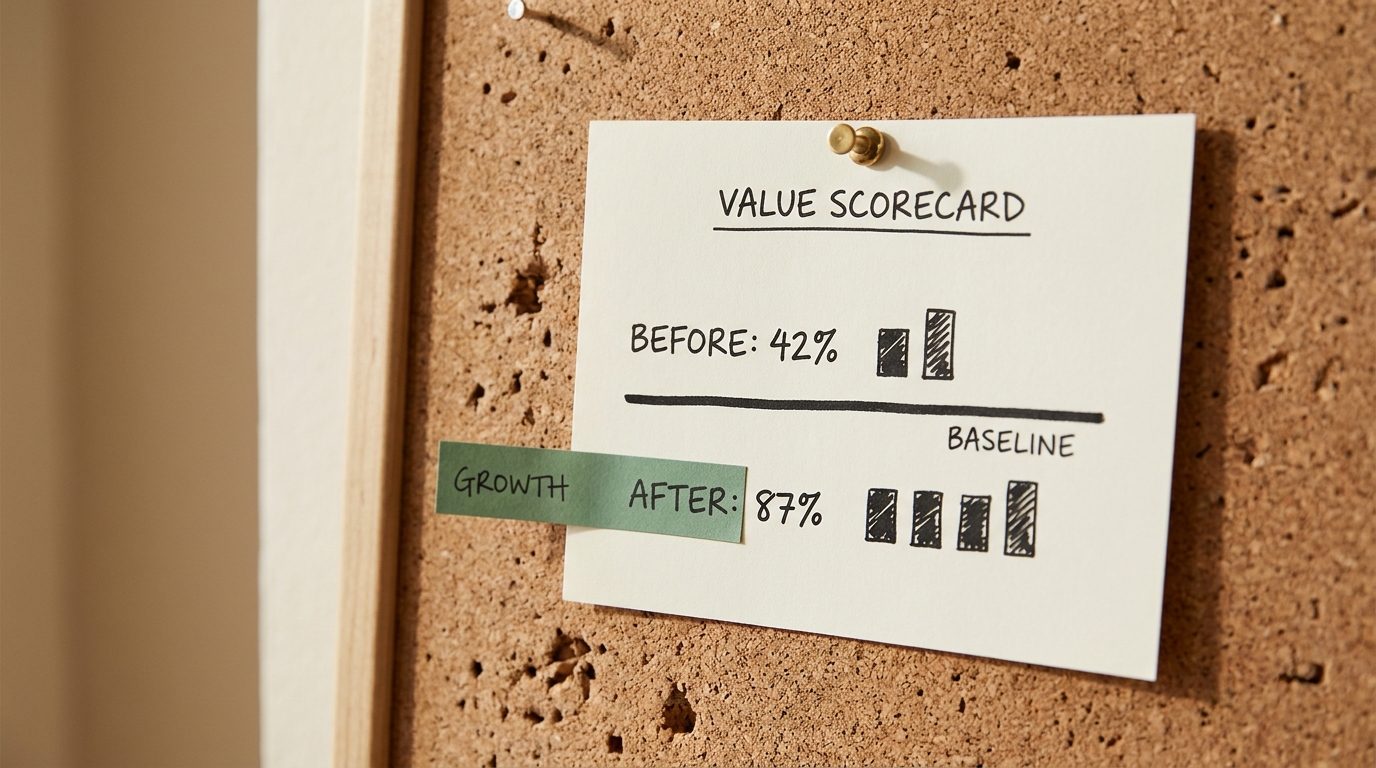
Start with a clear baseline before the first workflow ships , because you cannot claim improvement against a number you never captured. Then track two layers. Leading indicators - cycle time on the targeted task, volume handled without escalation, error rate - move early and tell you the system is working . Lagging indicators - cost per unit of work, headcount reallocation, margin on the affected process - move later and tell the board it mattered.
Two rules keep the scorecard honest. First, express outcomes as ranges and estimates when the data is thin, and label them as such, instead of reporting a false-precise percentage. Second, tie every metric to a workflow, not to "AI" in the abstract. "The invoice-matching workflow moved from a two-day cycle to same-day for roughly 80 percent of cases" is a claim you can defend in a board meeting. "AI improved efficiency by 40 percent" is not, and everyone in the room knows it.
The AI talent gap, and how to run the playbook without stalling
Here is the blocker most frameworks skip. Running this playbook well needs three distinct skill sets - the strategy to choose and sequence use cases, the engineering to build and integrate agents, and the operations discipline to run them safely in production . Very few organizations have all three in-house. Hiring them fast enough is its own multi-quarter project, sitting inside the project you already cannot staff.
There are three realistic ways to close the gap, and they trade off differently.
- Hire and build the team. Highest long-term control, slowest to stand up, and expensive in a market where these skills are scarce. Good if AI is core to your product and you can wait.
- Engage a big consultancy. Fast to authority and useful for board-level strategy, but the common failure is a deck and a maturity assessment that ends the day the consultants leave, with no system in production and no one to operate it.
- Embed a fractional team. A senior group that covers strategy, build, and operate on demand, working inside your operating model instead of alongside it. You get production capability without a full-time headcount bet before you have proven the value.
The embedded path is why the Fractional Agentic Team offer exists - an embedded agentic team that runs the playbook with you, ships the first workflows, and hands over an operating model rather than a slideshow.
Best for, not for, and a realistic timeline
A transformation program is not right for everyone, and saying so out loud builds more trust than pretending otherwise.
Best for:
- Organizations past curiosity, with at least one AI pilot behind them and a frustration that it never scaled.
- Executive sponsorship - a leader who owns the outcome and can clear the cross-functional seams.
- Real, bounded use cases where value is measurable, not science projects.
Not for:
- Teams with no executive sponsor yet - start with a smaller, single-workflow win first.
- Organizations without access to the underlying data the use cases need.
- Anyone shopping for a research lab rather than a production capability.
On timing, use ranges, not promises. A readiness baseline is typically a matter of about a week. A first production use case usually lands within a quarter when the workflow is well chosen and sponsorship is real. Scaling into a repeatable operating model is a multi-quarter effort measured in shipped workflows, not in months on a Gantt chart. Anyone quoting you exact dates before they have seen your data is guessing, and the guess is usually optimistic.
Cross the gap with a plan
The distance between "we are experimenting with AI" and "AI runs a slice of our business in production" is where most corporate AI money goes to sit. It is a crossable gap, but not with a bigger model or a longer strategy deck. You cross it with an operating-model change delivered in phases, each one gated by a real outcome and a named deliverable.
If you want to run this playbook against your own workflows, book an AI Transformation Discovery sprint and leave with a scoped first use case and a phased roadmap. If you are not ready to scope yet, get an AI Readiness Snapshot and start with an honest read on where AI will pay off first.