Language models, asked to play customers, liked pancake-flavored toothpaste. Real people did not. The study, reported in Harvard Business Review (2025), found that synthetic customers gave realistic answers for many familiar product attributes but rated novelty higher than humans do, until the model was tuned on data from an actual survey.
That one detail is the whole story of AI for market research. The speed is real, and so is the confident wrong answer. A competitor scan, a review analysis, or a first cut at segments that used to take an analyst two weeks can land on your desk the same afternoon. But the output is a draft. It reads like an answer, it is formatted like an answer, and some of it is wrong in ways you will not spot unless you check.
AI gives you a first draft of the market in hours. Checking it is what turns the draft into research.
This guide is for the CMO, strategy lead, product manager, or founder who has a decision due this week and an AI subscription already paid for . It walks through four jobs AI does well (competitor analysis, customer review mining, trend spotting, and segmentation), with the inputs to supply, what to ask, and what to check for each. Then it covers where AI market research breaks and the verification routine that keeps a made-up number out of your board deck.
What AI actually speeds up in market research
Most market research work is reading. Reading competitor sites, reading reviews, reading reports, reading interview transcripts, then sorting what you read into themes someone can act on. That is the part language models compress best.
A survey of more than 170 market research practitioners, reported in Harvard Business Review (2025), found that 45% were already using generative AI in their data and insights work. Among those users, 62% used it to synthesize long interview transcripts and documents, 58% to analyze data, and 54% to write reports. The same survey found that more than 70% of respondents worried about biased or inaccurate output. Both numbers matter. Practitioners use it, and practitioners do not fully trust it.
Here is the split worth keeping in your head:
- AI is strong at summarizing large volumes of text you give it, clustering comments into themes, drafting comparison frames, turning messy notes into a structured table, and generating hypotheses you had not considered.
- AI is weak at producing numbers it cannot point to, knowing what happened after its training data ends (unless it is browsing live sources), telling a credible source from a content farm, and judging which of its own claims are shaky.
So the working rule is simple: AI drafts, a human verifies, and nobody acts on the draft alone. Every workflow below is built that way. The model does the reading and sorting. You supply the sources and do the checking.
A word on tools. General assistants like ChatGPT, Claude, Gemini, and Perplexity can do most of this work if you feed them the right material. Their deep research or browsing modes go further by pulling live web sources and citing them. Specialist tools for social listening, review analytics, and surveys add scale and data access (and a second invoice). You do not need all of them. You need to know which job you are doing and what evidence that job needs. Start with the general assistant you already pay for, and add a specialist tool only when a workflow outgrows it.
The first job is the one where the rule gets skipped most often, because the model sounds so sure of itself.
Competitor analysis in an afternoon
Competitor analysis is where AI saves the most time, and where skipping the check is most tempting. A model will happily describe a competitor's pricing from memory. That memory may be a year old.
Inputs. Pick three to six competitors. For each, collect the pages that carry the facts: homepage, pricing page, main product or feature pages, the last few press releases, and their profiles on review sites like G2 or Capterra. Recent job postings are worth adding because they show where a company is investing. Paste the text in or attach the pages. Do not ask the model to "know" a competitor. Give it the source.
What to ask. Keep the requests specific and tied to the material you supplied:
- "Using only the pages I provided, summarize each competitor's positioning in two sentences: who they sell to and what they claim to do better."
- "Build a comparison table of pricing tiers, packaging, and headline features. Leave a cell blank if the pages do not state it. Do not fill gaps from memory."
- "List the messaging themes that repeat across their homepage and press releases. Then list what none of them claim that a buyer in our market would care about."
- "Draft a SWOT for each competitor and mark which points come from the supplied pages and which are your inference."
That last instruction is the one people drop, and it's the one that pays. Asking the model to label inference separately makes the next step much faster.
What to check. Open each competitor's live pricing page and confirm every figure in the table, then note the date you checked. Anything the model stated that is not in your supplied pages gets flagged or cut. Finally, sanity-check the competitor list itself. Models tend to name the incumbents they saw most in training and miss newer entrants, so ask your sales team who they actually lose deals to.
Done this way, the first draft takes an hour or two. The checking takes another hour. That is still a fraction of a traditional competitive review, and you can defend every line in it. Your customers, meanwhile, have already written the next input for you.
Mining customer reviews for what buyers actually say
Reviews are the cheapest primary research you have, and most teams barely use them. Your customers and your competitors' customers have already written down what they like, what annoys them, and why they switched. The problem has always been volume. Nobody reads 2,000 reviews by hand. A model will.
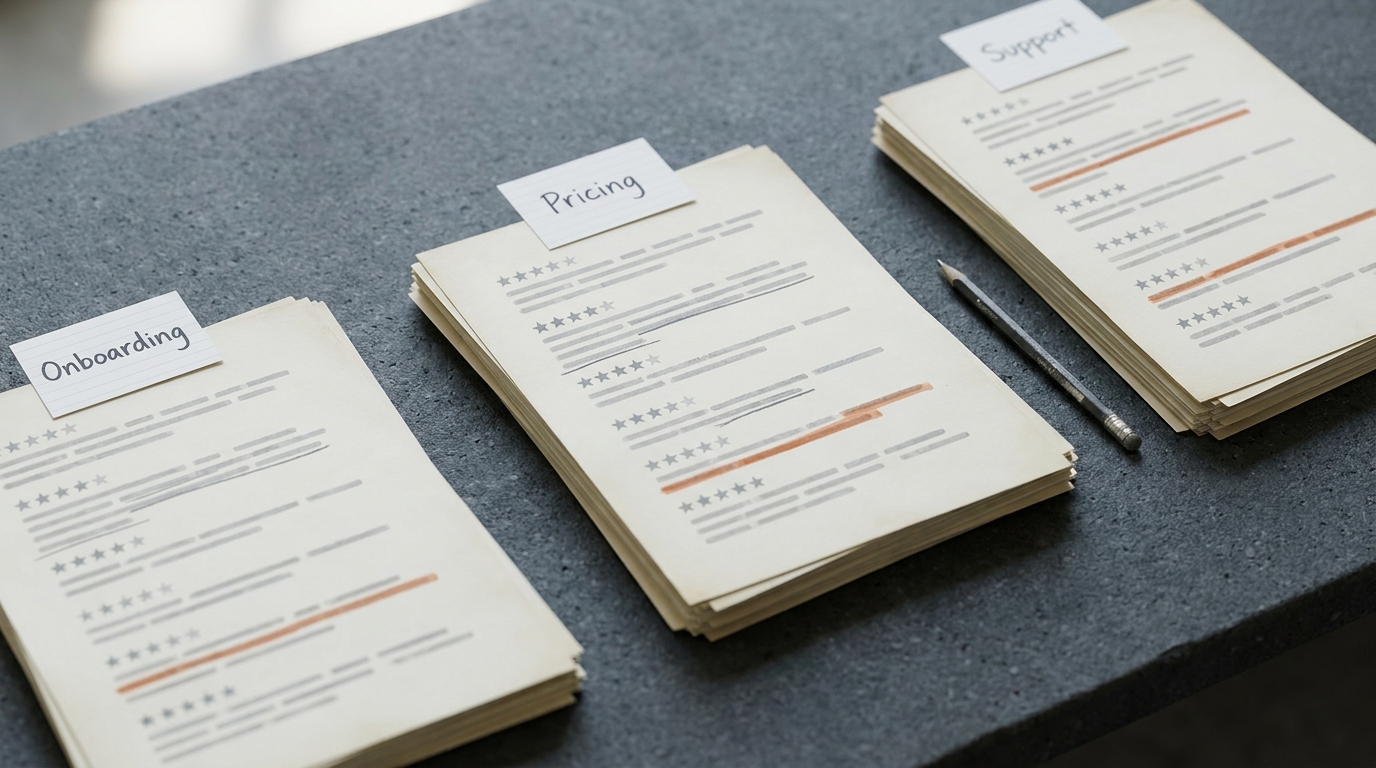
Inputs. Export reviews from G2, Capterra, Trustpilot, app stores, or wherever your category gets reviewed. Add your own support tickets, NPS comments, and churn survey answers if you have them. Strip names, emails, and account details before anything goes into an AI tool, and check whether your company's data policy allows customer text in the tool you are using.
What to ask.
- "Group these reviews into themes for praise and themes for complaints. Give a count for each theme and three verbatim quotes."
- "Compare the complaint themes across these three products. Which complaints are unique to one vendor?"
- "Find reviews that mention switching from or to another product. What triggered the switch?"
- "Which themes are rising in the last six months compared with the six months before?"
What to check. Start with the counts. Pull a random sample of 20 to 30 reviews and tag them yourself, then compare your tags with the model's themes. If your sample disagrees badly, the clustering is off. Next, take every quote the model gives you and search for it in the source file. A quote that is not in the file is a fabricated quote, and it must not go into a presentation. Watch for a single loud reviewer who posted the same complaint several times, which can inflate a theme. And write down the date range of the reviews, because a complaint from 2023 may already be fixed.
The output you want is a short table: theme, count, two real quotes, date range. That table is evidence. A paragraph of model prose about "customers valuing ease of use" is not. Reviews tell you what buyers think now. Trends are about what they will think next, and that is where the sourcing gets harder.
Trend spotting without chasing noise
Trend work is where AI most often hands you something stale or invented. A model without live sources can only describe patterns up to its training data. A model with live sources can still pick up a vendor's marketing claim and present it as a market shift.
Inputs. Use a browsing-enabled assistant or a deep research mode so the model works from current pages. Point it at primary sources wherever possible: earnings call transcripts, government and statistical agency data, Google Trends, regulatory filings, industry association reports, and analyst research your company already pays for.
What to ask.
- "List the signals that suggest [trend] is growing in [market]. For each signal, give the source, the publisher, and the date."
- "What would have to be true for this to be a real trend and not a hype cycle? What evidence would confirm or contradict each point?"
- "Find the strongest counter-evidence. Who argues this is overstated, and on what data?"
Most people skip the second and third prompts. They shouldn't: asking for counter-evidence is the quickest test of whether a trend holds up.
What to check. Every signal needs a link to a dated primary source. Open the links. If a cited page does not contain the claim, the signal is out. Drop anything older than your decision window. And separate independent data (a census release, an earnings number, search volume) from interested data (a vendor's survey of its own customers announcing that its own category is booming). Both can appear in the same list looking equally solid. They are not. Your own customer data has none of that problem, which makes the last workflow the most dependable of the four.
Segmentation from data you already have
Segmentation is a split verdict. AI does its best work here on your own data and its worst on someone else's. Ask a model to "segment the market for mid-market CRM" and you will get plausible personas built from nothing in particular. Give it your actual customer data and it becomes a fast analyst.
Inputs. Pull a CRM export with firmographics (industry, size, region), deal size, sales cycle length, win/loss reasons, and product usage if you track it. Add survey responses or interview notes if you have them. Anonymize account names.
What to ask.
- "Propose four to six candidate segments from this data. For each, give the defining attributes, the main need, and the number of accounts that fit."
- "Which segments have the shortest sales cycle and the highest win rate? Show the calculation."
- "For each segment, write two hypotheses we could test in customer conversations."
What to check. Recompute the segment sizes yourself in a spreadsheet. Language models are unreliable at arithmetic over large tables, even when the reasoning sounds right (especially then, in fact). Then test the segments for usefulness: can you reach each one through a channel you have, and are they distinct enough to need different messaging? Finally, take the hypotheses into five to ten real customer conversations before you build a plan on them. AI-generated segments are a starting point for talking to customers, not a replacement for it.
Where AI market research goes wrong
Most guides on this topic list the risks. Fewer explain how each one actually shows up in a research deliverable. Here are the five failure modes that do the damage.
Hallucinated figures. This is the big one. Ask a model for the size of a niche market and it may give you a precise number with a growth rate attached and no source behind either. The figure looks exactly like a real statistic. It may be stitched together from fragments, misremembered from a report on a different market, or invented outright. Precision is not evidence. A decimal point proves nothing.
Stale data. A model working from training data does not know about last quarter's price change, the acquisition announced last month, or the product a competitor just retired. Browsing modes reduce this risk but do not remove it, because the model may still pick an old page over a new one.
Weak sources. The web is full of vendor blogs and listicles quoting statistics from other vendor blogs. When a model searches, it finds those pages easily because they are written for search. A number can travel through three blog posts and lose its original context, sample, and date along the way.
Bias and missing context. Models trained mostly on English-language, US-centric text can misread markets outside that frame. In review mining, they can miss sarcasm or treat a complaint about a reseller as a complaint about the product. And as the toothpaste example showed, out-of-the-box models can lean optimistic about new ideas.
Data handling. Pasting customer records, interview transcripts under NDA, or unreleased plans into a consumer AI tool can create a privacy or contract problem. Check which tools your company has approved and what the data terms say before you upload anything sensitive. If nothing is approved yet, run these workflows on public pages and anonymized exports only.
None of these are reasons to stop using AI for research. They are reasons to build the checking step into the workflow instead of treating it as optional. Here is what that step looks like in practice.
A verification routine before any number ships
This is the part most guides wave at with "validate your findings." Here is what validating means, step by step. It fits on a sticky note. Run it before any AI-assisted research goes into a deck, a plan, or a decision.
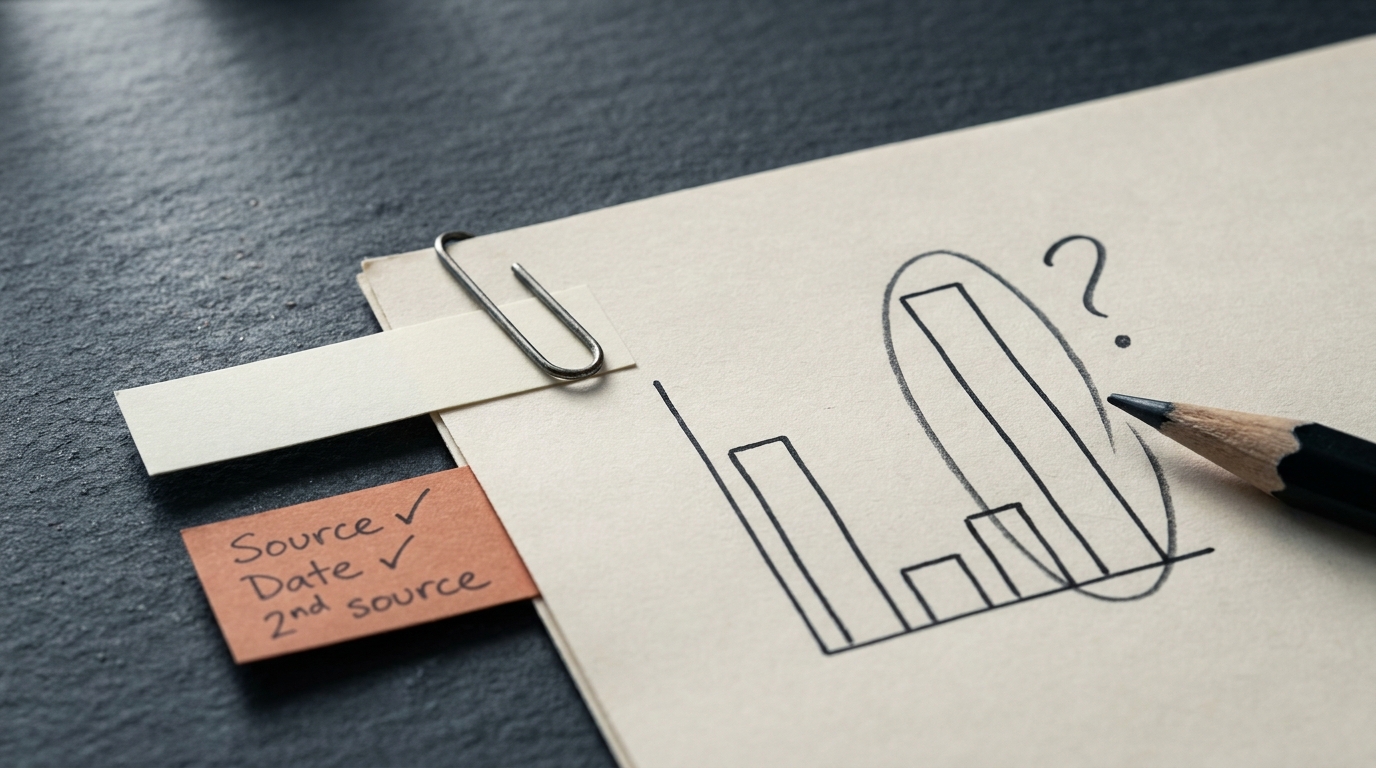
- Every number gets a primary source and a date, or it gets cut. No exceptions for numbers that "sound about right."
- Trace secondary citations to the original. If a blog cites a report, find the report and read the relevant page, including the sample size and date.
- Cross-check key figures against a second independent source. If two credible sources disagree, show the range and say why they differ (different definitions, regions, or years).
- Ask the model for its sources, then open every link. A cited URL that does not contain the claim counts as a failed check, not a minor slip.
- Date-stamp the research and record how it was produced. Note which tool and mode generated the draft and when, so anyone reading it later knows how fresh it is.
- Have a second person check the three numbers that will drive the decision. Fresh eyes catch the figure you stopped seeing after the fourth read.
The rule underneath all six steps: never ship a figure the model produced without a source. If you cannot find where a number came from, it does not go in the deliverable. A gap in a slide is better than a wrong number in a board meeting. Every time.
There's a side effect worth knowing about: the routine changes how you prompt. Once your team knows every claim will be traced, they start asking the model to cite as it goes, to label inference, and to leave blanks instead of guessing. The drafts get better because the checking is expected.
Making it a team habit
One person using AI for research gets faster. A team with a shared method gets faster and more reliable, which is the part leadership actually cares about. Three habits make the difference.
Separate the drafter from the checker. The person who prompted the model is the worst person to verify it, for the same reason writers are poor proofreaders of their own work. Assign the check to someone else, even if it takes them 30 minutes.
Keep a shared prompt library per use case. When a competitor-analysis prompt produces a clean table with labeled inference, save it. When a review-mining prompt surfaces fabricated quotes, fix it and note why. Over a few months, the library becomes your team's research method.
Log what you checked. A short research log (question, sources used, tool and date, what was verified, who verified it) takes five minutes per project and makes every finding auditable. It is also what finance or legal will ask to see when someone challenges a number.
Here is the whole method on one page:
| Use case | Inputs to supply | What to ask | What to check |
|---|---|---|---|
| Competitor analysis | Pricing, product, and press pages, plus review profiles | Positioning, pricing table, messaging gaps, labeled SWOT | Every price against the live page, competitor list with sales |
| Review mining | Exported reviews, tickets, NPS comments (anonymized) | Themes with counts and verbatim quotes, switching triggers | Hand-tagged sample, every quote found in the source |
| Trend spotting | Browsing mode plus primary sources | Dated signals, conditions for a real trend, counter-evidence | Every link opened, interested vs independent data |
| Segmentation | CRM export, win/loss, usage data | Candidate segments with sizes, hypotheses to test | Sizes recomputed, segments tested in customer calls |
If you want help working out which of these workflows your team can hand to AI safely, and where the verification step belongs in your process, book a free 30-minute AI Readiness Snapshot . We will map the research work your team does today and show where AI can compress it without putting an unsourced number in front of your leadership.
Start with one use case that has a decision attached this month. Run it with the checking step built in. Then decide what to scale.