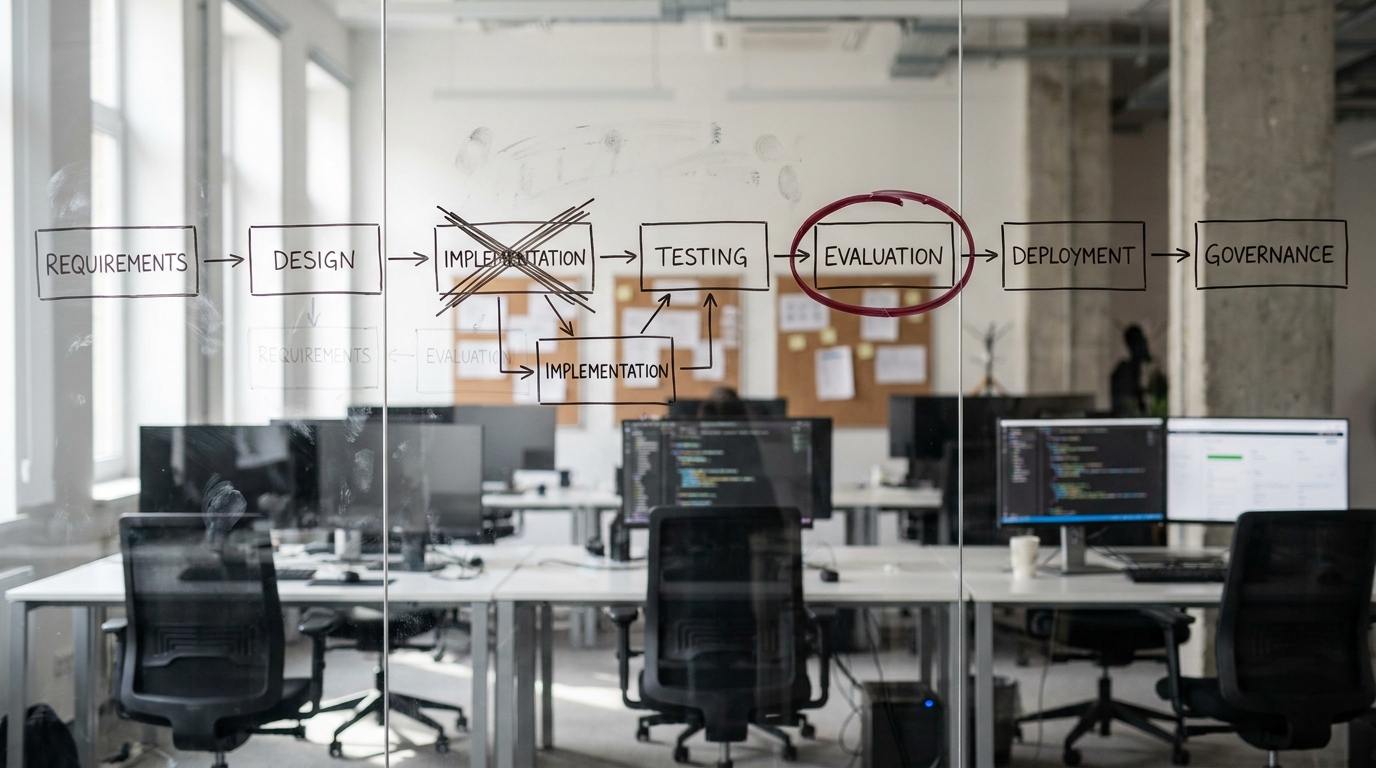
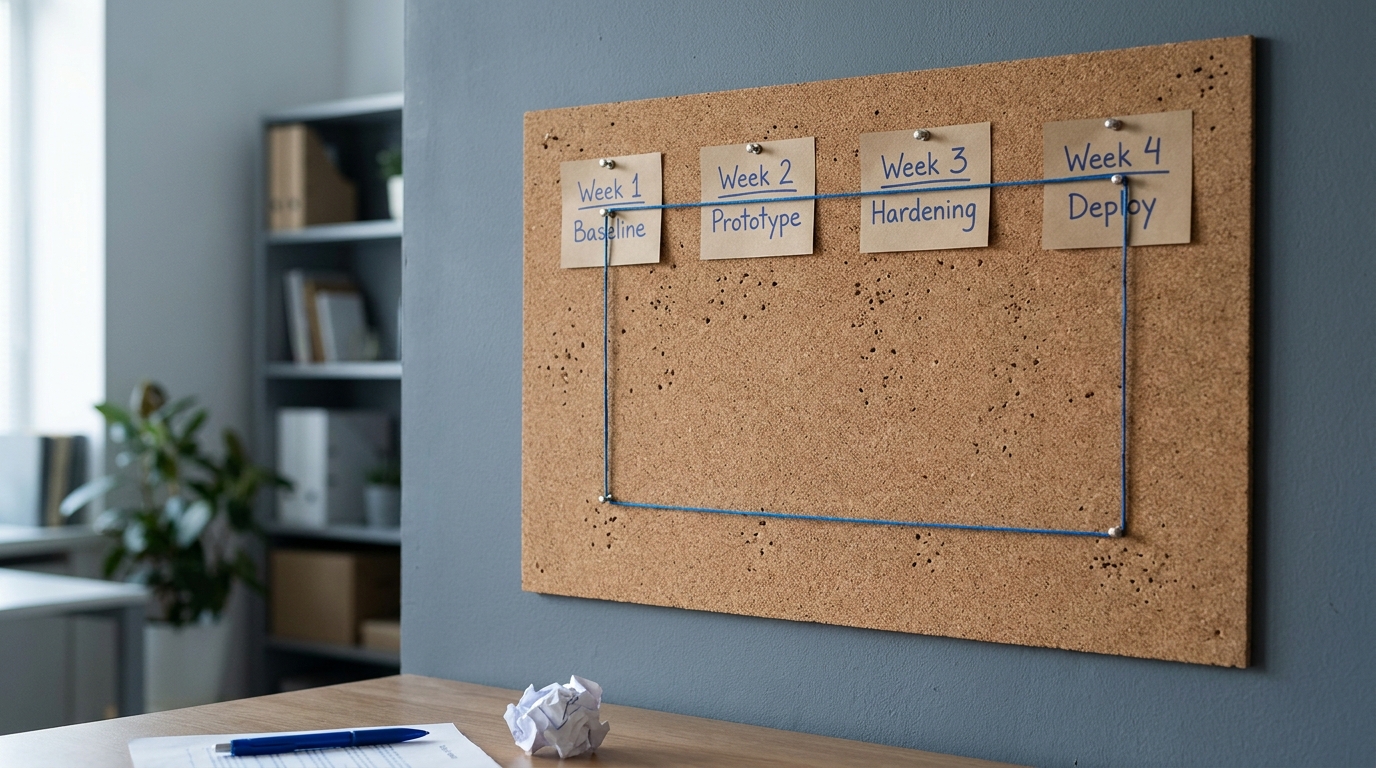
The AI program your board is about to approve has a seven-figure price tag, a six-month timeline, and one thing in common with most of the ones that came before it: it will never put a single workflow in front of a real user. There is a faster, safer way to start, and it inverts the whole plan. Instead of buying a transformation program, ship one production workflow in 30 days: pick a real, bounded task, put an AI-assisted version of it into the hands of the team that owns it, and measure what changed. The unit of progress is not a strategy binder or an impressive demo - it is one live workflow the team uses on Monday morning. The path is a simple loop: Discovery Sprint, then one production workflow, then a measurement loop, then the next workflow. Land one, prove it, and compound from there. This article lays out that 30-day sequence week by week, for the CEO, COO, or CIO who wants results before they commit to a strategy.
Why most AI roadmaps stall before production (and what to do instead)
Anyone who has run an AI pilot knows the pattern. A proof-of-concept demos beautifully in a conference room, everyone nods, and then it quietly dies. No one hardened it, no one governed it , and no one ever measured whether it saved a dollar or an hour. The idea was fine. The unit of work was wrong.
This failure is common. Widely cited industry research has reported for several years that the large majority of enterprise AI pilots never make it into production - McKinsey and BCG surveys through 2024 and 2025 consistently put the share of stalled or scrapped initiatives well above half, and some estimates of pilots that never reach scale run as high as the high-80-percent range (treat these as reported figures, since methodologies vary). The consulting research is also right about the cause: most of the value and most of the risk lives in people, process, and change management , not in the model itself.
Those same findings are the reason a 30-day production-first approach works. A pilot is designed to be optional. It has no owner on the hook, no real data, no controls, and no metric, so it is easy to abandon. A production workflow is the opposite. It has a named owner, real inputs, guardrails, and a number it has to move. Make "one workflow live in production" the unit of progress instead of "one impressive demo," and you force the exact disciplines the research says pilots lack: ownership, controls, measurement.
So the reframe is not "move faster and skip the rigor." It is "compress the rigor into 30 days and aim it at production, not a sandbox." The rest of this article is how you do that, one week at a time. If you want a low-commitment way to gauge where your organization stands first, a short AI Readiness Snapshot can size the gap before you pick a workflow.
What "one production workflow in 30 days" actually means
Precision matters here, because the whole approach collapses the moment "production" quietly slides back into "pilot." A production workflow is a single, bounded, real task that a real team performs, running on real data, behind real controls, with a measured outcome. The people whose job it is use it on Monday morning. It is not a demo, not a sandbox, and not a slide.
Three examples make the size right. Inbound-lead triage: an assistant reads new leads, drafts a qualification summary and a routing recommendation, and a sales rep approves or edits before anything moves. Invoice and AP exception handling: the system flags invoices that do not match a purchase order, drafts the likely resolution, and a clerk confirms. Support-ticket drafting: for common ticket types, the model writes a first-draft response that an agent reviews and sends. Each one is high-frequency, role-recognizable, and tolerant of a human check before anything reaches a customer or a ledger.
A good first workflow shares a few traits. It happens often, so a small percentage improvement compounds. It is bounded, with a clear start and finish, rather than an open-ended "make marketing better." It tolerates human-in-the-loop review, so a wrong answer gets caught before it does damage. And it has an obvious owner who feels the pain today.
A bad first workflow is the mirror image, and picking one is the most common way to lose the month. Anything safety-critical, where an error is expensive or irreversible, is a poor place to learn. Anything unbounded, where you cannot say what "done" looks like, will sprawl past 30 days. Anything without a clear owner will drift, because no one is accountable for shipping it. Resist the urge to pick the most strategic-sounding workflow. Pick the one you can put into production this month.
Prerequisites: what you need in place before day 1
A how-to that skips the prerequisites sets you up to fail in week 3. The good news for a mid-market company is that this list is short and assembled in days, not a data-platform program that takes quarters.
Before the clock starts, confirm you have:
- An executive sponsor. One of you - the CEO, COO, or CIO reading this - who clears blockers and protects the 30 days from competing priorities.
- A single workflow owner. The person whose team does the work today and who will own the AI-assisted version. One name, not a committee.
- Access to the relevant data and systems. The CRM, the AP system, the ticket queue - whatever the workflow touches - with a path to real or realistically masked data. If access takes six weeks of procurement, pick a different first workflow.
- A defined metric. The one number you will move: hours per week, cycle time, error rate, cost per transaction, or throughput. Agree on it before you build, so week 4 has something to measure against.
- A named human reviewer. The person in the loop who approves, edits, or overrides the AI output during the early production window.
Cannot assemble this list for a candidate workflow? That is not a reason to abandon the plan. It is the plan telling you that you picked the wrong first workflow. Move to one you can actually staff and access.
Week 1 - Baseline and workflow selection (Discovery Sprint)
Week 1 has one deliverable, and it is not a strategy: one selected workflow and a written baseline you can measure against later. That is the Discovery Sprint. Run it in these steps.
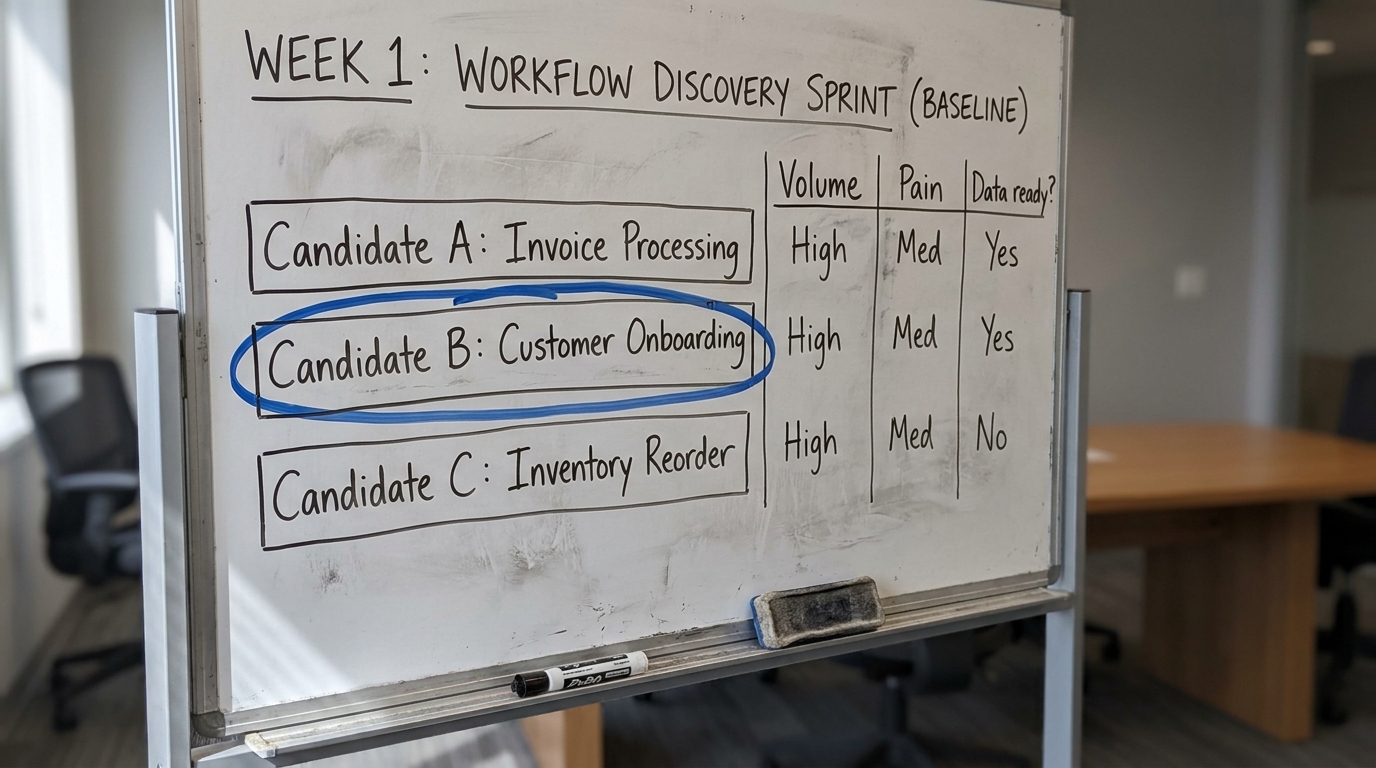
- Inventory candidates. With the sponsor and a few operators, list 8 to 12 real workflows that are frequent, painful, and bounded. Keep them concrete: "draft first-response for password-reset tickets," not "improve support."
- Score on impact times feasibility. Rate each candidate on business impact (how much time, cost, or error it removes) and feasibility (data access, boundedness, review-tolerance). A simple 1-to-5 on each axis is enough. The winners score high on both, not just impact.
- Pick exactly one. This is the hardest discipline in the whole 30 days. Do not hedge with two "small" workflows. One workflow, one owner, one metric.
- Capture the baseline. Measure the current state of the chosen workflow before any AI touches it: time per task, volume per week, current error or rework rate, and cost if you can attribute it. Write it down and have the owner confirm it. Skip this number and week 4 has nothing to prove.
The Discovery Sprint is exactly the mechanism a Discovery Sprint engagement is built to run when you do not have the internal bandwidth to facilitate it - a structured week that ends with a selected workflow and a signed-off baseline, not a deck. By Friday of week 1 you should be able to say, in one sentence, which workflow you are shipping and what number it has to move.
Week 2 - Design and prototype
By Friday of week 2, a real operator should be running a working prototype on live-like examples. The goal is not autonomy. It is a review-first design the owner can actually touch. Get there in these steps.
- Map the current workflow. Document the actual steps a person takes today, including the judgment calls and the edge cases. You are automating a real process, not an idealized one.
- Design the AI-assisted version with checkpoints. Decide exactly where the model drafts or recommends and where a human approves. Design for review and fallback first: what happens when the model is unsure, and how a person takes over cleanly.
- Build against real, masked data. Prototype with representative inputs, masking or redacting anything sensitive. Synthetic data hides the messy cases that break workflows in production.
- Put it in the owner's hands. Have the workflow owner run the prototype on live-like examples and react. Their friction points in week 2 are the controls you will build in week 3.
Two design principles keep week 2 honest. First, keep a human in the loop for every output that reaches a customer, a ledger, or a record of decision. Full autonomy is a later decision, earned by data, not assumed on day one. Second, design the fallback path now. A workflow with no graceful way to say "I am not confident, route this to a person" is not ready for production, no matter how good the demo looks. That fallback is also the first thing week 3 hardens.
Week 3 - Hardening and controls
Week 3 answers the question every executive is actually asking: what breaks if we put this in a real workflow? Governance here is not a gate that slows the deployment. It is what makes the deployment safe enough to ship at all. Frame it that way with your team.
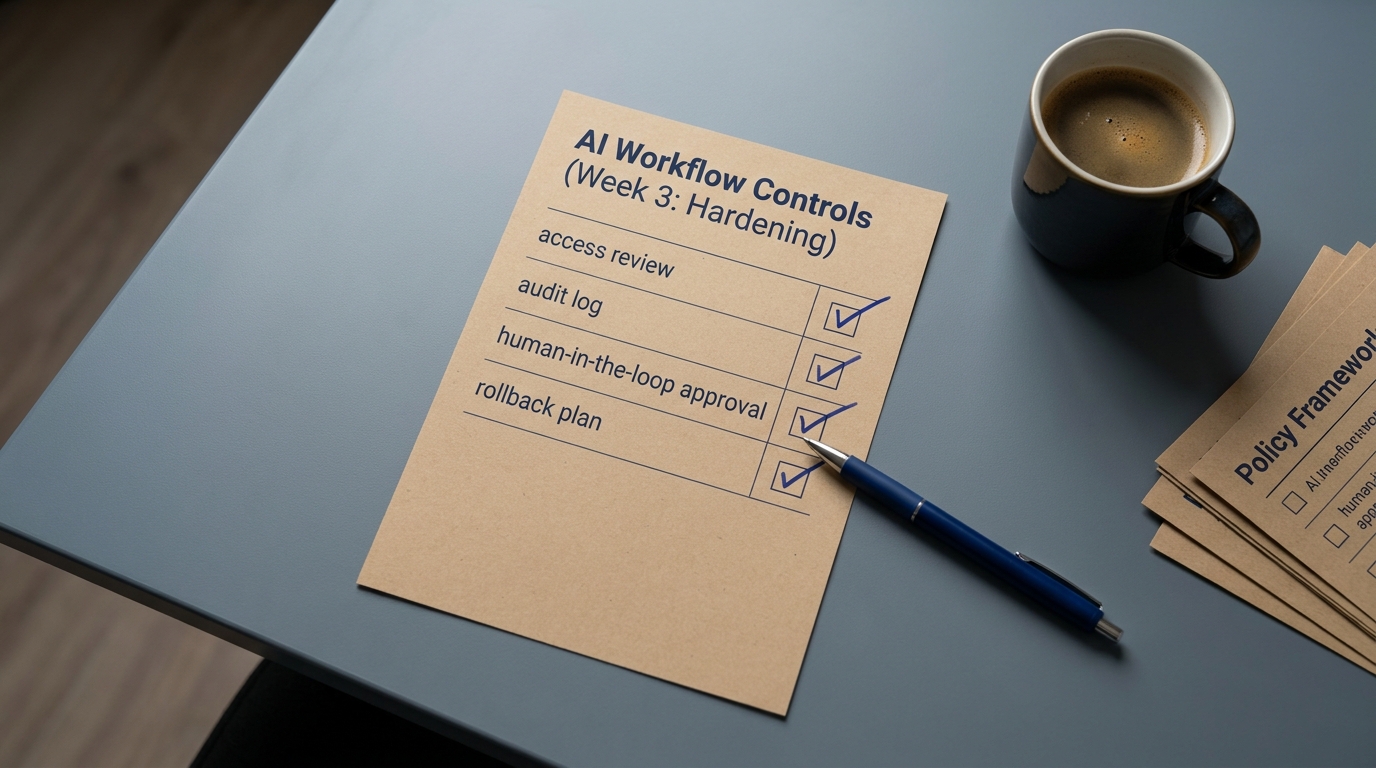
- Add input and output validation. Check that inputs are well-formed and in-scope, and that outputs meet basic rules before a human ever sees them. Format, range, and obvious-error checks catch a surprising share of failures.
- Set data-security and access controls. Confirm who and what can see the data the workflow touches, apply least-privilege access, and make sure masked or sensitive fields stay protected in the live path, not just the prototype.
- Turn on logging and an audit trail. Every AI action, every human override, and every input should be logged. You cannot govern or measure what you cannot see, and an audit trail is what turns an incident into a fixable event instead of a mystery.
- Define human override and rollback. Write down exactly how a person overrides an output and how you switch the workflow back to the fully manual process if something goes wrong. Test the rollback before you need it.
- Run a limited shadow test. For a few days, run the AI-assisted workflow alongside the current one without acting on its output, and compare. A shadow test surfaces failure modes cheaply, before real decisions ride on them.
By the end of week 3 you should have a workflow that is not just capable but controlled: validated, logged, reversible, and shadow-tested. That is the difference between a demo and something you are willing to run in production. Next week is where it earns that word.
Week 4 - Production deployment and measurement
Week 4 is where "in production" earns its name. Production means real users doing real work on real data behind the human-in-the-loop checkpoint you designed - not a wider pilot, and not a demo you show the board.
- Deploy to the real team. Turn the workflow on for the owner's team, with the human reviewer approving or editing outputs during the initial window. Start narrow: the specific ticket types, invoice categories, or lead segments you designed for.
- Monitor actively. Watch the logs and the override rate in the first days. A high override rate is not a failure. It is data telling you where the design needs another pass.
- Measure against the week-1 baseline. On the metric you agreed before you built anything, compare production performance to the baseline. Time per task, error rate, cycle time, volume handled - whatever you chose, measure it honestly, including the cost of human review.
- Write the result down. Capture what moved, by how much, and what it cost to get there. That written result is the input to everything that follows.
The discipline that makes week 4 work is that you decided the metric in week 1. You are not searching for a flattering number after the fact. You are checking a pre-agreed number against a pre-recorded baseline . That is what makes the result credible to a board that has seen too many demos and too few outcomes. And that one credible number is what chooses your next 30 days.
The measurement loop: how week 4 chooses your next 30 days
Almost every competitor skips this part, and it is the difference between a one-off win and a compounding program. Most roadmaps say "then scale," as if scaling were a generic next step. It is not. The result you just measured should choose your next 30 days.
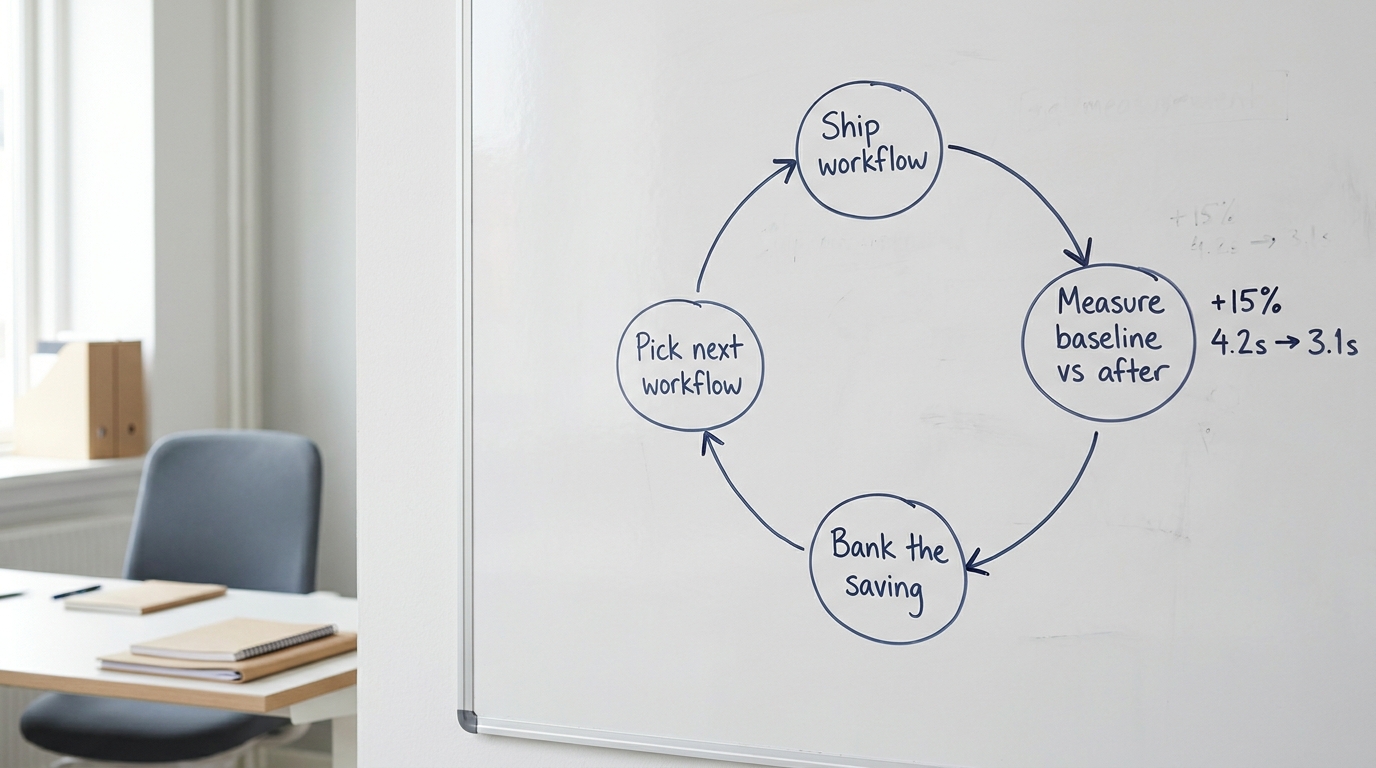
The loop has four moves:
- Measure the shipped workflow against its baseline (week 4).
- Decide what the result warrants: scale it to more of the same work, adjust the design and re-measure, or kill it if the honest number says it is not worth running.
- Learn what the cycle taught you about your data, your controls, your review capacity, and which kinds of workflow fit your organization.
- Select the next workflow using those learnings, and start the next 30-day cycle.
Play this forward and the arithmetic favors the loop. Three or four 30-day cycles a quarter, each one selected by a real measured result, beats a single six-month program that ships nothing and asks you to trust the plan. After a year you have a portfolio of production workflows , each with a documented baseline and outcome, and an organization that has learned - by doing - how to ship AI safely. That is a roadmap built from evidence, not slides.
The honest constraint is capacity. Running a disciplined 30-day cycle every month takes people who can facilitate the sprint, build the prototype, and harden the controls, and most mid-market companies neither have that bench nor should hire three permanent FTEs to find out if AI works for them. This is where a Fractional Agentic Team fits: an embedded team that runs the Discovery Sprint, ships the workflow, and builds the controls alongside your people, so the loop keeps turning without a permanent headcount commitment.
Common pitfalls (and how to avoid them)
Most 30-day cycles that fail, fail for the same handful of reasons. Watch for these:
- Picking a workflow that is too big or unbounded. If you cannot describe "done" in a sentence, it will not ship in 30 days. Narrow it until you can.
- Skipping the baseline. No week-1 number means no credible week-4 result. Capture the baseline before anything AI touches the workflow.
- No named owner. A workflow owned by a committee drifts. Assign one person who feels the pain and owns the outcome.
- Treating it as a pilot with no production intent. If everyone knows it is "just an experiment," no one will build the controls or push it to real users. Commit to production from day one.
- Over-indexing on model choice. Executives love to debate which model to use. The workflow design, the controls, and the measurement matter far more than the model badge. Pick a capable model and spend your energy on the process around it.
- Building for autonomy on day one. Skipping the human-in-the-loop checkpoint to look more impressive is how a small error becomes a customer-facing incident. Earn autonomy with data, later.
Validation and troubleshooting: how to know it worked
Success in this model is specific, not a vibe. A 30-day cycle worked if four things are true: the metric moved in the right direction versus the baseline, the team actually uses the workflow rather than routing around it, the controls held with no unmanaged incidents, and the cost of running it (including human review) sits comfortably below the value it created.
If the number did not move, resist the urge to declare AI a failure and diagnose instead. The usual culprits are diagnosable:
- The metric did not improve. Check whether you picked the wrong metric (you measured something the workflow does not really affect) or the wrong workflow (the task was too rare or too small to matter). Re-select rather than re-engineer.
- The team is not using it. This is an adoption problem, not a model problem. Sit with the owner, find the friction, and fix the workflow design or the review burden.
- Controls are too tight. If the override rate is near total, the design is asking humans to redo the AI's work. Loosen the scope to the cases the model handles well and expand from there.
- An incident slipped through. Treat it as a controls gap. Trace it in the audit log, close the specific hole, and re-run the shadow test before widening deployment.
The point of validation is not to grade the technology. It is to produce a clear, honest decision - scale, adjust, or kill - that feeds the next 30-day cycle. A workflow you killed for the right, measured reason is still a successful cycle, because it taught you something and cost you a month, not a six-month program.
Key Takeaways
- One production workflow in 30 days beats a six-month strategy program - it proves value with real users before you commit real budget.
- The repeatable unit is a loop: Discovery Sprint, then a production workflow, then a measurement loop, then the next workflow.
- Capture a baseline in week 1, or you will have nothing to prove in week 4.
- Governance and controls in week 3 are what make production safe, not what make it slow - validation, logging, and rollback are enablers.
- The loop compounds: several disciplined 30-day cycles a quarter, each selected by a real measured result, out-ship any single long program.
From one workflow to a year of production
A year from now you can have one of two things: a strategy binder that describes AI transformation, or a shelf of production workflows that already did it - each with a baseline, a measured result, and a team that trusts them. The second path does not start with a bigger budget or a Chief AI Officer. It starts with one bounded workflow, a written baseline, and 30 days.
You do not have to staff that alone. A Fractional Agentic Team embeds with your people to run the Discovery Sprint, ship the first production workflow, and harden the controls - then keeps the 30-day loop turning as measurement selects the next one. That is how a mid-market company gets AI into production without hiring three FTEs or betting the year on a plan. Land one, measure it, and compound.