"The cheaper model can't handle our refactoring work, so we pay for the big one." Picture that line in a planning doc written this spring, back when it was still true. On September 28, Anthropic shipped Claude Sonnet 5.5, which scores 70.6 on Terminal-Bench 4.0, ahead of the larger Opus 5.5 at 66.4, at $2 per million input tokens and $10 per million output tokens (MarkTechPost, 2026). The planning doc still says the old thing. Nobody was assigned to notice, so nobody did.
Companies that try to keep up with AI news usually stumble on ownership. The field moves fast and every leader knows it, yet very few companies have decided who checks whether last quarter's assumptions still hold. AI assumptions expire, and somebody has to check the dates. This article makes the case for a blunt fix: make following new AI model releases a minimum company rule, give it an owner in every team, and run it on a weekly rhythm. It will feel like homework for the first month. Then it becomes a habit, and the habit pays for itself.
The cost of working on last quarter's assumptions
Every AI decision your teams have made rests on a few assumptions about the tools. What a model costs per task. How much context it can hold. Whether it can write production code or only snippets. Whether an agent can be trusted to run a multi-step job without a human watching. Those assumptions go stale in months.
Look at what changed in a single stretch of a few weeks this autumn:
- Coding ability moved down a price tier. Claude Sonnet 5.5 outscored Opus 5.5 on Terminal-Bench 4.0, though at a higher effort setting, while costing $2 / $10 per million tokens (MarkTechPost, 2026). A team that routes all coding work to the premium model "because the cheap one can't do it" is now paying more for less.
- Prices reset. OpenAI's GPT-6.1 Sol launched at $2 per million input tokens and $10 per million output, with cached input discounted 95% (Mixed News, 2026). Any workflow that was shelved as "too expensive to run on every ticket" deserves a second look.
- Output limits jumped. Google describes Gemini 4 Argon as built with a 1-million-token output limit (Google, 2026). Work that used to be chopped into dozens of calls may now fit in one.
- Access changed under people's feet. Google is removing some Gemini models from its free and Plus tiers starting October 9 (TechRadar, 2026). If a team quietly depends on one of those models, the first sign of trouble is a broken workflow.
ThursdAI's release tracker counted 27 AI releases in the first week of October 2026 alone (ThursdAI, 2026). Most of them won't matter to you. One or two might change what's practical for a workflow you run every day.
Missing those one or two never shows up as an outage. It shows up as a budget line that should have shrunk, a project still parked on a "not yet possible" list, or a competitor shipping something your team ruled out last spring. Nobody gets blamed, because nobody owned the question . So why doesn't the news reach the people who need it?
Why "someone will tell us" doesn't work
Most companies run on an informal system. A vendor rep mentions a new model on a renewal call . An engineer posts a link in a random channel. A board member forwards a LinkedIn post. Each of these is real information, and none of it is a process.
Vendors announce to everyone and to nobody. Their release notes are public, but nobody inside your company is reading them for your workflows. Sales reps tell you about what they sell, which isn't the same as what changed for you. Social feeds reward demos and benchmark screenshots, which are the least reliable signal of whether something works on your data.
Then there's the enthusiast problem. Every company has one or two people who follow AI closely. They know about Sonnet 5.5 the day it ships. But their knowledge stays in their heads or in a channel nobody else reads, and it never reaches the team that would benefit (say, the support lead whose ticket triage is still running on a model two generations old).
The fix is not a better reading list. It's a rule with an owner.
The minimum rule and how to roll it out in a week
Here's the rule, short enough to send in an email from the CEO:
Everyone follows new AI model releases from the vendors we use. Each team has a named owner who reports what changed for us, every week.
That's the minimum, and it is deliberately small. It doesn't ask everyone to become an expert. It asks everyone to pay attention, and it makes one person per team accountable for turning attention into decisions.
Before you start
You'll need three things, and none of them take long:
- An inventory. A one-page list of which AI tools and models each team uses today, including the plan or tier you're on. A team that uses nothing yet still gets a line, because those are the teams a release can open a first workflow for.
- One channel. A Slack or Teams channel dedicated to releases and nothing else.
- Fifteen minutes. A slot in each team's existing weekly meeting. Don't create a new meeting.
Budget about two hours of setup for the leader driving this, and 30 to 45 minutes a week per team owner once it's running.
The rollout, step by step
- Write the inventory. List every model and AI tool in use by team, with the tier. Why: owners can't spot a relevant release if they don't know what the team depends on. Check: each team lead signs off that the list is complete.
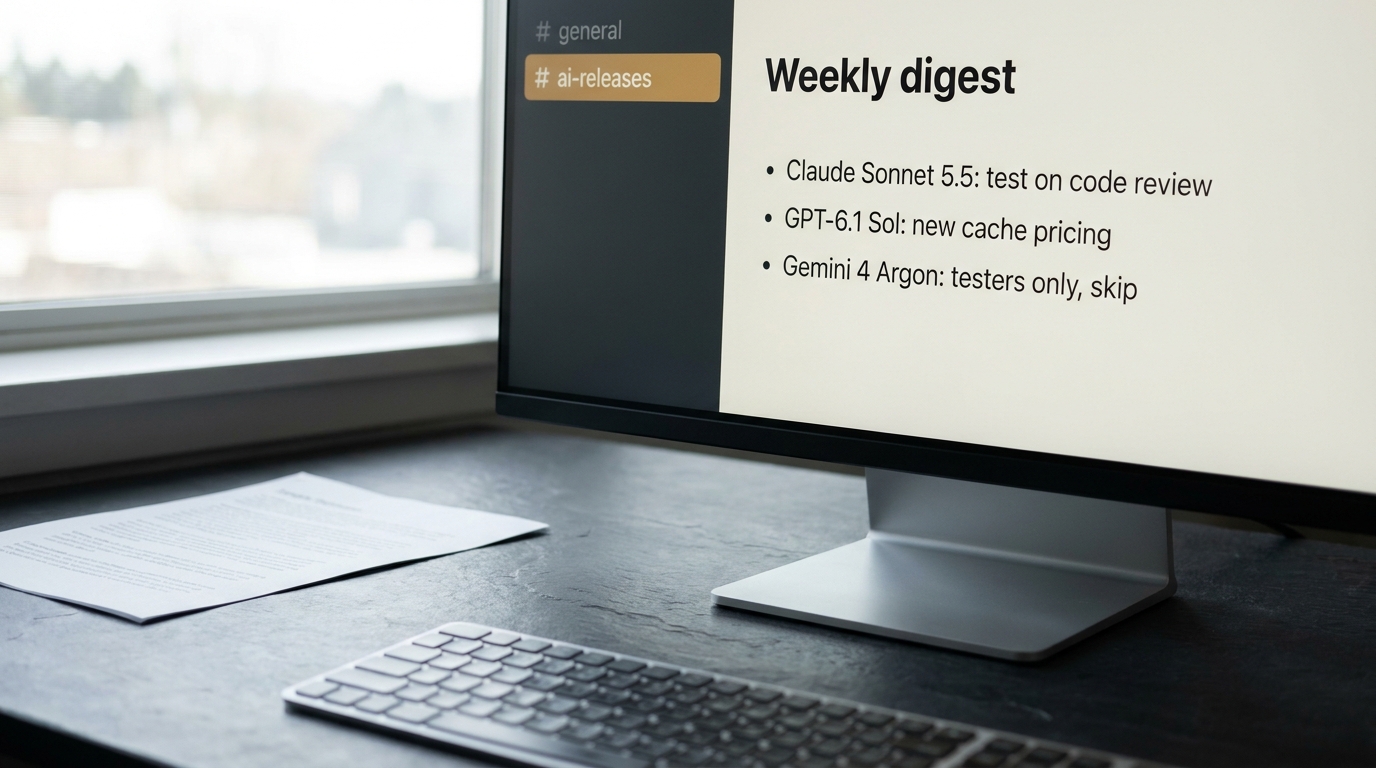
- Open the shared channel. Name it something plain, like #ai-releases. Rule for the channel: links to primary sources plus one line on why it might matter. No memes, no opinion threads. Why: one place makes it searchable, and the strict rule keeps it from turning into a hype feed.
- Name an owner per team. Not one central "AI person" for the company. Rotate the role every quarter. Why: a single owner becomes a bottleneck and burns out, and rotation spreads the skill. Check: every team on the inventory has a name next to it.
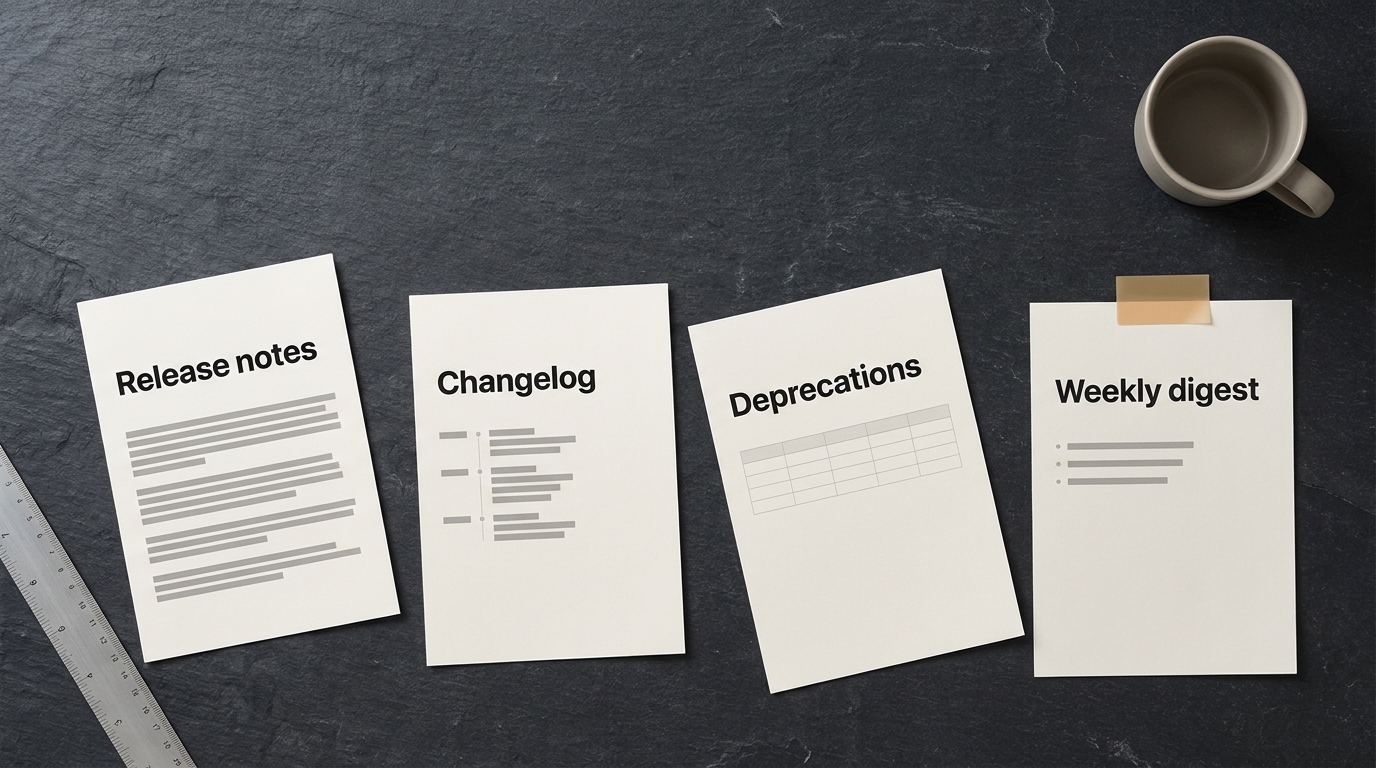
- Subscribe owners to primary sources. Each owner follows the release notes and changelogs for the vendors their team uses (the starter list below). Why: primary sources carry dates, numbers, and availability details that summaries drop.
- Publish a weekly digest. Three to five items, maximum. Each item gets two lines: what changed, and whether it affects us. Why: a short digest gets read. A long one gets archived.
- Run the 15-minute review. In the team's existing weekly meeting, spend five minutes on the digest, five on "does this change anything we do," and five on assigning one test or an explicit "no change."
- Log the decisions. Keep a running list: release, decision (test, ignore, change a workflow), owner, date. Why: the log is how you prove the rule is working, and how you avoid re-debating the same release a month later.
A simple digest entry looks like this:
Claude Sonnet 5.5 (Anthropic, release notes)
What changed: beats Opus 5.5 on a coding benchmark, $2/$10 per 1M tokens
Does it affect us: yes, we route code review to Opus. Test Sonnet on 20 PRs this week.
Owner: Platform team
A starter list of sources worth following
Start with primary sources. They're less exciting than newsletters, and they're the only place where the details that matter live: exact pricing, context limits, regional availability, deprecation dates. (Deprecation pages are the dullest pages on any vendor's site, and the ones most worth bookmarking.)

Official vendor sources (follow these first):
- OpenAI: the News page, the ChatGPT release notes in the OpenAI Help Center, and the API changelog and deprecations page.
- Anthropic: the News page, the release notes for Claude apps and the API, and the model deprecations page.
- Google: the AI section of The Keyword blog (Google publishes a monthly roundup of its AI announcements) and the Gemini API changelog.
- Microsoft and GitHub: the GitHub Copilot changelog, if your developers use Copilot.
- AWS: the Machine Learning blog's launch category, if you build on Bedrock or SageMaker.
- Your own tooling: changelogs for the IDEs, agent tools, and AI features inside the SaaS products your teams already use.
Secondary sources (pick one or two, not ten):
- A weekly release tracker that links back to primary sources, such as ThursdAI's monthly release pages.
- One daily or twice-weekly newsletter for context, if an owner wants it.
One rule settles most arguments: if a newsletter and a vendor's release note disagree, the release note wins. Newsletters are good at telling you something happened. Release notes tell you what shipped, to whom, and at what price.
How to filter hype from what matters to your work
A digest is only as good as what it leaves out. Benchmarks, leaderboards, and launch-day demos generate most of the noise. A pricing change on a model you call ten thousand times a day generates almost none, and it matters far more.
Give every owner the same four questions:
- Does it change cost, context, speed, or capability for a task we already do? If it doesn't touch an existing workflow, it's interesting, not urgent.
- Can we use it now? Check your plan, your region, and your compliance constraints. If the new model would touch customer or regulated data, loop in whoever owns AI policy before the test starts. Gemini 4 Argon, for example, debuted at the top of Text Arena but went to trusted testers only (ThursdAI, 2026). A model you can't access doesn't belong in this week's decisions.
- Is it in a primary source with a date and numbers? A thread that says a model is "insane at coding" is not evidence. A release note with a benchmark, a price, and an availability date is.
- Is anything we depend on being deprecated or restricted? These are the items most likely to break something, and the least likely to trend on social media.
An item that passes the first two questions goes in the digest. An item that fails both stays out, no matter how loud the launch was. We'd rather read a digest with two items than one with ten.
What to do when a release changes something
When the review finds a release that might matter, treat it as a small, time-boxed test, not a project.
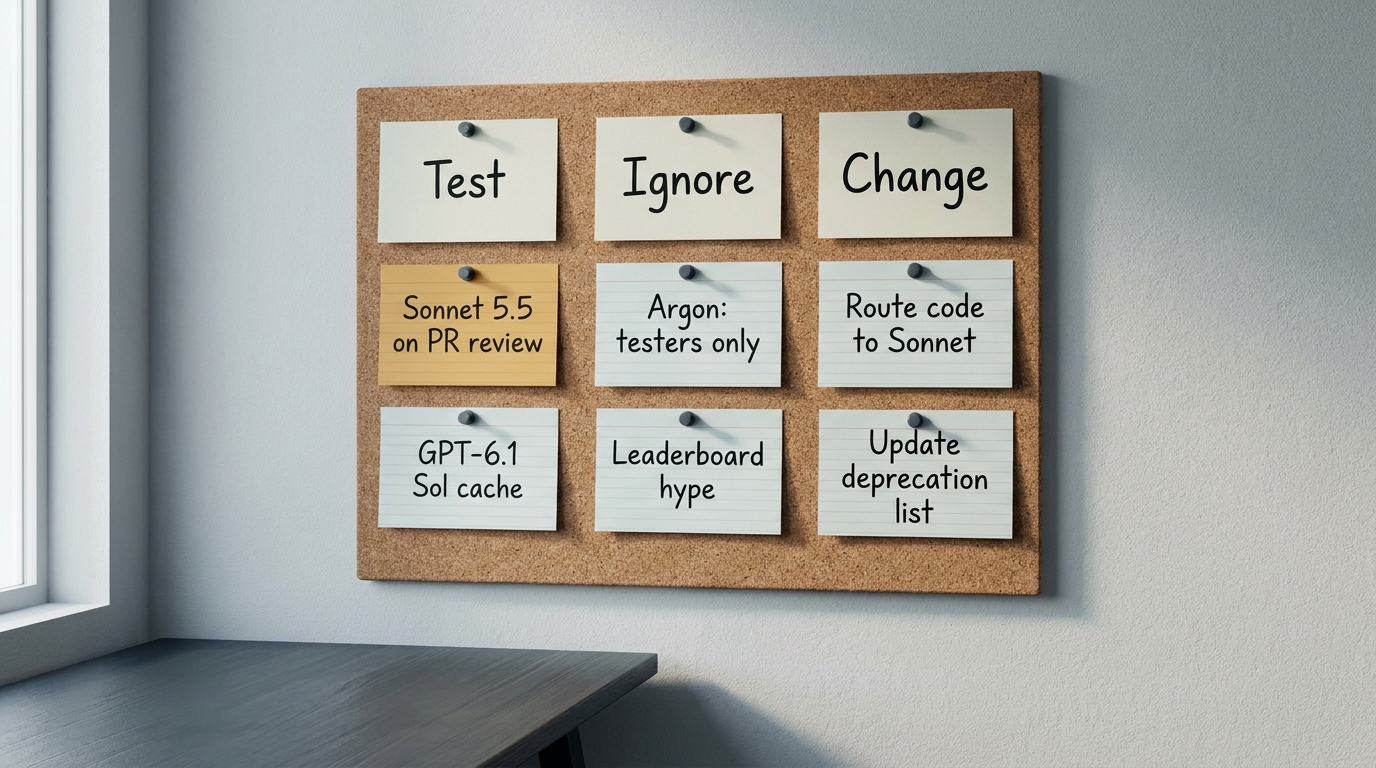
One workflow. Pick the single workflow the release is most likely to improve.
One week. Run the new model or feature alongside the current one on real work, not a demo prompt.
One measure. Cost per task, error rate, time saved, or pass rate on a review. Write down the old number before you start.
One owner. The team owner runs it and reports the result at next week's review.
Most tests end with "not worth switching," and that's a good outcome. You checked, you have a number, and you can stop wondering. When a test does show a material change in cost or capability, that's when it goes up to leadership with the evidence attached. Over a quarter, that log also becomes the simplest answer when the board asks what changed because of your AI spend. The decision log shows what was tested and why, so the conversation starts from data instead of enthusiasm.
Forced at first, a habit later: the first 90 days
Be honest with your teams about how this will feel. For the first month, it's homework, and they will say so. Owners will skim release notes because they have to. Digests will be thin, some weeks will have nothing worth reporting, and at least one owner will skip a week. That's normal. Keep the rule anyway.
The turning point is usually a single win. A test shows the cheaper model handles a workflow just as well , and a monthly bill drops. A team unshelves a project because a context or output limit moved. When that happens, say so loudly, in the channel and in the leadership meeting. One visible payoff does more for adoption than any mandate .
Signs the habit has formed, usually somewhere between week six and week twelve:
- People outside the owner role post releases to the channel unprompted.
- Decisions in planning docs cite a release note and a date.
- The 15-minute review regularly finishes early.
- The decision log has entries that led to real changes.
Once those signs show up, you can loosen the cadence, moving the review to every other week if the log shows steady use. Don't drop the owner role. The rule stops feeling like a rule when it works, but it keeps working only while someone is accountable.
Pitfalls and how to fix them
One central "AI person" becomes the bottleneck. Spread ownership across teams and rotate it. The goal is a company that notices change, not one employee who does.
The channel turns into a hype feed. Enforce primary-source links plus one line of relevance. Delete or redirect everything else without apology.
Reviews turn into demos. The question is "what changed for us," not "look what this can do." If an item has no workflow attached, it waits.
Nobody acts on anything. Every review ends with one test assigned or an explicit "no change" recorded. Silence is not a decision.
Leaders exempt themselves. If the CEO and CTO don't read the digest, nobody else will for long. Read it, reply to it, and reference it in your own decisions.
The one-sentence rule to send this week
Keeping up with AI news at the company level isn't about reading more. It's about making sure the assumptions behind your AI decisions get checked on a schedule, by someone accountable, against primary sources.
- Send the rule: everyone follows releases from the vendors we use, and each team's owner reports what changed for us weekly.
- Set up one channel, one digest, and one 15-minute review per team.
- Lead with vendor release notes and changelogs, and filter by your own workflows.
- Test small, log every decision, and expect it to feel forced before it feels normal.
If you'd like a second pair of eyes on which recent releases change something for your workflows, and help setting up the owner-and-review rhythm, start with an AI Readiness Snapshot, a free 30-minute call that maps where AI will have the most immediate impact on your team's cost and reliability.