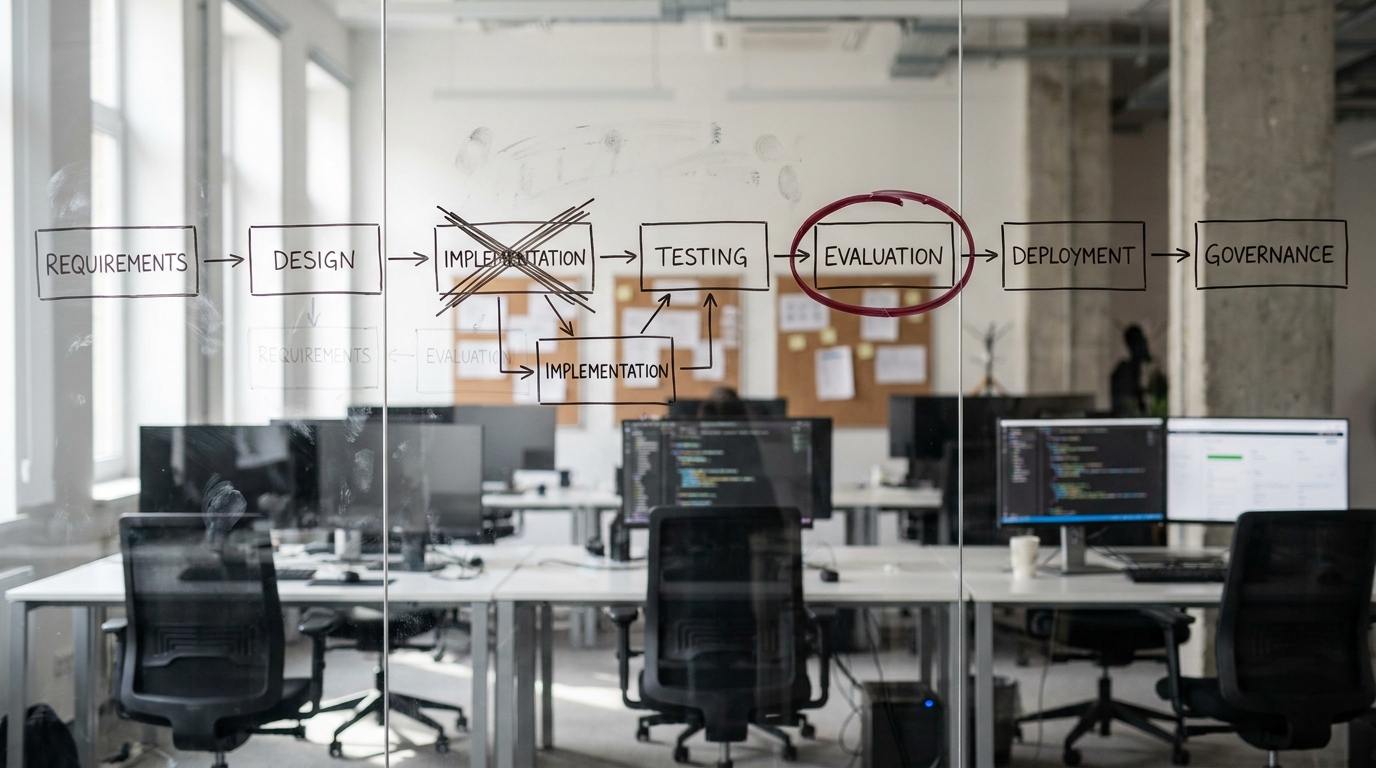
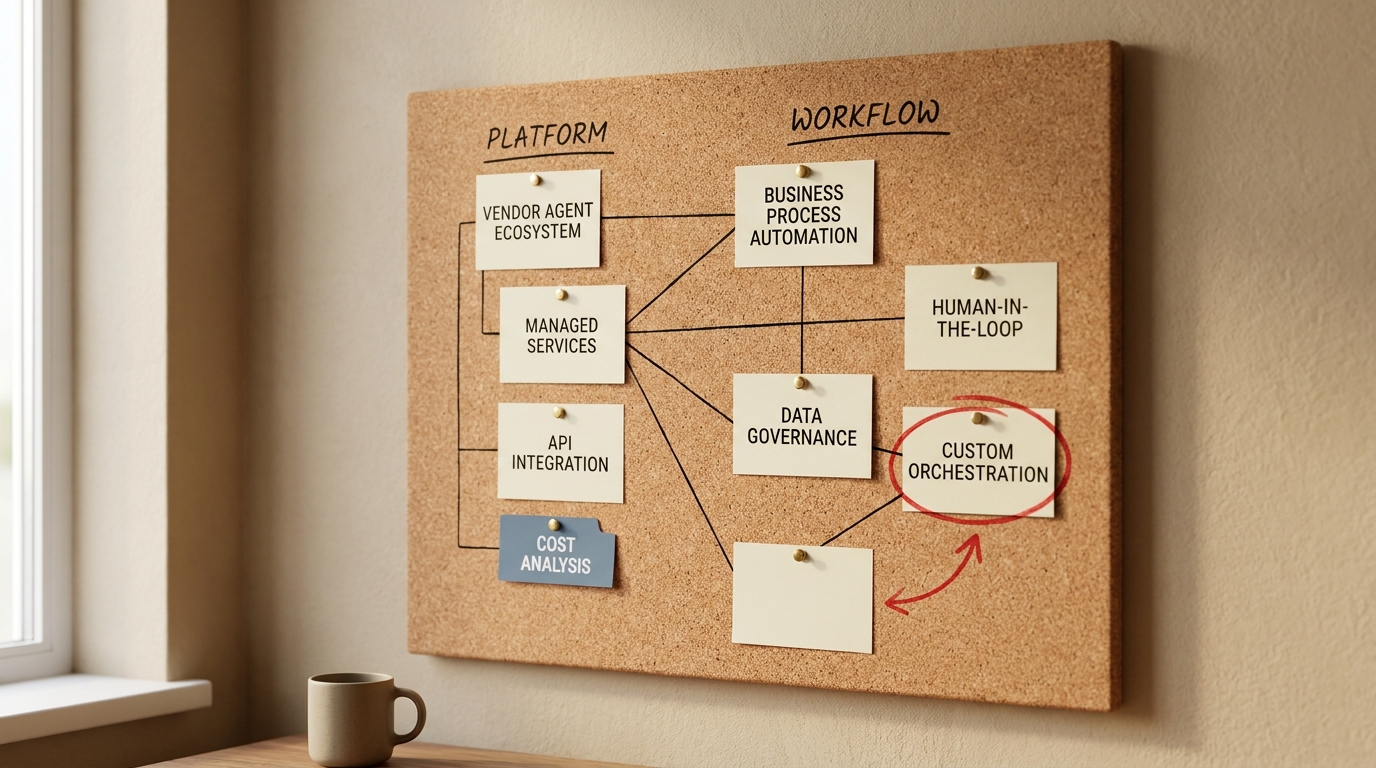
In the last eighteen months, seven of the biggest names in enterprise software have all shipped an agent platform: Meta, Salesforce, Microsoft, Google, Anthropic, UiPath, and ServiceNow. Each launch answers the same question with slightly different wrapping. Where should your agents run? None of them touches the question that actually decides whether agents earn their keep: which of your workflows should change, who owns the result, and how will you prove it worked?
That gap is the whole problem. Picking a platform feels like strategy because it is concrete. It has a demo. It comes with a purchase order. Redesigning work is slower, messier, and has no logo, so the market has quietly agreed to treat the platform decision as the strategic one. It is not. A platform is a place to run agents. A strategy decides which work is worth redesigning, and how you will govern it once a machine is doing part of the job.
This piece makes one argument and hands you one tool. The argument: platform-first thinking buys you a login, and workflow-first thinking buys you a result. The tool: a four-part test you can run against any workflow on Monday morning to decide whether it is ready for an agent at all. If you are a CEO, CIO, or CTO under pressure to show your AI spend is producing something, that test will matter far more than the logo you end up with.
The platform race everyone is watching
The race is real and it is loud. It helps to see who is running and what each one is actually selling, because the marketing blurs it on purpose.
Meta's Business Agent is the newest entrant and the cleanest example of the pattern. It is built around business operations, sales, support, and payments, with integrations into systems like Shopify and Zendesk. Read that list again. It is a list of surfaces and systems, not a list of your workflows. Meta has decided which channels an agent should touch. What it has not decided, and cannot decide, is which of your processes are broken enough, measurable enough, and owned enough to hand to an agent. That call is yours. No platform makes it for you.
The rest follow the same logic. Salesforce Agentforce puts agents inside the CRM, where your sales and service data already live. Microsoft's agents sit inside Microsoft 365 and the tools your knowledge workers open every day. Google's Gemini Enterprise is pitched as one platform for building and running agents across an organization's data. Anthropic sells the underlying model plus the developer tooling to build agents on top of it. UiPath brings agents to the automation and RPA workflows it already runs. ServiceNow embeds them in the IT and enterprise service management processes that flow through its platform.
| Platform | What it optimizes for | Primary surface or systems it plugs into | Best understood as |
|---|---|---|---|
| Meta Business Agent | Business operations, sales, support, payments | Messaging channels, Shopify, Zendesk | An agent for customer-facing commerce and support |
| Salesforce Agentforce | Sales and service actions on CRM data | Salesforce CRM, Service Cloud | An agent layer inside your system of record for customers |
| Microsoft | Knowledge work and productivity | Microsoft 365, Copilot surfaces | An agent layer inside daily office tools |
| Google Gemini Enterprise | Building and running agents across company data | Google Cloud, Workspace, enterprise data | A build-and-run platform for custom agents |
| Anthropic | Model quality and developer tooling | APIs and SDKs you build on | The engine and toolkit, not the finished agent |
| UiPath | Automating existing process flows | RPA and automation pipelines | Agents bolted onto established automation |
| ServiceNow | IT and enterprise service management | ServiceNow platform and workflows | An agent layer inside service processes |
Read this as a map of who is racing and what each vendor optimizes for. It is not a ranking, on purpose, because ranking these misses the point. Look at what every row shares: each platform is organized around a system or a feature set, never around a specific outcome in your business. That is not a knock on the vendors. It is just what a platform is. So the turn to make, before you get pulled into a bake-off, is this. Choosing where agents run is not the same as deciding what work should change. The rest of this piece is about that second decision, because it is the one that produces results.
Platform-first thinking, and why it stalls
Platform-first thinking has a familiar shape. You pick a vendor, sign the contract, stand up a center of excellence, then go hunting for use cases to justify the license. The platform shows up first. The problem it is supposed to solve shows up second, if it shows up at all.

You have probably watched this happen. A capable platform gets bought. A few keen teams build pilots. The pilots demo beautifully. Then most of them stall in the gap between "impressive in a meeting" and "trusted in production," and the handful that ship were never measured against a baseline, so nobody can prove they saved a thing. A year in, you have a platform, a pile of half-finished pilots , and a board asking what the return was.
Three failure patterns turn up almost every time, and not one of them is the platform's fault. First, pilots that never reach production, because nobody defined what "production-ready" even means for an agent that acts on real systems. Second, governance bolted on late. The platform gets deployed, agents start doing things, and only then does someone ask who signs off on an autonomous action and how you undo it. TechRadar has argued that most enterprise AI governance is already out of date, and the cause is exactly this ordering: governance treated as a cleanup step instead of a design input (TechRadar, 2026). Third, no baseline. If you never measured the workflow's current cost, time, or error rate, you cannot prove the agent improved anything, which means you cannot defend the spend or decide whether to scale it.
None of these is a platform failure. Every one is a sequencing failure. Platform-first thinking puts the tool before the target. It sweats the question "which vendor?" when the question that actually determines success is "which workflow, and is it even ready?" You can buy the best platform on the market and still produce nothing, because the platform was never the constraint.
Workflow-first thinking, and why it ships
Workflow-first thinking flips the order. You start from a single workflow. Not a department, not a use-case category. One specific flow of work with a name, a person accountable for its outcome, and a number you want to beat. Only once you have chosen the workflow and can say what "better" means do you ask which platform fits, and by then that question is usually easy, because the answer is "the one where this workflow's data already lives."
The contrast with platform-first is sharp enough to lay out plainly:
| Dimension | Platform-first | Workflow-first |
|---|---|---|
| Starting point | A vendor and a license | One named workflow |
| Owner | A committee or a center of excellence | A single accountable person |
| Success metric | Adoption, seats, activity | A baseline number you set out to beat |
| Governance timing | Bolted on after deployment | Designed in before the agent acts |
| Path to production | Assumed, discovered late | Defined up front as a gating criterion |
Workflow-first thinking ships because it makes success measurable and ownership clear before a single agent runs. When one person owns the outcome and there is a baseline to beat , the pilot has a finish line. When governance is part of the design instead of an afterthought, the workflow can actually go live rather than stall in review. And once you have proven one workflow end to end, you have something a platform-first program almost never has, which is evidence. You can point at a real number and say "we did this here, and here is what changed." That is the only credible basis for deciding what comes next.
This is also why the platform matters less than the noise suggests. The hard part of an agent program was never the runtime. It was choosing the right work, setting a baseline, defining what the agent is allowed to do, and building a path to production. Do that well and most platforms can execute it. Skip it and no platform can save you.
The four-part test: is this workflow ready for an agent?
Here is the tool. Before you commit an agent to any workflow , run it through four questions. Each one is a plain yes or no. If you cannot answer yes to all four, the workflow is not ready, and the honest move is to fix what is missing before you build anything.
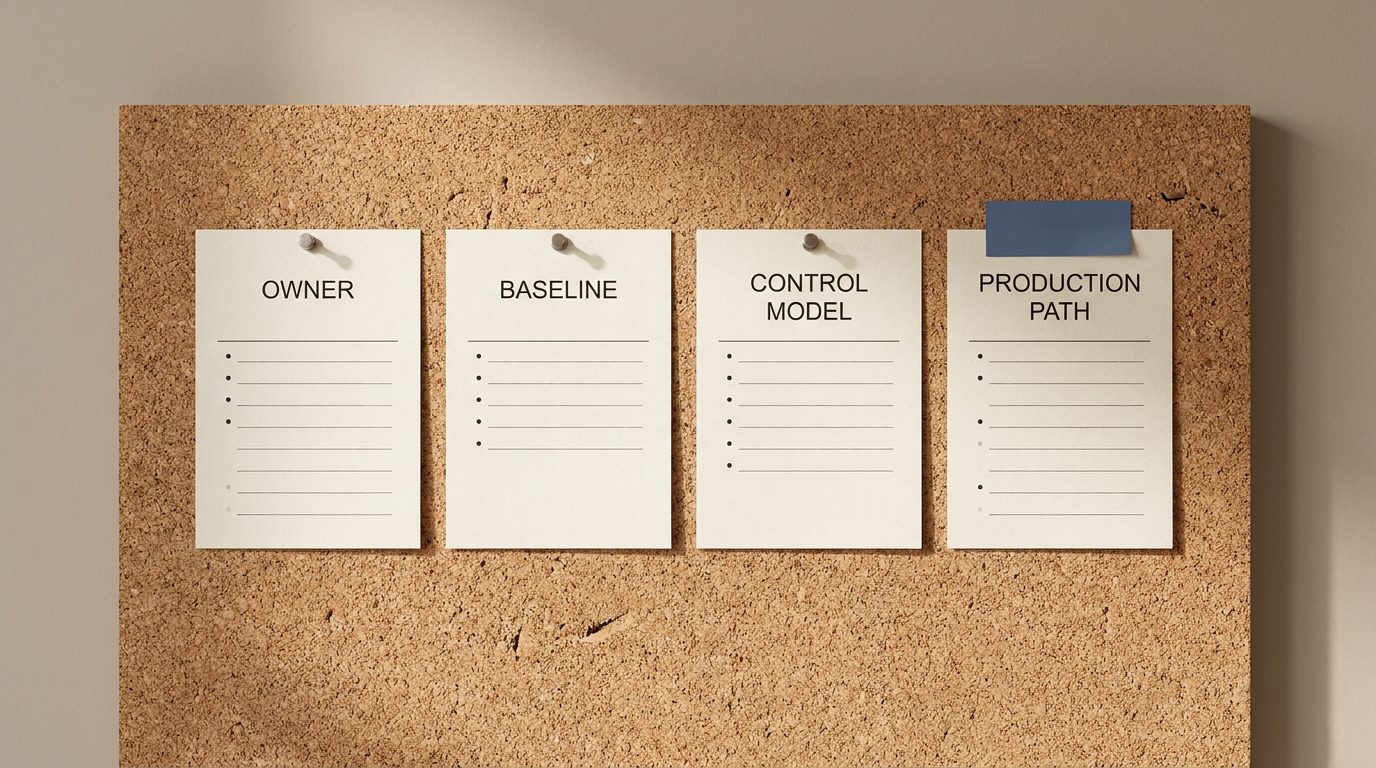
- Measurable owner. Is there a single person accountable for this workflow's outcome, not a committee? An owner has a name, a stake in the result, and the authority to change the process. If the answer is "the AI committee" or "shared across teams," you do not have an owner. You have a diffusion of responsibility that will stall the first hard decision.
- Baseline. Can you state the workflow's current cost, cycle time, or error rate today, as a number? The baseline is what makes improvement provable. Without it you can deploy an agent, feel faster, and have no way to demonstrate it, which leaves you with no defensible ROI and no basis for scaling. If you cannot measure the workflow today, measure it before you automate it.
- Control model. Have you decided what the agent may do on its own, where a human has to approve, how you roll an action back, and how you monitor it? A control model is the answer to "what happens when the agent is wrong," and every agent is wrong sometimes. This is governance as a design input, the thing that BCG argues you have to establish early, before agents are embedded across the enterprise, rather than retrofit after (BCG, 2026).
- Production path. Do you have a defined route from pilot to live, with an evaluation method, staging, human-in-the-loop checkpoints, monitoring, and the specific criteria that promote the workflow from experiment to production? If "how does this go live" is a question you plan to answer later, you have a demo, not a workflow ready for an agent.
The power of the test is that it is boring on purpose. It does not ask whether the technology is exciting. It asks whether the work is owned, measured, controlled, and shippable. A workflow that passes all four is one an agent can genuinely improve, and one you can defend to a board. A workflow that fails any of the four is a place where an agent will produce a great demo and a stalled program. Run every candidate through these four questions and you will kill the wrong projects early and fund the right ones with conviction.
If you want to pressure-test one of your own workflows against this test with people who have done it before, a Discovery Sprint scopes exactly one workflow against all four criteria in a week. It names the owner, sets the baseline, drafts the control model, and defines the production path, so you leave with a decision instead of a vendor demo. That is the point in an agent program where outside help pays for itself, because getting the four criteria right up front is what separates a workflow that ships from one that stalls.
What "production path" really means for an agent
Of the four criteria, production path is the one most often waved away, so it earns its own section. Here is why. A demo and a production workflow look almost identical for the first ten minutes and could not be more different after that.
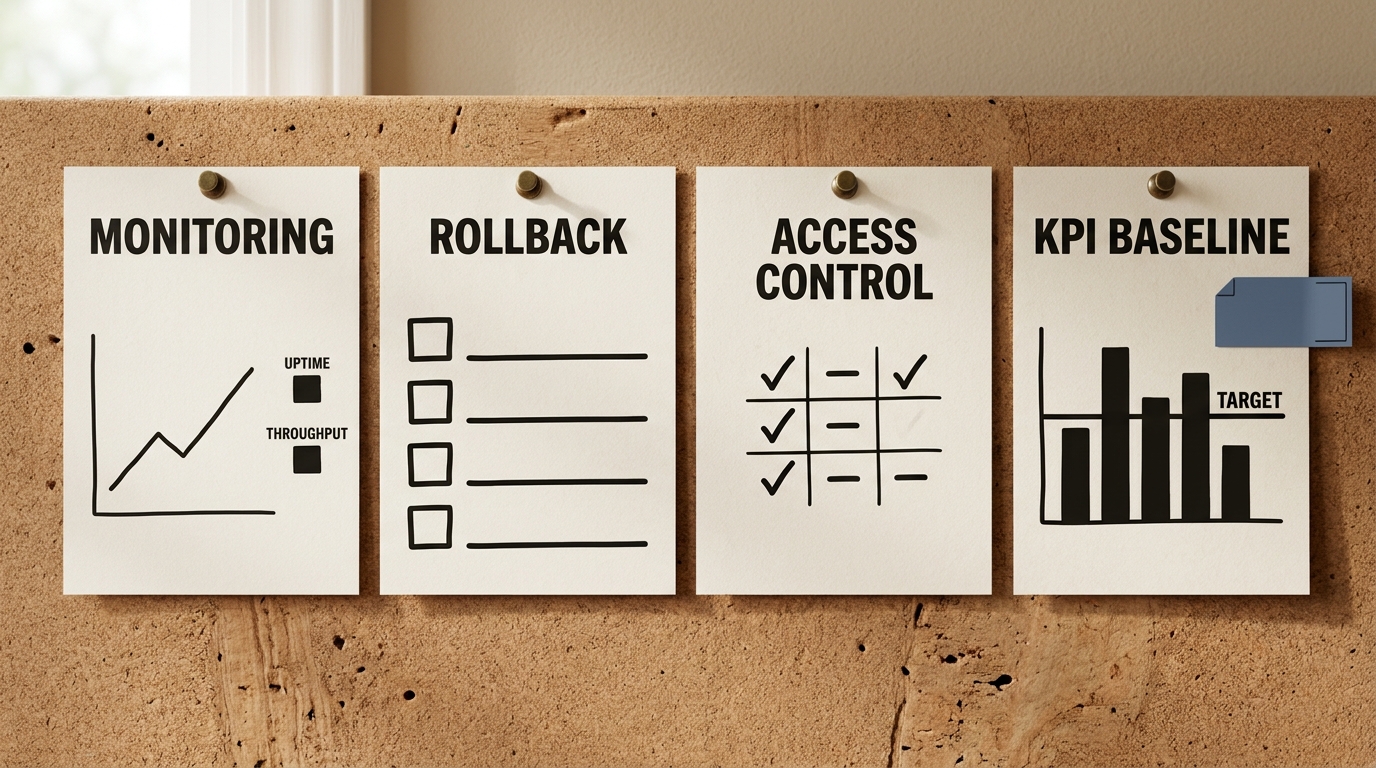
A demo shows the agent doing the right thing on a clean example while a human watches. A production workflow has the agent doing the right thing on messy real inputs, thousands of times, while nobody watches, on systems that hold real money and real customer relationships. Getting from the first to the second is not a deployment step. It is a discipline.
A real production path has at least five parts. It needs an evaluation harness, a way to test the agent against a representative set of cases and score whether it is good enough, run before launch and continuously after. It needs rollback, a defined way to undo an action the agent took, because "the agent did something wrong and we cannot reverse it" is the fastest way to lose executive trust for good. It needs observability, the logging and monitoring that let you see what the agent is actually doing in production, not just what it did in the demo. It needs a clear answer to who gets paged when the agent misbehaves, because an autonomous system with no on-call owner is a liability waiting to surface. And it needs promotion criteria, the specific agreed thresholds that move a workflow from pilot to live, so "it feels ready" is never the deciding factor.
None of this is exotic. It is the same operational rigor you already apply to any system that touches production. The mistake is assuming an agent needs less of it because the demo was so convincing. It needs more, because the agent acts on its own.
What this means for you, by role
Workflow-first thinking hands each executive in the room a different, concrete job. The failure mode is treating this as one undifferentiated "AI initiative." The fix is to split the work by what each role actually controls.
- If you are the CEO, your job is to fund workflows, not platforms. Refuse to approve "an AI platform" as a line item. Approve one workflow with a named owner and a baseline number, and demand that number back. Your leverage is the purse and the mandate. When you insist that every agent investment name its owner and its metric, you turn a vague AI budget into a portfolio of accountable bets. Ask one question in every review: which workflow, whose result, and what number moved?
- If you are the CIO, your job is to make the control model and the integration reality the gating criteria. You know where the systems of record are and how hard they are to touch. A workflow-first program lives or dies on whether the agent can safely act inside those systems, so the control model, who approves what, how you roll back, how you monitor, is yours to enforce before anything ships. Do not let a workflow proceed until its control model is real.
- If you are the CTO, your job is to own the production path. Evaluation, monitoring, rollback, and the promotion criteria that move a workflow from pilot to live are engineering disciplines, and they are the difference between a program that scales and one that stalls. Build that path once, make it the standard route every agent workflow follows, and you turn "can we ship this?" from a per-project argument into a repeatable process.
When each role owns its piece, the program stops being a platform purchase and becomes a disciplined way of redesigning work, one accountable workflow at a time.
So which platform should you pick?
You have read this far waiting for the platform answer, so here it is, honestly: pick it later, and it matters less than you think. Once you have a workflow with a measurable owner, a baseline, a control model, and a production path, the platform question mostly answers itself. The right platform is the one where your target workflow's systems of record already live. If the workflow runs on customer data in your CRM, the agent belongs where that CRM is. If it runs on service processes, it belongs where those processes already flow. If it runs on documents and productivity tools, it belongs where your people already work.
That is why the race, for all its noise, should not set your agenda. The platforms are converging on similar capabilities, model quality is increasingly commoditized, and the real differentiator was never the runtime. It was the discipline of choosing the right work and governing it well. Choose the workflow first, prove it, and the platform decision becomes a matter of fit rather than faith. Choose the platform first, and you are betting the right work will reveal itself after you have already spent the money. It rarely does.
Key takeaways
- The platform race is real, but a platform is a place to run agents, not a strategy. Choosing a vendor is not the same as redesigning work.
- Platform-first thinking stalls because it puts the tool before the target: pilots that never reach production, governance bolted on late, and no baseline to prove ROI.
- Workflow-first thinking ships because it starts from one named workflow with an accountable owner and a number to beat, then governs before the agent acts.
- Use the four-part test on any workflow before you build: measurable owner, baseline, control model, production path. If you cannot answer yes to all four, it is not ready.
- Pick the platform last. The right one is where your target workflow's systems of record already live, and by then the choice is easy.