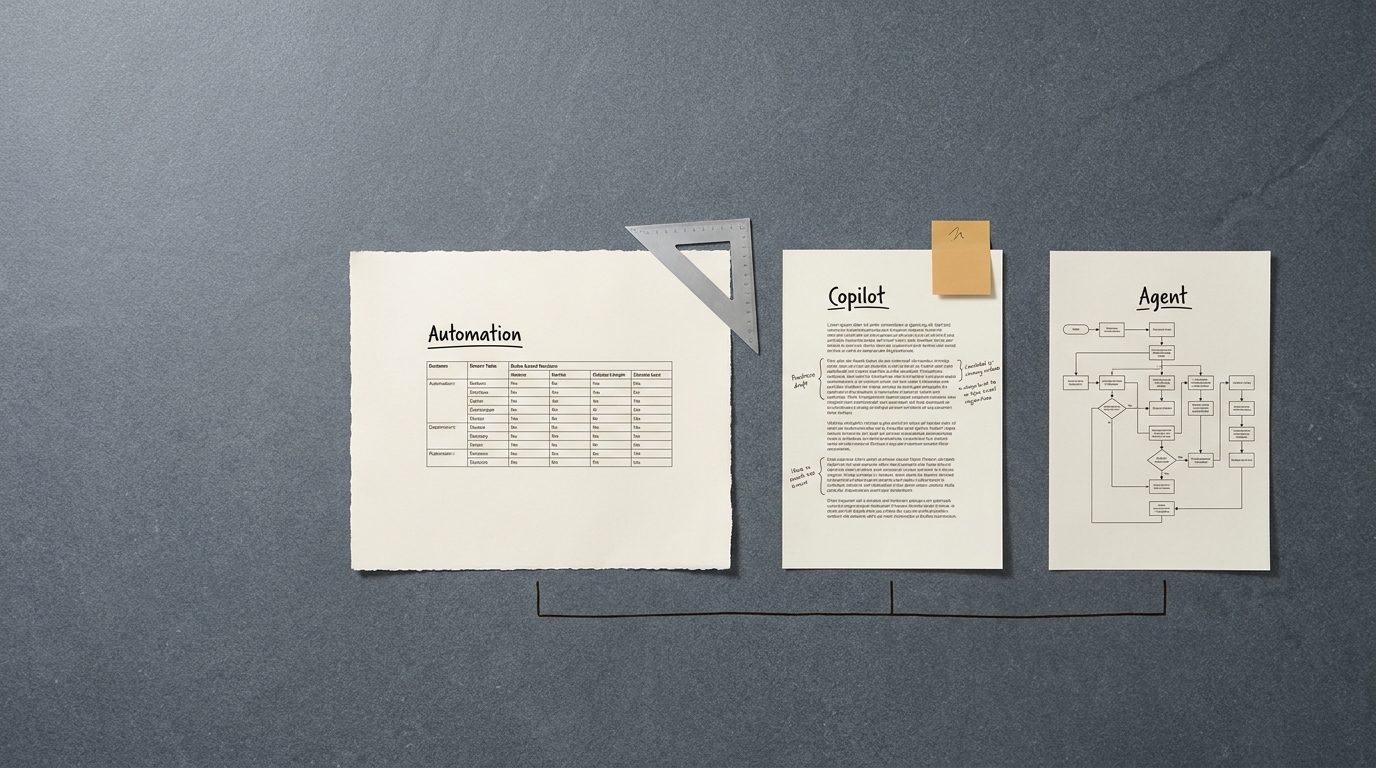
Three words show up in almost every AI vendor deck: automation, copilot, and agent. Most leadership teams treat them as three brand names for one purchase. They are not. They are three different architectures, with three different cost structures, three different risk profiles, and three different ways of paying you back. Fund the wrong one and you spend agent money on a copilot problem, or you bolt a copilot onto a task that plain automation already handled for a fraction of the price.
What makes the confusion expensive is that all three words have collapsed into one: "AI." A board approves "an AI initiative." A vendor sells "an AI platform." Nobody in the room has actually agreed on whether the thing being bought executes rules, assists a person, or acts on its own. The fix is not more enthusiasm. It is a sharper vocabulary. Separate the three patterns cleanly and the buying decision gets much easier. So does the harder question of what could go wrong.
The one word hiding three different bets
Here is the distinction, one line each. Automation executes predefined rules with no judgment: same input, same output, every time. A copilot assists a human who stays in the loop: it suggests, drafts, and retrieves, and a person decides. An agent owns a bounded workflow: it plans, takes multiple steps across systems, and works toward a goal within guardrails, without a human signing off on each move.
The differences that matter to a budget owner are not technical. They come down to who is accountable for the output, what the pattern costs to run and govern, and where the value actually shows up. The table below is the whole argument, compressed.
| Dimension | Automation | Copilot | Agent |
|---|---|---|---|
| What it does | Executes fixed rules | Suggests, a human decides | Plans and acts toward a goal |
| Human involvement | None at runtime | In the loop, every time | On the boundary, by exception |
| Best-fit work | Stable, high-volume, rule-based | Judgment-heavy, ambiguous | Bounded, multi-step, cross-system |
| Typical ROI shape | Low cost, capped upside, fast payback | Low cost, diffuse upside, hard to measure | Higher cost, largest upside, slow to prove |
| Primary risk | Brittle rules break silently | Over-trust of a wrong suggestion | Autonomous action at scale |
| Governance need | Change control and monitoring | Usage norms and review habits | Oversight, logging, and kill switches |
| When it is the wrong choice | The process keeps changing | The task has one deterministic answer | Nobody can afford a wrong autonomous move |
Keep this table in front of you for the rest of the decision. Everything that follows just expands one of its rows.
Automation: rules, executed the same way every time
Automation is the oldest and least glamorous of the three. For a large share of business processes, it is also still the right answer. It is deterministic: it follows explicit rules, so the same input always produces the same output. Think of robotic process automation shuttling invoices between two systems, a workflow that routes an approval when a field changes, a nightly reconciliation job. That is automation, and its whole virtue is that it is boring.
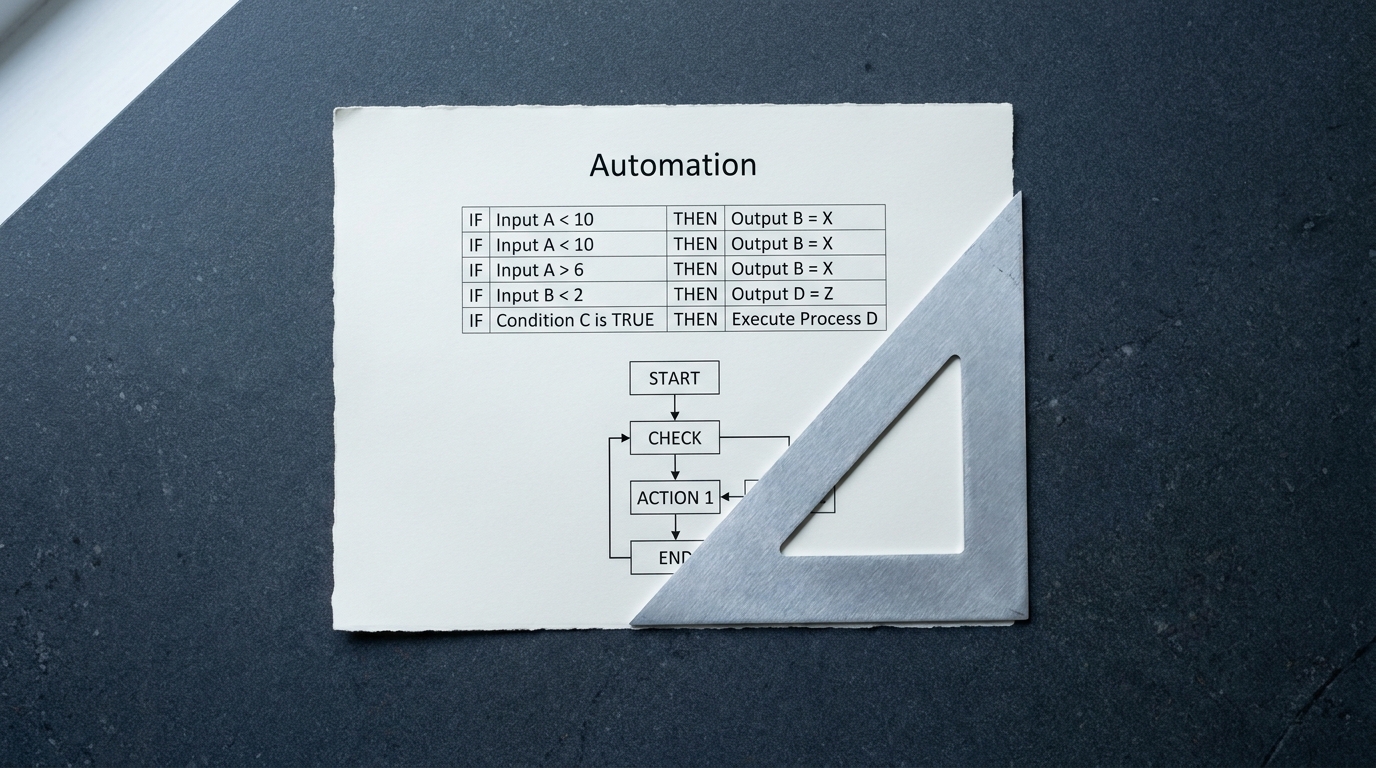
Boring is the feature. When a process is stable, high-volume, and rule-based, determinism beats intelligence. You want the payroll run to do exactly the same thing every cycle, and you want to audit precisely why it did it. Bolt a probabilistic model onto a task that has one correct answer and you do not make it smarter. You make it less predictable and harder to certify.
Zapier frames the contrast as agentic AI versus RPA: RPA follows the script you wrote, while an agent decides its own steps (Zapier, 2026). The moment your "rules" start requiring judgment you cannot fully write down, you have outgrown automation. Until then, automation gives you the fastest payback of the three, because it carries almost no integration or governance overhead beyond keeping the rules current.
If your process is genuinely stable and you can express it as rules, automation is not a consolation prize. It is the highest-ROI choice on the board.
Copilots: a second brain for judgment-heavy work
A copilot assists a human who stays in control. It drafts the email, summarizes the contract, suggests the code, retrieves the answer. Then a person accepts, edits, or throws it out. The defining trait is the human in the loop on every single instance. The copilot never acts alone.
That makes copilots the right tool for judgment-heavy, ambiguous work, the kind where a person still carries the accountability but wants to move faster. Microsoft frames the executive question plainly: decide when a copilot or an agent is the right tool for the work in front of you (Microsoft, 2026). A copilot fits when the task needs human judgment per instance and a bad output gets caught by the person before it ships.
The catch is measurement. Copilots reportedly deliver a modest organizational productivity lift, and Neomanex cites a range on the order of 5 to 10 percent (Neomanex, 2026). That value is diffuse, though. It shows up as slightly faster drafting across thousands of small tasks, which is real and also notoriously hard to pin to a spreadsheet. A copilot is also the wrong tool twice over: overkill for a deterministic rule, where automation is cheaper, and underpowered for a bounded workflow you want run end to end without a human babysitting each step. That last one is an agent's job.
If your people are the bottleneck on ambiguous, high-judgment work, a copilot is a low-cost, low-risk bet. Just do not expect a clean ROI number, and do not ask it to own a process.
Before you fund anything, it helps to know which of your processes fit which pattern. A short diagnostic like an AI Readiness Snapshot can map that before the budget conversation even starts.
Agents: bounded workflows that run themselves
An agent owns a bounded workflow. It plans a sequence of steps, acts across multiple systems, and works toward a goal inside guardrails, escalating to a human only by exception . This is the pattern that changed the conversation, because it is the first one that pulls the human out of the runtime loop instead of assisting them inside it.

Autonomy is a spectrum, not a switch. The useful mental model runs from prompt-and-response, to assisted, to fully autonomous action. Most enterprise-ready agents today sit in the middle: they act, but inside tight boundaries and with oversight. Neomanex's thesis is to deploy agents for well-defined, cross-system workflows. Not open-ended "do anything" mandates, but specific processes with a clear start, a clear end, and a definition of done.
The upside is the largest of the three. Neomanex reports efficiency gains in the 20 to 50 percent range on the workflows agents actually own (Neomanex, 2026), and Workday's global research (2025) finds that 82 percent of organizations are expanding their use of AI agents (Workday, 2025). Both numbers deserve a hedge. They are reported figures, and the efficiency claims describe the bounded workflow, not the whole business. The direction, though, is clear.
An agent is the right tool when the work is a bounded, multi-step process that crosses systems, when a human does not need to judge every instance, and when you can define success well enough to let something act toward it. It is the wrong tool when nobody can afford a wrong autonomous action, or when the "workflow" is really just one judgment call that a copilot would handle at a fraction of the cost and risk.
Three patterns, three very different ROI curves
The vocabulary matters because each pattern pays back on a different curve, and a funding model built for one will misjudge the others.
- Automation is low cost, capped upside, fast payback. You know roughly what it will save before you build it, and it pays back quickly. The ceiling is low because it only ever does the rule you gave it.
- Copilot is low cost, diffuse upside, hard to measure. The license is cheap, adoption is the real cost, and the return is a broad productivity lift that resists clean attribution.
- Agent is higher cost, largest upside, slowest to prove. It carries integration, orchestration, and governance costs on top of the model, and the payback only arrives once the workflow is trusted enough to run on a loose leash.
This is why one blanket "AI ROI" target across all three is a trap. Hold an agent to automation's fast-payback standard and you will kill it before it proves out. Hold automation to an agent's transformational upside and you will over-engineer a solved problem.
The cautionary number is worth saying plainly. In one PwC survey of roughly 4,454 companies cited by Neomanex, a reported 56 percent of CEOs said they had seen no measurable AI ROI (PwC, 2026). The usual reason is not that the technology failed. It is that the wrong pattern got funded for the work, and then measured with the wrong yardstick.
Risk and governance scale with autonomy
The governance burden is not flat across the three. It rises in direct proportion to how much the system is allowed to do on its own.
Automation's risk is brittleness. A rule silently breaks when an upstream system renames a field, and the failure stays quiet until someone notices the numbers are off. The governance answer here is mature and well understood: change control, monitoring, alerting.
A copilot's risk lives in the human's hands, and it is over-trust. The model produces a confident, wrong suggestion, and a rushed person ships it. Governance here is cultural more than technical: review habits, norms about what gets double-checked, and honest training on where the tool is unreliable.
An agent's risk is the action itself. Because it acts across systems without per-step approval, a mistake can propagate before anyone sees it. UiPath frames the discipline as "controlled agency," which means scaling agents by constraining what they are permitted to do, logging every action, and keeping a human on the boundary with the ability to step in (UiPath, 2026). That is orchestration and oversight, and it is a genuine operating cost, not a checkbox.
That cost is exactly why the "who runs the agents" question is real. Standing up agent oversight usually means new capability you may not want to hire permanently, which is where a fractional agentic team can carry the governance load without adding headcount. The rule of thumb holds: the more autonomy you grant, the more oversight you have to fund alongside it. Autonomy without governance is not a strategy. It is an incident waiting to be logged.
When each one is the wrong choice
Most buying mistakes are not about picking a bad tool. They are about picking a good tool for the wrong job. The cleanest way to dodge that is to know each pattern's failure case.
- Automation is the wrong choice when the process keeps changing. If the rules need rewriting every quarter, you will spend more maintaining the automation than it ever saves. That volatility is a signal you need judgment, so reach for a copilot or an agent.
- A copilot is the wrong choice when the task has one deterministic answer. Wrapping a probabilistic assistant around a rule you could just write down adds cost and unpredictability for no gain. Automate it.
- A copilot is also the wrong choice when you want a workflow run end to end. If the value only lands once the whole multi-step process finishes without a human in each step, a copilot's per-instance human dependency becomes the bottleneck. That is an agent's job.
- An agent is the wrong choice when a wrong autonomous action is unaffordable. If a single bad move carries legal, financial, or safety consequences you cannot reverse, keep a human in the loop with a copilot until the guardrails are proven.
- An agent is the wrong choice when the "workflow" is one judgment call. Autonomy is overhead. If the task is a single decision, you are paying agent governance costs to solve a copilot problem.
A five-question test to decide which to fund
You can run this in a meeting. Answer five questions about the specific process on the table, and the pattern usually names itself.
- Is the process rule-stable? If the rules are fixed and rarely change, lean automation.
- Does it need human judgment on every instance? If yes, and a person has to own each output, lean copilot.
- Is it a bounded, multi-step workflow across systems? If yes, with a clear start and a definition of done, lean agent.
- What is the cost of a wrong autonomous action? If a single unreviewed mistake is unaffordable, do not grant autonomy yet. Keep a human in the loop.
- Can you measure the outcome? If you cannot define success, you cannot govern an agent against it, and you probably cannot prove its ROI either. Fix the metric first.
The pattern is the honest reading of those answers, not the most exciting one. A rule-stable, measurable, deterministic process is an automation win even if "agent" sounds better in the board deck. A bounded, measurable, cross-system workflow with a tolerable error cost is where an agent earns its keep.
How to decide for your own processes
The strategic error is almost never buying AI. It is buying the wrong pattern for the work, then measuring it with the wrong yardstick. Automation, copilot, and agent are not a maturity ladder you climb in order. They are three tools, and a serious AI portfolio uses all three, each pointed at the work it actually fits.
The fastest way to decide which pattern to fund for your own processes is to map them against these five questions with someone who has done it before. That is what a Discovery Sprint is built for: a focused, one-week engagement that produces a concrete AI transformation roadmap, process by process, so the next budget you approve funds the right pattern for the right work.
Book a Discovery Sprint and turn three overloaded words into a decision you can defend in front of the board.