
Three-quarters of enterprises will tell you they have adopted agentic AI. Now ask a harder question. How many run a single agent that touches a customer, moves money, or changes a record in a system of record without a person clicking approve first? The number falls off a cliff. That space, between the adoption everyone reports and the production almost nobody has, is what this page is about.
Agentic AI consulting, done honestly, is the work of closing that space. Not another workshop. Not a maturity model. Not an eight-week deck that ends by recommending more discovery. What you should walk away with is a governed, evaluated agent doing real work, plus the discipline to keep running it after the consultants have gone home. AdvantageWorks treats agentic AI as an operating capability you install and hold. We de-risk the first step so you are not betting a big-bang contract on a technology your organization has not proven yet.
What agentic AI consulting is, and where chatbots stop
An agentic system perceives context, reasons across a multi-step problem, plans a sequence of actions, and then acts on the world with limited human oversight. It calls tools. It reads and writes to your systems. It adapts its plan when something shifts mid-task. That puts it in a different category from the chatbot most teams already deployed, which answers a question and then stops, and from the fixed automation of an RPA script, which walks the same path every time and breaks the moment the screen layout changes.
The practical difference is agency. A chatbot tells a customer how to reschedule an appointment. An agent reschedules it, checks the balance owed, and flags the exception when the payment fails. And here is the catch: the very thing that makes an agent useful is the thing that makes it hard to run in production. An agent that acts can act wrongly, at speed, across systems that matter.
The definition, honestly, is the easy part. What comes next decides whether an agent survives contact with real operations, and that is the rest of this page.
The pilot-to-production gap, and why this page exists
The gap is not a mystery, and it is not a model problem. Forrester's 2026 analysis of the state of agentic AI describes an adoption story where enthusiasm and investment are widespread while production-grade deployments remain rare, a pattern of companies chasing the capability faster than they are catching it. McKinsey's work on the foundations for agentic AI at scale arrives at the same root cause from the other side: agents scale on strong data, and most organizations have not done the data work that lets an agent act reliably.
When a pilot stalls, the failure almost always sits in one of a few predictable places:
- Data quality and access. The agent needs clean, permissioned, retrievable data to reason over. Pilots demo on a curated slice, then hit the real data and degrade.
- Missing evaluation. There is no repeatable way to prove the agent is right before it acts, so nobody trusts it enough to hand it real authority.
- No governance or approval gates. The pilot ran in a sandbox where mistakes were free. Production has consequences, and the controls that make those consequences survivable were never built.
- Unbudgeted running cost. Agentic workloads burn tokens and compute per step, and a multi-step agent run at volume costs far more to operate than the build quote implied.
- No failure recovery. When the agent gets it wrong, nothing catches it, corrects it, or learns from it.
None of these are glamorous. All of them are the line between a demo and a system. Most agentic pilots never reach production for a plain reason: someone has to own the boring, production-grade parts , and on a proof-of-concept nobody did.
Naming that gap out loud is where our engagement starts. You cannot close a gap the whole team is quietly pretending is not there.
Get an AI Readiness Snapshot is the low-risk way to see where your own gap sits. It is a free, 30-minute session that maps your highest-impact, lowest-risk first workflow, and it commits you to nothing.
What agentic AI consulting actually delivers
Read any consulting offer by separating the commodity work from the work that actually decides the outcome. Model configuration, prompt plumbing, wiring an API: all commodity now. Necessary, yes. But not where projects fail, and not where the durable value lives. The value sits in the parts that are specific to your operations and expensive to get wrong.
Here is what a real agentic AI consulting engagement produces, grouped by deliverable rather than by adjective:
- Strategy and use-case selection. An assessment of candidate workflows, scored by return and risk, so the first agent you build is the one most likely to survive and pay for itself. Feasibility before ambition.
- Data readiness. The quality, access, and architecture work that lets an agent reason over your information reliably. It is the precondition, and it gets its own section below.
- Agent design and development. The architecture, the tool integrations, and the orchestration logic that turn a use case into a working system.
- Evaluation and closed-loop testing. A repeatable way to measure whether the agent is correct, before and while it acts. This is what earns the agent the authority to run.
- Governance, security, and human-in-the-loop. Approval gates, scoped tool permissions, and an audit trail. The controls that make autonomy safe enough to allow.
- Production handoff and managed operations. Monitoring, runbooks, cost controls, and the option of an embedded team to keep improving the agent after launch.
Here is the fastest test I know for a provider. If their deliverable list reads as a run of capabilities with no output attached to any of them, that is the interchangeable-service-list problem the whole market has. Ask what artifact you hold at the end of each phase. If the answer is a slide, keep asking.
How the engagement works
The engagement is built to prove value early and to dodge the big-bang contract that makes agentic AI feel riskier than it is. Every phase leaves you a concrete output you can point at.

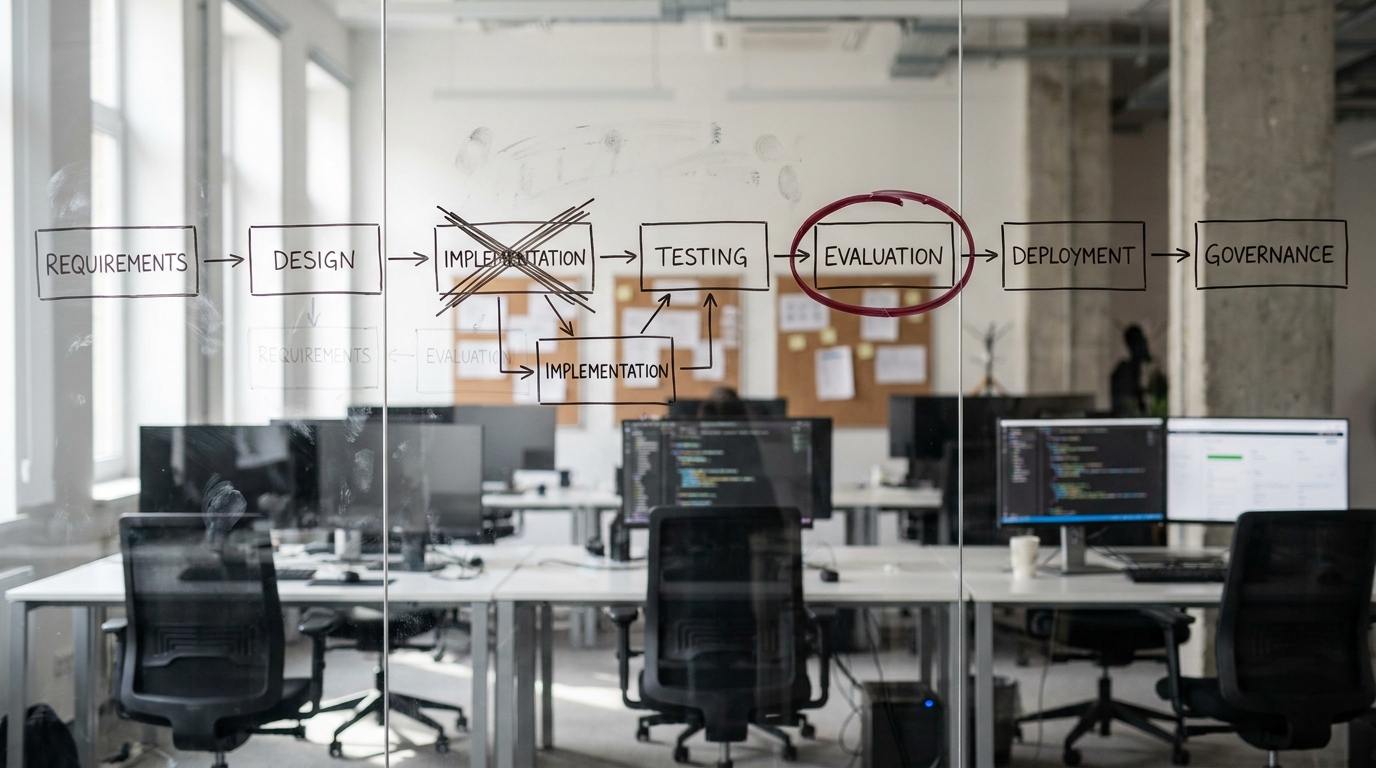
- Readiness Snapshot (free, 30 minutes). We map your workflows and identify the single highest-impact, lowest-risk agent to build first. Output: a clear first-workflow recommendation.
- Discovery sprint. A focused engagement that produces a transformation roadmap and a scoped specification for that first agent. Output: a roadmap and a build scope you can approve or walk away from.
- Build. We design and develop the agent, integrate the tools it needs, and wire the orchestration. Output: a working agent in a controlled environment.
- Evaluate. We run closed-loop tests, set guardrails, and put approval gates around the actions that carry risk. Output: evidence the agent is correct, plus the controls to keep it that way.
- Production handoff. We stand up monitoring, write the runbooks, and put cost controls in place so the agent's running economics stay visible and bounded. Output: an agent in production with an owner and a control surface.
- Operate. Ongoing optimization as the workflow and the data change. Output: an agent that keeps working, optionally run by an embedded Fractional Agentic Team rather than a permanent hire.
The shape matters as much as the steps. You start with a free snapshot, not a signed statement of work, and each phase hands you a real decision point before the next commitment. If you would rather move straight into a scoped engagement, the AI Transformation Discovery sprint is the entry point.
Governance, security, and keeping humans in the loop
Governance is the section enterprise buyers read most carefully, because it is the one that decides whether the agent gets anywhere near a real system. An agent that can act is a new kind of insider. Give it the same care you would give a new employee with broad access and no instinct for consequences.

Good governance for agentic AI has a few concrete parts:
- Scoped tool permissions. The agent can only touch the systems and take the actions you have explicitly granted, and nothing beyond that. Least privilege, applied to software that acts.
- Approval gates on consequential actions. Low-risk steps run on their own. Anything that moves money, contacts a customer, or changes a record of consequence pauses for a human to approve. The gate is deliberate rather than universal, so you keep speed on the safe steps and oversight on the dangerous ones.
- An audit trail. Every action the agent took, the reasoning behind it, and the human who approved it, all recorded and reviewable. That record is what makes the system defensible to a regulator, a security team, or a customer asking what happened.
- A compliance posture you can describe. Where the data goes, how it is protected, and how the agent's behavior maps to the standards your industry holds you to.
Good does not mean maximum autonomy. It means the right amount of autonomy on each action, with a clear record of everything the agent did. That framework is what we install, and we treat it as a first-class deliverable, not a checkbox bolted on at the end.
Data readiness, the precondition most pilots skip
Agents scale on strong data, and this is the step pilots skip, because it is unglamorous and the demo never needed it. An agent reasoning over messy, inaccessible, or ungoverned data will produce confident, wrong actions. It will do so faster than a human ever could.
Data readiness for agentic AI comes down to three questions. Is the data clean enough that an agent's reasoning over it holds up? Can the agent actually retrieve it, with the right permissions, at the moment it needs it? And is the underlying architecture built so that access is governed rather than a security hole waiting to be found? Most organizations have gaps in at least one of the three. The honest move is to find them before you build, not after the agent has already acted on bad information.
None of this is a reason to boil the ocean on a data platform before you do anything. It is a reason to scope the data work to the specific workflow the first agent will run, get that slice right, and grow from there. Readiness is per-workflow, not a two-year program you have to finish before the first agent ships.
Who this is for, and who should wait
Honest self-qualification earns more trust than a pitch claiming every workflow is agent-ready. Some are not. Starting on the wrong one is the fastest route to a stalled pilot.
Agentic AI consulting is a good fit when you have:
- A repetitive, high-value workflow that spans multiple systems and eats real human hours today.
- Leadership sponsorship and a named owner for the outcome, not just curiosity.
- Enough data hygiene to give an agent something reliable to reason over, or the will to do that work as part of the engagement.
It is not the right time when:
- Nobody owns the outcome, and the interest is exploratory rather than committed.
- The agent would need data it cannot reach or that no one trusts.
- The task is a single deterministic step that a plain script or rule would handle more cheaply and reliably than an agent ever would.
If you land in the second list, the responsible answer is to fix the precondition first. We will tell you so, rather than sell you an agent that is going to stall.
Agentic AI consulting versus traditional consulting
The difference is what you are holding when the engagement ends. Traditional management consulting sells analysis, interviews, and a roadmap, and the deliverable is a document recommending what to do next, often the next engagement. Agentic AI consulting, done right, sells a working system and the capability to run it.
That shifts the economics in a few ways worth naming:
- You finish with an operating asset that does work, not a slide deck describing work someone else still has to build.
- The value compounds. Your tenth agent costs far less than your first, because the connections, the evaluation harness, and the governance pattern are already sitting there.
- The relationship is about capability transfer, not dependency. The point is that you can run and extend the system, with us or without us.
It is a move from paying for advice to paying for a system plus the discipline to operate it. That is the frame AdvantageWorks works from.
Timeline, and what the first 90 days deliver
Precision here would be dishonest, because the timeline rides on the workflow, the data, and your governance requirements. Ranges are fair, though, so here is a realistic shape for a first agent.
Inside the first 30 days, you have a completed readiness assessment, a chosen first workflow, and a scoped build spec you signed off on. By 60 days, a working agent sits in a controlled environment with an evaluation harness around it and the first guardrails in place. By 90 days, the goal is that agent in production on its first real workflow, with monitoring, approval gates, cost controls, and runbooks, plus the operating pattern your team can reuse for the second agent.
The 90-day frame is not about speed for its own sake. It is that you should have real evidence, a governed agent doing real work, early enough to decide whether to expand before you have poured a year and a large budget into faith.
Why teams choose AdvantageWorks
Proof on a page like this ought to be honest, so here is proof by method rather than by invented logos.
We are model-neutral and workflow-first. We start from your workflow and its economics, not a preferred vendor stack we get paid to place, which means the recommendation you get is the one that actually fits your problem. We treat governance and evaluation as first-class deliverables, so the agent you ship is one you can defend and trust, not a demo with the risky parts left as an exercise. And we build the engagement to transfer capability, through an embedded Fractional Agentic Team when you want operating help without permanent hires, so you are left with an operating discipline rather than a dependency.
The differentiators are simple to state and hard to fake. A free first step instead of a high-friction sales consultation. An honest account of when not to start. Sourced claims rather than loose market-size numbers. And a promise measured in agents running in production, not workshops delivered.
Most of the market sells a project. We sell the operating discipline that keeps agents working after the project ends, and we would rather show you where your gap is for free than talk you into a contract you are not ready for.
Get an AI Readiness Snapshot - a free, 30-minute session that maps your highest-impact, lowest-risk first agentic workflow and gives you a clear first step, whether or not you work with us next.