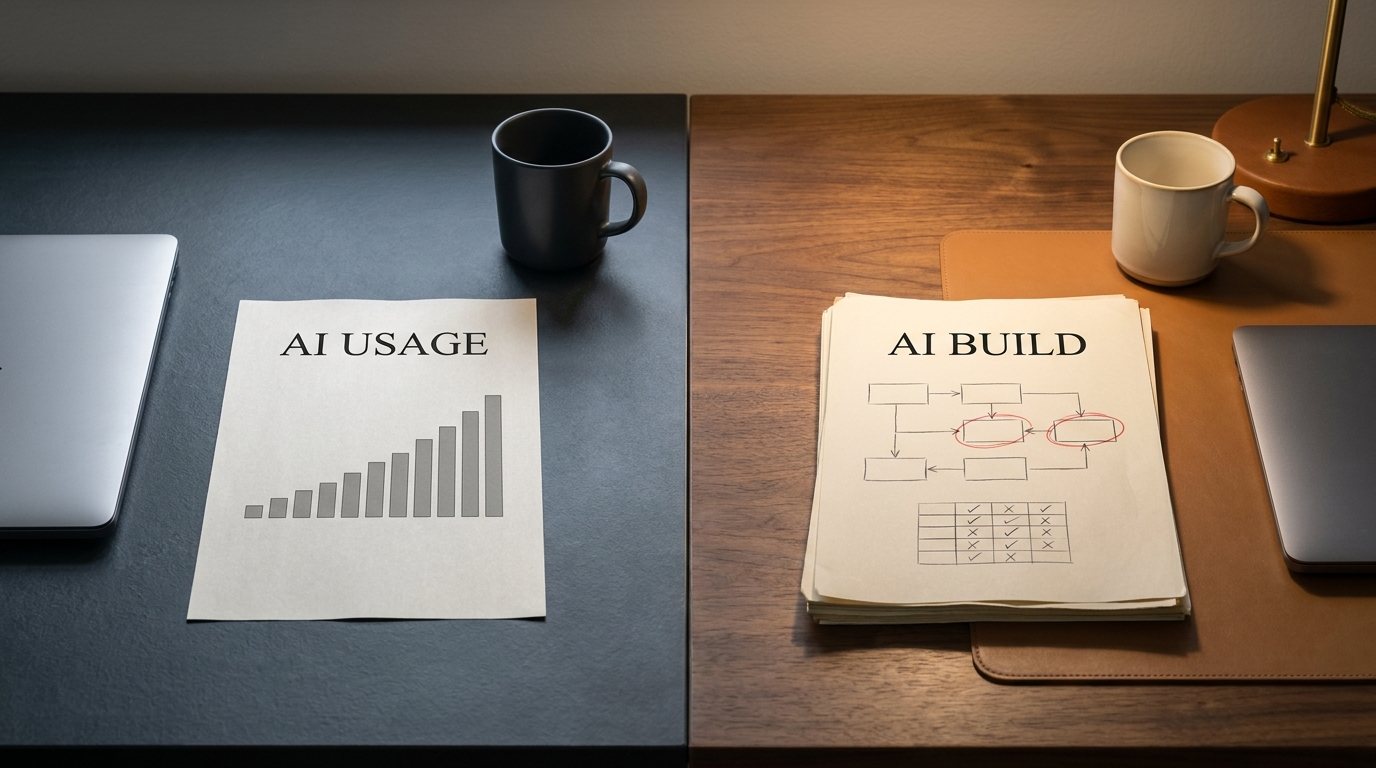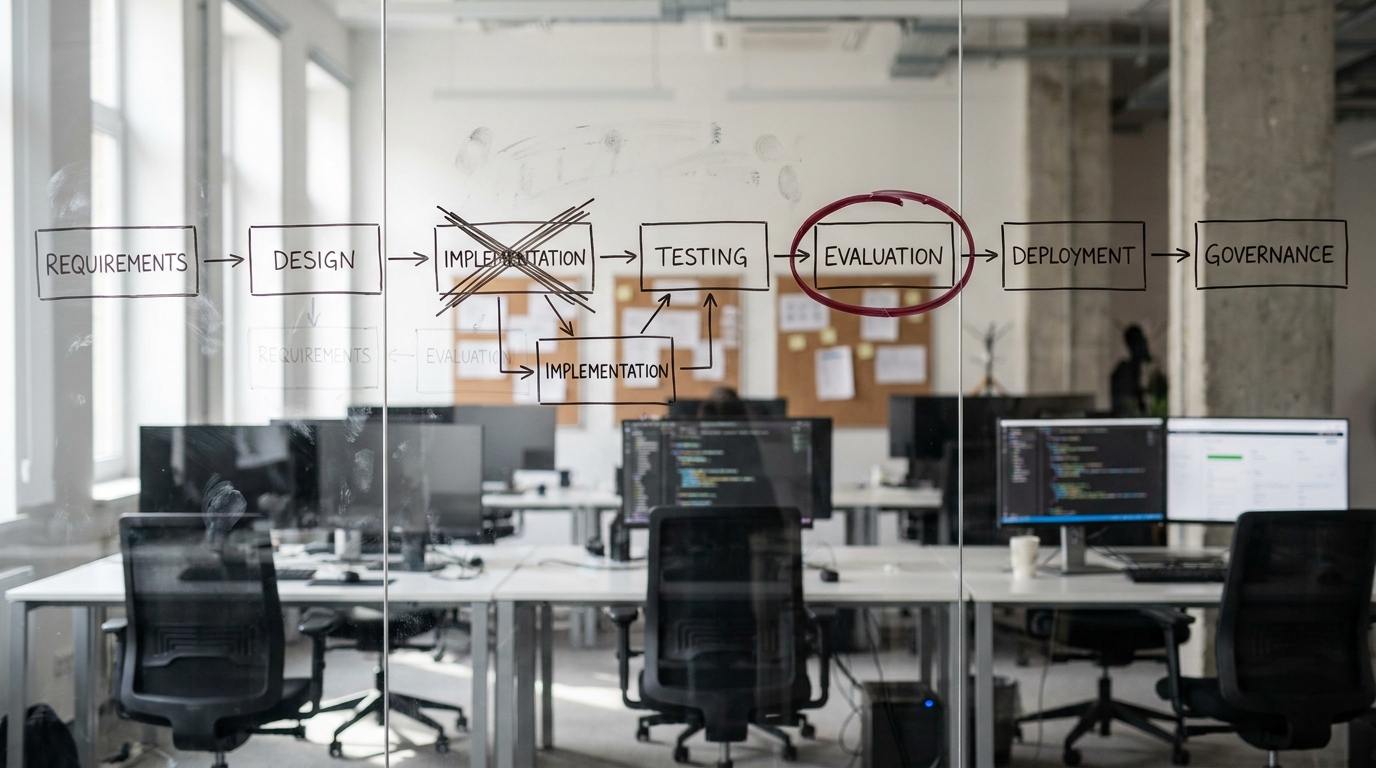

A stalled AI program never appears on the income statement. There is no line called "waiting," no invoice for the quarter you spent watching, no variance for a board to question. That absence is the whole trap: the delay keeps getting approved because it looks free. For a CFO, a CEO, or a COO who has decided to hold and see how the technology settles, the choice feels like the fiscally responsible one. No capital request, no failed rollout to explain, no headcount to defend.
The hold is not free. It is a line of spend with no owner, and it compounds every quarter it runs. The cost has just been booked under other names: seats bought and never used, the same pilot rebuilt in three departments, cycle times that never improved, staff quietly pasting company data into tools nobody approved. None of it is dramatic. All of it is real, and over a single 90-day window it is big enough to put a number on.
This is not an argument that you are behind or that the sky is falling. It is a way to see what the wait is already costing, using operating data you have on hand, so the decision to keep waiting gets the same scrutiny any other quarter of spend would get.
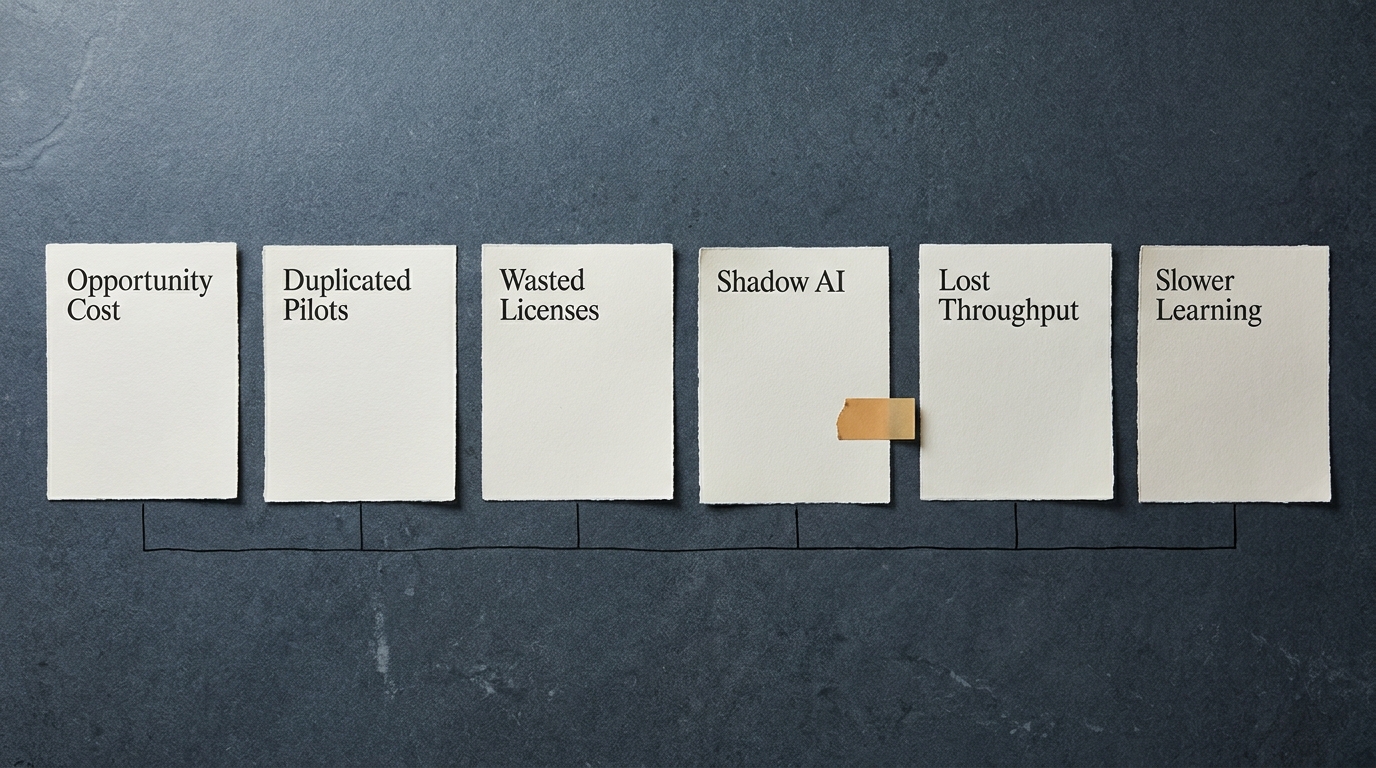
Quick answer: Delaying a managed AI program does not pause the cost of AI, it relocates it. The spend moves into six places that rarely carry an AI label: opportunity cost, duplicated pilots, wasted licenses, shadow AI, lost throughput, and slower organizational learning. Most are already accruing on your P&L under other names. Over one quarter they are large enough to model with numbers you already have.
Why waiting feels safe, and why the instinct misreads the risk
The logic behind waiting is sound on its face. There is no capital line to defend in front of the board. There is no visible failure, because you have not shipped anything that could fail. And there is a genuine belief, often correct in other technology cycles, that letting a fast-moving category settle saves you from betting on the loser.
Applied to AI, that instinct misreads where the risk sits. Inaction feels safe not because it is cheap but because it has no invoice. A failed deployment generates a cost you can see, argue about, and learn from. A quarter of drift generates a cost that no system captures, so it never reaches a budget review and never gets challenged.
Call it the accounting blind spot. Every other significant decision in the business gets weighed against its alternatives. The decision to wait on AI is the rare one that escapes the comparison, because the cost of the thing you did not do has no home in the ledger. The mistake is not choosing caution. The mistake is treating caution as free when it is not.
Unmanaged does not mean nothing is happening
Here is the distinction that changes the calculation. The choice in front of you is not "adopt AI" versus "do not adopt AI." That framing is already out of date inside your own building. The real choice is between a managed program and unmanaged experimentation, because the experimentation is underway whether or not you have sanctioned it.
The evidence is not subtle. Gartner reported in May 2024 that generative AI had become the most frequently deployed AI solution in organizations, ahead of every other category it tracked. Deloitte's State of AI research has documented worker access to these tools rising sharply and the expectation to move pilots into production climbing with it. Andreessen Horowitz, writing on where enterprises are actually adopting AI, found real usage concentrating in specific functions well ahead of any formal strategy to govern it.
Put those findings together and the picture is clear. Your people are using AI now. They are drafting with it, coding with it, summarizing with it, and in many cases paying for it on personal cards. What a delay postpones is not the adoption. It is the management of an adoption that is already happening. That gap, between the usage and the program that should be shaping it, is where the six costs live.
The six costs of a stalled AI program
None of the following shows up on your P&L with an "AI delay" label. Each one hides inside a category you already track, which is why it survives budget reviews untouched. The table below is the short version. The paragraphs after it show how to put a defensible number on each line using data you already have.
| Cost category | Where it hides on the P&L | How to estimate it in five minutes |
|---|---|---|
| Opportunity cost | Margin and throughput lines that look "normal" | Take one repetitive workflow, estimate the hours a managed tool would save weekly, multiply by loaded cost and by 13 weeks |
| Duplicated pilots | Departmental software and consulting spend | Count active AI pilots across teams, flag overlapping use cases, sum the redundant tool and vendor cost |
| Wasted licenses | SaaS and subscription renewals | Pull seat counts for AI tools already bought, subtract weekly active users, cost the idle seats for the quarter |
| Shadow AI | Risk, compliance, and rework, not a line item | Estimate the share of staff using unsanctioned tools, then the exposure and rework hours one bad data-paste would cost |
| Lost throughput | Cost of goods and service delivery | Compare current cycle time on one core process to a documented managed-rollout benchmark, cost the delta over 90 days |
| Slower organizational learning | Deferred, non-recoverable capability | Not a dollar this quarter, but count the managed experiments not run, each one judgment your team did not build |
Opportunity cost
Opportunity cost is the throughput and margin your competitors are capturing right now that you are not. It hides in plain sight because your margin lines still look normal. Nothing is broken, so nothing draws attention. To size it, pick one repetitive, high-volume workflow , estimate the weekly hours a managed tool would credibly save, and multiply by the loaded hourly cost and by the 13 weeks in the quarter. That single number is usually enough to reframe the conversation.
Duplicated pilots
When no one owns the AI program, the same use case gets built more than once. Marketing runs a content pilot, support runs a summarization pilot, operations runs a document pilot, often on three different tools with three different contracts, all solving substantially the same problem. To estimate it, count the active AI pilots across departments, mark the ones with overlapping use cases, and add up the redundant tooling and vendor spend. The duplication is the tax you pay for having no owner.
Wasted licenses
Seats get purchased in a burst of enthusiasm, then never operationalized, and the subscription renews on autopilot. This one is the easiest to measure and often the most uncomfortable. Pull the seat counts for the AI tools you already pay for, subtract the number of weekly active users, and cost out the idle seats for the quarter. Most organizations that have "already started with AI" carry more of this than they expect.
Shadow AI
Shadow AI is the staff who, absent a sanctioned option, paste customer records, contracts, and source code into consumer chatbots to get their work done. The cost does not appear as a line item. It appears as risk exposure and, eventually, as rework or a compliance event. Estimate the share of your workforce likely using unsanctioned tools, then reason through what a single bad data-paste would cost in exposure and remediation hours. You are not pricing a certainty here. You are pricing a probability you currently have no control over.
Lost throughput
Lost throughput is the compounding gap between your current cycle times and what a managed rollout would already be delivering on the same process. Unlike a one-time saving, this delta accrues every week the managed version does not exist. Take one core process, compare its current cycle time to a documented benchmark from a comparable managed deployment, and cost the difference across the 90 days. Label the benchmark as an assumption, because it is one, but do not pretend the gap is zero.
Slower organizational learning
This is the cost you can never recover. Every quarter you do not run managed experiments is a quarter your team does not build judgment about where AI helps and where it does not. It will not show up as a dollar figure this quarter, which is exactly why it is the most dangerous of the six. The organizations pulling ahead are not the ones with the best model access. They are the ones who have been learning, in a disciplined way, for several quarters longer than you have. Count the managed experiments you did not run this quarter. That is the learning you deferred.
A simple 90-day cost-of-delay model
The point of naming the six costs is to make them addable. Here is a worked example so you can see the shape of the arithmetic. Every input below is an illustrative assumption, not a measured result, and you should replace each one with your own figure before you take it anywhere.
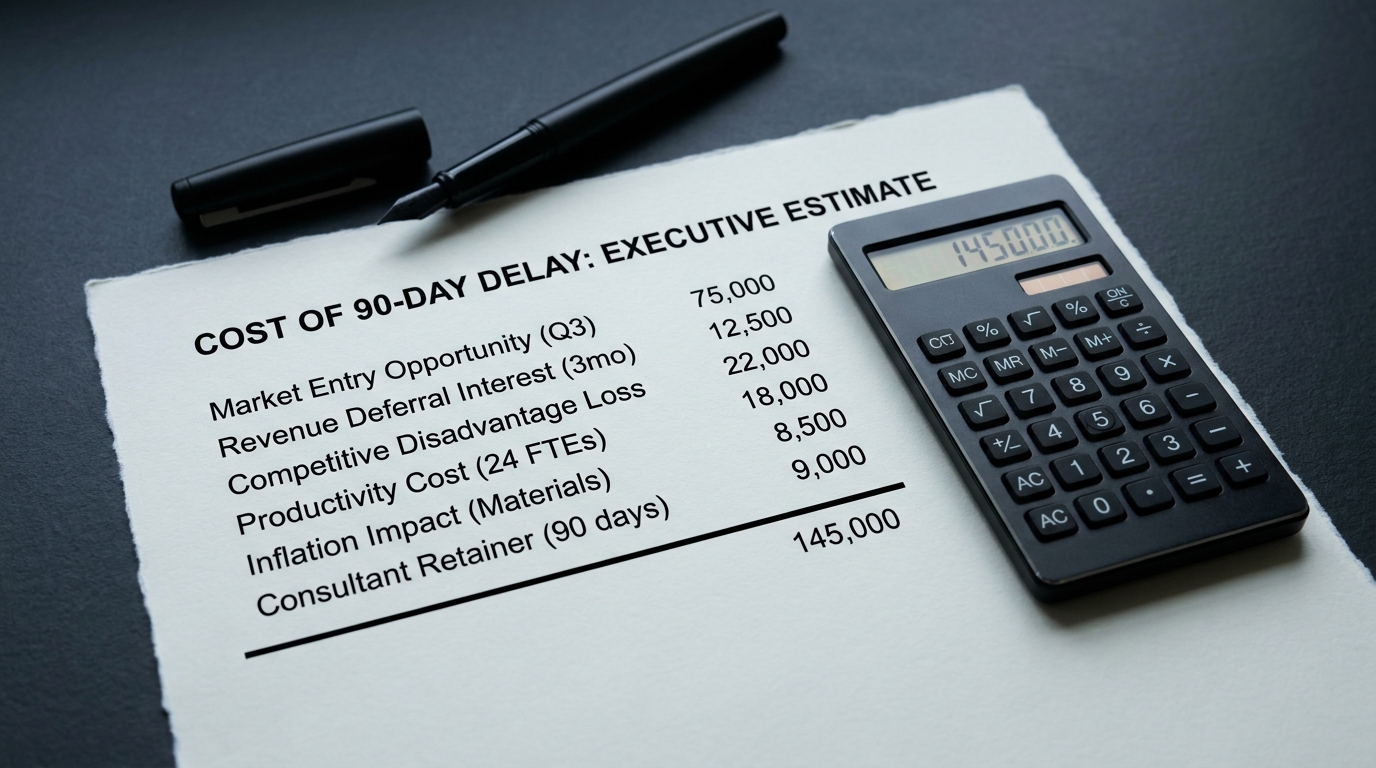
Take a 500-person organization. Assume a fully loaded cost of 75 dollars per hour for the roles the tools would touch.
- Opportunity cost: one workflow, 40 people, 2 hours saved per week each. That is 80 hours weekly, 1,040 over the quarter, roughly 78,000 dollars.
- Duplicated pilots: three overlapping pilots where one managed effort would do. Assume 20,000 dollars of redundant tooling and vendor time over the quarter.
- Wasted licenses: 120 seats bought, 45 active. The 75 idle seats at 30 dollars per month for three months is about 6,750 dollars.
- Shadow AI: a conservative risk-adjusted placeholder of 15,000 dollars for exposure and rework, deliberately low because the tail risk is larger than the expected value.
- Lost throughput: a 10 percent cycle-time gap on one core process, costed at roughly 25,000 dollars over the quarter.
- Slower organizational learning: carried at zero dollars this quarter by design, flagged as the non-recoverable line.
Add the measurable lines and the illustrative total lands near 145,000 dollars for one quarter, with the largest and least recoverable cost deliberately priced at zero. Change the assumptions and the number moves, but the exercise holds. The reason this model matters is not the total. It is that it converts a vague fear into a figure you can defend, line by line, in a room where every other number has to justify itself.
Run it with your own inputs. If you are ready to scope the exercise, an AI Transformation Discovery sprint builds this model against your actual operating data.
Why programs stall, so you can tell delay from diligence
Not all waiting is drift. Some of it is healthy sequencing, and a good leader needs to tell the two apart. The most useful signal comes from the competitors' own research. Gartner has identified estimating and demonstrating business value as the leading barrier to AI adoption, and HBR's analysis of why adoption stalls points to the same root: programs that cannot prove their worth lose their sponsors. Treat that as a diagnostic, not a headline.
Diligence looks like a scoped experiment with a named owner, a defined success metric, and a path to production if it works. Drift looks like the opposite: no one owns the program , no metric defines success, and the pilot has no route beyond the pilot. If you cannot point to who is accountable and what number would make the experiment a win, you are not sequencing carefully. You are drifting, and the six costs are running the whole time.
What managed experimentation looks like instead
The off-ramp is smaller than it sounds, and it is not a moonshot. A managed program has four features, and none of them requires a large capital commitment.

First, one owner. A single accountable person for the AI program, not a committee, so the duplication and the ownership vacuum both close. Second, a small portfolio of scoped experiments, three to five, each tied to a real operating problem rather than a technology someone read about. Third, a value metric per experiment, defined before it starts, so you can tell a win from a nice demo. Fourth, a production path, so the experiments that work have somewhere to go instead of dying as pilots.
Contrast that with the unmanaged pattern, where usage is everywhere, ownership is nowhere, and no one can say which of the running experiments is actually paying off . The difference between the two is not budget. It is management. If the honest answer to "who owns this" is no one, that is the gap to close first, and it is often the cheapest fix on the list. A fractional agentic team can supply that ownership without a permanent hire while your own people build the judgment.
The first move does not have to be big. It has to be owned, scoped, and measured . If you want a fast read on where a managed program would cut the most cost first, book a free 30-min AI Readiness Snapshot . It maps where AI will have the most immediate impact on your operating cost and reliability, with no obligation to proceed.
Key takeaways
- Delay does not pause the cost of AI, it relocates it into categories that carry no AI label and escape budget review.
- Six costs make up the total: opportunity cost, duplicated pilots, wasted licenses, shadow AI, lost throughput, and slower organizational learning.
- Five of the six can be modeled over a single 90-day quarter using operating data you already have.
- The real choice is managed program versus unmanaged experimentation, because the experimentation is already happening.
- The first step is small: one owner, a few scoped experiments, a metric each, and a path to production.
The wait was never neutral. Now you have a number for it, and a first move that fits inside a single quarter. The organizations moving ahead did not start with more certainty than you have. They started with an owner and a measurable experiment, and let the learning compound from there. When you are ready to size your own cost of delay and where to cut it first, book a free 30-min AI Readiness Snapshot .