The build quote is the cheapest number in your agentic AI budget. It shows up in a proposal, gets negotiated, gets approved - a fixed, one-time price to design and ship the thing. Finance signs it and moves on. That signature is where the real spending quietly starts.
The expensive part starts after the agent goes live and never switches off. An agent that chases a goal reads context, plans, calls tools, checks its own work, and retries when a step fails. Each of those moves burns tokens, compute, storage, and eventually a human's attention. None of it shows up in the build quote. And where a chatbot costs about the same on every query, an agent can spend three times as much on Tuesday as it did on Monday to finish the identical task.
This piece is for the finance and technology leaders who signed off on a clean build figure and are now staring at a monthly bill they can't forecast. It is not another "$5K to $500K to build" tier table - every competitor already owns that ground. It is a line-by-line operating-cost model you can carry into a budget review: what the recurring lines actually are, why each one runs continuous and variable instead of episodic, and how to estimate your own run-rate before it ambushes you.
Quick answer. Building an agentic AI system typically runs $15K-$400K+ one time, but the operating cost is what catches teams off guard: roughly $2K-$20K+ per agent per month at moderate scale once you count inference, orchestration, data retrieval, logging, monitoring, exception handling, support, security review, and the human hours to own the workflow. Operating cost is continuous and variable - the same task can cost several times more depending on how many tool calls and retries the agent burns. In most first-year deployments the run-rate quietly overtakes the amortized build cost, and model tokens are only 40-60% of it.
Key takeaways
- The run-rate usually passes the amortized build cost inside the first year, so a build-only budget understates true cost from day one.
- Token and inference spend is typically only 40-60% of monthly operating cost. The rest is orchestration, observability, exceptions, and people.
- Human oversight - the fractional hours to supervise, correct, and maintain the agent - is the single most under-counted line.
- Costs scale super-linearly with autonomy and tool count, not linearly with usage, so per-seat and per-call forecasting breaks down.
- You can forecast agentic AI cost, but only if you model all nine lines and carry a variance band instead of a single point estimate.
Build cost versus run cost: why the quote is the small number
Build ranges for agentic AI are the best-documented thing in the market, and the least useful for a budget that has to survive the year. A single-purpose agent that automates one narrow task tends to land around $15K-$40K. A production-grade agent with real integrations, guardrails, and testing runs roughly $80K-$200K. A multi-agent system coordinating several agents across a workflow starts around $150K and climbs past $400K. Those are the headline figures nearly every cost guide leads with, and they are a fair reference point for the one-time investment.
The catch is that the build happens once and the run-rate is forever. Worse, the run-rate compounds. A shipped agent doesn't sit quietly waiting to be called. It runs on an always-on control plane, re-embeds data as sources change, emits a steady stream of logs and traces, and needs someone watching for the day it does something unexpected in a live workflow. The build buys you the machine. The run-rate is the fuel, the maintenance, the insurance, and the driver - and you pay it every month whether the agent handled ten tasks or ten thousand.
That inversion is the whole point here. Budget the build, treat operating cost as a footnote - the "add 15-20% annually" line most quotes bury - and you will approve a number that is wrong inside the first quarter. The fix is to model the operate side with the same rigor you gave the build side.
| Dimension | Build cost | Operating cost (run-rate) |
|---|---|---|
| Timing | One-time | Recurring, monthly, indefinite |
| Predictability | Fixed, quoted up front | Variable, scales with autonomy and load |
| Visible in the vendor quote | Yes | Rarely, or as a vague percentage |
| Main drivers | Scope, integrations, model choice | Inference, orchestration, oversight, exceptions |
| Trend over time | Ends at launch | Compounds as usage and fleet size grow |
| Who owns it | Vendor or build team | Your P&L, every month |
Read that table as the frame for everything below. The rest of this piece takes the right-hand column and breaks it into the nine lines finance actually needs to see.
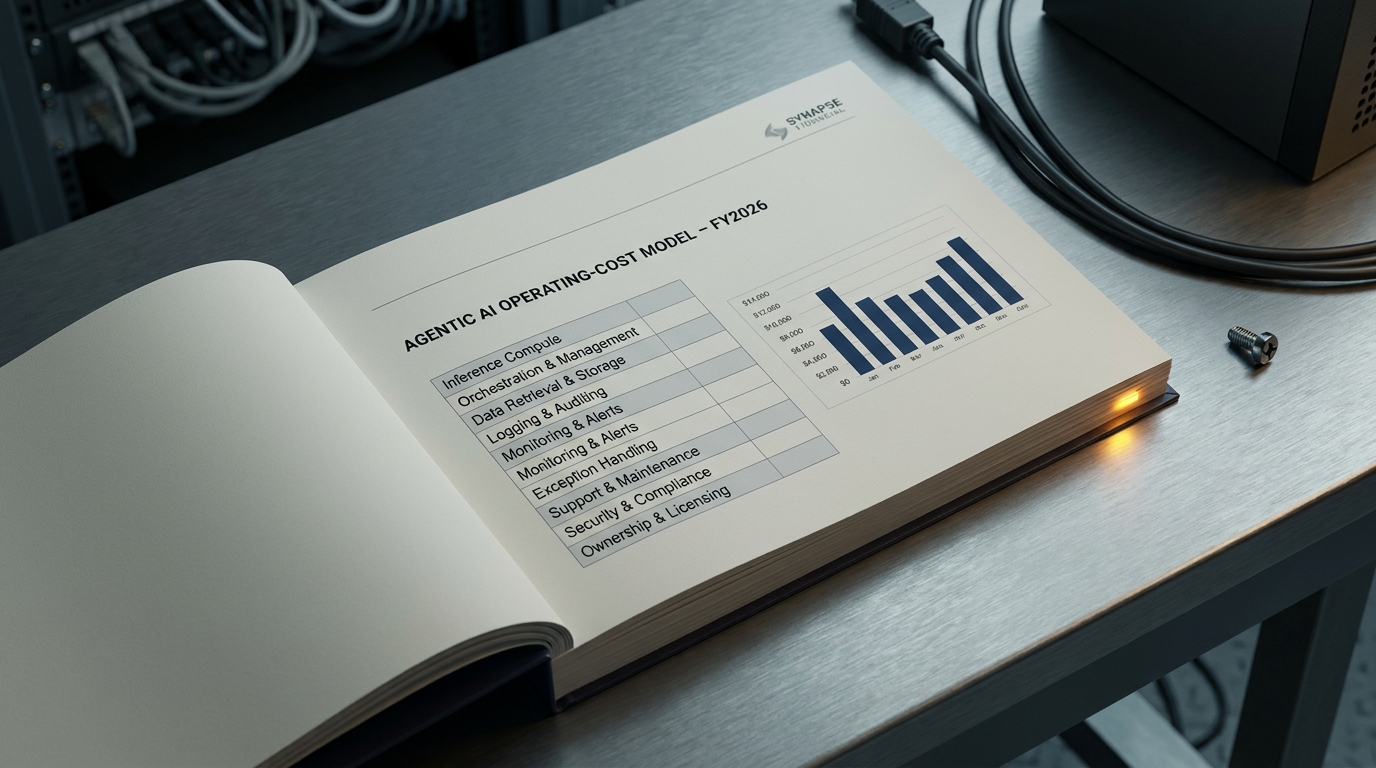
The nine lines of an agentic AI operating-cost model
This is the model to take into your budget review. Every line below is a recurring cost, and every one follows the same pattern: what it is, why it is variable and continuous rather than a flat monthly fee, and how to estimate it. Define the plumbing terms once and they stay defined - inference is the cost of the model generating output, orchestration is the control layer that decides what the agent does next, and retrieval-augmented generation (RAG) is the practice of fetching relevant data and feeding it to the model at run time.
1. Inference (model tokens)
Inference is the line everyone budgets and the one they underestimate most. It is the cost of the language model reading input and generating output, billed per token. An agentic work cycle burns far more tokens than a single chatbot turn, because the agent reads context, plans a sequence of steps, calls tools, processes the results, and often retries - each step passing an ever-growing context back through the model. A single agent task can eat five to fifteen times the tokens of one chatbot exchange.
So don't estimate it per query. Estimate it per minute of active agent work. One published experiment on a frontier model clocked an active agentic cycle at roughly $0.80-$1.20 per minute of real work, or about $1 per minute as a working figure (Optimaly, 2026). Multiply your expected minutes of active work per day by that rate, then by your working days, and you have a defensible inference baseline before any of the other eight lines.
2. Orchestration
Orchestration is the line teams most often assume is free, because it never shows up as a per-token charge. It is the always-on control plane: the schedulers, queues, state management, and retry logic that decide what the agent does next and keep it coordinated across steps. It is infrastructure, and it runs whether or not the agent is busy. An idle-but-ready fleet still costs money, because the control plane, the message queues, and the state stores stay up so the agent can respond the instant work arrives.
Estimate orchestration as a fixed platform floor plus a variable component that grows with the number of steps and concurrent runs. Even a modest production agent carries a non-trivial baseline here.
3. Data retrieval and RAG
Retrieval is what lets the agent ground its decisions in your data instead of only its training. The recurring costs are vector database hosting, the compute to generate and refresh embeddings as your source data changes, and the retrieval calls the agent makes on every step that needs context. An agent that consults a knowledge base on each of a dozen steps is making a dozen retrieval calls per task, not one.
Estimate it from three inputs: the size of your indexed corpus, which sets storage; how often that corpus changes, which sets re-embedding frequency; and retrieval calls per task times task volume, which sets query cost. A stale, small corpus is cheap. A large, fast-changing one is not.
4. Logging
Agents emit far more telemetry than a request-response application. To debug why an agent made a given decision, you have to log every step: the plan, each tool call, each result, each retry. That volume of structured trace data carries a real storage and egress cost, and it grows directly with task volume and step count.
Estimate logging from bytes-per-task times tasks-per-month, plus retention. The instinct to log everything forever is what turns this from a rounding error into a line item, so decide retention on purpose rather than by default.
5. Monitoring and observability
Logging captures the raw data. Observability turns it into something a human can act on before a small problem becomes an expensive one. Monitoring is the recurring SaaS and tooling spend for the platforms that watch the agent in production: tracing tools, evaluation frameworks, dashboards, and alerting. It is a subscription line that scales with seats, traced volume, and the number of agents under watch.
Estimate it as a per-agent or per-volume SaaS cost from your chosen observability stack. It is easy to defer until an incident forces the purchase - which is exactly why it belongs in the model up front.
6. Exception handling
This is where "variable" turns into "unpredictable." It is the cost of the long tail: failed tool calls, hallucination catches, fallback paths, and the reruns they set off. Every exception an agent hits either fails the task or forces a retry, and retries multiply every variable cost above them - more inference, more retrieval, more logging. A bad day of upstream API failures can quietly double a fleet's token spend.
Estimate it as an overhead multiplier on your baseline inference and orchestration - a factor that reflects your expected failure and retry rate - rather than a separate flat fee. The lower your reliability, the higher this multiplier climbs.
7. Support
Support is the internal burden when the agent does something unexpected inside a real workflow and a person has to step in. It is distinct from oversight: oversight is planned supervision, support is the unplanned "the agent just did something odd and a customer or colleague is waiting" response. The more live processes an agent touches, the more of this load it generates.
Estimate it from expected intervention rate times the loaded hourly cost of the people who field those interventions. A well-scoped agent generates little of this. An over-autonomous one generates a steady drip.
8. Security review
Security and compliance for an agent are recurring, not one-time. The ongoing lines include periodic access reviews, secret rotation, prompt-injection and red-team testing , and maintaining the audit trails a regulated environment demands. An agent that can call tools and touch data is a live attack surface, and it has to be re-examined on a schedule. Several market analyses put the compliance and security premium at roughly 25-40% on top of base operating cost in regulated settings.
Estimate it as a percentage uplift on the rest of the model, sized to your regulatory exposure. A low-stakes internal agent carries little. An agent in a regulated workflow carries the full premium.
9. Workflow ownership (human oversight)
This is the most under-budgeted line in the whole model, and usually the second-largest after inference. Workflow ownership is the fractional human time to supervise the agent, approve or correct its actions, maintain its prompts and tools as the world shifts, and own the outcome. Agentic systems are not fire-and-forget. Someone has to keep the agent aligned with a workflow that keeps moving, and that person's time is a real recurring cost even when no incident is in flight.
Estimate it honestly, as a fraction of a skilled person's time per agent - and resist the urge to set it to zero because "the agent runs itself." It doesn't. The teams that model this line accurately are the ones whose run-rate forecasts survive contact with reality.
| Cost line | What drives it | Fixed or variable | How to estimate |
|---|---|---|---|
| Inference | Active agent minutes, tokens per step, retries | Variable | Active minutes/day x ~$1/min x working days |
| Orchestration | Control plane, concurrent runs, step count | Mostly fixed + variable | Platform floor + per-run compute |
| Data retrieval / RAG | Corpus size, refresh rate, retrieval calls per task | Variable | Storage + re-embedding + calls x task volume |
| Logging | Trace volume per task, retention window | Variable | Bytes/task x tasks/month + retention |
| Monitoring | Traced volume, agents under watch, seats | Mostly fixed | Observability SaaS per agent or per volume |
| Exception handling | Failure rate, retry policy | Variable | Overhead multiplier on inference + orchestration |
| Support | Intervention rate, live-workflow exposure | Variable | Interventions x loaded hourly cost |
| Security review | Regulatory exposure, audit cadence | Recurring uplift | 25-40% uplift in regulated settings |
| Workflow ownership | Autonomy level, rate of change, fleet size | Recurring | Fraction of a skilled FTE per agent |
Why agentic costs are continuous and variable, not episodic
Here is the mechanic most cost guides miss. Traditional software scales predictably: a chatbot, a SaaS seat, an API call each carry a known unit cost, so you multiply by volume and you have a forecast. Agentic AI breaks that model, and the reason is worth stating precisely.
An agent chasing a goal decides for itself how many steps to take. As one industry analysis put it, identical tasks handed to an agentic system can generate widely different numbers of model calls depending on how the agent is designed and what it runs into along the way (TechTarget, 2026). The same invoice-matching task might resolve in three tool calls when the data is clean and twelve when it is not. You are no longer paying for a known unit of work. You are paying for a goal, and the path to that goal has variable length.
Layer the always-on nature of orchestration on top and the picture sharpens. Even with no tasks in flight, the control plane, the queues, the state stores, and the monitoring stay up and keep billing. A fleet of agents has both a floor it never drops below and a ceiling that spikes with load and failures. That combination - a fixed idle cost plus a highly variable active cost - is why a per-seat or per-call model can't forecast agentic AI.
The implication for finance is direct. Don't model a point estimate. Model a run-rate with a variance band: a realistic low, a realistic high, and an honest statement of what pushes you toward the top of the range. A forecast that admits variance is far more useful in a budget review than a single confident number that will be wrong by the second month.
Worked example: estimating one agent's monthly run-rate
The numbers below are illustrative, built to show the method rather than to describe any specific client deployment. Treat them as a template to fill with your own inputs.
Take one mid-tier production agent that does real work about 15 minutes of every active hour, across an 8-hour day, 5 days a week. That is a common active-work ratio for a goal-seeking agent that spends much of its wall-clock time waiting on tools and data.
- Inference. At roughly $1 per minute of active work, 15 active minutes per hour across 8 hours is about $120 per day, or roughly $2,400 per month for one agent (Optimaly, 2026, illustrative). This is the single largest variable line for most agents, but note that it is still only part of the total.
- Orchestration. A modest always-on control plane and its queues and state stores might run several hundred dollars a month at this scale, call it $400, mostly fixed regardless of how busy the agent is.
- Data retrieval and RAG. Vector database hosting plus periodic re-embedding plus per-step retrieval calls might add another $300-$600 depending on corpus size and refresh rate. Use $450.
- Logging. High-volume step logging with a reasonable retention window might add $200-$400. Use $300.
- Monitoring and observability. A tracing-and-eval SaaS line for one agent might run $300-$500. Use $400.
- Exception handling. Apply a failure-and-retry multiplier to the inference and orchestration lines. At a moderate 20% overhead on roughly $2,800 of inference-plus-orchestration, that is about $560.
- Support. A low intervention rate times loaded internal hourly cost might add $300-$600. Use $450.
- Security review. In a lightly regulated context, a 10-15% uplift on the running total. In a heavily regulated one, 25-40%. Use 15% here, roughly $800.
- Workflow ownership. A quarter-day per week of a skilled person to supervise, correct, and maintain, at loaded cost, can easily reach $1,500-$3,000 per month. Use $2,000.
Add those and one mid-tier production agent lands near $7,800 per month, with a realistic band from roughly $5,000 on a clean, low-oversight month to $12,000+ on a high-failure, high-oversight one. Inference - the line everyone budgets - is under a third of the total. The people and the plumbing are the other two-thirds. Multiply across a fleet and the build quote you approved starts to look like the down payment it always was.
What drives your position in the cost range
The spread between a $5,000 month and a $12,000 month for the same agent is not noise. It comes from choices you control. The main levers:
- Autonomy level. The more freedom the agent has to pick its own path, the more steps, tool calls, and retries it can generate. Higher autonomy raises both capability and variance.
- Number of tools and integrations. Each integration is another surface for calls, failures, and retries. Tool count drives inference, exception, and support costs together.
- Model choice and routing. Running every step on a frontier model is the most expensive policy available. Routing simple steps to cheaper models moves the inference line substantially.
- Retry and evaluation strategy. Uncapped retries and heavy per-step evaluation multiply cost quietly. Sensible caps and targeted evals hold the line.
- Scale. Cost is roughly agents times runs times steps. Growth in any factor compounds, which is why linear per-seat forecasting understates a growing fleet.
- Compliance burden. A regulated workflow carries the full security-review premium and heavier oversight. An internal low-stakes agent carries little of it.
Good, in practice, looks like a team that routes models by task difficulty , caches repeated retrievals, caps retries, right-sizes autonomy to the task instead of maxing it out, and consolidates oversight into a small number of accountable people rather than scattering it across a dozen part-time watchers. Those teams sit near the bottom of the range. Teams that maximize autonomy, run everything on the top model, and leave retries uncapped sit near the top.
Cost-control levers that actually move the run-rate
Once you can see all nine lines, the levers that matter get obvious - and they are not the ones vendors advertise. In rough order of impact:
- Model routing and semantic caching. Send only the hard steps to the expensive model, and cache repeated retrievals and prompts. Teams that do this well report cutting inference cost by roughly 50-60% (industry estimates), and inference is your largest variable line.
- Retry and timeout caps. Uncapped retries are how a bad upstream day becomes a doubled bill. Hard caps turn an unbounded tail into a known ceiling.
- Right-sized autonomy. Give the agent exactly the freedom the task needs and no more. Over-autonomy is expensive in inference, exceptions, and support all at once.
- Observability that catches runaway loops early. The value of monitoring is not the dashboard, it is catching a looping agent in minutes instead of at the end of the billing cycle. This line pays for itself by protecting the lines above it.
- Consolidated oversight. Scattered part-time supervision is both expensive and ineffective. Concentrating workflow ownership into a focused, accountable team lowers the oversight line and improves reliability, which lowers the exception line too.
That last lever - who carries the oversight burden - is where the operating-cost model runs into a real structural decision, which is the next section.
Build versus buy versus borrow, through an operating-cost lens
The build-buy-borrow debate usually gets framed around the build cost. Seen through the run-rate, the sharper question is who carries the operate and oversight lines month after month. Analyst framing from firms like KPMG on the build-buy-borrow decision, and multi-year total-cost-of-ownership analyses from providers such as Tata Communications, land on the same underlying point: the ongoing cost of running and governing agentic systems, not the up-front build, is where the real money and the real risk sit over a three-year horizon.
- Build puts every one of the nine lines on your P&L, permanently. You own the run-rate and the oversight burden in full. This makes sense when the workflow is core, differentiating, and stable enough to justify owning end to end.
- Buy shifts some infrastructure lines to a vendor but rarely removes the oversight, integration, and exception burden - those still land on your team, and the vendor's margin is now inside your run-rate too.
- Borrow - partnering with a fractional team that operates and oversees the agent for you - shifts the operate-and-oversight lines off your permanent headcount and onto flexible capacity you scale up or down. You get continuous ownership of the workflow without carrying a full-time team through the quiet months.
The right answer depends on how core the workflow is and how much variance you are willing to carry on your own books. But the decision only makes sense once you have the nine-line model in hand. Without it, build-buy-borrow is a debate about the build price - the small number - while the run-rate, the number that actually compounds, goes unexamined.
Reading the competitor ranges: why $500 and $20,000 are both right
If you have already shopped this topic, you have seen operating-cost figures that span from a few hundred dollars a month to well over twenty thousand. That spread isn't because someone is wrong. It is because each source counts different lines at different scale.
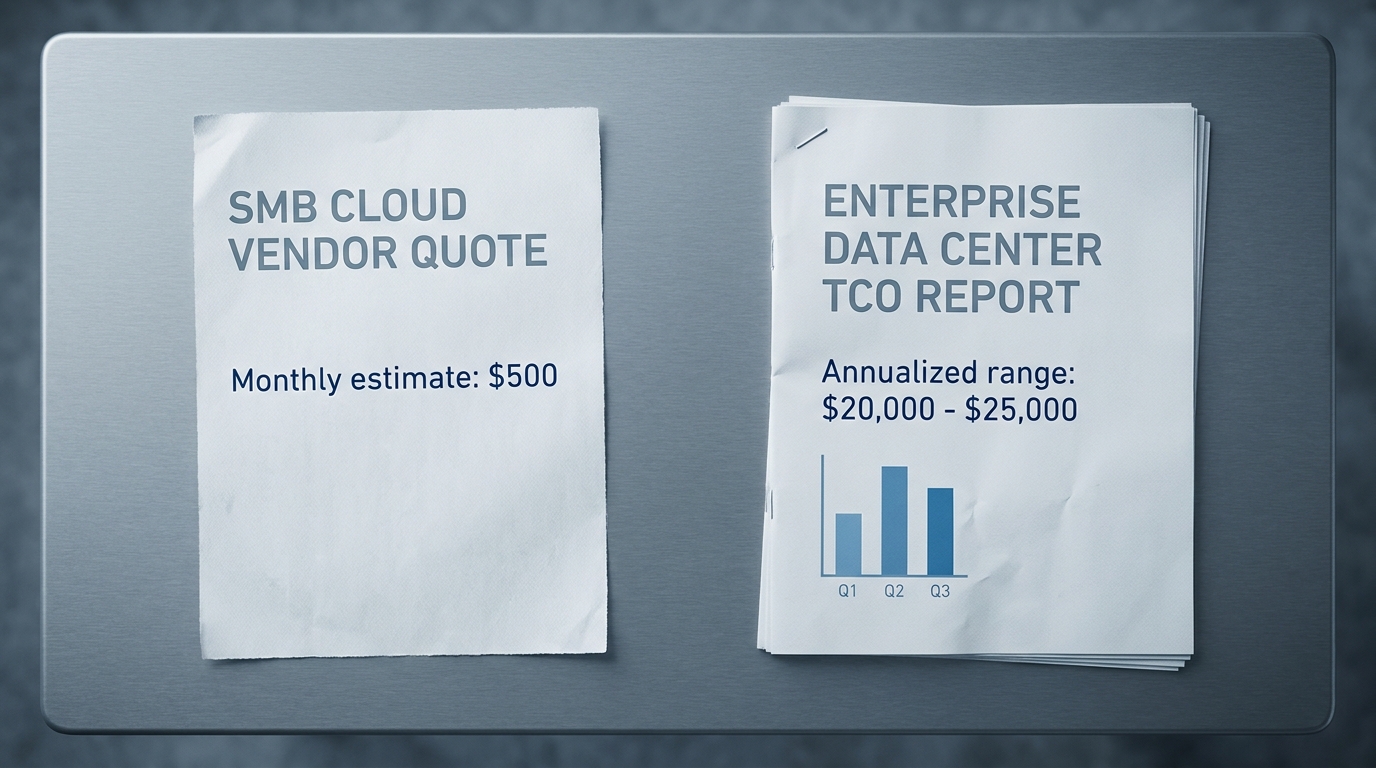
A guide that quotes "$500-$5,000 a month" is usually counting inference and hosting for a single small agent and stopping there. A figure like the $9,600-a-month calculation that circulates from the "$1 per minute of active work" math counts inference for a busy agent across a full work week and little else (Optimaly, 2026). A $20,000+ figure is counting a small fleet with full observability, security review, and human oversight loaded in. Same technology, radically different scope of accounting.
The practical move is to treat any single published number as an anchor for one or two lines, not a total. When a figure lands in front of you, ask which of the nine lines it includes and at what scale. Then map it onto your own model. Used that way, the wild variance in the market turns into a feature: it tells you exactly how much the accounting boundary and the scale assumption move the answer, which is the same lesson your own forecast has to encode as a variance band.
Common mistakes when budgeting for agentic AI
The failure modes are consistent across teams, and every one of them traces back to the same root: modeling the build instead of the run-rate.
- Budgeting build-only. Approving the one-time quote and treating operating cost as a vague percentage. This understates true cost from the first month.
- Assuming linear scaling. Forecasting cost as a flat per-task or per-seat unit. Agentic cost scales super-linearly with autonomy, tools, and steps, so linear math undershoots a growing fleet.
- Ignoring oversight labor. Setting the workflow-ownership line to zero because "the agent is autonomous." Oversight is the most under-counted line and often the second-largest after inference.
- Running blind on exceptions. Skipping observability, so runaway loops and retry storms stay invisible until they show up on the bill. You can't control a cost you can't see.
- Treating token price cuts as the whole story. Celebrating a model-price drop as if it solved cost. Inference is only 40-60% of the total, so a cheaper token moves less of your run-rate than you would hope.
Dodging these is not about spending more. It is about seeing all nine lines before you commit a number to a budget you will have to defend next quarter.
Key takeaways
The operating-cost model is the deliverable to walk away with. In summary:
- The build quote is the one-time, cheap number. The run-rate is the recurring number that compounds, and it usually passes the amortized build inside year one.
- Model nine lines, not one: inference, orchestration, data retrieval, logging, monitoring, exception handling, support, security review, and workflow ownership.
- Inference is typically only 40-60% of the total. Orchestration, observability, exceptions, and especially human oversight make up the rest.
- Agentic cost is continuous and variable because an agent chooses its own number of steps, so forecast a run-rate with a variance band, never a single point.
- Your position in the range is a choice: model routing, retry caps, right-sized autonomy, early observability, and consolidated oversight are the levers that move it most.
- Build-buy-borrow is really a question about who carries the operate-and-oversight lines. Borrowing flexible capacity keeps the workflow yours while shifting the run-rate off permanent headcount.
If the largest and most under-counted line in your model is the human oversight it takes to run agentic workflows well, the practical next step is continuous capacity to own and operate those workflows without standing up a full in-house team. That is exactly what a Fractional Agentic Team provides - experienced people who supervise, correct, and maintain your agents as flexible run-rate rather than fixed headcount. If you are earlier in the journey and want to size the operating burden before you commit, start with an AI Transformation Discovery to map the workflow and its true run-rate, or take the quick AI Readiness Snapshot to see where you stand today.