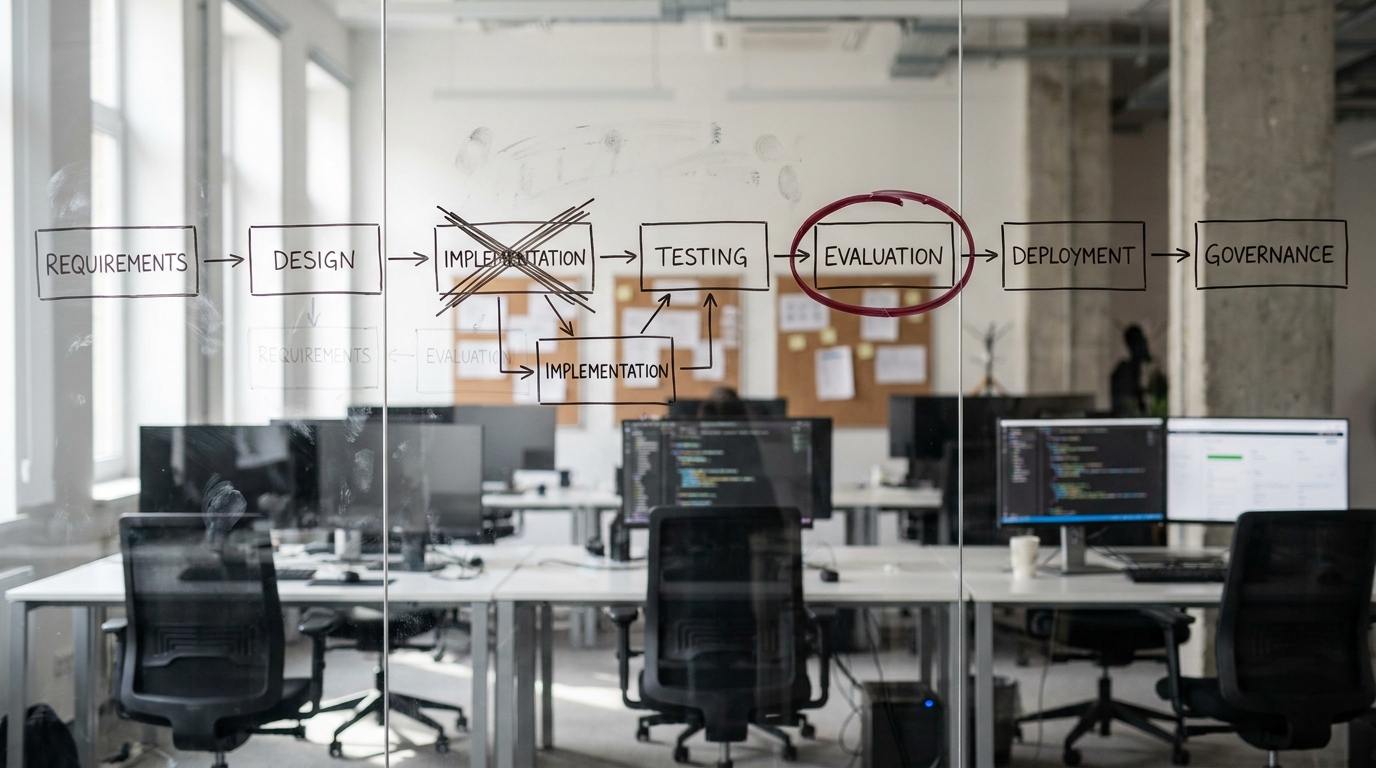

The tenth AI workflow a company ships should cost almost nothing. By then the hard parts are solved once already: the connection to the CRM, the approval flow a human signs off on, the test that catches a bad answer before it reaches a customer. In most companies, though, the tenth workflow costs roughly what the first one did. Nothing built for the first survived to help the tenth.
That is the quiet reason AI spend keeps climbing while returns stay flat . The budget funds pilots, and pilots are built to be thrown away. Treat every AI workflow as a one-off experiment and you never build compounding capability. You just accumulate demos. So for a CEO, COO, or CIO staring at a growing line item and a wall of finished proofs-of-concept, the reflex is to fund more pilots.
The fix runs the other way: stop managing AI as a series of pilots and start managing it as a portfolio of product lines that share the same underlying assets.
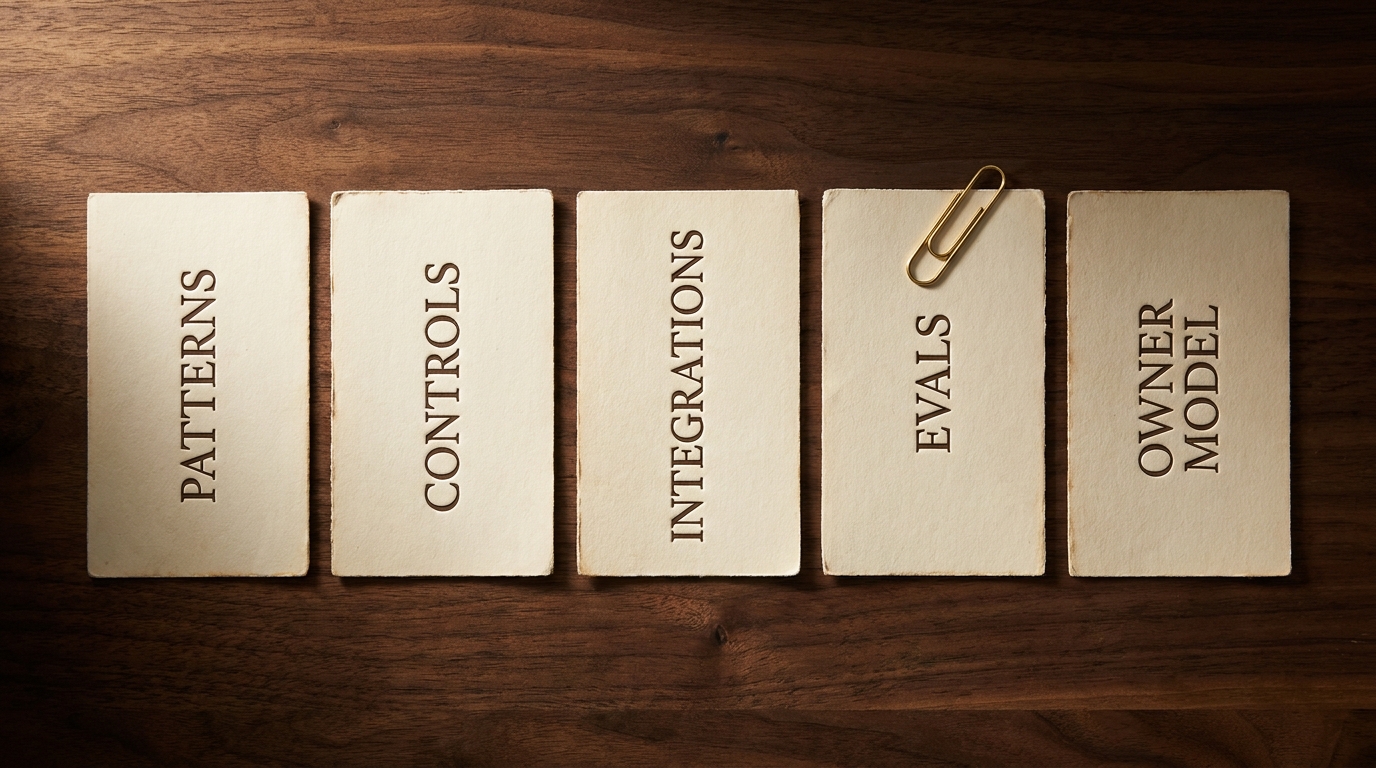
The short version: you scale AI by moving from disposable pilots to owned, reusable product lines. Five shared assets - patterns, control templates, integrations, evals, and a clear owner model - let each new workflow inherit what the last one built, so the second is cheaper than the first and the tenth is nearly free.
The pilot factory problem
Walk through most enterprise AI programs and you find the same shape. A team picks a promising use case, stands up a bespoke prototype, demos it to enthusiastic applause, and moves on to the next promising use case. The pilots multiply. The capability to run AI in production does not.
The market data backs up the gap between activity and outcome. Accenture's research on scaling found that only about 8% of companies are scaling AI effectively and embedding it in core strategy, and while roughly 70% recognize how important their data is, few actually leverage their proprietary data ("The Front-runners' Guide to Scaling AI", Accenture, May 2025). More recent numbers are only slightly kinder: around 32% of leaders report sustained, enterprise-wide AI impact (Accenture Pulse of Change, 2026). Adoption itself is no longer the constraint. G2 found 57% of companies already have AI agents in production (G2 2025 AI Agents Insights). The tools are in the building. The compounding is not.
This is not new pressure. Back in 2019, 75% of C-suite executives believed that failing to scale AI could put them out of business within five years (Accenture, "AI: Built to Scale", November 2019). Six years on, the deadline has passed and most companies are still stuck at the same wall. Adoption is also uneven in ways that hide the problem inside aggregate numbers, as the Anthropic Economic Index (September 2025) and Bloomberry's analysis of 76,000 companies (October 2025) both show.
The root cause is not a shortage of good ideas, and it is not a shortage of pilots. It is the absence of a shared substrate: the reusable layer of connections, controls, and tests that lets a proof-of-concept graduate into something durable. Without that layer, every pilot is a fresh build, and a fresh build almost never survives contact with production budgets, security review, and the question no demo answers. Who owns this on Tuesday morning when it breaks?
Pilot vs. product line: the mental model shift
The shift that fixes this is easy to say and hard to live: stop shipping pilots, start shipping product lines.
An AI pilot is a time-boxed experiment. It exists to answer a question. Can this model do this task well enough to matter? Once the question is answered, the pilot has served its purpose, and its code, prompts, and hacked-together data connections are disposable by design.
An AI product line is a workflow that is owned, versioned, monitored, and reused. It has a name, an owner, a place in the roadmap, and a set of tests it must pass to change. It runs on shared infrastructure rather than bespoke plumbing, and it is expected to run for years, not weeks. The platform team, the group that owns that shared infrastructure, is the third entity worth defining now, because it is the piece most companies are missing.
Here is the distinction across the dimensions that actually decide whether something compounds:
- Owner: a pilot has a sponsor for a quarter. A product line has a standing product owner.
- Lifespan: a pilot ends when the question is answered. A product line runs until it is retired on purpose.
- Evals: a pilot is judged by a demo. A product line is judged by a shared test suite it must keep passing.
- Integration: a pilot uses throwaway connections. A product line consumes integrations built once and reused.
- Funding: a pilot is a project with a start and end date. A product line is funded like an internal product, on an ongoing basis.
The point of the list is not the rows. It is that a pilot is optimized to be discarded and a product line is optimized to be kept, and only kept things compound.
What actually compounds: the five reusable assets
If product lines compound and pilots do not, the only question that matters is what exactly gets reused. "Build a platform" is where most competitor advice stops, and it is useless at that altitude. Here is the concrete asset inventory an executive can ask their team for by name. There are five.
Shared patterns
A shared pattern is a reference architecture or solution template that a new workflow starts from instead of a blank page. Retrieval over your document store, a human-in-the-loop review step, a summarize-and-route pipeline: these recur constantly across use cases. Captured once as a documented, working template, the fifth workflow that needs retrieval starts at 60% done. Captured nowhere, every team reinvents it and each version drifts. Shared patterns are how the design cost of workflow #1 gets amortized across workflows #2 through #10.
Control templates
A control template is a reusable guardrail: an approval flow, a human sign-off gate, a policy check, a content filter, a logging-and-audit hook. Safety and compliance are where bespoke AI projects quietly die, because each one has to re-litigate what "safe enough to ship" means with legal and risk. When the approval flow and the audit trail are pre-built and pre-blessed, a new product line clears governance in days instead of quarters . That is governance built into the architecture as a first-class asset, not compliance bolted on after the fact. Controls stop being per-project heroics and become defaults every workflow inherits.
Reusable integrations
A reusable integration is a connector, to the CRM, the data warehouse, the identity provider, the ticketing system, built once and consumed many times. Integration is usually the largest hidden cost in an AI workflow and the least visible in a demo. The demo runs on a CSV export. Production needs live, authenticated, permissioned access to the real system. Build that connector once as a shared service and every future workflow that touches the CRM skips the single most expensive step.
Common evals
A common eval is a shared test harness - quality checks, safety checks, regression tests - applied to every product line rather than reinvented per project. This is the asset competitors most often ignore, and it is arguably the most important. Without shared evals, "is this AI still working?" gets answered by vibes and by the occasional angry customer. With them, every product line has a scoreboard - a shared test suite that gates every merge in CI - so changes are gated by tests and a regression is caught before release rather than in production. Evals are how you keep ten live workflows trustworthy with one team instead of ten.
Owner model
The fifth asset is not code. It is a clear split of ownership, and it is the one that makes the other four survive. The platform team owns the shared substrate: the patterns, controls, integrations, and eval harness. A product owner owns each individual product line and its roadmap. A business sponsor owns the outcome the line is supposed to produce. Competitors say "you need governance" and stop there. Governance without named roles is a meeting. The owner model is what turns the shared layer from a one-time project into something that is maintained, funded, and defended when budgets tighten.
Put the five together and the compounding stops being a slogan and becomes arithmetic. Workflow #1 pays the full cost of building a pattern, a control template, an integration, and an eval from scratch. Workflow #2 reuses the integration and the eval harness. Workflow #5 reuses all four asset types and mostly configures rather than builds. By workflow #10, shipping is closer to assembly than construction. The exact savings depend on your stack, so treat those as illustrative rather than a promise, but the direction is the whole argument, and the staged path later in this article is how you measure the real curve on your own stack. Pilots hold cost flat because they share nothing. Portfolios bend the cost curve down because they share almost everything.
Choosing which workflows earn a product line
Not every workflow deserves productization, and treating all of them as product lines is its own trap. McKinsey's argument for scaling agentic AI turns on this exact point: the return comes from selecting high-impact workflows and rebuilding the operating model around them, not from spreading effort thin across every idea that demos well (McKinsey agentic-AI research). Selection is a leadership decision, not a technical one.
A simple lens keeps the decision honest. Score each candidate workflow on three factors:
- Impact: how much value does this create if it runs reliably at scale? Vanity use cases score low here even when they demo beautifully.
- Reuse potential: how many of the five shared assets would this workflow build that other workflows could then inherit? A first workflow that also produces the CRM integration everyone needs is worth more than its own output.
- Data readiness: is the underlying data governed, accessible, and clean enough to trust? Low data readiness is where most productization attempts stall.
Workflows that score high across all three earn a product line. Workflows that score high on impact but low on data readiness tell you where to invest in the shared data foundation first. And workflows that score low across the board should stay pilots or be killed outright. Retiring a dead pilot is not a failure. It is how you stop paying rent on demos that will never compound.
The shared data foundation
Every serious study of AI scaling lands on the same blocker, and it is not the model. It is the data. Accenture's finding that most companies recognize their data matters but few actually leverage it is the polite version of a harder truth: per-pilot data plumbing does not scale, and it quietly poisons everything built on top of it.
A portfolio needs one governed data architecture and consistent data quality, funded and maintained as shared infrastructure, not re-solved inside each workflow. When each pilot builds its own extract, its own cleaning rules, and its own definition of "customer," you get ten subtly incompatible views of the business and ten places for quality to rot. When the data foundation is a portfolio asset, every product line draws from the same governed source, and a fix to data quality improves all of them at once.
This is why data architecture and data quality belong in the operating-model conversation, not the engineering backlog. They are the ground the five assets stand on. A control template cannot enforce a policy on data it cannot see cleanly, and an eval harness cannot certify quality on inputs that drift silently. Fund the data layer once, govern it centrally, and the rest of the portfolio gets more reliable for free.
The operating model and who owns what
The reusable assets are the technical half of the shift. The operating model is the organizational half, and it is the half companies get wrong most often, because it means deciding who is accountable rather than buying a tool.
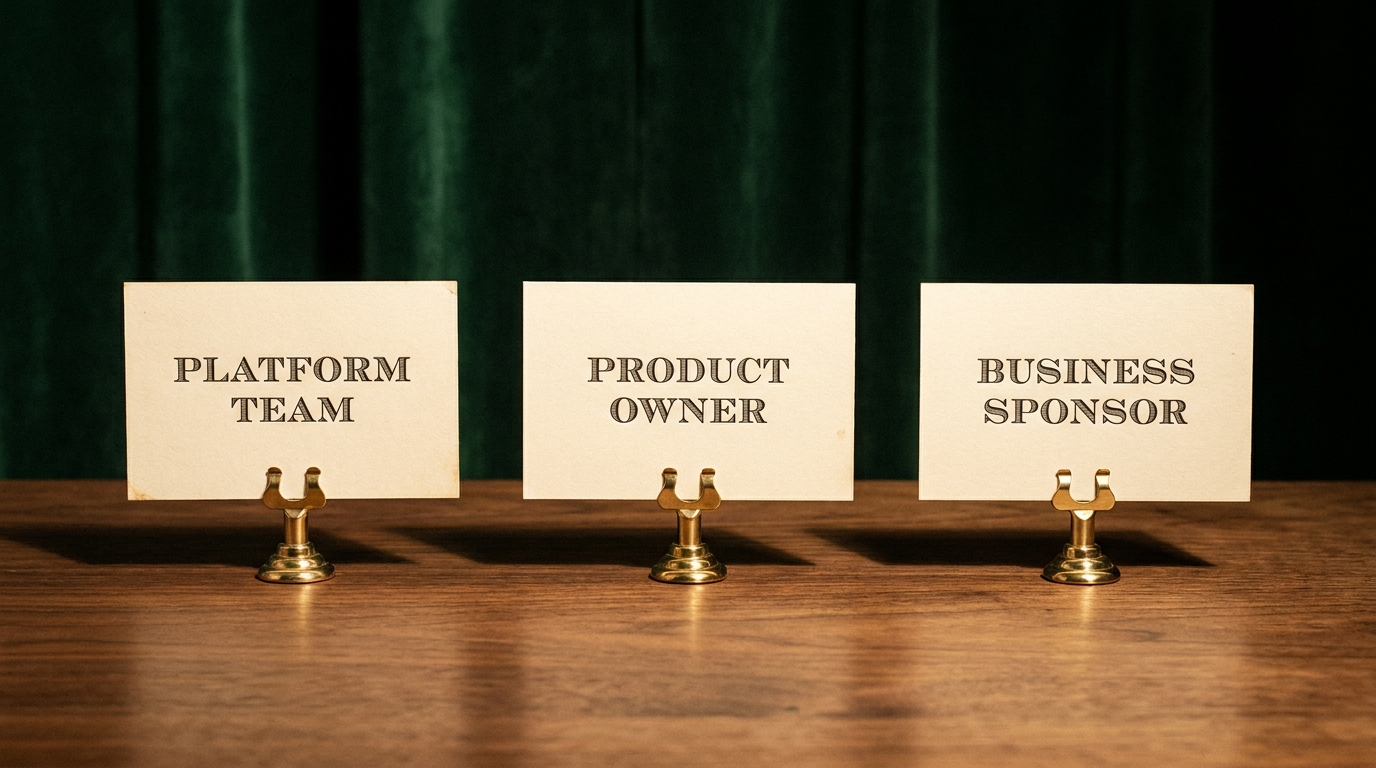
The structure that works is a platform team plus product-line owners plus business sponsors. The platform team is a funded, standing internal team that builds and maintains the shared substrate. Treat it as an internal product with its own roadmap, not a project that disbands when a grant runs out. Each product line has a product owner responsible for its performance and evolution. Each line has a business sponsor accountable for the outcome it exists to deliver. Funding follows the same logic: the platform is funded continuously like a product, and individual lines draw on it, rather than every workflow raising its own capital from scratch.
The change-management work is real and worth naming. Teams have to be reskilled to build on shared assets instead of reaching for bespoke ones. Incentives have to reward reuse, not just novel demos. And the pilot-factory habit, the reflex to celebrate the launch and ignore the operation, has to be retired on purpose, because it is comfortable and it is exactly what keeps returns flat.
This is the point in most transformations where ambition meets capacity. The operating model is clear on paper, and the organization still lacks the embedded engineering muscle to build the shared layer without a year-long hiring spree. That is the specific gap a fractional agentic team is built to close: an embedded team that builds your shared AI substrate alongside your people, so the platform, the controls, and the eval harness exist in months rather than after a reorg. For leaders who want to scope the portfolio shift before committing, an AI Transformation Discovery sprint maps which workflows earn a product line and what the shared layer needs to support them.
A staged path from pilot factory to portfolio
None of this requires a big-bang reorganization, and attempting one is a good way to stall. The move from pilot factory to portfolio is a sequence you can start where you are.
- Pick one high-impact workflow using the impact, reuse, and data-readiness lens. Choose one that will also produce a shared asset others need.
- Extract the first shared asset from it. When you build that workflow's CRM integration or its human-in-the-loop control, build it as a reusable service, not a one-off. The first asset is the seed of the platform.
- Assign the first owner. Give the workflow a real product owner and name the person accountable for the shared asset. Ownership is what keeps the asset alive after launch.
- Standardize one eval. Write the shared test that this product line must keep passing, and make it the template for the next one. One scoreboard beats ten sets of vibes.
- Retire one dead pilot. Publicly kill a proof-of-concept that will never compound. It frees budget and it signals that the standard has changed.
Do that, and you have the beginning of a portfolio: one owned product line, one reusable asset, one shared eval, one owner, and one fewer demo pretending to be progress. The second workflow is now cheaper than the first. The habit has started to compound.
Key takeaways
- Pilots do not compound. Portfolios do. Accumulating one-off proofs-of-concept grows spend without growing capability. Only reusable, owned product lines bend the cost curve.
- A product line is owned, versioned, monitored, and reused, where a pilot is a disposable experiment. That difference decides whether anything survives to help the next workflow.
- Five assets create the compounding: shared patterns, control templates, reusable integrations, common evals, and a clear owner model. Ask your team for them by name.
- Select workflows deliberately on impact, reuse potential, and data readiness. Not everything earns a product line, and killing dead pilots is part of the discipline.
- The operating model is the hard half: a funded platform team, product-line owners, and business sponsors, sitting on one governed data foundation.
Scaling AI from pilot to production was never a modeling problem. It is an operating-model problem, and the companies that solve it stop paying full price for every workflow . If your pilots are not compounding, the missing piece is almost always the shared layer and the team to build it, which is exactly what an embedded fractional agentic team exists to stand up, so your next workflow is nearly free.