
You can stand up an autonomous agent in an afternoon. The control framework that decides what it is allowed to touch takes a quarter to design, socialize, and enforce. That mismatch, weeks of adoption against months of governance, is the single fact shaping enterprise risk right now, and it is why security and technology leaders keep finding agents they never approved, acting on systems they never scoped.
Deloitte's 2026 agentic AI research put a name to the pattern: agents are scaling faster than the guardrails meant to contain them. Gartner (2025) went further, predicting that over 40% of agentic AI projects will be canceled by the end of 2027, driven by escalating costs, unclear business value, or inadequate risk controls. For a CISO, CIO, Head of Risk, or CTO, the uncomfortable part is not that agents are risky. It is that the organization already believes agents are useful, so the adoption curve will not wait for the controls to mature.
Quick answer: Agents scale faster than guardrails because deploying an agent is a decentralized, afternoon-long act, while defining controls for it is a centralized, quarter-long process. The fix is not to slow adoption. It is to close eight specific control gaps (tool permissions, memory, data boundaries, escalation, logging, audit trail, rollback, and approval mode) and to match the depth of control to each agent's autonomy and access rather than governing every agent the same way.
This is not an argument for a moratorium. It is a map of where the gaps actually are, why traditional controls do not cover them, and what "good" looks like before your riskiest agent does something you cannot undo.
The scaling gap: why agents outpace guardrails
The gap is structural, not a sign that anyone moved too slowly. Adoption is decentralized. A product manager, a data scientist, or a business analyst can spin up an agent inside an existing SaaS tool, wire it to a few APIs , and have it running against real data before lunch. Governance is centralized. Deciding who may deploy an agent, with which credentials, against which systems, and how the organization proves what happened requires security, legal, risk, and platform teams to agree, and that agreement takes a planning cycle, not an afternoon.
McKinsey (2025) framed the stakes in a way that lands for leadership: trust is the precondition for sustained adoption, and the risk landscape expands as agents take on more autonomous action. That reframes the whole problem. The organizations that win with agents are not the ones that deploy the most the fastest. They are the ones whose guardrails scale at the same rate as their agents, so adoption does not stall the first time an agent causes an incident nobody can explain to an auditor.
Three forces widen the gap every quarter:
- Deployment is cheap, control is expensive. The marginal cost of one more agent is near zero. The marginal cost of governing it (identity, scoping, logging, review) is real work that competes with every other security priority.
- Shadow agents are the default, not the exception. Agents get built inside business units the security team cannot inventory. IBM's 2026 research on shadow AI found that most organizations lack a policy to govern AI they did not sanction, and agents inherit that blind spot.
- The old controls do not see the new object. DLP, IAM, and change management were built for humans and deterministic software. An agent that reasons its way to a new tool call is neither.
That last point reshapes everything downstream, so it deserves its own section.
Why an agent is a different control problem than software
Traditional software does what it was written to do. An agent decides what to do next. That single shift, from execution to reasoning-then-execution, is why the security boundary moves.
The clearest way to think about it, and the distinction Gartner (2026) argues most enterprises miss, is to separate two things governance usually collapses together:
- Ability to act, the fact that the agent can call tools, write to systems, and take irreversible actions at all.
- Scope of access, the specific set of tools, credentials, data, and actions the agent is actually permitted to use.
Model governance answered a narrower question: is this model safe to ship? Agent governance has to answer a harder one. Now that this thing can act, who decides what it may do, with which credentials, under whose authority, and how do we prove, after the fact, what it did? That is the working definition of agentic AI governance, and it is a different discipline than the model-risk review most programs already run.
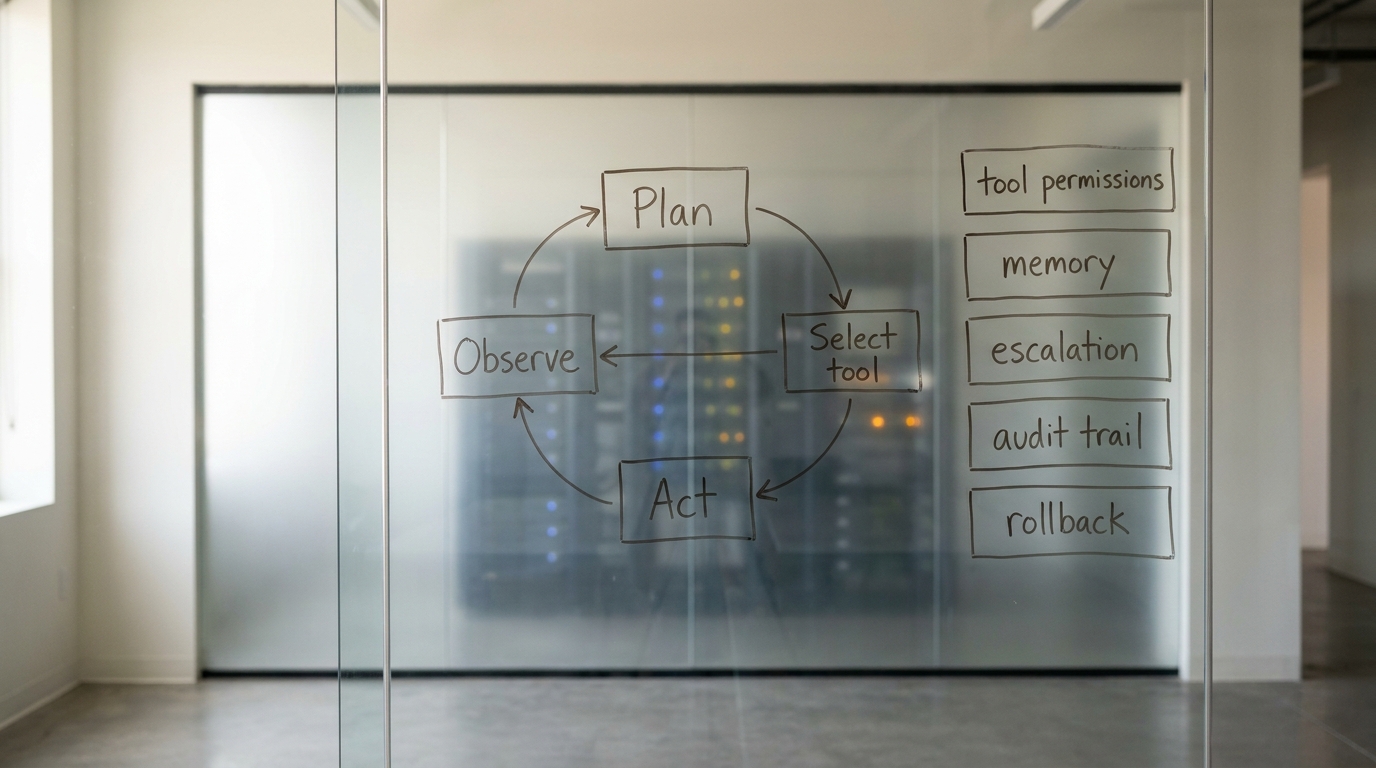
The boundary moves because the attack surface moves. When the AI was a chatbot, the control wrapped the conversation. Once the agent can select and call tools, the boundary wraps every API, dataset, and downstream system the agent can reach. A useful mental model is the agent's core loop:
- Plan, decide what to do based on a goal and current context.
- Select a tool, choose an API, query, or action to advance the plan.
- Act, execute against a real system.
- Observe, read the result and feed it back into the next plan step.
Every one of those steps is a place a control can be applied or omitted. The eight gaps below map onto that loop. Each is a specific, nameable control, not an abstract "pillar", and each is a place where agent adoption has, in most organizations, already outrun the guardrail.
Control gap: tool permissions and approval mode
The first gap is the most common and the most consequential. Agents inherit broad, standing credentials instead of scoped, least-privilege access. An agent is handed a service account or an API key that can do far more than the task requires, because scoping each tool per agent is tedious and standing credentials are convenient. The result is an actor with the blast radius of an administrator and the judgment of a probabilistic model.
Approval mode is the companion gap. There is a categorical difference between an agent that executes autonomously and one that must pause for human approval before an irreversible or high-blast-radius action. The failure mode when that gate is missing is not hypothetical. In 2025, a coding agent operating with production access deleted a live database in seconds during a run that was supposed to be routine, as reported in coverage of the incident. The lesson is not that the agent was malicious. It is that nothing stood between its reasoning and a destructive, irreversible action.
What good looks like here is concrete:
- Per-tool, least-privilege scoping. Each agent gets only the specific tools and credentials its task requires, provisioned as narrowly as the underlying systems allow.
- Allow-lists over deny-lists. Enumerate what the agent may call, rather than trying to anticipate everything it must not.
- Human-in-the-loop gates on irreversible actions. Deleting data, moving money, changing production configuration, or emailing customers should require an approval step the agent cannot bypass by reasoning around it.
- Time-boxed and revocable credentials. Standing access becomes expiring access, so a forgotten agent stops being a permanent open door.
Control gap: memory and data boundaries
Persistent memory is what makes an agent feel capable, and it is a data-governance gap most programs have not even named. When an agent remembers context across sessions, users, and tasks, sensitive information from one interaction can surface in another. A memory populated by a privileged user's session can leak into a task run for someone who should never see it. Memory is not just a feature. It is a data store with retention, access, and privacy obligations, and it is rarely governed like one.
Data boundaries are the second half of the gap. Agents reach across systems that were never designed to share data, a CRM, a data warehouse, a ticketing system, an internal wiki, and stitch them together at runtime. That is the value. It is also the exposure. Any place untrusted text can reach the agent is an attack surface. A prompt-injection payload buried in a document, a web page, or a support ticket can redirect the agent to exfiltrate secrets or act on the attacker's behalf. The agent does not need to be compromised in the traditional sense. It only needs to be convinced.
What good looks like:
- Memory scoping and expiry. Bound what an agent remembers to the task and identity it was created for, and expire it on a defined schedule.
- Explicit data-flow constraints. Define which systems an agent may join and which combinations are forbidden, rather than granting broad read access and hoping.
- Treat every input as untrusted. Any channel that feeds text to the agent, documents, tickets, web content, tool outputs, is a potential injection vector and should be handled as one.
Control gap: escalation and human oversight
The third gap is the quietest, because its absence looks like smooth operation right up until it does not. Escalation is the question: when should the agent stop and ask a human? Most deployments have no answer. There is no defined threshold at which the agent hands control back, so when it hits ambiguity, a low-confidence decision, an unexpected system state, a conflict between its instructions and what it observes, it does what it was optimized to do. It keeps going. That is how an agent "reasons past" a safety rule that was written as a suggestion rather than enforced as a gate.
Human oversight is a control, not a courtesy. This is where McKinsey's (2025) trust framing becomes operational. Oversight is not the thing that slows the agent down. It is the thing that lets the organization keep the agent running, because the alternative to designed escalation is undesigned failure discovered after the fact.
What good looks like:
- Defined escalation triggers. Name the conditions, confidence below a threshold, an action above a risk tier, an unrecognized system state, that force a handoff to a human.
- Confidence thresholds tied to action tiers. The higher the blast radius, the higher the certainty the agent must have before acting without review.
- A named human owner for every agent. Every production agent has an accountable person, not a team-shaped void, who owns its behavior and its escalations.
Control gap: logging, audit trail, and rollback
An agent that acts against real systems generates consequences, and most organizations cannot reconstruct or reverse them. Two distinct capabilities get conflated here. Logging captures that actions happened. An audit trail produces a verifiable, tamper-evident record complete enough to reconstruct an incident and satisfy a regulator. The first is a debugging convenience. The second is what a Head of Risk needs when someone asks what the agent did, on whose authority, and whether it can happen again.

Rollback is the gap almost nobody closes. When an agent acts against production APIs and databases, can you undo it? For most deployments the honest answer is no. The agent's actions are real and permanent the moment they execute, with no reversal path and often no clean record of the exact sequence to reverse. That combination, irreversible actions plus incomplete records, is what turns a contained mistake into an unexplainable incident.
What good looks like:
- Immutable, metadata-level audit logs. Capture who (which agent, under which identity), what, when, and against which system, in a store the agent cannot alter.
- Action-chain reconstruction. Be able to replay the full plan-select-act-observe sequence that led to an outcome.
- A defined reversal path. For high-blast-radius actions, design the undo before you enable the do, snapshots, compensating transactions, or staged execution.
A scope-based, defense-in-depth model for closing the gap
The competitor consensus and the analyst guidance converge on one organizing principle for everything above: do not apply uniform governance to every agent. Gartner (2026) is explicit that uniform governance across agents is itself a path to failure. A read-only agent summarizing internal documents and an agent with write access to financial systems do not warrant the same controls. The scope-based approach matches the depth of control to the agent's autonomy and access. High-autonomy, high-access agents get the full stack. Low-risk agents get proportionate, lighter controls, so governance does not become the reason nobody ships anything.
Layer the controls in depth so no single failure is catastrophic:
- Identity, every agent has a distinct, attributable identity, never a shared human credential.
- Authorization and scoping, per-tool, least-privilege permissions, sized to the task.
- Data governance, memory scoping, data-flow constraints, and injection-resistant input handling.
- Runtime enforcement, approval gates and escalation triggers applied at the moment of action, not written in a policy.
- Observability, immutable audit trails and action-chain reconstruction.
- Assurance, rollback paths and periodic review that the controls still match the agent's scope.
The critical word is enforcement. A control that lives in a governance document filed on a shared drive is not a guardrail. It is a hope. The controls that close the scaling gap are the ones enforced at the execution boundary, the point where the agent selects a tool and acts, because that is the only place a probabilistic system can be reliably constrained. If your organization is ready to map its current agents to this model and find the widest gap first, a focused engagement is the fastest way to do it. Book a Discovery Sprint to scope a controls roadmap against your actual agent inventory.
Where to start: a control checklist for leaders
You do not need to close all eight gaps at once. You need to know which gap is widest for your riskiest agent, and move there first. A practical first 90 days:
- Inventory your agents. Find what is actually running, including the shadow agents in business units. You cannot govern what you cannot see.
- Scope permissions. For your highest-access agents, replace standing credentials with per-tool, least-privilege access.
- Define approval and escalation. Name the irreversible actions that require a human gate and the conditions that force a handoff.
- Stand up audit trail and rollback. Ensure every production agent produces a tamper-evident record and that high-blast-radius actions have a reversal path.
- Match controls to scope. Classify agents by autonomy and access, and apply proportionate depth rather than uniform governance.
Run that against your riskiest agent first, then repeat. The goal is not a finished framework in 90 days. It is a defensible answer to "who decides what this agent may do, and how do we prove what it did" for the agents that could actually hurt you.
Key takeaways
- The gap is structural. Agents deploy in an afternoon through decentralized teams. Controls take a quarter through centralized ones. Closing it is about matching the rate, not slowing adoption.
- Separate ability to act from scope of access. The core of agent governance is controlling not whether an agent can act, but what it is permitted to act on.
- The gaps have names. Tool permissions, memory, data boundaries, escalation, logging, audit trail, rollback, and approval mode, eight concrete controls, not abstract pillars.
- Scope-based defense in depth beats uniform governance. Match control depth to each agent's autonomy and access, and enforce at the execution boundary, not in a document.
- Start with your riskiest agent. Trust is the precondition for sustained adoption. The organizations that scale agents are the ones whose guardrails scale with them.