

A security reviewer asks one plain question during an audit: how many AI agents are running in production right now, and what can each of them touch? In most companies the honest answer is a shrug. Agents show up from every direction. Internal teams build them on LangChain or CrewAI. SaaS vendors switch on agent features you already pay for. Individual employees wire copilots and MCP servers into company systems on their own. Every control leadership answers for - security, audit, compliance, access - rests on a fact nobody has nailed down. You cannot govern agents you cannot list.
An AI agent registry (or agent inventory) is a centralized, continuously updated catalog of every agent in your organization: what it does, which tools it can call, what data and systems it can reach, who owns it, and what it logs. It is the single source of truth that makes governance, security, and audit possible.
This is a governance problem before it is a tooling problem. What follows is a working model for the inventory itself: what it is, why it matters now, what belongs in each record, how the agent, tool, and data layers relate, and how to stop it from rotting into a stale spreadsheet.
What an AI Agent Inventory Actually Is
An AI agent inventory is a centralized catalog of every autonomous agent deployed across your environment. It answers the three questions security, compliance, and engineering teams otherwise cannot: how many agents exist, what each one is allowed to do, and who is responsible when one misbehaves.
One clarification first, because the phrase is overloaded. An "agent inventory" here means a governance record of the autonomous agents in your environment. It is not an inventory-management agent for warehousing or supply chain. Both are real. This is the governance one.
It also helps to separate a registry from the lists people confuse it with. A directory or marketplace is a catalog of agents you might adopt. Useful for discovery, but it makes no promise that any entry is legitimate, current, or safe. A registry is the opposite: a governed source of truth about the agents you already run, carrying identity, ownership, and versioning. Public agent directories now list well over a thousand entries, and a long list is not the same as trust. A directory tells you what exists in the world. A registry tells you what exists in your organization, and it holds someone accountable for each entry.
Why You Need One Now
The urgency comes from two shifts happening at once, and together they turn every unknown agent into a liability.
The first is sprawl. Agents no longer enter through a single controlled pipeline. Engineering teams build them. SaaS platforms ship them inside products you already pay for. Employees stand up their own copilots and MCP connections with no approval trail at all. This is shadow AI, and it grows faster than any manual tracking effort can keep up with.
The second is the move from predicting to acting. A model that only generates text is a contained risk. An agent that can call tools, move money, change records, email customers, or modify infrastructure is an actor inside your systems. Every unknown agent that can take action is an unmonitored path to your data and your operations.
The consequences land differently depending on the seat you hold. For the CISO, an unlisted agent is an unmanaged attack surface and a data-exfiltration route no one is watching. For the CIO, it is a failed audit waiting to happen, because you cannot attest to controls over systems you cannot even enumerate. For the CTO, it is reliability and architectural risk: an agent in production that no one owns and no one can safely change. None of those controls are possible until the inventory exists. So the real question is what a single record has to hold to make them possible.
What Belongs in the Record: The Six Dimensions
Most competitor definitions stop at "a list of agents." A list of names governs nothing. A useful record captures six dimensions for every agent, and each one maps to a specific control leadership needs.
| Dimension | What it captures | Why it matters for governance |
|---|---|---|
| Which agents exist | A unique identity for each agent: name, purpose, environment, status, and version | You cannot secure or audit what you cannot name. Identity is the anchor everything else hangs on. |
| What tools they can call | The functions, APIs, and MCP servers the agent is permitted to invoke | Capabilities are where real exposure lives. Tool access defines what the agent can actually do. |
| What data they access | The systems, datasets, and records the agent can read or write | Maps the blast radius of a compromised or misbehaving agent, and drives data-classification and DLP decisions. |
| Who owns them | A named human owner and team accountable for the agent | Turns an incident from "no one knows" into a clear line of responsibility and a person to call. |
| What logs they produce | The traces, decisions, and actions the agent records, and where those logs live | Without logs there is no audit trail, no incident forensics, and no way to prove what an agent did. |
| What workflows they affect | The business processes and downstream systems the agent participates in | Shows what breaks if the agent fails, and which processes inherit its risk. |
Fill these six fields for every agent and the record stops being a directory entry. It becomes a governance artifact. You can answer the auditor, scope an incident, and decide whether a given agent should exist at all. The fields also expose something a flat list hides: the agent, its tools, and its data are three separate layers of exposure.
Agent Registry, Tool Registry, and Data Registry
The six dimensions imply three connected layers, and treating them as one is where most inventories fall short.
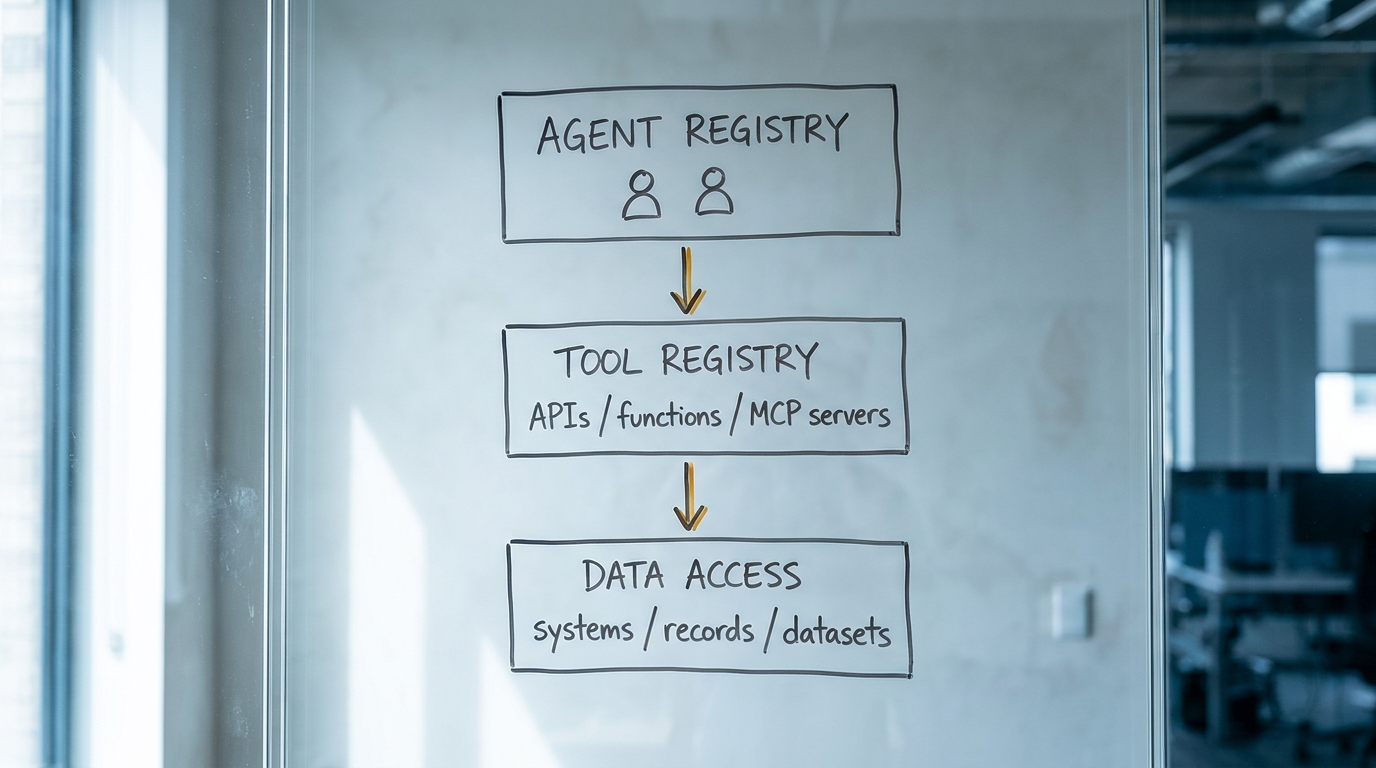
The agent registry lists the actors: the autonomous agents themselves. The tool registry lists the capabilities those actors can invoke, the APIs, functions, and MCP servers that let an agent do more than talk. The data-access inventory lists what those capabilities can reach: the systems, records, and datasets exposed through each tool.
These layers stack. An agent is only as risky as the tools it can call, and a tool is only as sensitive as the data behind it. Catalog the agents alone and you learn that actors exist, but not what they can do or touch. The exposure lives one and two layers down, in the tools and the data. A complete inventory follows the chain from agent to tool to data, so that granting an agent a new capability becomes a visible, governed decision instead of a silent one.
This is also why a model registry, which many engineering teams already run, is not a substitute. A model registry tracks the models you deploy. An agent registry tracks the autonomous actors built on top of them, plus the tools and data they reach. Related, but not the same layer.
How Enterprises Build and Maintain One at Scale
Standing up an inventory is a program, not a spreadsheet, and it runs in four moves.
Discover what is already running. Start from the truth on the ground, not a wish list. Pull from the platforms agents live on: your cloud and identity logs, gateway and API traffic, and the SaaS tools that now embed agents. The first pass exists to surface the shadow AI you did not know was there.
Assign ownership. Every agent gets a named owner and team. Unowned agents are the ones that cause incidents, so an agent with no owner is either assigned one or retired. There is no third option.
Wire it into existing controls. The inventory should not be a parallel universe. Connect it to your IAM, security monitoring, and audit tooling so agent identities, tool permissions, and data access flow through the systems you already trust rather than around them.
Keep it continuous. This is the step competitors skip, and the one that decides whether the whole effort survives. Agents are not static. They gain and lose tools, spin up for a project, and quietly disappear. A one-time census is stale within weeks. The inventory has to refresh on its own as agents change, or it turns into fiction that everyone stops trusting.
The market is converging on this need from several directions at once. Security vendors are extending their tooling to cover AI agents. Cloud providers are adding native agent inventories. Purpose-built governance platforms are emerging. The specific tool matters less than the operating model. A vendor-neutral inventory that spans agents, tools, and data will outlast any single product choice.
Turning Your Inventory into Governance
Once you can list agents, every control you have been asked to sign off on becomes achievable. Access management can be scoped to real agent identities. Monitoring can watch known actors and flag unknown ones. Audit can trace what each agent did , because the logs and ownership are recorded. Policy can be enforced, because there is finally a complete population to enforce it against.
That is the whole argument in one line. The inventory is not the goal. It is the precondition. Security, compliance, and reliability all sit downstream of one deceptively simple capability: knowing what exists. The companies that get this right treat the agent, tool, and data inventory as core infrastructure, the same way they treat asset management or identity, rather than a document someone updates the night before an audit.
Key Takeaways
- An AI agent registry (agent inventory) is a governed, continuously updated source of truth for every agent you run, not a directory of agents you might adopt.
- It matters now because of agent sprawl and shadow AI, and because agents have shifted from predicting to acting, which turns unknown agents into real operational and security risk.
- A useful record captures six dimensions per agent: which agents exist, what tools they can call, what data they access, who owns them, what logs they produce, and what workflows they affect.
- Agents, the tools they call, and the data those tools reach are three connected layers. Listing agents alone misses where the exposure actually lives.
- Build it by discovering what already runs, assigning ownership, wiring into existing IAM and security tooling, and keeping it continuous. A stale spreadsheet governs nothing.
Governing your agents starts with listing them, and most teams do not have the time or the internal picture to do that discovery on their own. A Discovery Sprint is a scoped, one-week engagement that inventories your agent, tool, and data landscape and hands you a governance roadmap you can act on. If you are earlier in the journey, start with an AI Readiness Snapshot , or bring in a Fractional Agentic Team to build and operate the inventory without new hires.