Restructuring announcements are the last step in an AI transition, not the first. By the time a company names AI in a reorganization, the work it describes moved months earlier, one task at a time, and nobody wrote it down.
An analyst stopped building the first draft of the monthly report and started editing one. A coordinator stopped assembling status updates and started checking them. A support lead stopped writing responses and started approving them. No job description changed. No reporting line moved. The work moved anyway.
That gap is where AI workforce decisions go wrong. Leaders are asked for a headcount plan and build it from an organizational map that stopped being accurate two quarters ago. The map is not wrong on purpose. It is just describing a company that no longer exists.
And underneath that sits a second problem that is easier to miss and more expensive to get wrong. When a model writes the draft and a person sends it, the accountability does not move with the task. It stays with the person. Except in most organizations nobody has said that out loud, and there is now research on what happens when they do not.
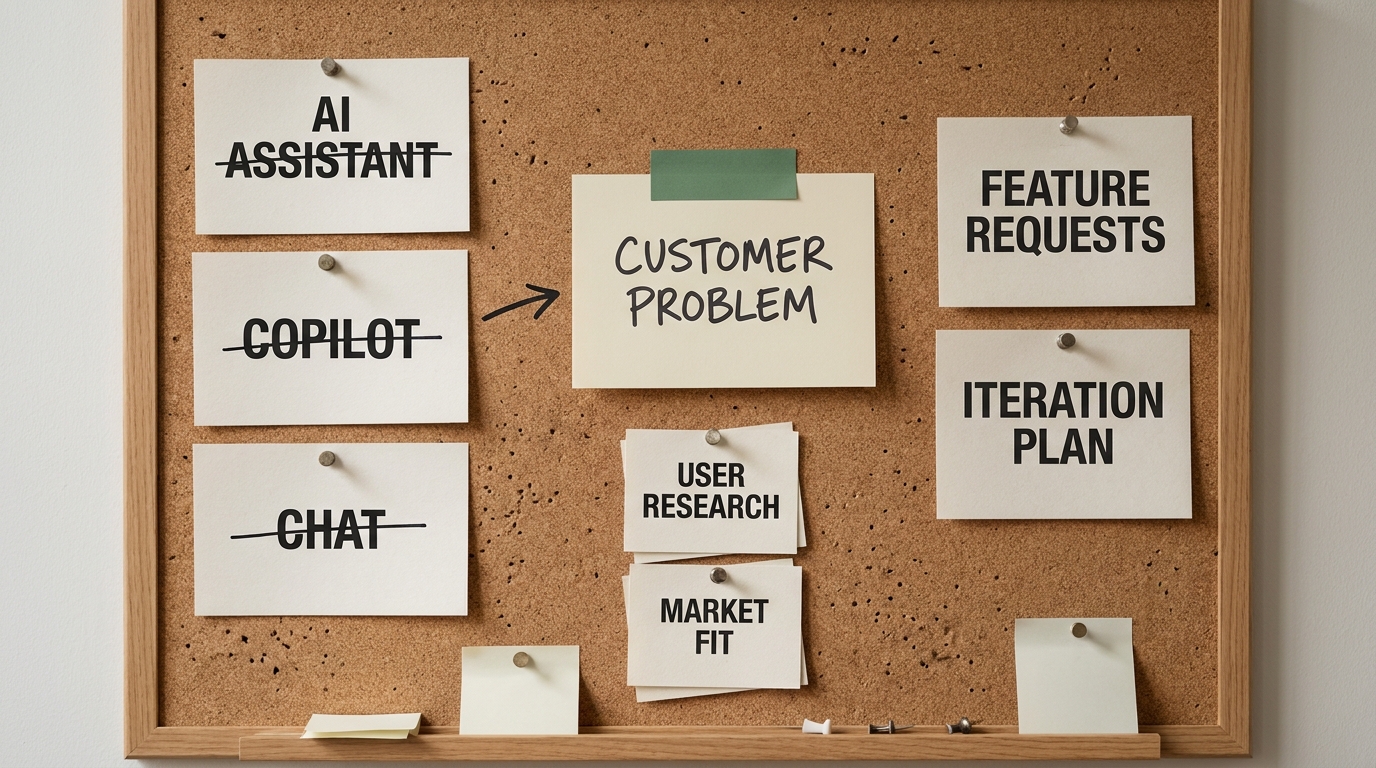
If you are a CEO, COO, HR lead, or delivery lead facing this decision, the headcount number is the wrong place to start. Three questions come first: which tasks have moved, who owns the output now that a model produced the first version of it, and what happens to the pipeline that was supposed to produce the people who check that output in five years.
The published coverage settles the first part of the argument and stops. AI reshapes work more than it eliminates it. Task-level analysis beats role-level analysis. Cutting headcount to fund AI produces budget rather than value. All true, all documented, none of it actionable on a Monday. What follows is the part nobody finishes: how to run the decomposition, where accountability actually lands, and what it costs to staff the review layer that makes any of it safe.
The org chart is the last thing to change
The sequence inside most organizations runs in a predictable order. Tasks shift first, usually because an individual contributor found a faster way to produce something and did not announce it. Workflows adapt informally around that change. Accountability gets fuzzy, because the person who used to produce the work is now the person who checks it, and nobody redefined what checking means. Then, two or three quarters on, the structure catches up in a formal reorganization.
Redesigning the structure first inverts that order. It commits headcount and reporting lines against a description of work that has already drifted.
What leaders tend to notice before the formal change is a set of weak signals rather than a clean break. Output volume rises without a matching rise in review capacity. Adoption becomes uneven between teams in a way that has nothing to do with the teams' formal mandates. Handoffs between functions get slower, not faster, because the front end of a process now runs at machine speed while the approval steps behind it still run at human speed. That mismatch is the tell. Speed at the front of a workflow becomes value or risk depending entirely on how the handoff is designed.
None of this shows up in a headcount model. It shows up in a task inventory, which almost no organization keeps. Nobody schedules that work, which is part of why it does not exist. So the first move is to build one.
Decompose the role before you touch the headcount
Every serious piece of analysis on this topic says the same thing: stop treating a job as the unit of analysis and look at the tasks inside it. Almost none of them explain how. Here is a method you can run on one real role in an afternoon.
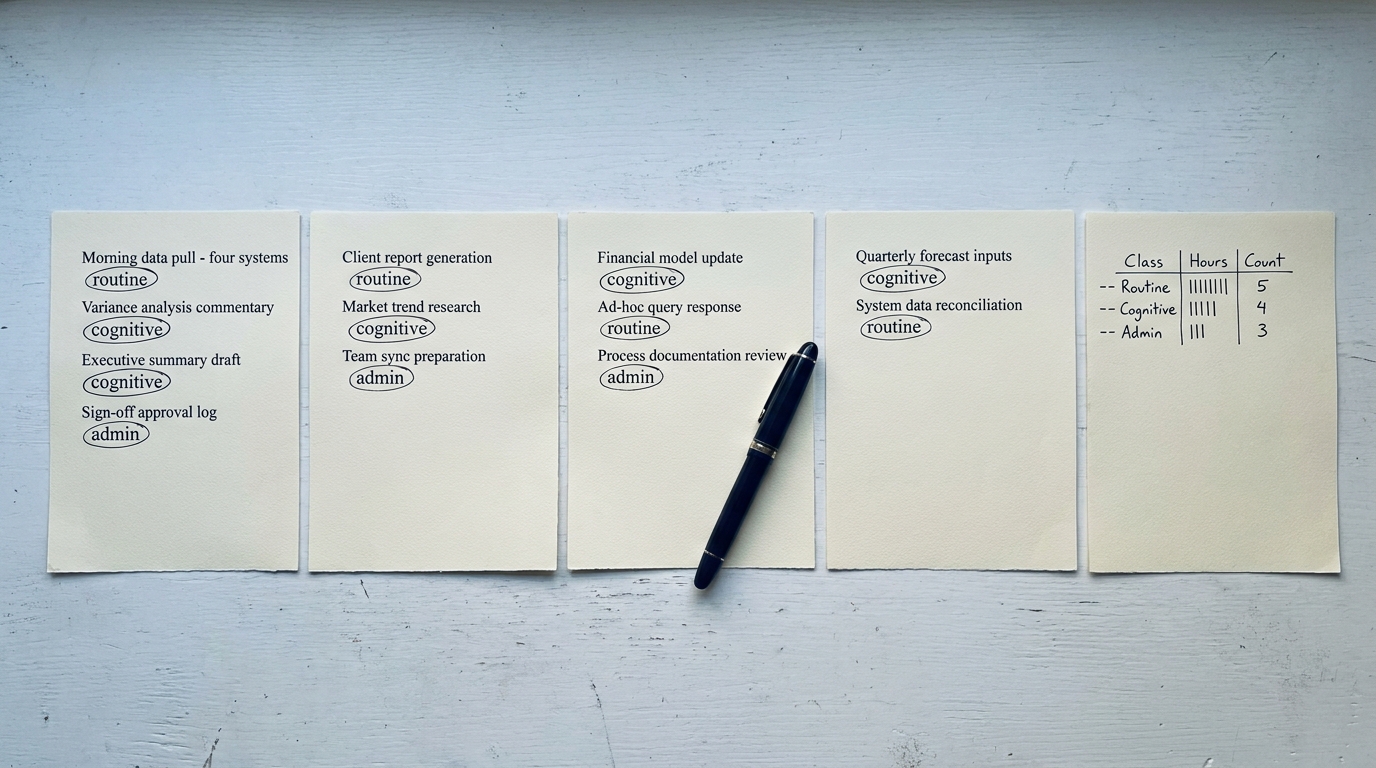
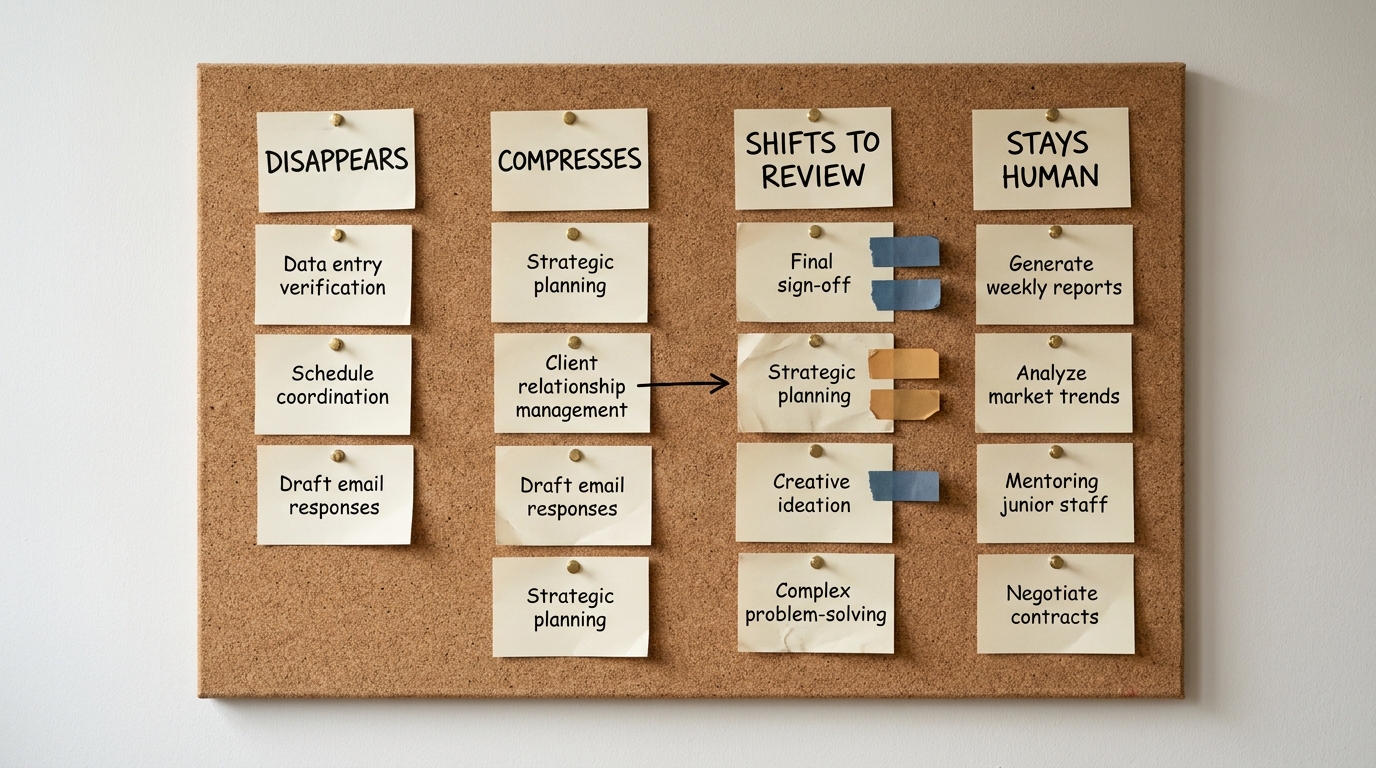
Pick a role. List fifteen to twenty tasks the way they actually happen, not the way the job description phrases them. Then sort each task into one of four classes, using the test attached to it.
Disappears. The task existed only to move information between systems, formats, or people. The test: does anyone consume its output as anything other than an input to the next step? If the answer is no, the task is overhead that survived because moving information used to be expensive.
Compresses. The work still happens, but the human time collapses. The test: is the person now editing a draft rather than producing one? Compression is where most of the measurable time savings live, and where most organizations mistakenly book a headcount reduction. A task that takes twenty percent of the time it used to has not disappeared. It has become cheap.
Shifts to review. A model produces the output and a person validates it and owns the result . The test: would you defend this output to a client, a regulator, or your board? If yes, the task has not been automated. It has been converted into a review task, and review is work.
Stays human. Judgment under ambiguity, relationship and negotiation, and accountability that cannot be delegated to anything. The test: does it require someone to decide with incomplete information and then be answerable for that decision? Those tasks are unaffected by tooling, and they are usually a smaller share of a senior role than the person holding it expects.
| Task class | What AI does | What the human owns | What triggers a review |
|---|---|---|---|
| Disappears | Replaces the transfer step entirely | Nothing. Retire the task and the reporting around it | One-time confirmation that no downstream consumer relied on it |
| Compresses | Produces a working first version | Judgment on framing, exceptions, and what to cut | Spot checks on a sample, not every instance |
| Shifts to review | Produces the full output | The result, the sign-off, and the consequences of an error | Every instance that leaves the team |
| Stays human | Nothing, or supplies background material | The decision and the relationship | Not applicable. There is no draft to check |
Once the tasks are sorted, count the hours by class. That number is the picture of the role that no job description contains, and it is the only defensible basis for a structural decision. The exercise is duller than it sounds, which is probably why so few teams run it.
Run it on a mid-level analyst and the pattern usually looks like this. Pulling figures from four systems into one spreadsheet: disappears. Writing the commentary that explains the variance: compresses, because the model drafts it and the analyst rewrites the half that is wrong. Deciding which variance is worth escalating: stays human. Signing the number that goes to the executive team: shifts to review, and it is now the most consequential thing in the role.
The count matters more than the categories. A role where fourteen of twenty tasks compress and two shift to review has not lost a headcount. It has changed shape, and the two review tasks now carry risk that used to be spread across the whole role. Which raises the question the sort cannot answer on its own: when one of those two goes wrong, whose problem is it?
Accountability does not move with the task
The most useful research finding in this field is also the most abandoned. Writing in Harvard Business Review, researchers from the BCG Henderson Institute reported on a study of more than 1,200 managers examining what happens when AI is framed as an "employee" rather than as a tool. When managers thought of the AI that way, they identified 18% fewer errors in its output. Individual accountability for those errors dropped by 9 percentage points, and accountability attributed to the AI itself rose by 8 points (BCG Henderson Institute in Harvard Business Review, 2026).
Read that as an operating risk rather than a philosophical one. Almost a fifth of the errors in front of a manager stopped being visible, and the only thing that changed was a word. Nobody decided to check less carefully. The framing did it for them, which is why this is a governance problem rather than a training problem .
The rule that follows is simple enough to state in one line and hard enough to enforce that most organizations skip it. Accountability attaches to the person who ships the output. Always. Regardless of what produced the draft.
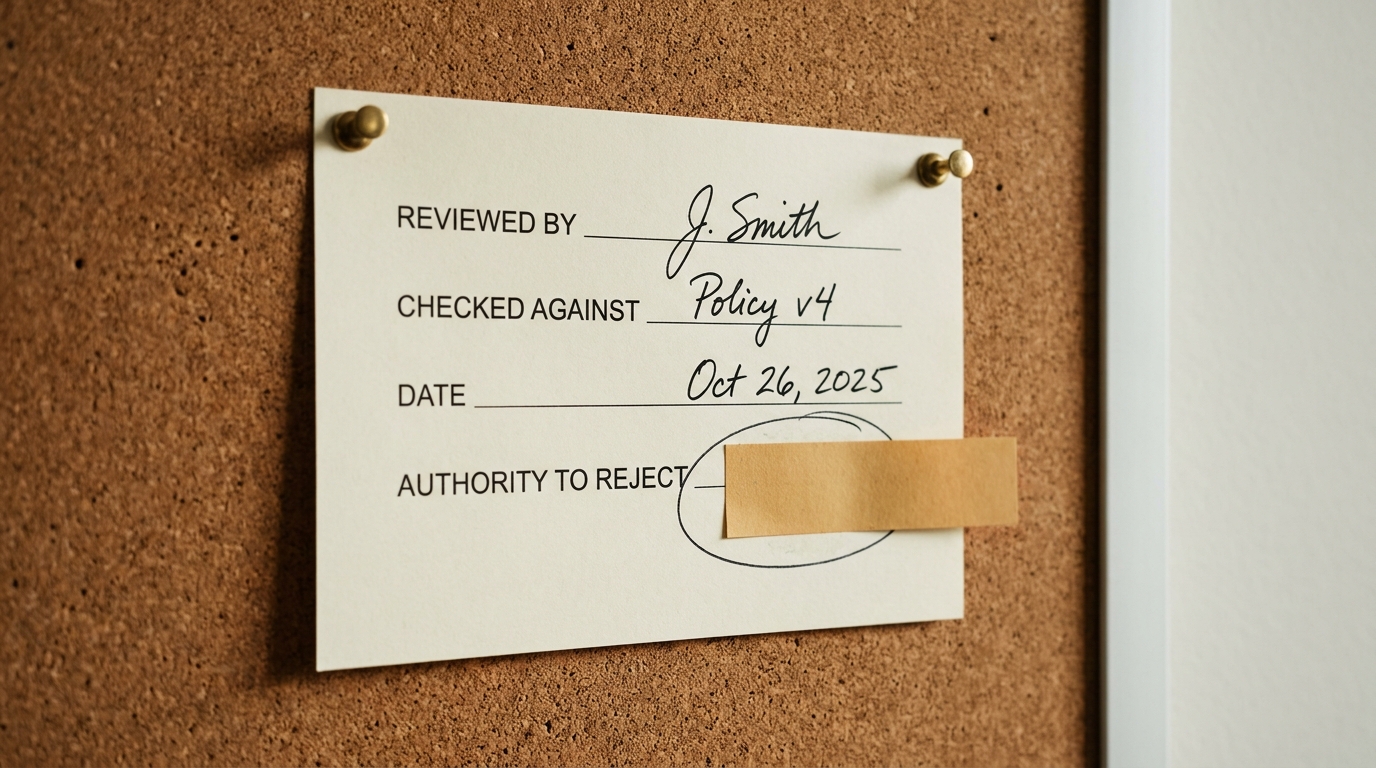
That rule only works if shipping is a distinct act with a record behind it. A sign-off does not need a governance program. It needs four fields:
- Who reviewed it
- What they checked it against, named specifically rather than "reviewed for accuracy"
- When they reviewed it
- Whether they were empowered to reject it, and what happened if they did
The fourth field is the one that exposes the problem, and most sign-off templates stop after the third. In most organizations, the person nominally reviewing AI output has no authority to send it back, no time budgeted to do so, and no definition of what would justify rejection. That is not a review. That is a signature.
The obvious objection is that this sounds like bureaucracy layered onto work that was supposed to get faster. The answer is that the same discipline already exists elsewhere in your organization and nobody calls it bureaucracy. Financial statements get signed. Code gets reviewed before it merges. Contracts get counter-read. Applying that same control to machine-drafted work is the only new part, and only because work a human produced end to end used to be trusted implicitly.
Review is a role, not an afterthought
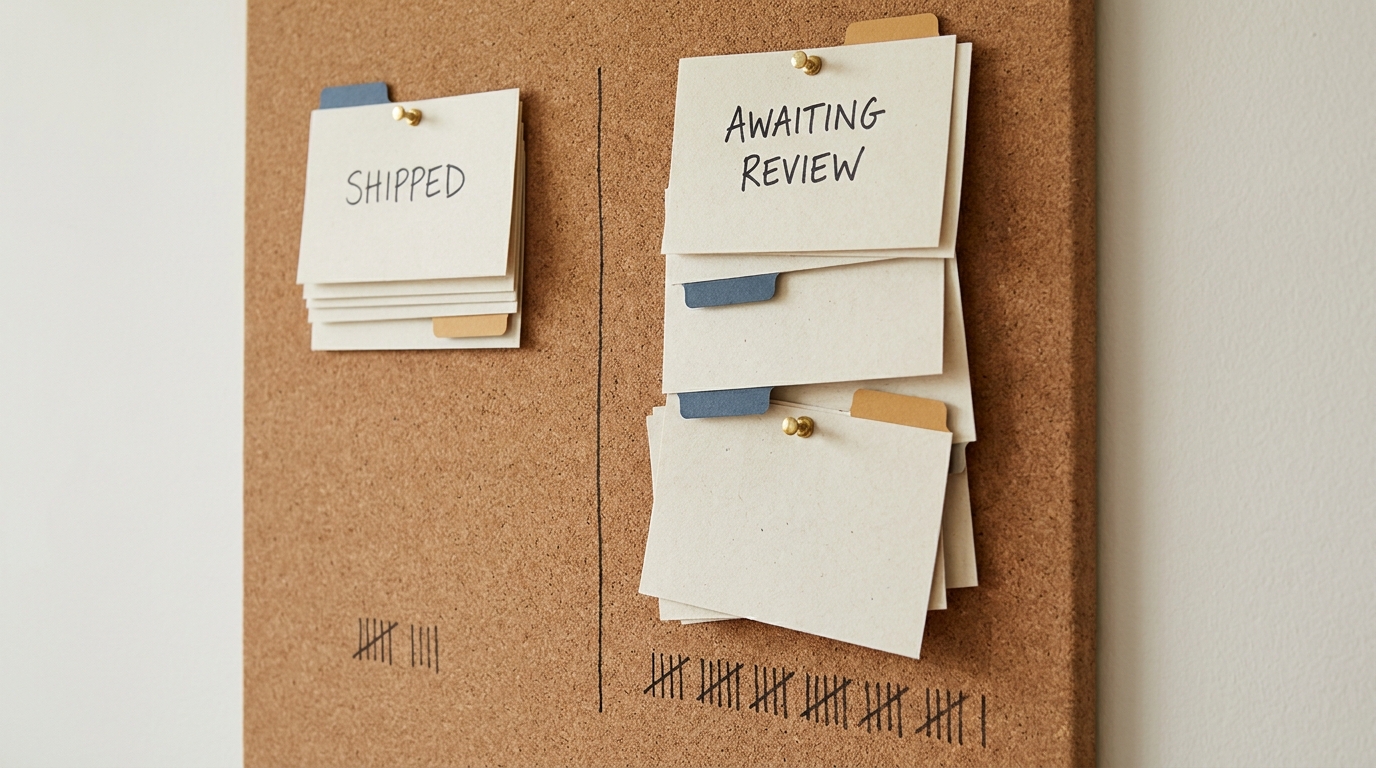
Every workforce model treats review as friction to be minimized. Invert that. Review capacity is the constraint that determines how much AI output your organization can safely ship, which makes it the thing worth planning around.
Doing it well requires three things that are rarely found together. Enough domain depth to spot an answer that is plausible and wrong, which is the specific failure mode that matters and the one a junior reviewer cannot catch . Actual authority to send work back. And enough volume literacy to know what normal looks like, so an anomaly registers as an anomaly.
The failure mode is easy to describe because it is common. Review gets assigned to whoever has spare capacity that week. They have no authority to reject and no standard to reject against. Output volume climbs, error detection falls , and the organization finds out about the gap through a client rather than through its own process. By then it is not a quality issue. It is a relationship one.
Budget review the way you budget capacity, not the way you budget overhead. If a tool triples draft output in a function, review hours become the bottleneck in that function by definition. Nobody puts that line in a budget, which is exactly the problem. Planning for the tripled output while leaving review hours flat is not an efficiency gain. It is a decision to ship unchecked work, made implicitly.
The functions that already do this well are worth copying rather than reinventing. Engineering has code review, with a defined reviewer, a standard, and a rejection path. Finance has the close, with reconciliation steps that exist specifically to catch plausible-looking errors. Both treat review as scheduled work with named owners, both measure how long it takes, and both accept that it costs real hours. Neither treats it as something a busy person does between other tasks.
For organizations that need review capacity faster than they can hire it, an embedded fractional AI team is one way to staff the layer while the internal pipeline catches up. That is a stopgap, not a fix. The fix is the next section, and it takes years.
The people who were going to become your reviewers
Here is the second-order cost almost nobody follows through on. Reviewing well requires having done the work badly first. Pattern recognition comes from producing a few hundred flawed versions of something and learning where they break. AI has removed exactly the junior tasks that produced that experience.
The people you need as reviewers in five years are the people whose training ground you are currently automating.
PwC's work on role convergence describes one visible consequence. As AI reduces the execution barriers that made narrow specialization necessary, responsibilities consolidate into broader roles, and PwC (2026) expects knowledge work to settle into an hourglass, with strong junior and senior tiers and a thinner middle, while front-line operations move the other way into a diamond that needs fewer entry-level people and more mid-level staff orchestrating agent-run work. The hourglass is not a design choice. It is what happens when the middle stops being produced.
The problem compounds from the other end. Rob Hillard, Deloitte's Asia-Pacific CEO, has said that graduates arrive with a negative perception of AI because university taught them that using it counts as cheating (Deloitte, 2026), which means the entry-level cohort is simultaneously less prepared for the work that remains and given less of the work that used to build judgment.
There is no clean answer, and it would be dishonest to offer one. There are partial moves worth making now:
- Give juniors review work early and supervised, with a senior reviewing the review. Reviewing is a skill, and it can be taught directly rather than acquired as a byproduct.
- Make juniors defend AI output rather than produce alternatives to it. Arguing why a draft is right or wrong builds the same judgment the old production work built, faster.
- Rotate early-career staff through the decomposition exercise itself. Sorting tasks into classes forces them to reason about what the work is for, which is the thing job descriptions never taught anyone.
None of this closes the gap. It narrows it, and it is a slower fix than anyone wants. It is also more than most organizations are doing, which is optimizing against the problem without noticing.
What changes in how you run the week
"New operating rhythm" is the phrase everyone uses and nobody specifies. Here is what actually changes in the management cycle.
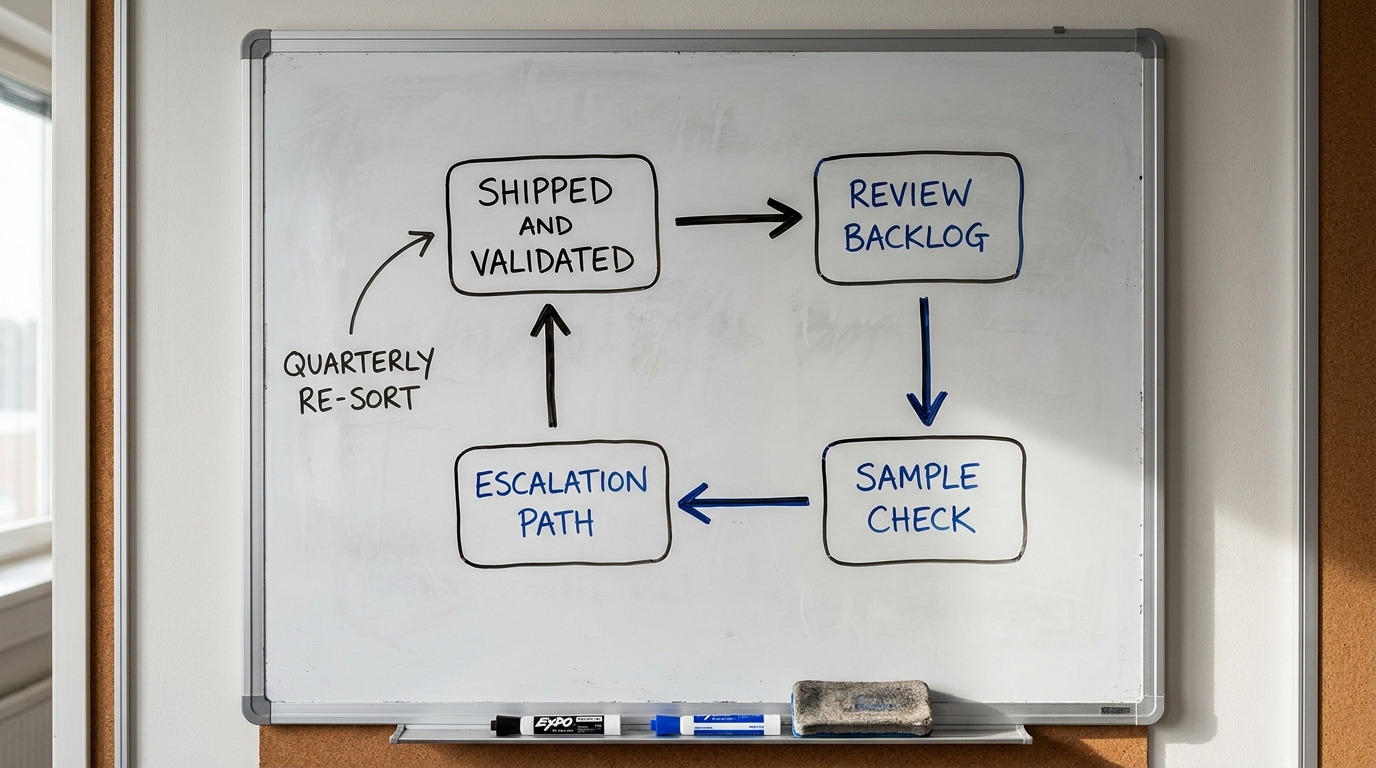
Status reporting changes its unit. The question shifts from what the team produced to what it shipped and who validated it. It reads like a reporting tweak. It changes what people optimize for, because volume stops being a proxy for progress the moment volume gets cheap.
Review backlogs become a standing agenda item, sitting beside delivery backlogs and treated with the same seriousness. A growing review backlog is the clearest early indicator that a function has taken on more AI-assisted output than it can stand behind.
Quality signals move upstream. Instead of waiting for a client escalation, sample reviewed output on a schedule and look at what got through. The sample rate matters less than the fact that someone is looking at all.
Escalation paths get shorter and more specific. When a reviewer rejects something, the path back has to be fast enough that rejecting is realistic. If sending work back costs a day of negotiation, reviewers stop sending work back.
Underneath all of it sits a quarterly re-sort. The decomposition from earlier is not a one-time exercise. The boundary between "compresses" and "shifts to review" moves every time the tools improve, which is faster than annual planning can absorb. A task that needed heavy human editing last quarter may need spot checks this quarter, and a task you were confident about may have become riskier without anyone noticing, because the output got more fluent without getting more correct.
The structure question, answered last
Only now is it worth discussing the org chart, and the ordering is the whole argument.
The structural patterns are real and well documented. Roles converge, and the boundaries between specialisms blur (PwC, 2026). Middle management gets reinvented rather than eliminated, because coordination work grows when more of the execution is machine-produced. Workforce planning starts having to account for a mix of human and machine capacity in the same model rather than treating tools as a separate line item.
What matters is where those changes come from. Deloitte's research on AI-driven workforce reductions found no consistent evidence that cutting roles improves financial performance, while a large majority of companies deploying autonomous capabilities are reducing workforce anyway (Deloitte, 2026). BCG's modelling points the same direction from the other side: over the next two to three years, roughly half of US jobs are expected to change substantially, and most of those roles remain (BCG, 2026). The pattern in both is that structure is being changed faster than work is being understood.
So the closing rule is a constraint on your own decision-making. If you cannot point to the task decomposition that justifies a structural change, the change is a guess with a headcount attached. Do the sort first. Fix accountability second. Staff review third. Then, and only then, redraw the chart, because by that point the chart is describing something you actually know.
Key takeaways
- Work redistributes months before structure changes. A headcount plan built from the current org chart is built from an out-of-date map.
- Sort tasks into four classes - disappears, compresses, shifts to review, stays human - and count the hours in each. That count, not the job description, is the basis for any structural decision.
- Accountability attaches to whoever ships the output, regardless of what produced the draft. Framing AI as a colleague measurably reduces how much error managers catch.
- Review capacity is the constraint on how much AI output you can safely ship. Budget it as capacity, with named owners and a real rejection path.
- The junior tasks AI removed were the training ground for the reviewers you will need in five years. Teach reviewing directly, because it will no longer accumulate on its own.
If the sequence above is right, the first thing worth knowing is where your own work has already moved - and that is usually invisible from inside the current org chart. A free 30-minute AI Readiness Snapshot maps where AI is already changing task distribution in your organization and where accountability has gone unassigned. Book a readiness call and start with the decomposition rather than the reorganization.