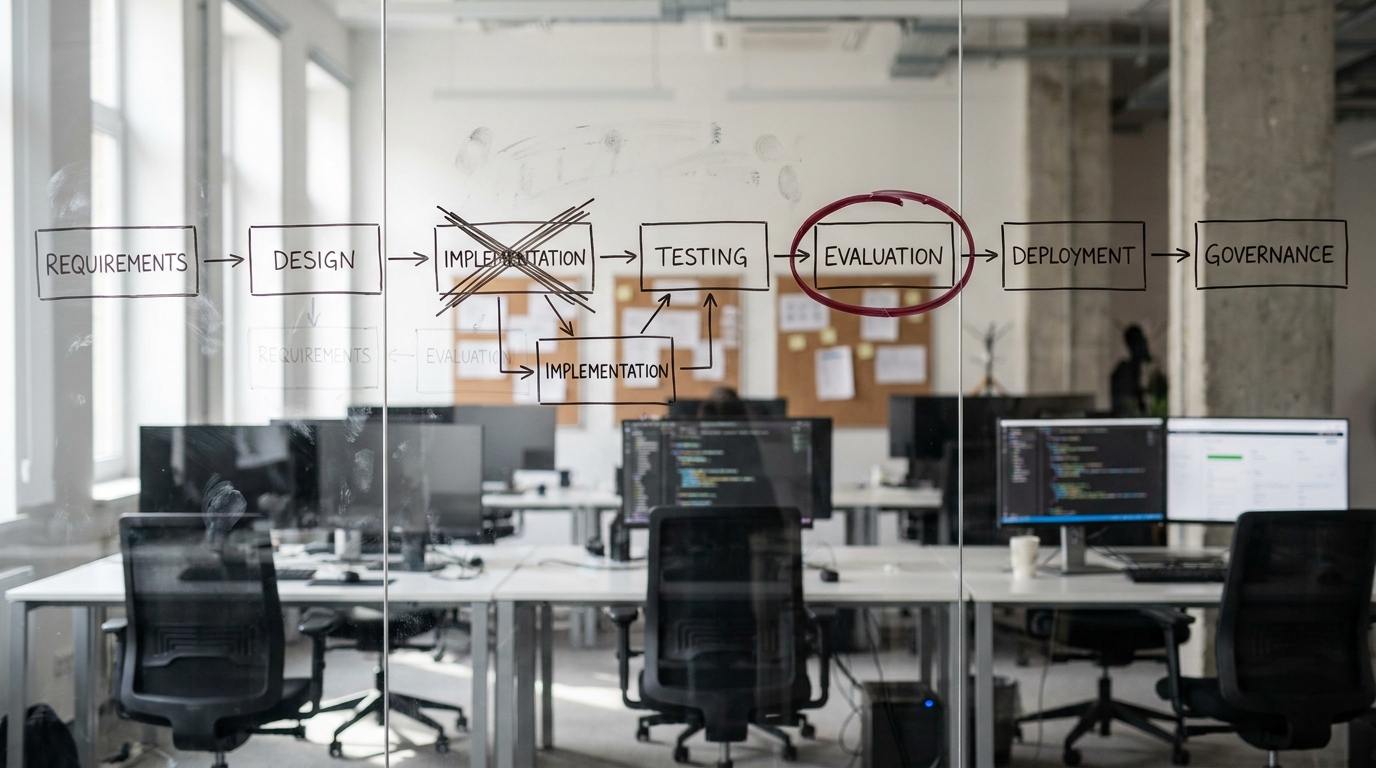
An agent that is right and an agent that is wrong produce output that looks exactly the same, right up until someone checks. The prose reads clean either way. The confidence is identical either way. That one fact is why a working agent and a shippable agent are not the same thing, and it is why so many capable agents are stuck a single step short of production. A May 2026 industry finding put a name to the stall: a capability-deployment verification gap. Teams had working agentic capability sitting in a pilot and could not move it into production, because the mechanisms to verify the output were not there. The blocker was never the model. It was proof.
This article is about closing that gap. Not with a better model, but with a verification stack. Six mechanisms that, assembled correctly, let a technical leader say "here is how we know this agent is behaving, and here is how I would defend that to the board." I will define each one, name when it applies and what it misses, then show how to layer them by risk instead of bolting all six onto everything.
The demo lied to you (a little): capability is not proof
A good agent demo shows exactly one thing. The agent completed a task once, under conditions someone picked, with a person in the room to catch it if it went sideways. That is real. It is also a sample size of one, drawn from the friendliest corner of the input distribution.
Verification is the work of turning that single observation into a defensible claim about behavior nobody watched. The gap is the distance between "it can do the task" and "we can prove it does the task correctly, unobserved, at the scale and variety production will throw at it." Capability sits on the left of that gap. Proof sits on the right. A demo only ever speaks to the left.
What makes the gap dangerous is that a good demo actively manufactures overtrust. Someone watches an agent read a document, reason through it, hand back a clean answer, and their intuition quietly generalizes: if it did that, it can do the rest. Ordinary software mostly behaves that way, so the intuition is usually safe. Agents break it. The demo case and the failure case can look identical right up to the output, and the output can be fluent, confident, and wrong. Naming the gap is the first control, because a team that believes capability equals proof will not build any of the mechanisms below. They ship on vibes and learn the hard way.
Why your existing QA playbook doesn't transfer
Every QA instinct you have was built for deterministic software, and most of them quietly fail on agents. It is worth being precise about why, because the failure is structural rather than a matter of trying harder.
- Non-determinism. The same input can produce different outputs across runs, all of them valid. A traditional test assertion compares against one expected value. That comparison means nothing when three phrasings are equally correct and a fourth is subtly wrong.
- No single ground truth. For a lot of agent work, summarizing a contract, drafting a reply, deciding which tool to call, there is no one canonical answer to diff against. Correctness is a range, sometimes a judgment call, rarely a string match.
- Silent, plausible failure. Deterministic systems fail loudly. A null pointer, a 500, a stack trace. Agents fail quietly. They return something that reads perfectly and is factually or procedurally wrong, and nothing throws.
- Compounding across steps. A modern agent chains tool calls and reasoning steps. A small error early, a misread field, a wrong assumption, propagates and amplifies. Google's research on scaling agent systems (2026) lands on the same point: failures in multi-step agents often trace back to an earlier step whose output looked fine on its own.
So "we tested it" no longer means what it used to. You cannot write a fixed suite of pass/fail assertions and call the system verified. You need mechanisms built for behavior that is probabilistic, judgment-laden, and quiet when it breaks. That is the next section.
The six verification mechanisms that close the gap
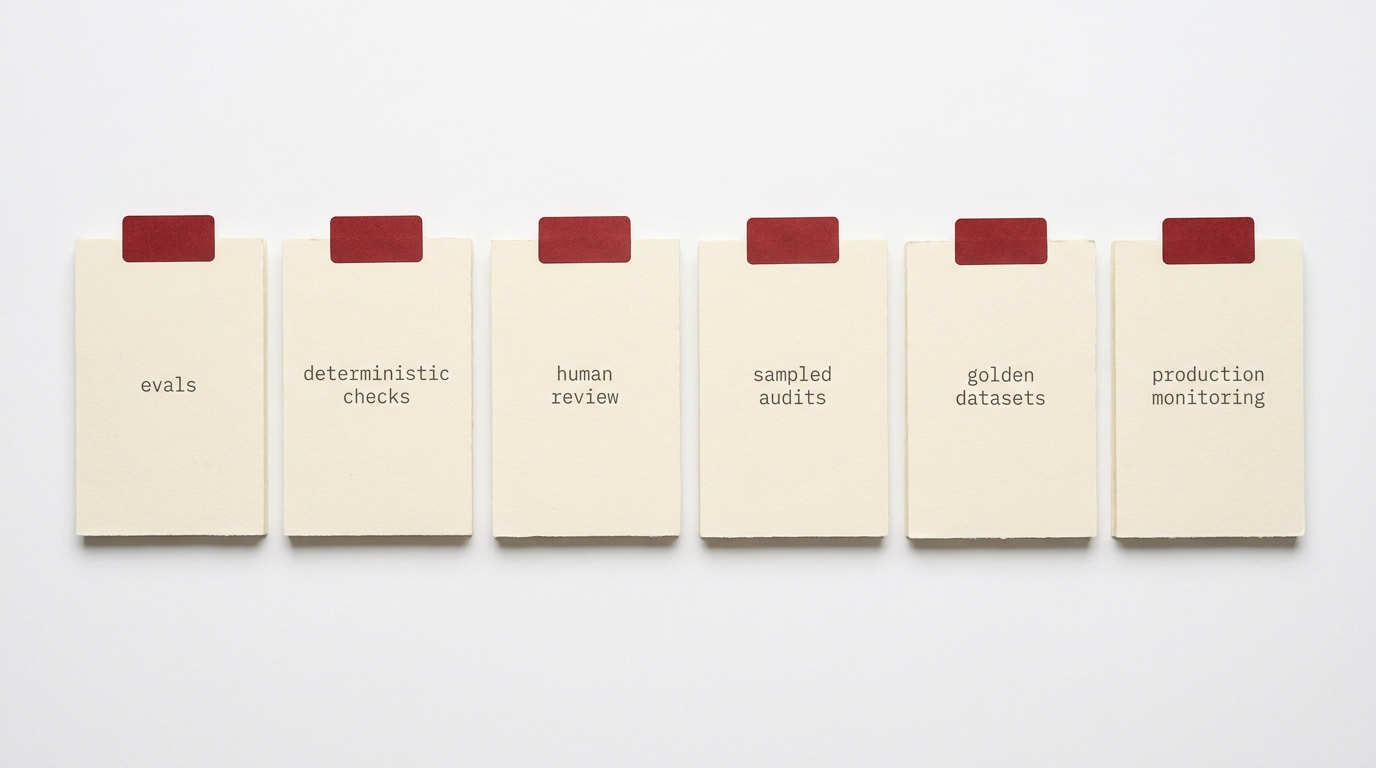
No single tool closes the verification gap. Six do, each verifying a different thing, each with a blind spot the others cover. For each one: what it checks, when to reach for it, and what it will not catch.
Evals
Evals are structured tests of agent output against a scoring rubric, run offline on a fixed dataset or online against live traffic. Offline evals catch regressions before deploy. Online evals, scoring a sample of real production output, catch the drift between your test distribution and reality. Scoring can be exact-match where a ground truth exists, or LLM-as-judge where correctness is a matter of quality. LangChain's writing on agent evaluation (2026) frames evals as the backbone of the whole loop, with observability data as the raw material feeding it.
Use evals as your primary regression gate on every change, and as an ongoing sample-based health check in production. What they miss: anything your eval set does not represent. An eval is only as honest as its coverage, and an LLM-as-judge inherits the judge model's own blind spots. A high score on a stale dataset is a comfortable illusion.
Deterministic checks
This is the cheap, high-certainty layer. Schema validation, format assertions, range and type checks, allow and deny rules, policy assertions the output has to satisfy. Did the agent return valid JSON. Is the dollar amount inside a sane bound. Does the drafted email contain a banned phrase. None of it needs a model to evaluate, and none of it is probabilistic.
Use deterministic checks everywhere you can, because they are the highest-confidence, lowest-cost verification you will ever get, and they can hard-block bad output before it acts . What they miss: semantic correctness. A response can clear every schema and policy check and still be dead wrong on the substance. Deterministic checks verify the shape of the output, never its truth.
Human review
A person inspects the agent's output before it takes effect (in-the-loop) or after (on-the-loop). In-the-loop review gates the action. The agent proposes, a human approves, then it executes. On-the-loop review lets the agent act while humans supervise and correct after the fact. In-the-loop is the strongest control available and the most expensive in latency and headcount , which is why it belongs on high-stakes, irreversible actions rather than everything.
The staffing question, who actually runs the reviews and audits and monitoring once volume grows, is where most verification plans quietly break. If your team cannot sustain review at production scale, that is a resourcing gap to solve on purpose, sometimes with a Fractional Agentic Team rather than a heroic rota. What human review misses: what humans do not look at. At scale, 100 percent review is impossible, and rubber-stamping under volume pressure turns the control into theater.
Sampled audits
When you cannot review everything, you review a statistically meaningful slice. Sampled audits pull a random or risk-weighted sample of live output and put it under real scrutiny, producing an error-rate estimate with a confidence interval instead of a false sense of total coverage. Sizing matters. The sample has to be large enough to detect the error rates you care about, and stratified so rare high-risk cases do not vanish in the noise.
Use sampled audits as the scalable stand-in for full human review on medium-risk, high-volume flows. What they miss: the specific bad output that was not in the sample. Sampling gives you a rate, not a guarantee on any one case, and a too-small or badly stratified sample can walk right past a rare but catastrophic failure mode.
Golden datasets
A golden dataset is a curated set of reference cases, inputs paired with known-good outputs or acceptance criteria, that you run on every meaningful change. It is your regression backbone. When a prompt, model, or tool changes, the golden set tells you whether behavior you already trusted still holds. The strongest practitioners treat it as non-negotiable, and internal pipelines like Amazon's responsible-AI work (2026) lean hard on curated reference evaluation before anything ships.
Use golden datasets to lock in verified behavior and catch regressions early. What they miss: novelty. A golden set encodes the past. It says nothing about input types it does not contain, and it rots. As production shifts, an unmaintained golden set slowly stops representing reality, and passing it means less and less every month. Curation is an ongoing job, not a one-time build.
Production monitoring
Everything above is point-in-time. Production monitoring is continuous. Traces of every agent run, drift detection on inputs and outputs, real-time guardrails that block or flag in flight, alerting when behavior moves. Traces are the raw material, the same signal that feeds online evals and post-hoc audits. OpenAI's deployment-safety model cards (2025) and the broader push toward agentic observability both treat this live signal as the thing that separates a monitored deployment from a hopeful one.
Use production monitoring on everything that reaches production, always. It is the only mechanism that runs after deploy, on real traffic, in real time. What it misses on its own: it tells you something changed, not always whether the change is bad, and a guardrail only stops the failure modes you thought to encode. Monitoring with no evals or audits behind it just generates alerts nobody can read.
Here is the same six at a glance.
| Mechanism | What it verifies | What it can't catch | Relative cost / latency | Best for (risk tier) |
|---|---|---|---|---|
| Evals | Output quality vs. a rubric, offline and online | Anything outside the eval set, plus judge-model blind spots | Medium | All tiers as a gate |
| Deterministic checks | Output shape: schema, format, policy | Semantic correctness | Very low | Every tier, as a hard block |
| Human review | Correctness by expert judgment | What humans don't look at, plus theater at scale | High | High / irreversible actions |
| Sampled audits | Error rate across live output | The individual case not sampled | Medium | Medium, high-volume flows |
| Golden datasets | Regressions against known-good cases | Novel inputs, plus set rot | Low-medium | Change gating, all tiers |
| Production monitoring | Live behavior, drift, real-time flags | Whether a change is actually bad | Medium (continuous) | Everything in production |
You don't need all six on everything: building a verification stack by risk tier
The mistake right after learning the six mechanisms is to reach for all of them on every workflow. It is expensive, it is slow, and it trains your team to tune out controls that never catch anything. The better model is simpler. Match verification depth to the blast radius of a wrong output. Layer by risk tier.

Start with the base layer that covers everything: deterministic checks and production monitoring. They are cheap, always-on, and there is no reason to run an agent in production without them. Then add depth as the stakes climb.
- Low-risk, reversible. An internal tool that summarizes documents for a human who will read the source anyway. A wrong summary is a minor annoyance, caught fast. Base layer plus periodic offline evals is plenty. Human review here is waste.
- Medium-risk, customer-facing but bounded. An agent that drafts customer replies a human sends, or classifies and routes tickets. A mistake reaches a customer but is recoverable and visible. Add sampled audits and a maintained golden dataset on top of the base layer, with online evals watching the live sample.
- High-risk, irreversible. An agent that moves money, changes a record of account, or does something hard or impossible to undo. Here you want everything, and you want an in-the-loop human gate on the action itself, not just after-the-fact sampling. The cost of the gate is justified by the cost of being wrong once.
The tiering is the actual engineering decision. It is what turns six abstract mechanisms into a deployable design, and it is the part you can defend line by line: this workflow is tier two, here is the verification it carries, here is why that coverage is proportionate to what a failure would cost. That sentence is the thing a board actually wants to hear.
What 'production-ready' actually means for an agent
"Production-ready" gets thrown around as if it means "it worked in the demo" or "it passed an eval run." Neither is a control. A defensible definition has three parts, and you should be able to point at each.
First, coverage across the relevant verification layers for the risk tier. Not all six on everything, but the right subset, chosen on purpose and written down. Second, a monitored feedback loop: live traces feeding evals and audits, so the system tells you when its own behavior moves rather than waiting for a customer to. Third, a defined human-escalation path: a named owner and a route for when a guardrail trips or an audit finds an error, because a control with nobody to answer it is decoration.
Set that against the false finish lines. Passing the demo tests the friendliest input once. Passing one eval run tests one dataset at one moment. Neither says a word about the inputs you have not seen or the drift that starts the week after launch. Production-ready is not a line you cross. It is a posture you can show is holding.
If you are staring at the gap between a pilot that works and a production system you can prove, that is exactly what a Discovery Sprint is built to close. A focused engagement to map your agents to the verification stack they need before they ship. It lands after the design work, not instead of it.
Failure patterns the verification gap hides
The gap does not announce itself. It hides inside a handful of patterns that feel like progress right up until they do not.
- Overtrust from a good demo. The most common one by far. A strong demo generalizes in someone's head into "it works," and the verification conversation never happens.
- Eval-set overfitting. The team tunes prompts and models until the eval score is beautiful, and the eval set has quietly become the target instead of a measure. Scores climb, real behavior does not.
- Unmonitored drift. Everything passes at launch, monitoring is thin, and the input distribution shifts over weeks. Nobody notices until an error compounds into something a customer sees.
- Review theater. Humans are "in the loop," but at production volume they approve faster than they can actually read. The control lives on the org chart and not in reality.
- Happy-path-only deterministic checks. Schema and policy checks that validate the cases the team pictured and silently wave through everything they did not. Coverage looks complete and is not.
Every one of these is a spot where a verification mechanism was present in name but not doing its job. Naming them is how you audit your own stack for the same rot.
Key Takeaways
- The blocker to shipping agents is a verification gap, not a capability gap. The demo proves the agent can do the task once, observed. Production needs proof it does the task correctly, unobserved, at scale.
- Traditional QA does not transfer: agents are non-deterministic, often lack a single ground truth, fail silently, and compound errors across steps.
- Six mechanisms close the gap, evals, deterministic checks, human review, sampled audits, golden datasets, production monitoring, and each has a specific blind spot the others cover.
- Do not run all six on everything. Layer verification by risk tier, with deterministic checks and monitoring as the always-on base and human gating reserved for high-risk, irreversible actions.
- "Production-ready" means demonstrable coverage for the risk tier, a monitored feedback loop, and a defined escalation path. A posture you can prove is holding, not a demo you passed.
Conclusion
Capability was the easy part. The teams shipping agents into production are not the ones with a better model. They are the ones who built the stack that proves the model is behaving. Verification is the deployment. Name the gap, tier your workflows by what a wrong output would cost, and put the right mechanisms on each tier on purpose. Do that, and "trust me, the demo worked" turns into "here is how we know," which is the only sentence that actually clears the path to production.