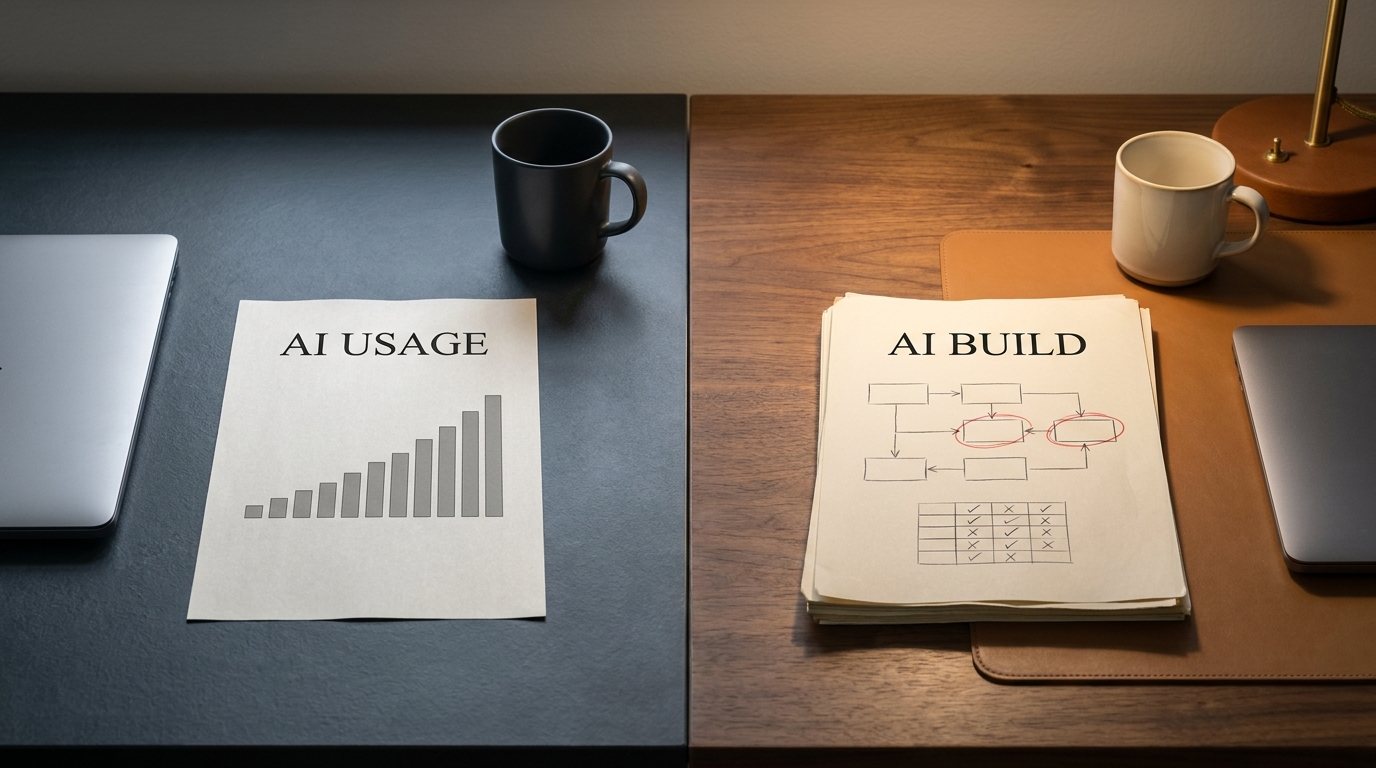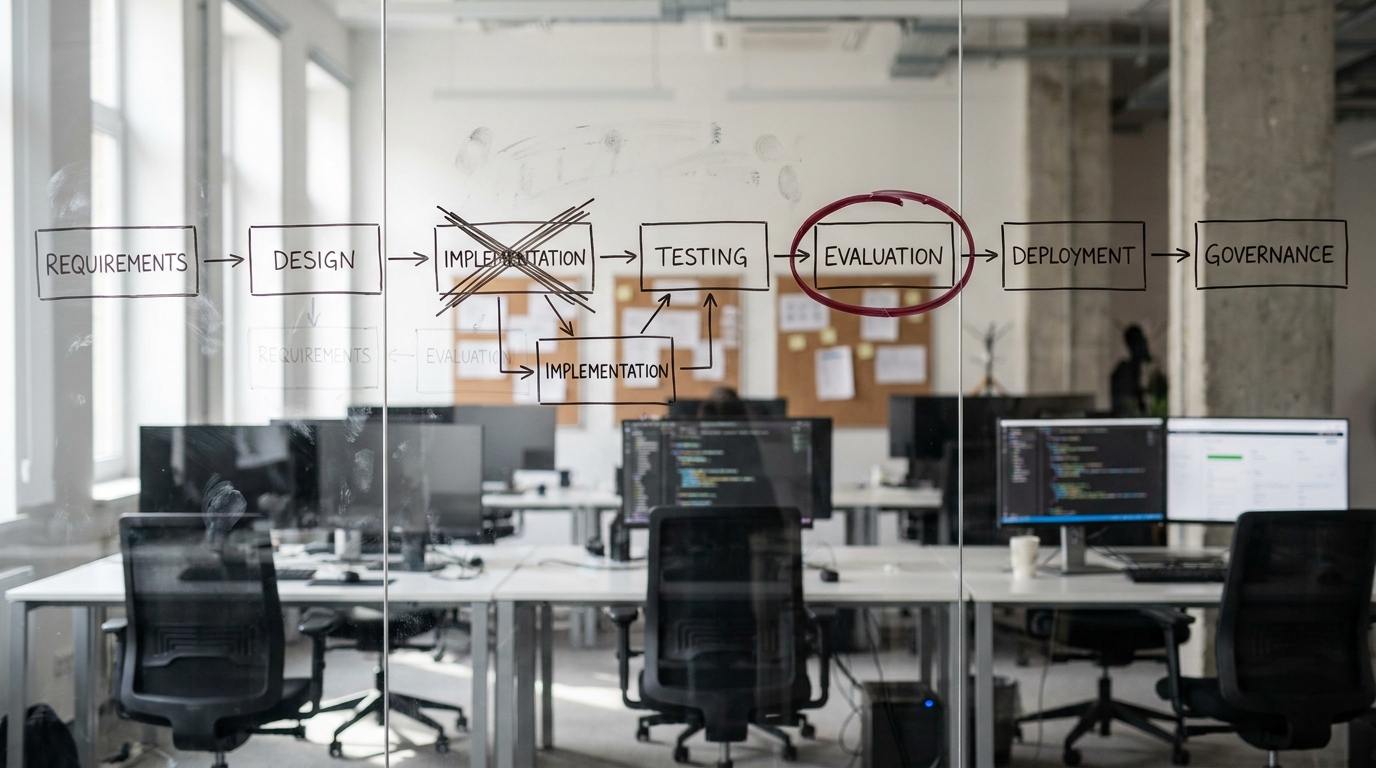
A mid-market company can run a dozen live AI pilots and still operate exactly the way it did two years ago. The chatbot handles support tickets. A few teams draft with Copilot. Someone built a clever internal tool that maybe three people actually use. On paper that looks like progress. In the numbers that reach the board, nothing has moved: same cycle times, same headcount math, same margins. That gap between "we are using AI" and "AI changed how we operate" is the whole story of digital transformation right now, and most of the advice written about it comes from the firms selling the platform underneath.
What follows is a plain-language guide to closing that gap. It covers what AI for digital transformation actually means, a simple way to diagnose where your program is stuck, why transformations stall for reasons that have nothing to do with the technology, and the first three moves a leader can start in a matter of weeks - no nine-figure budget, no dedicated AI department.
What "AI for digital transformation" actually means
AI for digital transformation is the use of artificial intelligence to redesign how an organization operates, not just to automate isolated tasks. It differs from AI adoption in one decisive way: the goal is changed workflows and changed decisions, not added tools. Adoption gives people new capabilities. Transformation rebuilds the work around those capabilities, so the operating model itself ends up different.
These are two distinct things, and conflating them is where most programs go wrong. AI adoption means buying and deploying AI tools - licenses, assistants, point solutions - so people can do their existing jobs faster. AI transformation means redesigning the end-to-end process, the roles, and the measurement so the organization produces an outcome it could not produce before.
The mechanism is clear once you pull the two apart. Adoption drops a faster tool into an unchanged process , so you get a local speed-up that rarely reaches the P&L. Transformation starts from the process instead and asks what it should look like if an AI system did part of the reasoning and a human owned the judgment. Then it rebuilds the process that way, measures the before and after, and standardizes the result. The tool is an input. The redesigned workflow is the product.
Adoption versus transformation: the gap most companies fall into
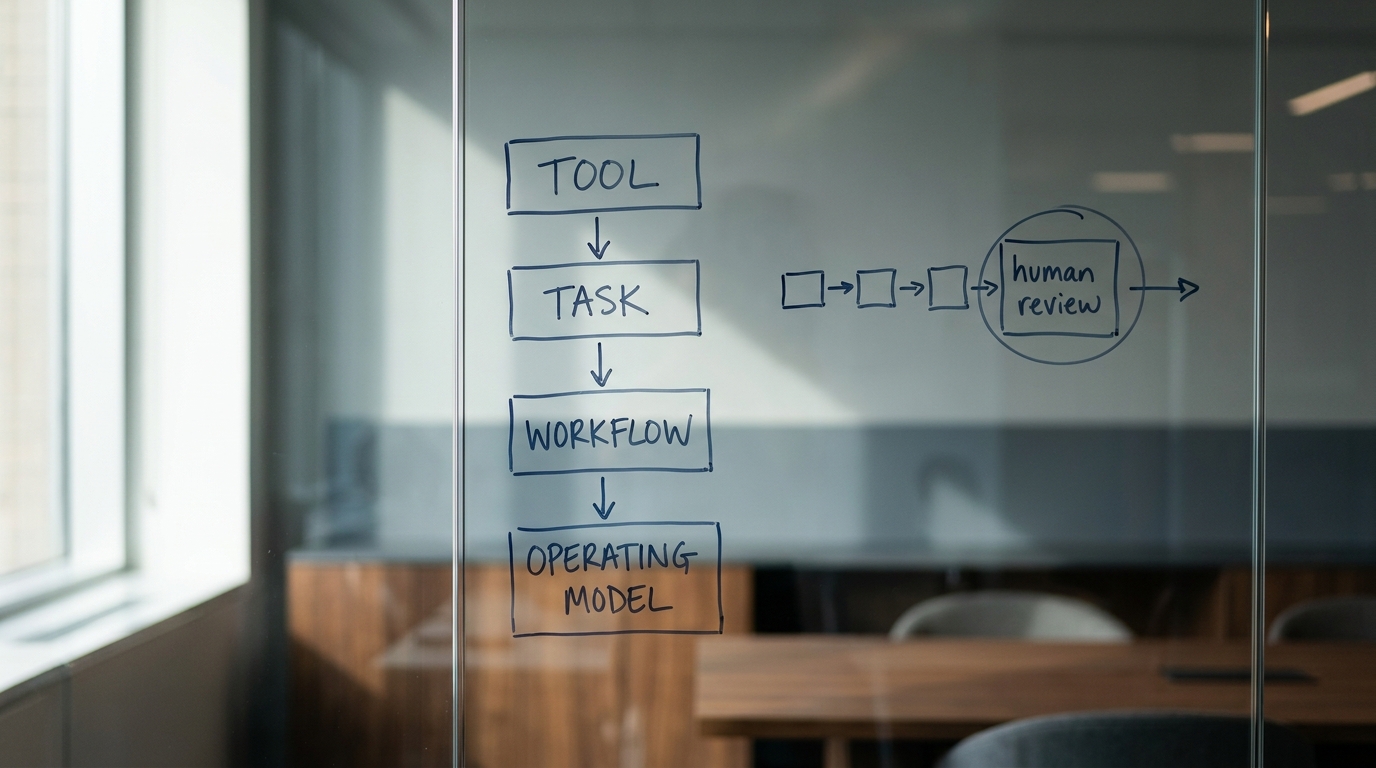
The cleanest way to see where a program sits is a four-layer model. Every AI initiative lands on one of these layers, and the value compounds as you go down:
- Tool - a new capability is available (a license, a model, an assistant). Nothing about the work has changed yet.
- Task - a person uses that tool to do a discrete task faster, like drafting an email or summarizing a document.
- Workflow - an end-to-end process is redesigned around AI plus a human checkpoint, and its inputs and outputs are measured.
- Operating model - those redesigned workflows change roles, decision rights, and how the business is structured and staffed.
Most companies stall at tool and task. That is adoption. Real transformation starts at the workflow layer and only pays off at the operating-model layer, because that is the one place where changed work turns into changed economics.
Two quick examples make it concrete. First, an adoption story: a finance team buys an AI assistant, and analysts use it to write commentary on the monthly close faster. The close still takes the same number of days, involves the same people, and produces the same report. Real convenience, zero operating change. Now a transformation story: the same team maps the close end to end, lets an AI system draft variance explanations and flag anomalies while an analyst reviews and signs off, then rebuilds the calendar around the new speed. The close drops from ten days to four, one role shifts from producing to reviewing, and finance now closes and forecasts in the same window. Same tool. Completely different result, because the second team changed the workflow instead of just the task.
Why AI transformations stall (the organizational causes)
When a transformation stalls , the instinct is to blame the model, the data, or the vendor. The evidence points somewhere less comfortable. Microsoft's leadership has argued that in this phase "execution is the new differentiator," not access to the technology itself. Harvard Business Review has framed the central corporate challenge as moving from AI experimentation to AI transformation, two different capabilities, and most firms are stuck on the first (HBR, 2026). An opinion widely echoed in the European business press put it more bluntly: AI does not fail because of the technology, but because of how companies are designed (Cinco Días, 2026).
The symptoms are familiar. Pilots multiply but never scale. Every demo works and nothing ships to production. First-quarter enthusiasm curdles into third-quarter fatigue. Underneath those symptoms sit organizational root causes, not technical ones:
- No clear owner. A pilot with no single accountable leader has no one whose actual job is to push it into production.
- The workflow was never redesigned. The tool got bolted onto the old process, so the old process caps whatever gain you were hoping for.
- Nothing is measured. With no before-and-after baseline, there is no case to justify scaling, and the pilot dies quietly.
- A real skills and capacity gap. No in-house team can both set strategy and build, so the work competes with the day job and loses.
- Change fatigue. The organization has sat through failed modernization programs before and treats this as one more.
None of these gets solved by a better model. They get solved by ownership, redesign, measurement, capacity, and honest change management - the parts consultancies tend to underplay, because none of them sell licenses.
What good looks like: the building blocks of an AI-led transformation
A transformation that sticks usually has the same handful of building blocks in place. You do not need all of them on day one, but a program missing several is usually the one that stalls.
- A clear operating-model target. Name the specific outcome you want the business to produce that it cannot today: faster close, higher win rate, lower cost-to-serve. Transformation without a destination is just tool-buying.
- A data and systems foundation. AI reasons over your data, so the systems holding it have to be reachable and reliable. Deloitte frames this as modernizing the "intelligent core," the underlying platforms that let AI actually plug into the business, and it is one concrete example of foundation work rather than the whole thesis.
- Redesigned workflows. The unit of transformation is a process rebuilt around AI plus a human, not a tool handed to a person.
- Human-in-the-loop roles. Someone owns the judgment the AI does not. Designing that checkpoint on purpose is what makes the workflow trustworthy enough to scale.
- Measurement. A baseline and a target for every redesigned workflow, so success is a number and not a vibe.
Treat this as a diagnostic checklist, not a sequence you have to finish before you start. The point is knowing which blocks you are missing.
How to cross the gap: the first three moves
Getting from a pile of pilots to real operating change does not take a transformation office or an unlimited budget. It takes picking one workflow and doing it properly. Three sequenced moves, each startable in weeks:
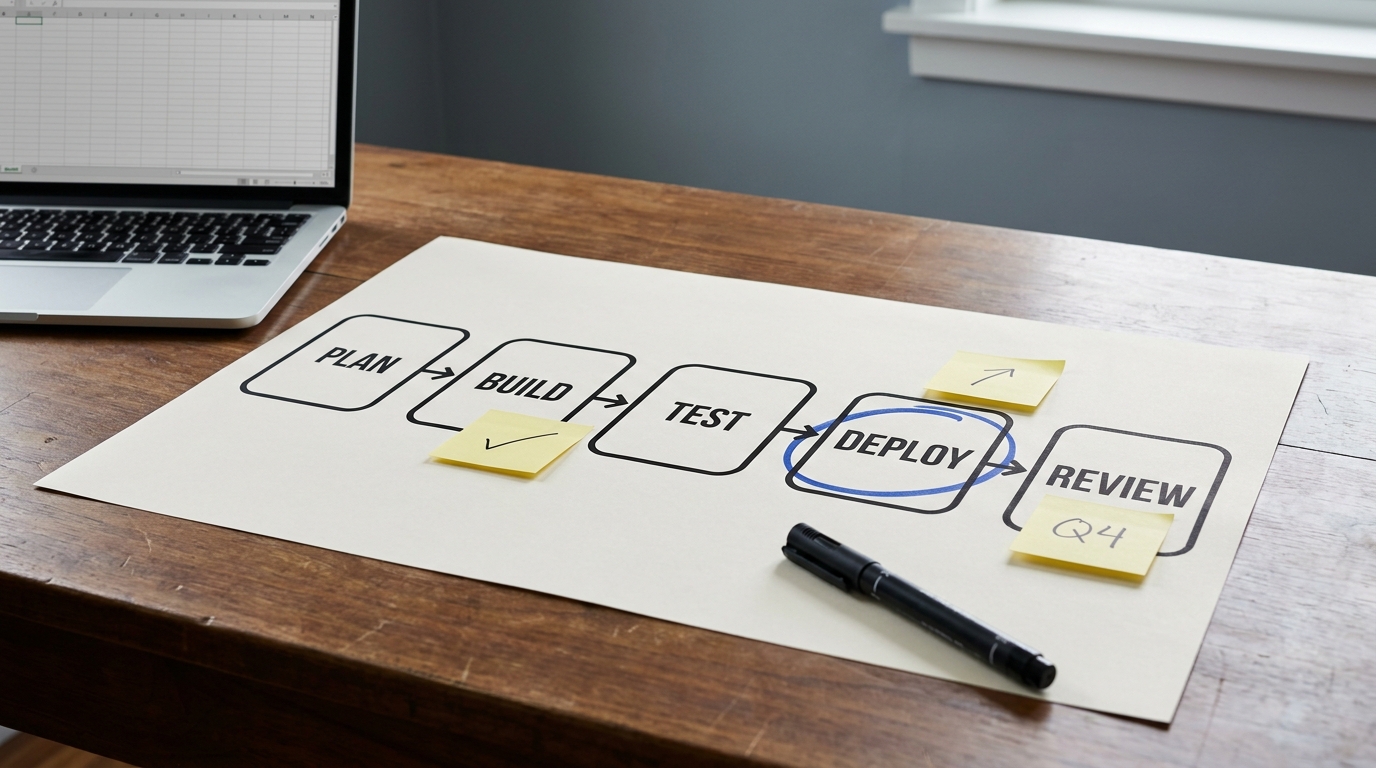
- Pick one high-cost, high-reliability workflow and map it end to end. Not a demo, not the flashiest use case. A process the business runs constantly, where cost is real and correctness matters. Map every step, hand-off, and decision as it works today.
- Redesign the workflow around AI plus a human checkpoint, and measure before and after. Decide which steps the AI drafts or decides, where the human reviews and owns the outcome, and what the new process looks like. Capture the baseline before you touch anything, then measure the redesigned version against it.
- Codify what worked into an operating standard before you scale. Write down the redesigned workflow, the checkpoint, and the metrics as a standard other teams can follow. Standardize first, scale second. Scaling an unwritten process just multiplies the chaos.
That is the whole playbook in miniature: one real workflow, redesigned and measured, then codified. Do it once and you walk away with proof, a template, and a team that has learned how transformation actually works.
If you want a structured version of exactly this - one workflow mapped, redesigned, and turned into a concrete roadmap in a week - that is what an AI Transformation Discovery sprint is built to produce. Book a Discovery Sprint once you have a candidate workflow and want a plan you can act on.
Common pitfalls (and how to avoid them)
Most stalled programs share a small set of avoidable mistakes. Watch for these:
- Buying tools before redesigning work. A license is not a strategy. Do this instead: start from the workflow you want to change and let it dictate the tools.
- No accountable owner. Shared ownership means no ownership. Do this instead: name one person accountable for moving each initiative to production.
- Measuring activity, not outcomes. "We ran forty pilots" is not a result. Do this instead: track the business metric the workflow was supposed to move.
- Ignoring the talent and capacity gap. Strategy with nobody to build it stalls. Do this instead: secure dedicated build capacity before you commit to a timeline.
- Boiling the ocean. Transforming everything at once transforms nothing. Do this instead: prove the model on one workflow, then expand.
- Treating it as an IT project. AI transformation changes how people work, not just which systems they log into. Do this instead: run it as an operating change with the business, not a technology rollout parked next to it.
Where to start if you are a mid-market team
Most of the writing on this topic assumes a Fortune 500 budget and a standing AI organization. If you have neither, the path is different but not worse. It is actually cleaner, because the constraints force focus. Skip the transformation office. Pick a single high-value workflow , run the three moves above on it, and treat the result as both your proof and your template.
The honest obstacle for a mid-market team is usually capacity, not strategy. You can see exactly what needs to happen and still have nobody who can both design the new workflow and build it without pulling your best people off their day jobs. The pragmatic answer is to borrow that capability instead of hiring for it permanently: an embedded Fractional Agentic Team closes the build-and-strategize gap for the length of the work and hands it back once the workflow is codified. Borrow the capacity, prove the model, keep the standard.
Key takeaways
- Adoption is not transformation. Buying AI tools speeds up tasks. Transformation redesigns workflows and the operating model, and only the second one reaches the P&L.
- Stalls are organizational, not technical. The usual causes are no owner, an unredesigned workflow, no measurement, a capacity gap, and change fatigue. Not the model.
- Start with one real workflow. Map a high-cost, high-reliability process end to end instead of chasing the flashiest demo.
- Measure before and after. A baseline is what turns a pilot into a case for scaling.
- Codify before you scale. Standardize the redesigned workflow so scaling spreads a proven process instead of chaos.
Adoption gets you tools. Transformation gets you a different company, and the difference is not the AI. It is whether you had the discipline to redesign the work around it.