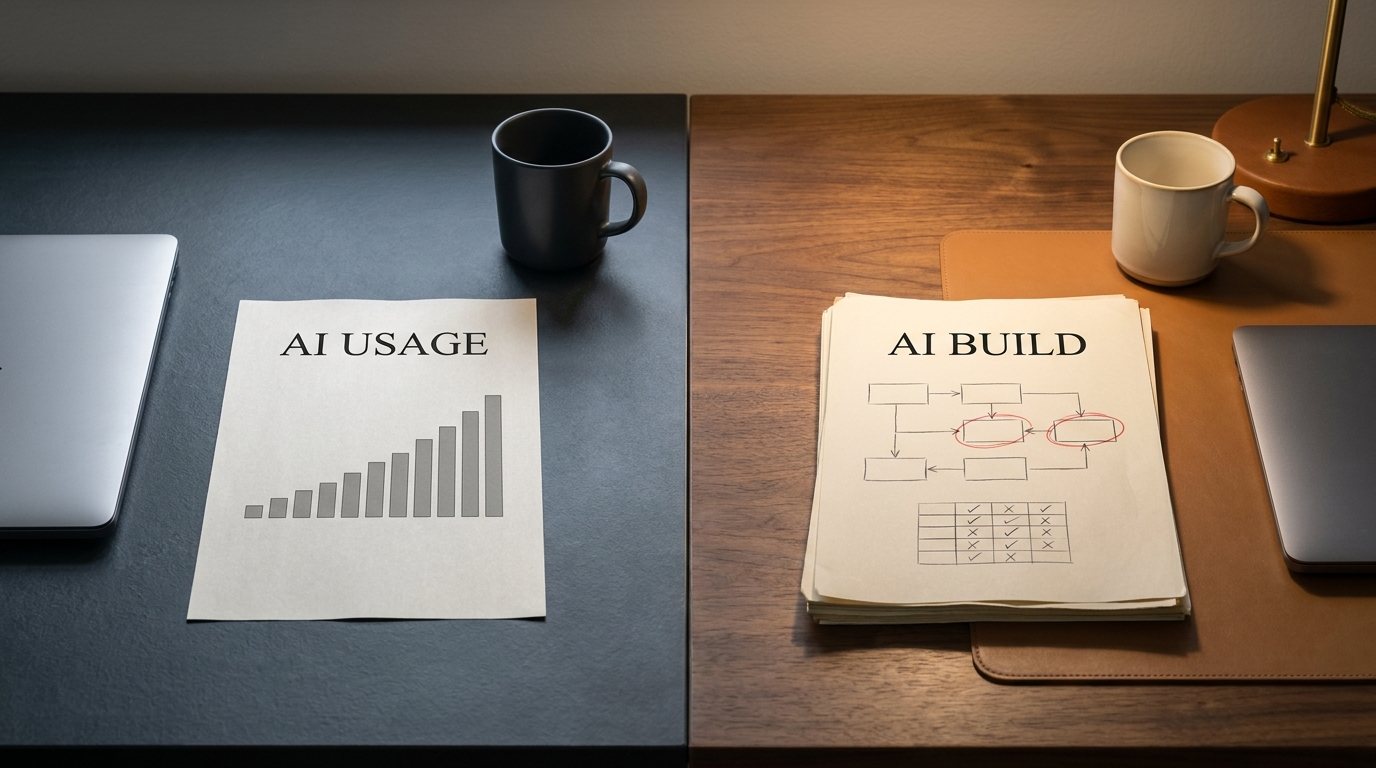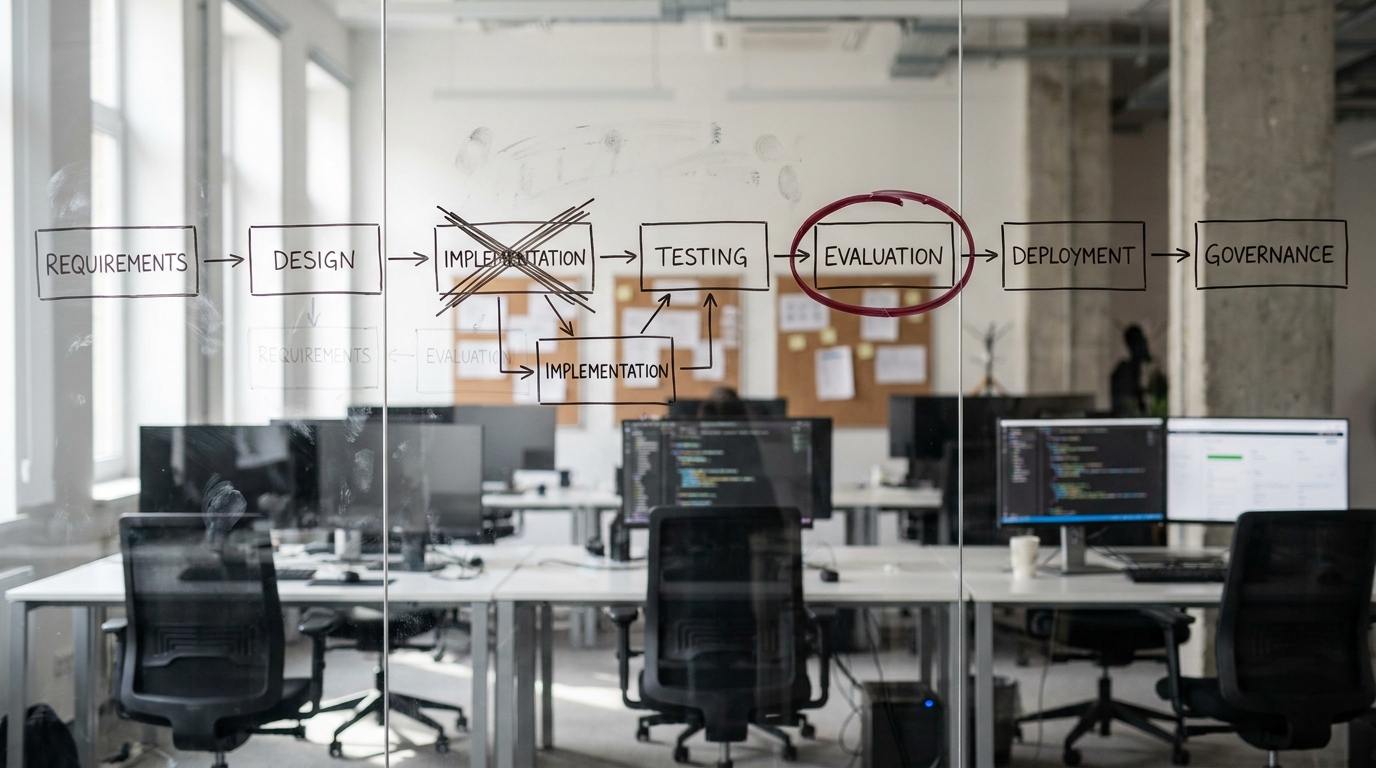

Every vendor deck now ends in the same place: autonomous agents running the business while the executive team sleeps. What nobody puts on that slide is the distance between it and where most companies actually stand. A recent industry maturity framework mapped six levels of enterprise AI use and found most organizations still parked at the earliest ones, using AI as an assistant that helps a person rather than an operator that runs work on its own.
For a mid-market CEO, COO, or CIO, that gap is not a failure. It is the normal starting point. The real mistake is treating agentic AI as a single purchase decision, a jump from pasting prompts into ChatGPT straight to a fleet of self-directed agents. AI maturity is not a leap. It is a ladder, and most companies are only one or two deliberate rungs away from real, measurable leverage.
This article hands you a simple, opinionated five-rung ladder scoped to a company of roughly 200 to 2,000 people. Use it to locate where you sit today, see what the next rung looks like in your own business, and name the one move that gets you there. No sixty-page taxonomy. No consultancy vocabulary. Just a mental model you can act on this quarter.
The five rungs, in order: ad hoc AI use, role copilots, workflow copilots, governed agents, and a measured agentic operating model. Most mid-market companies sit on rung one or two right now. You climb by making one specific move per rung, and the most expensive error is trying to skip from the bottom to the top.
What "AI maturity" actually means for a mid-market company
AI maturity has little to do with how sophisticated your models are. You are almost certainly renting the same frontier models as everyone else. Maturity is about how reliably AI is built into the way work actually gets done, and how much of that work you can trust to run with less human effort over time.
It helps to separate two ways of using AI. The first is assistant, or compensator, use: AI helps a person do a task faster, and the person still owns every step. Drafting an email. Summarizing a document. Writing a first pass of code. The second is agentic use: AI executes multi-step work under defined governance, taking actions across systems instead of just producing text for a human to copy and paste.
That word, agentic, needs a plain definition, because the market has stretched it past the point of meaning. Agentic AI is software that can pursue a goal across several steps and take actions on its own, within limits you set. Its exact meaning is vendor-dependent. As one Associated Press report on the term put it, "agentic" today is a mix of marketing fluff and real promise, so treat any product claim as a question to verify, not a fact to accept.
Mid-market companies climb this ladder under different conditions than the Fortune 500. You have less governance scaffolding, tighter budgets, and a real talent gap. The enterprise frameworks you have probably seen, from Accenture and Carnegie Mellon, from KPMG, from Microsoft, are rigorous, but they were built for organizations with dedicated AI governance teams. A copilot maturity model written for a company with 40,000 employees does not map cleanly onto yours. That is the reason for a lighter ladder.
Why it is a ladder, not a leap
The central point is this: the expensive mistake is skipping rungs. Real deployments do not go from informal ChatGPT use to trusted autonomous agents in one budget cycle. They advance through stages, and each stage builds the foundation the next one needs.
The proof shows up in the adoption data, and it is blunt. That six-level framework found most organizations still at early levels, not autonomous operation. KPMG's Q1 2026 Global AI Pulse survey found only 11 percent of companies had deployed and scaled AI agents to enterprise-wide outcomes (KPMG 2026), which leaves the vast majority still short of it. Older Accenture research from 2022 found only 12 percent of organizations using AI at a maturity level that produced strong competitive advantage, with more than 60 percent still experimenting. The trend has improved since, but the shape holds. Most companies are still climbing, and climbing is normal.
Here is the whole ladder in one view. Find the row that sounds most like your company today.
| Rung | What it looks like | Signals you are here | The one move up |
|---|---|---|---|
| 1. Ad hoc AI use | Individuals use ChatGPT or Copilot on their own, no standards | No shared prompts, no measurement, "shadow AI" you can't see | Standardize AI on 2-3 high-frequency tasks |
| 2. Role copilots | AI reliably assists a specific role with agreed tools | One team gets real value, others are inconsistent | Wire AI into a repeatable multi-step workflow |
| 3. Workflow copilots | AI spans a whole workflow, human approves key steps | You measure cycle time and quality, not just usage | Add governance so AI can act, not only suggest |
| 4. Governed agents | Agents run bounded tasks inside explicit guardrails | Permissions, audit logs, and rollback exist | Instrument outcomes so agents are measured like operations |
| 5. Measured operating model | Agents are a governed, measured part of how work runs | ROI is tracked, new agents deploy on a repeatable path | Keep raising the bar on reliability and coverage |
The rest of this article walks each rung: what it looks like, how to know you are on it, and the single highest-leverage move to the next.
Rung 1: Ad hoc AI use
Rung one is when individuals across the company use AI tools on their own initiative, with no standards, no shared prompts, and no measurement. Someone in marketing keeps a ChatGPT tab open. A developer runs Copilot. Finance quietly pastes a spreadsheet into a chatbot to explain a variance.
Signals you are here: there is no agreed way to use AI on any given task, output quality swings wildly between people, and leadership cannot actually see what tools are touching company data. That last point is the real risk. Ad hoc use is shadow AI, and it carries quiet exposure. Data leaks into consumer tools. Inconsistent and sometimes wrong output gets presented as finished work. Nothing gets written down, so the company learns nothing.
None of this makes ad hoc use bad. It is where every company starts, and the enthusiasm is a gift. The problem is that it does not compound. Ten people solving the same problem ten different ways produces ten private habits, not a company capability.
The one move up: pick two or three high-frequency tasks and standardize how AI is used on them. Choose tasks a lot of people do often, such as drafting customer replies, summarizing meeting notes, or writing first-draft job descriptions. Agree on the tool, write down the prompt, and share it. You are not building anything technical yet. You are turning private habits into a repeatable practice, which is the foundation rung two stands on.
Rung 2: Role copilots
Rung two is when AI reliably assists a specific role, with agreed prompts and tools the whole team uses. Your sales team has a shared way to draft outreach and prep for calls. Support has an agreed approach to summarizing tickets. Finance has a standard method for first-pass analysis. The key word is reliably: the same task done the same way produces consistent results across the team.
Signals you are here: at least one function gets real, repeatable value from AI, onboarding a new team member now includes "here is how we use AI for this," and you can point to time saved with some confidence. What good looks like is a role where AI has become part of the standard toolkit rather than a novelty.
The common pitfall at this rung is tool sprawl without adoption. It is easy to buy five AI point solutions, one per team, and end up with five underused licenses and a confused staff. More tools is not more maturity. Depth of adoption on a few tools beats a wide, shallow collection.
The one move up: stop optimizing individual tasks and wire AI into a repeatable, multi-step workflow. Rung two makes a person faster. Rung three makes a process faster. That shift, from helping a role to running a workflow, is the most important conceptual jump on the ladder, so it earns its own rung.
Rung 3: Workflow copilots
Rung three is when AI spans an entire workflow, with a human in the loop at the decision points that matter. Think quote-to-cash, or ticket triage through to resolution, or lead intake through to a booked meeting. AI handles the connective steps, drafting, routing, summarizing, checking, and a person approves the moments that carry real consequence.
Signals you are here: measurement starts to get serious. You are tracking cycle time, throughput, and quality on the workflow itself, not just counting how many people opened an AI tool. You can say, credibly, that a process is faster or more consistent because AI is embedded in it. The Stanford Digital Economy Lab's Enterprise AI Playbook, published in April 2026 and drawn from 51 real deployments, is a useful reference for what genuine workflow integration looks like in practice: the wins come from redesigning the flow around AI , not from bolting a chatbot onto an unchanged process.
This rung is also where the need for governance becomes obvious. Once AI is drafting the customer email, updating the CRM record, and routing the case, "who approved that" and "what happened, exactly" turn into questions you have to answer. If your workflow is moving fast and you are still relying on individual judgment to catch mistakes, you have found the ceiling of rung three.
The one move up: add the governance layer, permissions, audit trails, and guardrails, so AI can safely act rather than only suggest. That capability is what turns a workflow copilot into a governed agent. If you want a concrete roadmap for that transition rather than a general plan, an AI Transformation Discovery sprint produces one in about a week.
Rung 4: Governed agents
Rung four is when AI agents execute bounded tasks autonomously, inside explicit guardrails you have defined. The agent does not just draft the refund reply. It issues the refund when the order clearly qualifies, logs the action, and escalates the edge cases to a person. Autonomy here is narrow and supervised by design, not open-ended.

The governance is the whole point. KPMG frames mature agentic adoption around a unified control system that lets an organization trust agents at scale, and that framing is right. At this rung you have permissions that scope what each agent can touch, audit logs that record every action, guardrails that stop an agent before it does something out of bounds, and a way to roll back when something goes wrong. Salesforce's language about the "agentic enterprise" points at the same shift, from AI that advises to AI that acts under control.
Signals you are here: agents run specific, bounded jobs in production, every action is attributable, and you could answer an auditor who asks how many agents are running and what each one is allowed to do . If you cannot answer that question, you are not on rung four yet, no matter how many agents you have deployed.
This is also the rung where mid-market companies most often stall, and the reason is capacity, not ambition. Building governed agents needs people who understand both the business process and the engineering, and that talent is scarce and expensive. Many firms this size simply cannot hire a full agentic AI team fast enough to matter. A Fractional Agentic Team is one way through that specific bottleneck, giving you embedded senior capability without a permanent headcount bet before you know the return.
The one move up: instrument outcomes so agent performance is measured like any other business operation, on reliability and result, not on novelty.
Rung 5: Measured agentic operating model
Rung five is when agents are a governed, measured part of how the business runs, and the organization has a repeatable path to deploy new ones. This is not "we have a lot of agents." It is "we know what our agents produce, we track the return, and standing up the next one is a known process rather than a fresh science project."
Signals of arrival: ROI is tracked per agent or per workflow, reliability is monitored the way you monitor any critical system, and the cost of shipping the next agent keeps falling because the hard parts, the integrations, the guardrails, the review process, are solved once and reused. The tenth agent should be far cheaper and faster to deploy than the first.
Why measured is the operative word: the top of the ladder is not defined by agent count or by how autonomous your systems are. It is defined by reliable business outcomes you can prove. A company running three agents it fully understands and measures is more mature than one running thirty it cannot account for . Maturity is trust backed by evidence, and evidence comes from measurement.
How to find your rung
You can usually place yourself in about a minute. Read these signals and stop at the first one that does not describe you yet.

- Do individuals use AI with no shared standards? You are at rung one.
- Does at least one role use AI the same, agreed way with real value? You have reached rung two.
- Does AI run an end-to-end workflow with humans approving key steps, and are you measuring that workflow? Rung three.
- Do agents take bounded actions in production with permissions, audit logs, and rollback? Rung four.
- Do you track ROI on agents and deploy new ones on a repeatable path? Rung five.
Each transition has an owner. At the jump from rung one to two, the COO usually owns picking the workflows and driving adoption. From two to three and three to four, the CIO owns the workflow redesign and the governance layer, the permissions, the audit, the guardrails. Across the whole climb, the CEO owns the honest question of whether AI is producing measurable results or just activity, and is the one who has to resist the vendor pressure to skip ahead.
Whatever rung you land on, the action is the same: take the "one move up" for your current rung and make it the priority, before you buy anything aimed at a rung above you.
Sequencing the Climb: A Four-Phase Roadmap
A ladder tells you where you stand. A roadmap tells you how to move one rung without falling off. For a mid-market company the sequence that works has four phases, and each ends with something you can point at.
- Assess. Inventory the workflows, name the systems and data each one depends on, and score candidates on business value against readiness. Output: a ranked shortlist, not an ambition.
- Prove. Take one workflow, capture its baseline, and ship a contained version into real use with a human checkpoint. Output: a number that shows whether it beat the manual process.
- Harden. Add the parts a pilot skips — monitoring, exception handling, access control, an owner, and a runbook. Output: a system somebody is accountable for.
- Extend. Roll the proven pattern to the adjacent workflow, reusing the integration and evaluation work rather than starting again. Output: the second win costing less than the first.
The phases matter less than the rule underneath them: each one has to end in something usable. A phase whose output is a document is a phase that can quietly repeat forever.
Three Anti-Patterns That Stall a Mid-Market Roadmap
The pilot zoo. Eight simultaneous pilots in eight functions to see what sticks. A mid-market team does not have the bandwidth to operationalize eight wins, let alone eight pilots that each need data, evaluations, and change management. Sequence ruthlessly: one function in production beats eight in pilot.
Assessment-only spend. Buying a six-figure roadmap deck, then running out of budget before anything ships. The deck has no half-life — by month three the vendor landscape has moved and the recommendations are stale. Assessments should be cheap and tightly scoped, with the money in delivery.
Building without evaluation gates. Shipping to production with no measurement of whether the system beats the human baseline. The drift is silent and the regression is real. Every production AI system needs an evaluation harness sized to its risk before launch, not after the first complaint.
Each of these is a way of skipping a rung while appearing to climb, which is why they are worth naming before a plan gets approved rather than after it stalls.
The most common and most expensive mistake: skipping rungs
The single most costly error in mid-market AI is trying to jump straight from ad hoc use to autonomous agents. It is also the most common, because it is exactly what the market is selling. The pitch skips the middle. The reality does not.
Skipping rungs fails in predictable ways. Deploy agents without the workflow discipline of rung three, and the agents automate a broken process faster . Deploy them without the governance of rung four, and you cannot see what they did or stop them when they drift, which is how a promising pilot becomes a liability . Deploy them without the adoption habits of rungs one and two, and the people who were supposed to supervise them never trusted AI enough to use it well in the first place. The data reflects this: the reason more than half of companies stall before advantage-grade maturity is rarely the technology. It is the missing foundation underneath it.
What good looks like is unglamorous by comparison. A company on rung three that has redesigned two workflows around AI, measures them, and is now adding governance sits in a far stronger position than a peer that bought an agent platform and has a dozen half-trusted bots and no way to measure any of them. The first company is one deliberate move from governed agents. The second has to climb back down and rebuild the foundation it skipped.
Climbing one rung at a time is not the cautious choice. It is the fast one, because each rung makes the next one cheaper and safer to reach.
Key takeaways
- AI maturity is a ladder, not a leap. The five rungs are ad hoc AI use, role copilots, workflow copilots, governed agents, and a measured agentic operating model.
- Most mid-market companies sit on rung one or two today, and that is a normal starting point, not a failure.
- You advance by making one specific move per rung, not by buying your way to the top.
- Skipping rungs is the most common and most expensive mistake, because agents built on a missing foundation automate broken processes and cannot be governed or measured.
- The top of the ladder is defined by measured, reliable business outcomes, not by how many agents you run or how autonomous they are.
The most useful next step is to locate your rung honestly and pick the one move that lifts you to the next one. If you want an outside read on where you actually sit and where AI would produce the most immediate return, get an AI Readiness Snapshot , a free 30-minute call that, in effect, locates your rung and names the highest-leverage move from it.