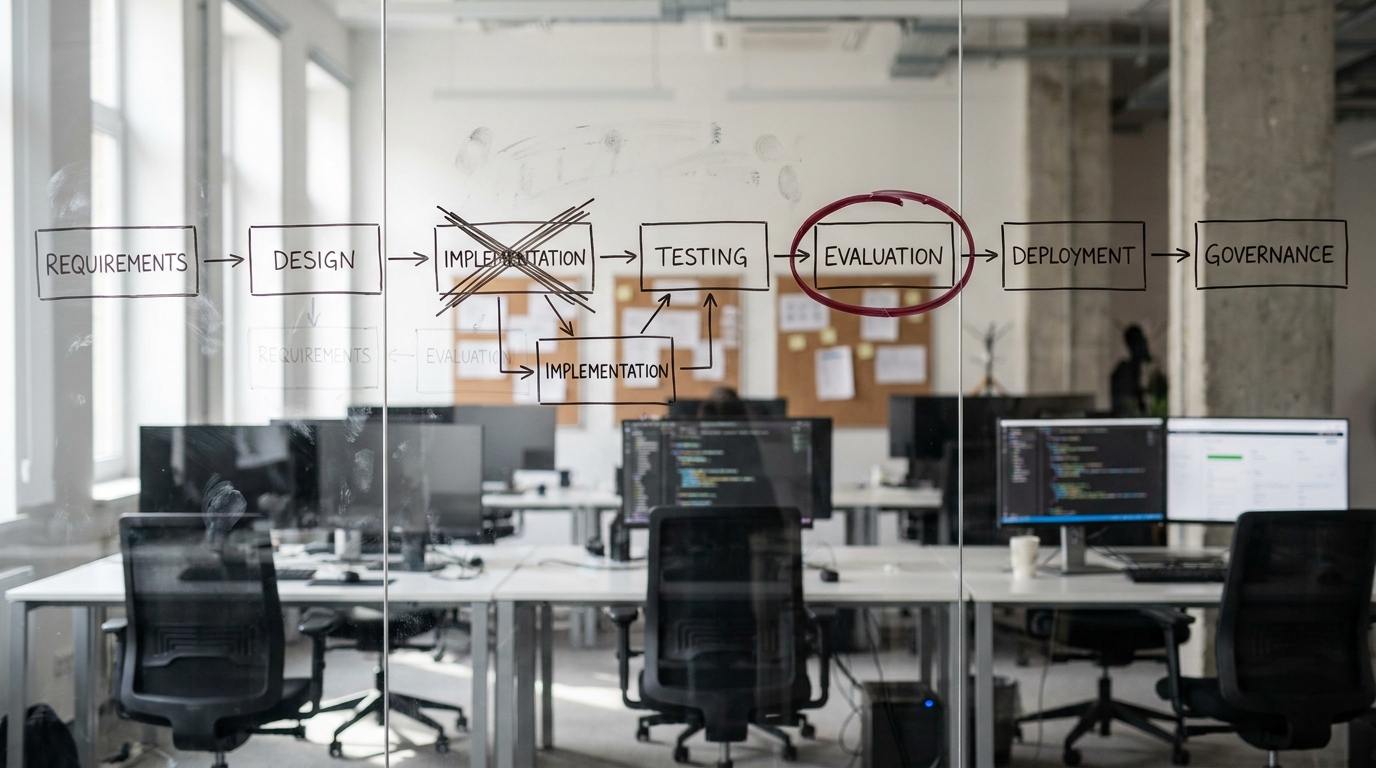
Adding another agent looks like a promotion for your architecture. Most of the time it is a demotion in reliability, and the two are easy to mix up. The pitch decks make more agents sound like more maturity. A planner here, a researcher there, a critic to check the work, all coordinating like a well-run team. What actually ships to production is usually slower, more expensive, and much harder to debug than the single agent it replaced.
The numbers back the caution. A 2026 study of enterprise agent adoption found that of twelve companies studied, only one had reached what the researchers called Level 3, genuine multi-agent orchestration. The other eleven were still operating at earlier levels. Single assistants answering questions, or single agents patching gaps in an otherwise fixed workflow. One in twelve is the real state of the field, and it is worth sitting with before you greenlight a swarm.
Here is the thesis this article defends. Maturity is matching the architecture to the problem and operating it reliably, not stacking agents. Multi-agent orchestration is one design choice among several. For a large share of real workloads, a deterministic workflow with a single well-scoped agent is the more mature decision, not the less ambitious one.
Quick answer: Multi-agent orchestration means several LLM-driven agents coordinating on a task under some control structure. It is justified only when a problem is genuinely parallel, needs distinct specialized roles, or exceeds one agent's context and tool budget. Otherwise a deterministic workflow with one well-scoped agent is cheaper, faster, and easier to trust. Treat multiple agents as a deliberate tradeoff, not a maturity milestone.
What multi-agent orchestration actually is (and isn't)
Three things get blurred in most conversations. Define them once and the rest of the decision gets easier.
A single agent is one LLM-driven loop. It reasons, calls tools, observes results, and repeats until the task is done. One context, one set of permissions, one line of accountability.
A deterministic workflow with one agent wraps that agent inside fixed, coded steps. The control flow is hard-coded software. Step one runs, then step two, then a branch based on a rule you wrote. The agent handles only the fuzzy, language-heavy parts inside those rails. You always know what runs next, because you programmed it.
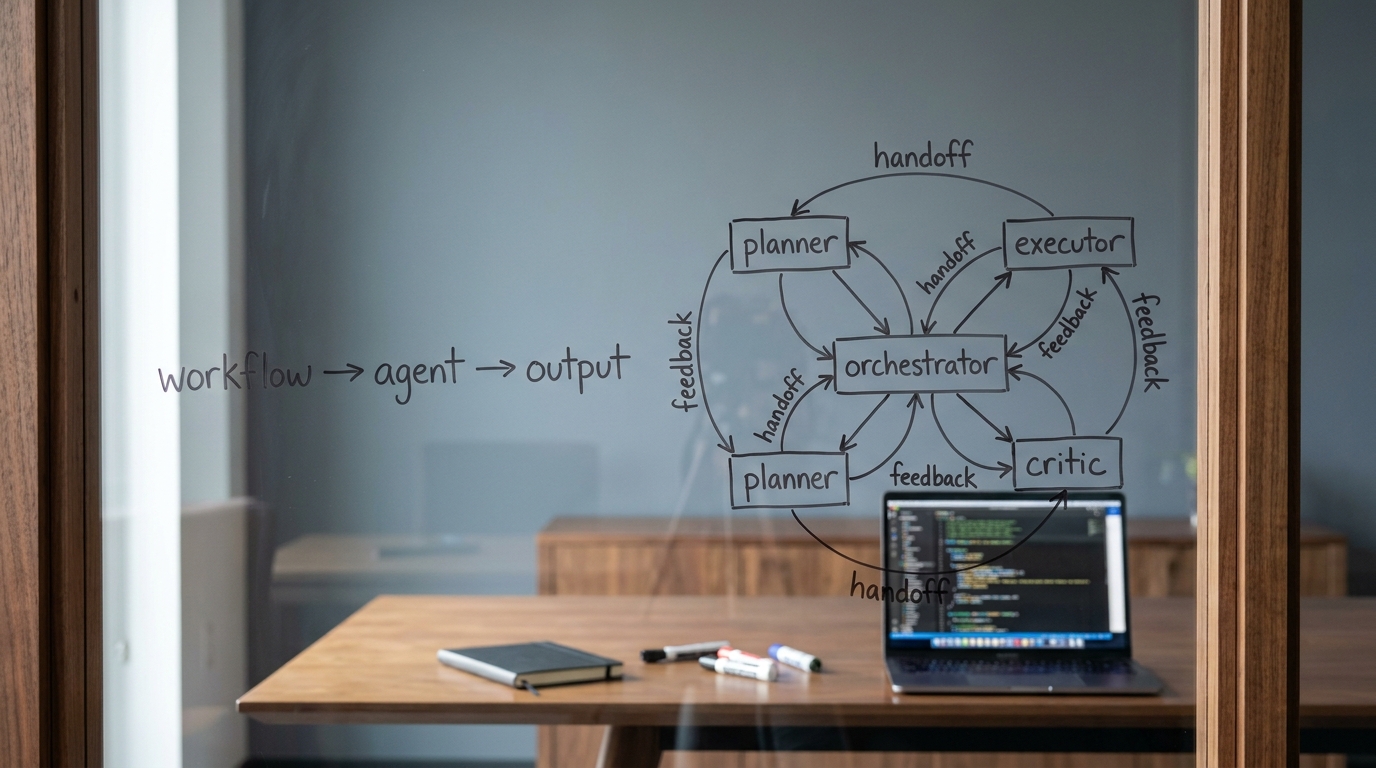
Multi-agent orchestration is different in kind, not degree. Several agents, each with its own context and often its own model, tools, and permissions, coordinate through a control structure. An orchestrator, sometimes called a supervisor, routes work and decides who acts next. A handoff is the moment one agent passes control and context to another. The coordination itself is now part of your system, with its own cost and its own ways to fail.
Here is the distinction that matters for a budget owner. In a deterministic workflow, the routing logic is deterministic code you can read and test. In multi-agent orchestration, the routing is itself a model decision. That makes it probabilistic, harder to reproduce, and harder to audit . That single shift is the source of nearly every tradeoff below.
Maturity is not agent count
The industry keeps score in a way that rewards the wrong thing. Vendor content from most of the major platforms frames capability as a ladder you climb by adding agents . The implicit message is that a single agent is a starter project, and a coordinated fleet is the finished, grown-up system.
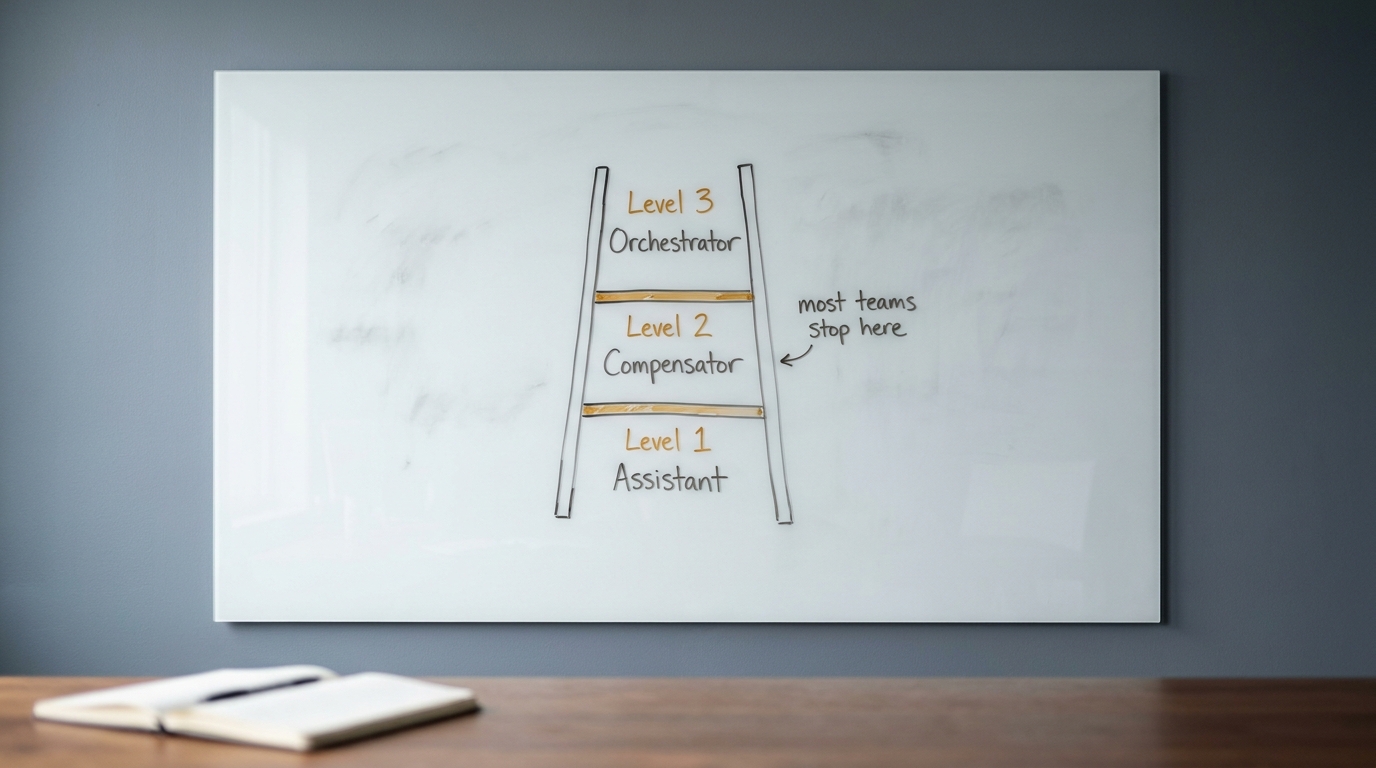
A more useful maturity model looks at what the organization can actually operate.
- Level 1, Assistant. A model answers questions or drafts content on demand. A human drives every step and reviews every output. The value is real but bounded, and there is almost no operational risk.
- Level 2, Compensator. A single agent takes over a slice of a defined process, filling gaps a rigid workflow could not handle. It acts with some autonomy inside guardrails, and a human stays on the loop. This is where most capable teams actually live and get durable ROI.
- Level 3, Orchestrator. Multiple agents coordinate across a task with delegation, handoffs, and shared or partitioned context. This unlocks genuinely parallel and multi-specialty work, and it demands real operating capacity to run safely.
Now read that ladder again with the study in mind. If only one in twelve companies had reached Level 3, the honest reading is not that eleven companies are behind. It is that Level 3 is expensive to operate and rarely the right fit, so most disciplined teams correctly stopped at Level 2. Reaching Level 3 without the monitoring, evaluation, and cost controls to run it is not progress. It is regression dressed as ambition, because you have added failure surface faster than you have added the capacity to manage it.
Maturity, then, is not the level number. It is the fit between the problem, the architecture, and your ability to operate what you built. Hold that definition, because it decides every call that follows.
When multi-agent design is genuinely justified
Multiple agents earn their coordination cost only when the problem has a shape a single agent cannot serve well. Look for these concrete signals, and be strict about them.
- Genuinely parallel subtasks. The work splits into pieces that can run at the same time with little dependence on each other. A research task that fans out across ten independent sources, each explored in parallel and then synthesized, is a natural fit. Anthropic (2025) described building exactly this kind of research system, where a lead agent spawns subagents to explore in parallel and the speedup comes from the parallelism itself, not from the agent count.
- Distinct, separable specialties. The subtasks need meaningfully different skills, tools, or permissions, and blending them into one prompt makes each worse. A planning agent that decomposes work and an execution agent that carries it out is a common, defensible split, because the two roles reward different instructions and different tool access.
- A single agent's context or tool budget is genuinely exhausted. One agent cannot hold the whole problem, and no reasonable prompt or retrieval strategy fixes it. Partitioning the context across agents is a real remedy here, not a preference.
- Independent failure isolation is required. You need one part of the system to fail without corrupting the rest, and separate agents give you that blast-radius boundary by design.
- Different models or trust levels per role. One step needs a frontier model with broad tool access. Another needs a cheap, sandboxed model with read-only permissions. Separate agents let you match the model and the permissions to the risk.
Notice what unites these signals. Each one is a structural property of the problem, not a preference for a more impressive diagram. If you cannot point to at least one of them clearly, you are buying coordination cost you do not need.
When one agent plus a deterministic workflow wins
For most teams, most of the time, the mature choice is a single well-scoped agent inside a deterministic workflow. That is not a fallback. It is frequently the correct architecture, and it takes more discipline to choose than a fashionable swarm.
The signals that point here:
- The steps are predictable. You can enumerate the process in advance. When the path is knowable, encoding it as software beats asking a model to rediscover it on every run.
- Auditability and compliance matter. You need to prove what happened and why. Deterministic control flow produces a reproducible trace. Model-decided routing does not, at least not without heavy additional tooling.
- Latency or cost budgets are tight. Every agent handoff adds model calls, tokens, and wall-clock time. A workflow spends the model only where language reasoning is actually needed.
- Tolerance for non-determinism is low. The same input should produce the same behavior. Fixed workflows give you that. A mesh of agents making routing decisions does not.
LangChain (2025) makes the same point plainly in its guidance, that not every task needs multiple agents, and that teams reach for orchestration before a single agent's limits have actually been hit. Microsoft's Azure guidance (2026) on choosing between single-agent and multi-agent designs lands in the same place. Start with the simplest architecture that solves the problem, and add agents only when a concrete limit forces the move.
If your process is a line, not a web, a workflow plus one agent will almost always be cheaper, faster, and easier to trust. Choosing it on purpose is a sign of maturity, not caution.
Before you commit either way, it is worth an honest look at whether your operating setup could even run the more complex option. A short, structured readiness check is often more clarifying than another architecture debate. Book a free 30-minute readiness call if you want a second set of eyes on that question.
The failure modes that multiply with every agent
"Coordination challenges" is the phrase most vendor content uses, and it hides the real bill. Here is what actually multiplies as you add agents, made legible for a steering committee.

- Cost and token overhead. Each agent carries its own context and reasoning. A multi-agent run can consume several times the tokens of a single agent doing comparable work, because context gets re-established at each handoff and agents re-reason over shared state. Anthropic (2025) reported that its multi-agent setup used far more tokens than single-agent chat, which is fine when the task value justifies it and painful when it does not.
- Latency stacking. Agents that hand off in sequence add their round-trips together. What was one slow call becomes four, and the user waits for the sum.
- Error propagation across handoffs. A small mistake by an upstream agent becomes the trusted input of a downstream one. Errors do not just occur, they compound, and the final output can be confidently wrong in ways no single step would reveal.
- Non-determinism and reproducibility. When routing is a model decision, the same request can take different paths on different runs. Reproducing a bug becomes a research project.
- Debugging and observability difficulty. You are no longer tracing one reasoning loop. You are reconstructing a conversation among several, each with partial context. Without purpose-built tracing, root-cause analysis can take hours.
- Coordination and prompt-contract drift. Agents communicate through prompts and structured messages. Change one agent's output format and a downstream agent silently misreads it. These contracts are brittle and rarely versioned.
None of these are reasons never to build multi-agent systems. They are the price of admission, and the point is to pay it knowingly. A CTO who can name these six costs in a budget meeting is far better positioned than one who inherits them by accident.
A decision framework you can apply now
Reduce the choice to something you can run on Monday. The rule fits on one screen.
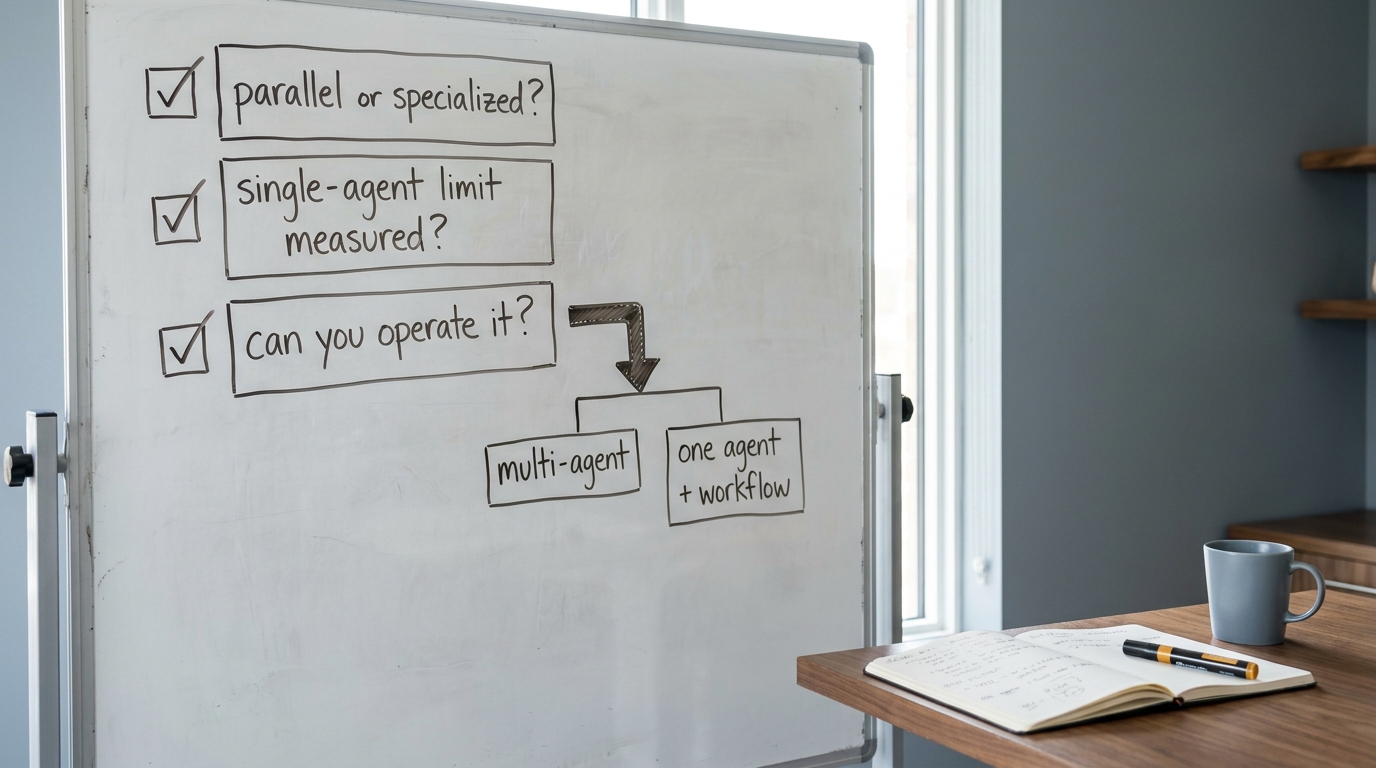
Go multi-agent only if all three hold:
- Parallelism or specialization is structural. The problem genuinely splits into concurrent subtasks or distinct specialties that a single agent serves poorly.
- A single agent's limit is measured, not assumed. You have actually hit a context, tool, or permission ceiling with one well-scoped agent, and you can point to the evidence.
- You can operate it. You have the monitoring, evaluation, cost controls, and human oversight to run coordinated agents safely in production.
If any one of the three fails, use a deterministic workflow with one agent.
A migration note that saves most teams a great deal of money. Start smaller than you think you need. Ship value with one agent inside a workflow first. Instrument it, measure where it actually breaks, and split into multiple agents only when a real, observed limit forces the move. The teams that succeed at Level 3 almost always arrive there by growing into it, not by starting there. Building the fleet before you have proven the single agent is how pilots stall in the pilot-to-production gap .
Orchestration patterns, briefly
If you do move to multiple agents, you will hear a handful of pattern names in vendor pitches. Here they are as vocabulary, so you can follow the conversation. This is not a build tutorial.
- Supervisor (orchestrator). A central agent routes work to specialist agents and decides who acts next.
- Sequential. Agents run in a fixed order, each passing its output to the next, like a pipeline.
- Concurrent (parallel). Agents work on independent subtasks at the same time, and a step combines their results.
- Handoff. One agent transfers control and context to another mid-task, common in support-style flows where a triage agent passes to a specialist.
Knowing the names is enough to evaluate a proposal. Choosing among them is an implementation detail that only matters after you have decided multi-agent is warranted at all.
Are you ready to operate Level 3?
The real gate on Level 3 is rarely the model. It is the operating capacity of your organization. Coordinated agents in production need infrastructure and people that single-agent pilots never demanded.
Ask whether you have the following before you commit.
- Observability built for agents. Tracing that reconstructs multi-agent runs end to end, not just per-call logs.
- Evaluations you trust. Automated checks that catch regressions across the whole orchestrated flow, not just individual prompts.
- Cost controls. Budgets, rate limits, and alerting sized for runs that can consume many times a single agent's tokens.
- Human-in-the-loop where it counts. Clear points where a person approves or intervenes, matched to the risk of each action.
- The talent to run it. People who can design agent contracts, debug non-deterministic coordination, and own the system in production.
That last point is where most organizations actually stall. The architecture is buildable. The team to operate it reliably is the scarce resource, and it is exactly the gap the study exposes when only one in twelve companies has reached Level 3. If your roadmap depends on operating capacity you do not yet have, the honest move is to close that gap first. Our AI Transformation Discovery works through that readiness question with your team before any architecture is locked in.
Key takeaways
- Maturity is fit and reliable operation, not agent count. More agents is not more mature.
- The levels run assistant, then compensator, then orchestrator. Most disciplined teams get durable value at the compensator level and correctly stop there.
- Go multi-agent only when parallelism or specialization is structural, a single agent's limit is measured, and you can actually operate coordinated agents in production.
- When the process is a predictable line with auditability, latency, or cost constraints, one agent inside a deterministic workflow is the mature choice.
- Failure modes multiply with agent count: cost, latency, error propagation, non-determinism, debugging difficulty, and brittle coordination contracts.
The mature move is often the smaller one
The pressure to add agents will not let up, and the vendor narrative will keep equating a bigger diagram with a better system. The evidence points the other way. The one company that reached Level 3 is the exception, and the eleven that stayed at Level 2 on purpose are not behind. They are matching architecture to what they can operate.
So carry one rule into your next architecture review. Add agents only when the problem is structurally parallel or specialized, the single-agent limit is measured, and you can operate what you build. Everything else is a workflow with one good agent, and choosing it is a sign you have understood the tradeoff, not ducked it.
Closing that operating-capacity gap is the hard part, and it is not something you hire your way out of quickly. A Fractional Agentic Team embeds the people who design, ship, and run agentic systems alongside your own, so you build the maturity to operate the architecture you actually need, whether that turns out to be one agent or many.