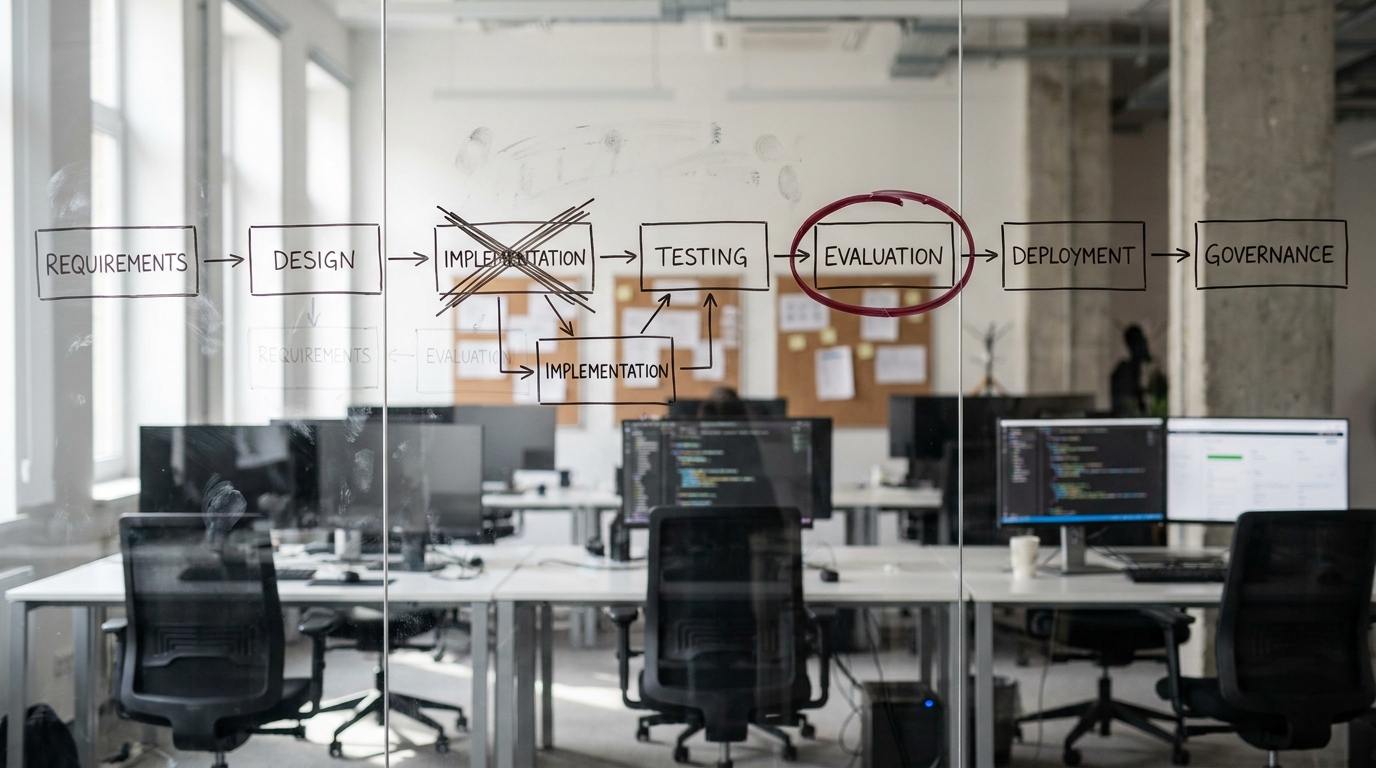

The demo dazzled. A model summarized tickets, drafted replies, flagged the risky accounts, and the room nodded. Three months later the pilot is still a pilot. The dashboard nobody trusts is open in one tab, the budget review is in another, and the only honest answer to "is it working?" is a shrug. This is the most common shape of an AI project right now: a great demo that never becomes a system.
Why AI pilots fail is rarely a model problem. Pilots stall on four missing foundations: no measured baseline, no accountable owner, no quality-control bar, and no engineering path to production. Close those four gaps and a pilot becomes a shippable system.
The pattern is well documented. MIT's NANDA initiative, in its 2025 report GenAI Divide: State of AI in Business, found that 95% of enterprise generative-AI pilots showed no measurable P&L impact. That number gets forwarded around boardrooms as proof that "AI doesn't work yet." It proves something narrower and more useful. Almost every organization can build a pilot, and almost none can ship one. The capability is real. The bridge from capability to production is what keeps collapsing.
For a CIO or Head of Operations, the good news is that the collapse is predictable. After enough stalled pilots, the failure modes stop looking like bad luck and start looking like a checklist. There are four of them. Each is recognizable on sight, each traces back to a root cause that has nothing to do with the model, and each has a concrete fix you can watch happen in a real workflow.
It's not the model
Start by separating two things that get blurred together. A pilot is an experiment that proves a model can do a task under favorable conditions: clean inputs, a friendly evaluator, no integration, no edge cases. A production system does that task every day, on messy real inputs, inside an existing workflow, with someone accountable when it's wrong. The distance between those two is not a capability gap. The model that worked in the demo is usually the same model that would work in production.
What changes is everything around the model. The demo had a data scientist babysitting it. Production has a support agent at 2 a.m. with a customer on the line. The demo ran on a curated sample. Production runs on whatever arrives . The demo was judged by whoever built it. Production has to clear a standard the business agreed to in advance. When pilots fail to reach production, they fail on organization and engineering, not on the quality of the underlying model.
That reframe changes who needs to act. If the problem were the model, you would wait for a better one. Because the problem is the four gaps, you can close them now, with the model you already have. Here is the diagnostic.
| Gap | Symptom you'll recognize | Root cause | What "closed" looks like |
|---|---|---|---|
| Baseline | "It feels faster" but no one can prove ROI | The before-state was never measured | A pre-pilot number for cost, time, or error rate that "better" is measured against |
| Owner | The pilot is an orphan after the demo team rolls off | Staffed as an experiment, not a product | One named, accountable owner with a thin operating model |
| Quality control | One bad answer and trust evaporates | No evaluation set or acceptance bar | A scored eval set plus a defined "good enough to ship" threshold |
| Production path | Works in a notebook, dies on integration | No engineering route from POC to a governed system | Workflow integration, monitoring, and rollback in place |
The four sections that follow take each row in turn. Read them as a checklist for the pilot sitting stalled on your own desk.
A demo is not a pilot
Before the gaps, one reframe that saves more money than any of them. A demo and a pilot are not the same thing. A demo shows the happy path on clean data to a friendly audience. A pilot has to survive real users, messy inputs, and the long tail of edge cases the slide deck never mentioned.
When a demo gets mistaken for a pilot, the organization celebrates a milestone it has not reached. The hard work, the work that decides whether anything ships, has not started yet. Treat the demo as the beginning of the question rather than the answer. The real question is whether the four gaps below are closed, and usually they are not.
Gap 1 — The Baseline Gap
The first gap is the quietest, because nothing visibly breaks. The pilot runs, people say it feels faster, and then the budget review arrives and you cannot answer the only question that matters: by how much? Without a measured before-state, "better" is an anecdote. An anecdote does not survive a CFO.

The root cause is timing. Teams switch the AI on, like what they see, and only then think about measurement, by which point the "before" is gone. You cannot reconstruct last quarter's handle time once the workflow has already changed.
The fix is one discipline applied a week earlier. Consider a support operation that wanted an AI assistant to draft first responses. Before turning anything on, the team logged two numbers for two weeks: median handle time per ticket, and the reply-revision rate, meaning how often a drafted answer got rewritten before sending. Handle time was 14 minutes. Revision rate was 38%. Only then did the AI go live. Eight weeks later the same two numbers read 9 minutes and 21%. "Faster" became "35% lower handle time, revisions cut by almost half." That sentence funds a rollout . A shrug does not.
What good looks like here is small. One or two metrics, captured before the pilot starts, that the business already cares about. You are not building an analytics program. You are giving the pilot a number to be judged against.
Gap 2 — The Owner Gap
The second gap shows up the week the data-science team rolls off to the next experiment. The pilot still runs, but now there is no one to escalate to when an answer looks wrong, no one deciding what to fix first, no one whose job depends on the thing working. It becomes an orphan, and orphaned software decays .
The root cause is that pilots get staffed like experiments instead of products. An experiment ends when the question is answered. A product needs an owner for as long as it runs. When the org chart treats the pilot as a finished experiment, nobody inherits it, and "nobody's job" quickly becomes "nobody's problem."
The fix is unglamorous and decisive. Name one accountable owner before the pilot starts, and give that owner a thin operating model. Not a 30-person team. One person who owns the outcome, a defined way to triage issues, and a regular review where the owner reports the baseline numbers from Gap 1. The owner does not have to be a data scientist. Often the right owner is the Head of Ops for the workflow involved, supported on the technical side rather than leading it.
Capacity is the common objection, and it is a fair one. The team that can build the pilot is rarely the team that can run it, and hiring a permanent AI function for an unproven bet is hard to justify. This is where an embedded agentic team earns its place: a fractional group that owns the run-state while your internal owner holds the outcome, so the pilot has a home without a permanent headcount commitment on day one.
Gap 3 — The Quality-Control Gap
The third gap is the one that kills trust fastest. A pilot can run for weeks on goodwill, and then one confidently wrong answer reaches a customer or an executive, and the whole thing gets branded unreliable. The deeper problem is that nobody could have told you, before that moment, whether the output was good enough to ship. There was no bar to clear.
The root cause is the absence of an evaluation harness. In the demo, quality was judged by vibes. The builder looked at a few outputs and decided they were fine. Vibes do not scale to thousands of daily outputs, and they give you no way to catch a regression when a prompt or a model version changes.
The fix is a lightweight evaluation set plus an acceptance threshold. Take 100 to 200 real examples from the workflow, have an expert label the correct or acceptable answer for each, and score the AI against that set. Now "good enough" is a number, not an opinion. One legal-intake team did exactly this. They built a 150-case eval set, set the acceptance bar at 95% on must-not-miss fields, and added a human-in-the-loop review for anything the model flagged as low-confidence. Before the eval gate, every change felt risky. After it, they could ship a prompt update in an afternoon, because the eval set told them in minutes whether quality held.
What good looks like is a scored eval set you can rerun on demand and a written threshold the business has agreed to. With those two artifacts, "is it shippable?" stops being a debate and becomes a measurement .
Gap 4 — The Production-Path Gap
The fourth gap is the most technical and the most underestimated. The model works in a notebook. Then it has to read from the real ticketing system, write back to the real CRM, respect permissions, handle the record that has a null where the schema promised a value, and keep doing all of that while someone watches for failures. The notebook did none of this. The distance between "works in a notebook" and "works in the workflow" is where most pilots quietly die.

The root cause is that no one mapped the engineering route from proof of concept to a governed, integrated, monitored system. The pilot proved the model could do the task. It said nothing about plumbing, observability, or what happens when the AI is wrong in production.
The fix is to treat the path to production as its own piece of work, not an afterthought. Four things have to exist: integration into the actual workflow rather than a side tool people have to remember to open, data plumbing that handles real and imperfect inputs , monitoring that tells you when quality or latency drifts, and a rollback so a bad day does not become a bad week. The before-and-after is stark. One operations team ran a POC that summarized inbound documents in a notebook for a month. Moving it to production meant wiring it into the document queue, adding a confidence threshold that routed uncertain cases to a human, logging every decision for audit, and building a kill switch. That work took longer than the POC did, and it is the reason the system is still running a year later instead of sitting in the pilot graveyard.
What good looks like — the 5% playbook
The pilots that reach production are not the ones with better models. They are the ones designed for production from the first week, so all four gaps get closed by default rather than discovered one crisis at a time. If you want to self-assess a pilot right now, ask four questions.
- Baseline: Do we have a pre-pilot number for cost, time, or error rate that we can prove "better" against?
- Owner: Is there one named person accountable for this in production, with a way to triage issues?
- Quality control: Do we have a scored evaluation set and a written threshold for "good enough to ship"?
- Production path: Is there a real plan for integration, monitoring, and rollback, not just a notebook?
Four "yes" answers describe the 5% that ship. For most stalled pilots the honest tally is three or four "no" answers, which is exactly why they stalled, and exactly why the fix is in your control. If you are earlier in the cycle and want a fast read on which gaps you are exposed to, a free AI Readiness Snapshot is a low-commitment place to start.
Key takeaways
- AI pilots rarely fail on model quality. They fail on four foundations: baseline, owner, quality control, and production path.
- The Baseline Gap means you never measured the before-state, so you cannot prove ROI. Capture one or two metrics before the pilot starts.
- The Owner Gap means the pilot is orphaned after the demo team leaves. Name one accountable owner and a thin operating model.
- The Quality-Control Gap means no one can say the output is shippable. Build a scored eval set and an acceptance threshold.
- The Production-Path Gap means it works in a notebook but dies on integration. Plan integration, monitoring, and rollback as real work.
- The MIT NANDA 2025 finding that 95% of pilots show no P&L impact is not a verdict on AI. It is a measure of how few teams close all four gaps.
Turn four gaps into a roadmap
The four gaps are not a reason to stop. They are a scope of work. Each one is nameable, fixable, and closable with the model you already have, which means a stalled pilot is far closer to production than it feels on the morning the numbers won't move.
Book a Discovery Sprint — a paid one-week engagement that audits your pilot against all four gaps and hands you a concrete roadmap to close them, with the owner, the baseline, the eval bar, and the production path defined.