Here is a test that cuts through two years of AI headlines. Pick the pilot your team is proudest of, then send the one person who runs it on a two-week vacation. If the value leaves with them, you do not have an applied capability. You have one talented employee and a very good demo.
That gap - between a demo that impresses and a capability that lasts - is what this guide is about. The organizations pulling ahead did not buy a better model than everyone else. They rebuilt the workflow around it, put governance under it, and measured what it moved. The ones still stuck ran impressive demos that never became durable capability, and somewhere between the proof of concept and the quarterly review the question changed from "can this work?" to "where is the return?" The honest answer got harder to give.
This is a guide to closing that gap. It covers what "applied" generative AI actually means, why so many initiatives stall right before they pay off, where value shows up first by business function, the operating model that scales scattered pilots into real transformation, and a 90-day sequence a mid-market team can run without a Fortune-500 budget. The framing you will recognize from the big consultancies is here. What is added is the part they leave out: the how.
Applied generative AI for digital transformation means embedding generative and agentic AI into real business workflows - governed, measured, and scaled - instead of running isolated experiments. The organizations that capture value treat it as an operating-model change across strategy, data, governance, and adoption, not a tool rollout. Value shows up first where high-volume knowledge work meets a clear success metric.
What "applied" generative AI really means (and what it isn't)
Experimentation and application look similar from the outside. Both involve people using AI, both produce outputs, both generate excitement. The difference is where the AI lives. In experimentation, the AI lives beside the work - a person opens a chat window, gets help, and closes it. In application, the AI lives inside the work. It is a step in a process that runs whether or not anyone is watching, with inputs, outputs, checks, and an owner.
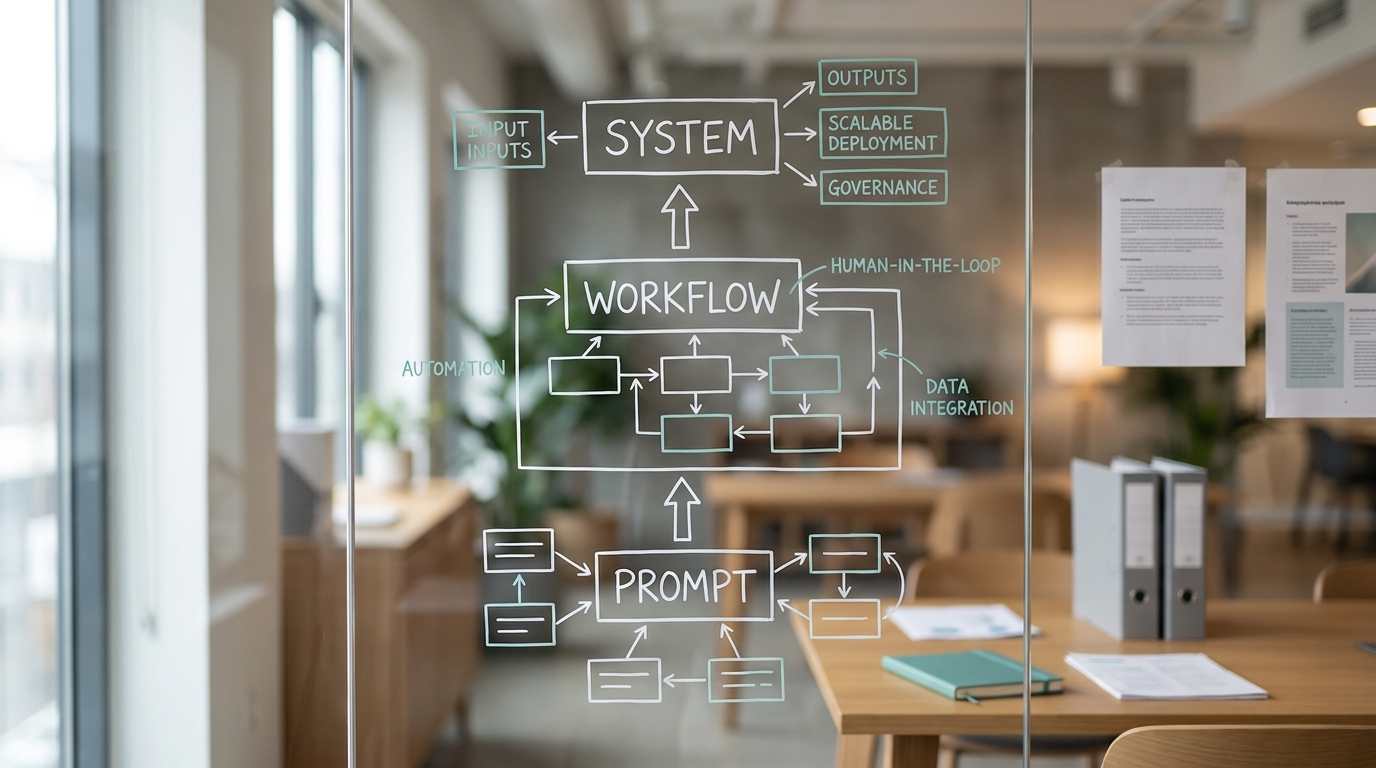
A useful way to see the distinction is a three-stage progression: prompt, workflow, system.
A prompt is a single request to a model. It is fast, cheap, and completely dependent on the person typing it. This is where most pilots stop. The value is real but it stays trapped with the individual who discovered it.
A workflow is a prompt wrapped in a repeatable process. The inputs are defined, the output has a home, and a second person could run it and get the same result. This is the first rung of applied AI, because the value no longer depends on one clever operator.
A system is a set of workflows that connect to your data, your tools, and your controls, and that improves as it runs. It has an owner, a metric, guardrails, and a feedback loop. This is where transformation actually happens, because the AI has become part of how the business operates rather than a tool people reach for.
Applied generative AI is the deliberate climb from prompt to system. Digital transformation is what changes on the way up: not the software you bought, but the operating decisions, the data plumbing, and the daily habits that reorganize around a new capability.
The signals you are still in pilot mode
That vacation test was not a throwaway. It is easy to mistake activity for progress, so here are a few honest signals that a program is still experimenting rather than applying:
- The value disappears when a specific person is on vacation.
- You cannot name the metric the AI is supposed to move, only the general idea that it "saves time."
- The output still needs a human to reformat, re-check, or re-enter it somewhere else before it counts.
- Nobody owns the workflow the way they would own a hiring number or an uptime target.
- Success is measured in demos given, not in decisions changed or hours redeployed.
None of these mean the pilot failed. They mean the pilot has not yet become a system. That transition is the whole game.
Why most generative AI initiatives stall before value
The stall is not a technology problem. The models are good enough for a wide range of real work today. The stall happens in the space between a working demo and a governed, measured capability , and it is remarkably consistent across companies. BCG's 2024 research on AI adoption found that only about one in four companies had built the capabilities to move beyond proofs of concept and generate tangible value, a gap that has more to do with operating discipline than model quality.
The root causes cluster into a short list, and naming them is the first step to avoiding them:
- No value target. The pilot was launched to "explore generative AI," not to move a specific number. Without a target, there is no way to know when to scale, kill, or double down, so the pilot drifts.
- Data that is not ready. The workflow needs clean, accessible, permissioned data, and the organization discovers mid-pilot that the data is scattered, stale, or locked behind systems nobody wants to touch.
- No operating model. There is no clear owner, no path from idea to production, and no shared way to build the next workflow. Every pilot is a one-off, so nothing compounds.
- Governance debt. Security, legal, and risk were not in the room early, so the pilot hits a wall when it needs real data or a customer-facing surface. The debt comes due at exactly the moment value was about to arrive.
- Tool sprawl. A dozen teams bought a dozen tools. Nothing connects, costs pile up, and no single capability gets strong enough to matter.
- The plug-and-play myth. The assumption that a capable tool will deliver value on its own. Cognizant's research on enterprise AI has been blunt about this: plug-and-play AI is a myth, because the value lives in the surrounding process, not the box.
If you recognize three or more of these, the problem is not that you picked the wrong model. It is that the pilot never had the scaffolding it needed to become a system. That is fixable, and it usually starts with an honest look at which of these gaps is actually blocking you.
If you want a fast, outside read on where your own program is stuck, a free 30-minute AI Readiness Snapshot will map your data readiness, value targets, and governance gaps before you spend another quarter on pilots that cannot scale.
The ghost-GDP trap
There is a subtler failure worth calling out on its own, because it fools smart teams. Call it ghost GDP: gains that are real in a demo but never reach the P&L. A team reports that the AI "saves each analyst four hours a week." The number is even true. But the four hours are scattered across the week in small pieces, none large enough to redeploy, so no headcount shifts, no project ships sooner, and no line on the income statement moves. The value evaporated on contact with reality.
The fix is not to stop measuring time. It is to insist that saved time convert into something the business can bank: a task removed entirely, a role redeployed to higher-value work, a cycle time cut enough to win more deals, or a cost eliminated. Value that cannot be traced to a business outcome is a story, not a result.
Where generative AI creates value first, by function
This is where most guides get vague and where an applied playbook has to get specific. Generative AI does not create value uniformly across a company. It creates value first where three things overlap: high volume, unstructured language or code as the core material, and a clear definition of a good result. Below are six functions where that overlap is strongest, each with the workflow that actually changes and how the value is measured. Read them as a menu, not a mandate - pick the one where the overlap is sharpest for you.

Customer experience and support. The workflow that changes is first-response resolution. Instead of routing every ticket to a human, a governed assistant drafts or resolves the routine cases, pulls answers from your real knowledge base, and escalates the rest with context attached. The applied version is not a public chatbot bolted onto the website. It is an agent embedded in the support queue with access to order history and policy, guardrailed against inventing answers. Measure it by deflection rate on resolvable tickets, first-contact resolution, and the change in handle time on the cases humans still take.
Operations and back office. The workflow that changes is document-heavy processing: invoices, claims, onboarding paperwork, compliance checks. Generative AI reads the unstructured document, extracts the structured fields, flags exceptions, and routes them. The value is not "faster typing." It is a process that runs with a fraction of the manual touch and a lower error rate on the exceptions that used to slip through. Measure straight-through processing rate, exception rate, and cost per document.
Software engineering. The workflow that changes is the path from ticket to merged code. Assistants draft implementations, write tests, explain unfamiliar code, and review pull requests. The applied version is measured, not vibes-based: teams track how much of the work is genuinely accelerated versus rework created downstream. Measure cycle time from ticket to production, change-failure rate, and the share of routine changes that ship without a senior engineer in the loop.
Knowledge work and research. The workflow that changes is synthesis: turning a pile of documents, transcripts, or data into a decision-ready brief. An analyst who used to spend two days reading and one hour deciding now spends one hour verifying and makes the decision the same day. This is where the ghost-GDP trap bites hardest, so the discipline is to point the reclaimed time at a specific higher-value output, not to let it dissolve. Measure time-to-decision and the volume of decisions a team can support without adding people.
Marketing and sales. The workflow that changes is the production and personalization of content and outreach at a scale humans could never sustain by hand. Draft the variants, tailor the message to the segment, summarize the account before the call. The applied guardrail matters here: brand voice and factual accuracy are enforced, not hoped for, because a wrong claim at scale is a liability at scale. Measure content throughput, pipeline influenced, and conversion on AI-assisted touches against a held-out control.
Finance. The workflow that changes is the close and the analysis that follows it. Generative AI drafts the variance commentary, reconciles the exceptions, and answers "why did this line move?" against the ledger. The applied version keeps a human accountable for every number that leaves the building, with the AI doing the reading and first-pass writing. Measure days to close, analyst hours per cycle, and the speed of answering ad-hoc financial questions.
Notice the pattern. In every function, the applied version is an agent or workflow embedded in a real process with real data and real guardrails, measured by a business metric rather than a productivity feeling. That pattern is the transferable part. The specific function is just where you start.
From generative to agentic: when workflows become the unit of work
The generative era was about producing a good output from a prompt. The agentic shift is about completing a multi-step task with minimal supervision. An agent does not just draft the email. It reads the incoming request, checks the system of record, takes an action, and hands off to a human at the point where judgment is required.
The practical difference is the unit of work. With a chat assistant, the unit is a turn: you ask, it answers, you decide what to do next. With an agent, the unit is a workflow: the goal is set, and the agent moves through several steps, using tools and data, to reach it. That changes what you are designing. You are no longer writing better prompts. You are defining a process, the tools the agent may use, the checks it must pass, and the exact points where a person stays in the loop.
This does not rewrite your roadmap so much as raise its ceiling. The functions where generative AI creates value first are the same functions where agents create the most value next, because the groundwork - clean data access, defined workflows, guardrails, an owner - is exactly what an agent needs to run safely. Teams that built that scaffolding for generative pilots are the ones who can adopt agents without starting over. Teams that skipped it will hit the same wall twice. The honest caution: agentic AI is powerful and still immature, so the applied move is to give agents narrow, well-instrumented jobs with a human at the accountable step, not to hand them the keys and hope.
The operating model that scales pilots into transformation
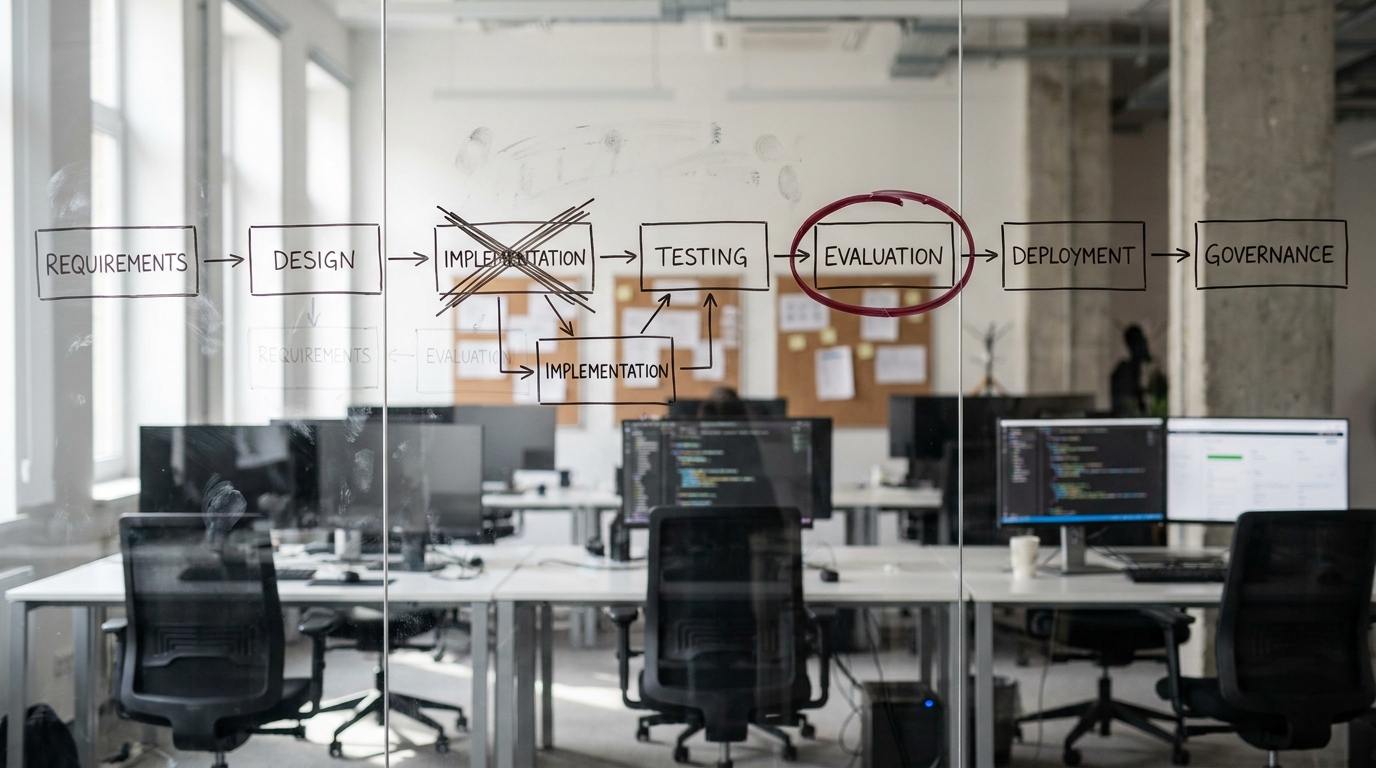
A pilot proves a workflow can work once. An operating model makes the next twenty workflows repeatable. This is the "system running it" that changes a business, and it has five moving parts that run as a loop, not a line.

Strategy. Decide where AI has to matter for the business this year, and just as importantly where it does not. A focused portfolio of a few high-value workflows beats a hundred experiments. Strategy is mostly a subtraction exercise.
Value targeting. For each workflow, define the metric it must move and the threshold that would justify scaling it . This is the step that prevents ghost GDP, because a workflow with no target cannot be scaled or killed on evidence.
Build. Create the workflow with production in mind from day one: real data access, error handling, and a human-in-the-loop design. The build step is where most one-off pilots differ from systems, and where reusing a common pattern saves months on the next one.
Govern. Put the guardrails, monitoring, and review in place before the workflow touches customers or sensitive data, not after. Governance is not a gate at the end. It is a rail that runs alongside the whole track.
Scale. Templatize what worked so the next team can reuse the pattern, the data connections, and the guardrails instead of rebuilding them. Scale is the payoff of having done the first four steps deliberately.
The loop matters more than any single step. Each workflow you ship should make the next one cheaper, because the data connections, the guardrail patterns, and the review process are already there. That compounding is the difference between a company with a hundred pilots and a company with a growing system.
The uncomfortable part for mid-market teams is talent. The consultancy playbook assumes you can field a bench of forward-deployed engineers, data scientists, and governance specialists. Most companies cannot, and hiring a full team before you have proven a single workflow is how budgets die. A pragmatic alternative is an embedded agentic team - a fractional group that brings the build, govern, and scale muscle you have not yet hired, works inside your workflows, and leaves the pattern behind so your people can run it. The goal is to buy the capability you are missing for the exact window you need it, not to staff a permanent department on a hope.
Once you have proven one workflow and want to design the portfolio deliberately, an AI Transformation Discovery sprint maps your highest-value workflows, the operating model to run them, and the sequence to scale - the strategy-and-value-targeting work that keeps the loop from turning back into scattered pilots.
Governance, data, and adoption as first-class workstreams
The three things most likely to quietly sink a transformation are the three things easiest to defer: data, governance, and adoption. Each deserves to be a workstream with an owner, not a task someone squeezes in.
Data readiness is the ground truth. Generative AI is only as good as the information it can reach, and most companies discover mid-project that their knowledge is scattered across wikis, drives, and someone's head. Applied programs treat data access, quality, and permissions as prerequisites for a workflow, not as a cleanup project to do someday. You do not need to fix all your data. You need the specific data one workflow depends on to be clean, reachable, and correctly permissioned.
Governance is what lets you move fast without breaking something expensive. Responsible-use guardrails, human review on consequential outputs, monitoring for drift and errors, and clear rules about what data may flow where. The mistake is treating governance as the thing that slows you down. Done well, it is the thing that lets you deploy into real, sensitive workflows at all, because the alternative is staying in the safe sandbox of demos forever.
Adoption is the bottleneck almost nobody budgets for. The model is not the constraint. Whether people change how they work is. A brilliant workflow that people route around delivers nothing. Adoption means designing the change with the people who do the work, retraining the process and not just the tool, and measuring whether behavior actually shifted. When transformations fail after the technology worked, this is usually why.
Measuring business value beyond "time saved"
"Saves time" is where value measurement goes to die. It is easy to claim, impossible to bank, and it lets a program feel successful while the P&L stays flat. Applied measurement is more disciplined and more honest.
Start by separating leading and lagging indicators. Leading indicators tell you a workflow is being used and working: adoption rate, output quality against a rubric, error and escalation rates. Lagging indicators tell you it mattered to the business: cost removed, revenue influenced, cycle time cut, capacity freed and actually redeployed. A healthy program watches both, because strong leading indicators with flat lagging ones is the early warning sign of ghost GDP.
Then take a unit-economics view. Pick the unit that matters for the workflow - a ticket, a document, a close, a piece of content - and measure cost, quality, and speed per unit before and after. This makes value concrete and comparable, and it exposes the workflows that look impressive but do not change the economics.
Finally, tie it to the P&L with a straight face. For each scaled workflow, be able to name the line it affects and how. If you cannot draw that line, you have a promising experiment, not a transformation. That standard sounds harsh, but it is the same standard every other capital allocation in the business is held to, and holding AI to it is how AI earns its next round of investment.
Common pitfalls and how to avoid them
Most failures are not novel. They repeat, which means they can be anticipated. The recurring ones, each with the fix:
- Starting with the tool instead of the workflow. The fix: pick the workflow and its metric first, then choose the tool that serves it. The tool is the last decision, not the first.
- Boiling the ocean. A hundred simultaneous pilots guarantee that none get strong enough to matter. The fix: a focused portfolio of a few workflows you intend to take all the way to production.
- Skipping governance until it blocks you. The fix: bring security, legal, and risk in at the design stage, so the guardrails are built in rather than bolted on at the worst moment.
- No human in the loop on consequential output. The fix: design the accountable human checkpoint into the workflow from the start, especially anywhere a wrong answer has cost.
- Measuring activity, not outcomes. Demos given and prompts written are activity. The fix: measure the business metric the workflow was built to move, and nothing else counts as success.
- Letting saved time dissolve. The ghost-GDP trap again. The fix: convert reclaimed capacity into a specific, named outcome - a task removed, a role redeployed, a cycle shortened.
- Treating adoption as automatic. The fix: budget for change management explicitly and measure whether behavior actually shifted, not whether the tool was deployed.
None of these require a bigger model. They require operating discipline, which is exactly the muscle the SERP leaders reserve for their paid work and exactly the muscle an applied program builds for itself.
A 90-day applied starting sequence
Here is the part no thought-leadership piece gives you: a concrete sequence a mid-market team can actually run, without an army of specialists. It is deliberately narrow, because narrow is how you get a real result inside a quarter.

Days 1 to 15 - Pick one workflow and define the metric. Choose a single high-volume workflow where language or code is the core material and a good result is easy to define. Write down the one metric it must move and the threshold that would justify scaling. Resist the urge to pick three. One workflow, one metric, one owner.
Days 16 to 45 - Build it for production, not for the demo. Connect the real data the workflow needs, design the human-in-the-loop checkpoint, and put basic guardrails in place. Keep the scope small enough to finish, but build it as a system from the first day, so you are not throwing away a prototype in month two. This is where an embedded team earns its keep if your own bench is thin.
Days 46 to 75 - Measure against the metric, honestly. Run the workflow with real work and compare to the baseline you wrote down on day 15. Watch both leading indicators (is it used, is it good) and the lagging metric (did the number move). If the value is ghost GDP, name it now and fix the conversion into a real outcome, or kill it and move on. A clean kill in month three is a success, not a failure.
Days 76 to 90 - Templatize and choose the next one. If it cleared the threshold, document the pattern: the data connections, the guardrails, the review process, the owner. That template is what makes workflow number two take weeks instead of months. Then use the same selection discipline to pick the next workflow. You now have the first rung of an operating model, built from one real win rather than a hundred abstract slides.
Ninety days will not transform a company. But it will produce the one thing the stalled programs never have: a single governed, measured workflow in production, and a repeatable way to build the next one. That is what transformation actually compounds from.
Key takeaways
- Applied means system, not pilot. The climb from prompt to workflow to system is the whole game. Value that lives with one clever person is still experimentation.
- The stall is operational, not technical. Initiatives fail for missing value targets, unready data, no operating model, and governance debt - not for lack of a better model.
- Value is function-specific and measurable. Start where high volume, language or code, and a clear success metric overlap, and measure a business number, not "time saved."
- The operating model is the real transformation. Strategy, value targeting, build, govern, and scale run as a loop so each workflow makes the next one cheaper.
- Governance and adoption are first-class work. The model is rarely the bottleneck. Whether people change how they work usually is.
- Start narrow and instrument value. One workflow, one metric, 90 days, then templatize - that is how a mid-market team gets real without a Fortune-500 budget.
If you would rather not guess your way to the first workflow, an AI Transformation Discovery sprint turns this playbook into your specific portfolio, operating model, and 90-day plan - built for the team and budget you actually have.