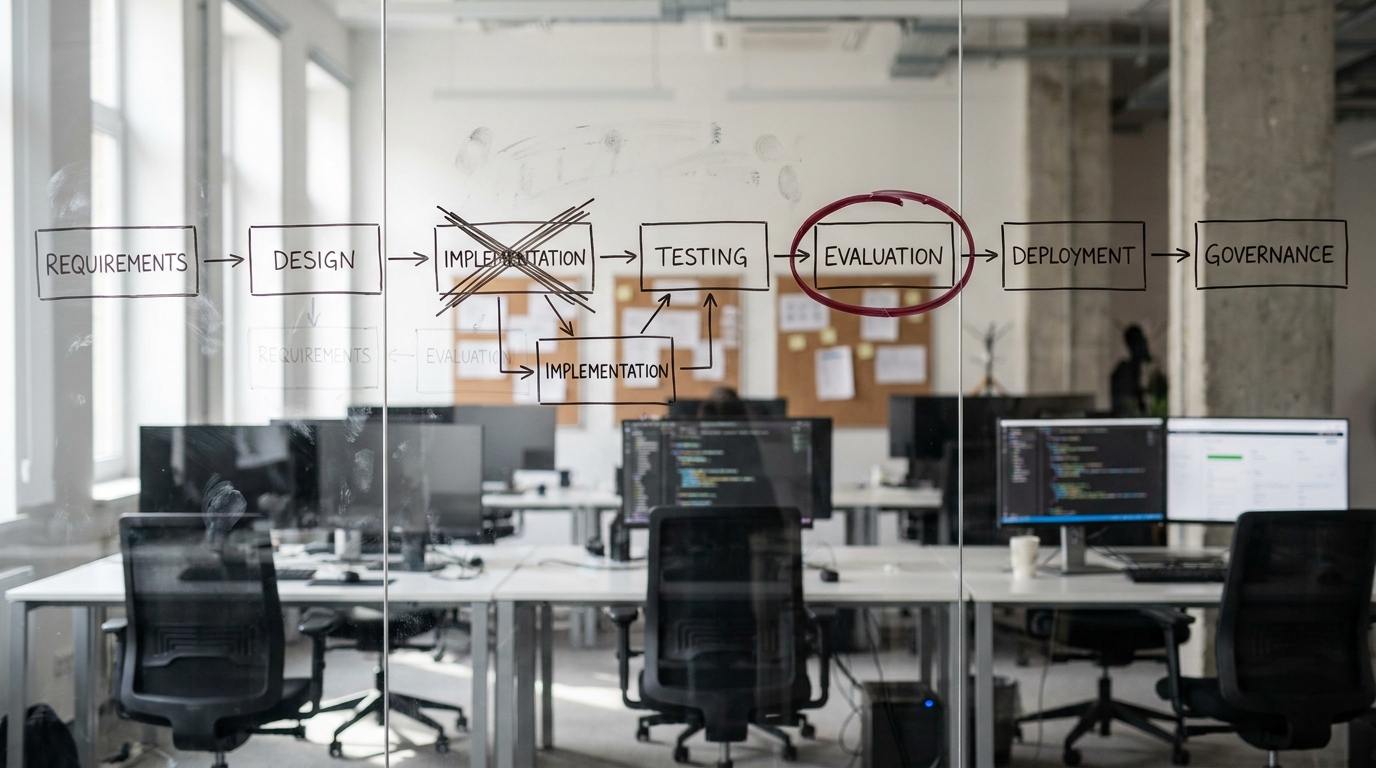

Every debate about a first enterprise AI agent fixates on the wrong dial. Which model runs it, which vendor supplies it, which benchmark it tops. None of that decides whether the deployment survives its first real audit. One quieter choice does: how much consequential action the agent is allowed to take before a human signs off. Capability and autonomy are separate dials, and most companies turn the wrong one up first.
That distinction is the whole game on day one. You can run a genuinely capable model while keeping its authority to act on a very short leash. The answer that survives contact with a real audit, a real incident, and a real boardroom is counterintuitive: the safest first agent is usually the least autonomous one that still delivers real value. The reason it matters so much the first time is precedent. The first agent a company runs is the one that teaches the whole organization whether these systems can be trusted, and that lesson sticks long after the code changes.
Quick answer: No, your first enterprise AI agent should not be fully autonomous. Start it in an approve-before pattern (the agent proposes, a human commits) or a review-after pattern (the agent acts inside a tightly bounded scope, a human reviews the trace) within a single reversible workflow. Grant more autonomy only after the agent earns it against explicit, measured criteria. Capability and control are separate dials. Turn up capability first, autonomy last.
This is a sequencing decision, and it belongs to the C-suite, not just the security team. CEOs set the risk appetite. COOs pick the workflow. Risk and compliance leaders own the guardrails. CTOs own the technical controls. Each of those roles has a stake in getting the first agent right, because a first agent that misfires does not just cost money. It costs the political capital that funds every agent after it.
What "autonomous" actually means for an enterprise agent
Before the sequencing argument makes sense, the vocabulary has to be clean, because vendors blur it on purpose.
An assistant or chatbot answers questions and drafts content. It waits for a human at every turn and takes no action in your systems. A tool-using assistant can fetch data or fill a form, but a person still initiates and confirms each step. An agent is different in kind, not degree . It decides a sequence of steps toward a goal and executes them against real systems, often calling tools, writing to databases, or triggering downstream processes without a human touching each one.
Autonomy is the amount of consequential action an agent takes without a human in the decision. It is not a single switch labeled "on" or "off." It is a dial. An agent can draft an email and stop, or draft and send it. It can flag an invoice for coding, or code it and post it to the ledger. Same underlying capability, radically different autonomy, and radically different consequences when it gets things wrong.
The industry conversation collapses these distinctions constantly. A demo shows a highly capable agent, and the pitch implies that capability and autonomy are the same purchase. They are not. You can deploy a very capable agent on a very short leash. That combination, high capability and low autonomy, is exactly where a first deployment should live.
The governance gap: capability is outrunning control
There is a reason "keep the leash short" is not just cautious boilerplate. The tooling that makes agents capable is advancing faster than the tooling that makes them verifiable.
Model providers now ship agents that can plan, use tools, and act across multi-step workflows out of the box. Gartner estimates that roughly 17 percent of organizations have deployed agentic AI in some form, with about 60 percent planning to within two years (Gartner, 2026). Capability, in other words, is arriving on a steep curve and enterprises are rushing to adopt it.
The verification layer is arriving more slowly. Reliable ways to trace what an agent did and why, to bound what it can touch, to prove it behaved correctly, and to roll back cleanly when it did not, are still maturing across most stacks. Anthropic's research on measuring agent autonomy makes the same point from the lab side: understanding and quantifying how autonomously an agent is operating is itself an open, active problem (Anthropic, 2026). Scale's work on keeping a human in the loop treats human oversight as a design requirement for exactly this reason, because the automated checks are not yet trustworthy enough to stand alone (Scale, 2026).
For an executive the implication is simple. When capability outruns verification, the responsible move is to decouple the two. Adopt the capability. Withhold the autonomy until your verification catches up. The first agent is where you prove you can do both.
The autonomy ladder: five levels from assistive to fully autonomous
The cleanest way to make this decision legible to a leadership team is a ladder. Place any candidate workflow on one of five rungs. The rungs differ by one variable that a board actually cares about: how much consequential action happens without a human in the decision, and how reversible that action is.

| Level | What the agent does | Human role | Reversibility | Example workflow |
|---|---|---|---|---|
| 1. Assistive | Drafts, summarizes, suggests. Takes no action in live systems. | Human does everything consequential. | Total. Nothing was executed. | Draft a customer reply for an agent to send. |
| 2. Approve-before | Proposes a specific action and waits. | Human reviews and commits each action. | Total. Nothing runs until approved. | Agent proposes invoice coding, a clerk approves the posting. |
| 3. Review-after | Acts inside a bounded scope, then logs a trace. | Human reviews the trace, can reverse. | High, if the action is reversible by design. | Agent triages support tickets, a lead audits the routing daily. |
| 4. Bounded-autonomous | Acts freely within hard limits and budgets. | Human monitors metrics and exceptions. | Partial. Limited by scope caps and rollback. | Agent handles refunds under a fixed dollar cap. |
| 5. Fully autonomous | Sets and pursues goals across systems. | Human sets policy and reviews outcomes. | Low. Actions are wide-ranging and hard to undo. | Agent manages an end-to-end procurement cycle. |
Two things about this ladder matter more than the labels. First, reversibility falls as you climb. A level 1 mistake is a bad draft nobody sent. A level 5 mistake is a chain of committed actions across systems that may take days to unwind. Second, the human's job changes shape, not just size. Low on the ladder a person makes decisions. High on the ladder a person sets policy and watches aggregates . The oversight does not disappear. It moves upstream and becomes harder to exercise.
Your first agent should live on rung 2 or rung 3. That is not timidity. It is the only position on the ladder where a mistake is cheap enough to be a lesson rather than an incident.
Why your first agent belongs near the bottom of the ladder
The temptation is to skip the low rungs. Leadership has read about autonomous agents running whole functions, the pressure to "move fast on AI" is real, and a supervised agent can feel like a half-measure. Starting near the bottom is the opposite of a half-measure. It is the move that makes everything above it possible.
The first deployment sets precedent. Whatever autonomy level you choose for agent one becomes the unspoken default for agent two and three. Choose carefully at level 2 and you install a culture of graduation, where autonomy is earned. Choose carelessly at level 4 and you install a culture of hope, where autonomy is assumed and audited only after something breaks.
The first deployment sets your audit posture. The first time Risk asks "show me exactly what the agent did and prove it was correct ," you want the answer to be a clean trace, not a shrug. Building that muscle on a bounded, reviewable workflow is far easier than retrofitting it onto a wide-open one.
The first deployment sets trust, which is political before it is technical. A first agent that quietly does its job for ninety days and never surprises anyone earns the credibility to expand. A first agent that takes one costly, irreversible action nobody sanctioned can freeze an entire program, regardless of how sound the underlying technology was. The failure that kills momentum is rarely a model failure. It is a scope-and-oversight failure that a lower rung would have prevented.
Near the bottom of the ladder, capability is not the constraint. You can run a genuinely capable model. The constraint you deliberately keep is on consequential, irreversible action. That is the constraint worth keeping first.
Approve-before vs review-after: the two starter patterns
Rungs 2 and 3 correspond to the two patterns worth starting with. They are not interchangeable, and the choice between them is a real design decision.

Approve-before means the agent proposes and a human commits. The agent does all the work, assembles a specific recommended action, and stops. Nothing touches a live system until a person clicks approve. This pattern fits actions that are irreversible, high-value, or externally visible, where the cost of a wrong action is high and the cost of a short delay is low. Issuing a payment, sending a contract, changing a customer's plan, posting to the general ledger. The tradeoff is latency and human load. Every action needs a person, so throughput is capped by review capacity.
Review-after means the agent acts inside a bounded scope and a human reviews the trace afterward. The agent executes in real time and produces an auditable record of what it did and why. A person reviews samples or exceptions rather than every action. This pattern fits actions that are high-volume and reversible, where waiting for approval on each one would defeat the purpose and a wrong action can be undone. Routing tickets, tagging records, drafting and filing routine documents, first-pass categorization. The tradeoff is that review happens after the fact, so the scope must be tight enough and the actions reversible enough that a missed error is recoverable.
The organizing principle underneath both is reversibility. Approve-before puts the human in front of actions you cannot easily take back. Review-after lets the agent move on actions you can. When you are unsure which pattern a workflow needs, ask a single question. If the agent gets this wrong and no one catches it for a day, what does it cost to undo? A high, hard-to-undo cost points to approve-before. A low, easy-to-undo cost allows review-after.
Choosing the first workflow: selection criteria
The pattern matters less than the workflow you point it at. Pick the wrong first workflow and even a perfectly supervised agent will generate noise, mistrust, and a bad story. The best first workflow is boring on purpose. Score candidates against these criteria:
- Bounded. The task has clear edges. The agent touches a small, well-defined set of systems and data, not a sprawling surface.
- Reversible. A mistake can be undone within hours, cheaply, without customer or regulatory fallout.
- High-volume. The task happens often enough that automating it delivers visible value and generates enough traces to actually learn from.
- Well-understood. Your team already knows the correct answer for most cases, so "was the agent right" is a question you can answer confidently.
- Low blast radius. The worst plausible failure is contained. It does not cascade into other systems, cost real money at scale, or reach a customer without a checkpoint.
- Measurable. Success and failure are countable. You can state an error rate, not just a vibe.
Two concrete illustrations show the criteria in action. Invoice coding is a strong approve-before candidate: the agent reads an invoice, proposes the general-ledger codes, and a clerk approves before anything posts. It is bounded, high-volume, well-understood, and the approval gate makes an error harmless. Internal ticket triage is a strong review-after candidate: the agent reads inbound IT or HR tickets and routes them to the right queue, a team lead audits the routing daily, and a misroute is trivially reversible. Both are unglamorous. Both generate the trace history and the trust that fund the next, more ambitious agent. Neither will end up in a cautionary case study.
How to earn more autonomy: graduation criteria
The whole point of starting low is to climb deliberately. Most published guidance names the autonomy levels and stops there. The part that matters is the gates between them, the concrete conditions a workflow must meet before it moves up a rung. Do not promote an agent because it feels ready. Promote it when it clears explicit criteria:
- Sustained error rate below a set threshold. Define the threshold before you start, measure it against known-correct outcomes, and require the agent to hold under it for a defined period, not a good week.
- Complete audit coverage. Every consequential action produces a trace a human can read and reconstruct. If you cannot see what the agent did on the current rung, you have no business giving it a longer leash.
- A verified rollback path. You have actually tested undoing the agent's actions, not just assumed you could. Reversibility is a property you prove, not one you hope for.
- Business owner sign-off. A named owner in the operating function, not just the technical team, agrees the agent is ready for less oversight and accepts accountability for that call.
- An incident runbook. Before more autonomy is granted, there is a written, rehearsed answer to "the agent did something wrong, now what," including who is paged, how it is stopped, and how actions are reversed.
Treat these as a checklist that gates every rung, not a one-time launch review. Moving from review-after to bounded-autonomous should require re-clearing them at the higher stakes of the new rung. Autonomy that is earned this way is defensible in front of an auditor and a board. Autonomy that is merely assumed is a headline waiting to happen.
Who owns what: CEO, COO, Risk, and CTO
Because this is a sequencing decision and not a purchase, ownership has to be explicit. When everyone assumes someone else owns the agent's risk, no one does. Four roles carry distinct pieces.

The CEO owns the risk appetite. How much irreversible action the organization is willing to delegate to software, and how fast, is a strategy question, not an IT setting. The CEO sets the tolerance the other three operate inside and protects the "earn it" culture from the pressure to skip rungs.
The COO owns the workflow choice and the change management. Which first workflow, which pattern, and how the humans whose jobs now include supervising an agent are trained and staffed. The COO makes sure the review-after trace actually gets reviewed and the approve-before gate does not become a rubber stamp.
The Head of Risk or Compliance owns the guardrails and the audit. The scope limits, the approval requirements on consequential actions, the audit trail, the graduation criteria themselves. Risk defines what "prove it was correct" means for this workflow and holds the line on it.
The CTO owns the technical controls that make the rest enforceable: least-privilege scoped permissions so the agent can only touch what its workflow requires, the traces that make review possible, and a working kill-switch that stops the agent immediately. Policy documents do not stop an agent. Controls do, and the CTO owns the controls.
A useful test of readiness: pick your first workflow and ask each of these four people to state their piece out loud. If any answer is a shrug or a "that's someone else's call," you are not ready to grant autonomy at any level yet.
Common failure modes
The ways first agents go wrong are predictable, which means they are avoidable. Watch for these.

The "demo behaves itself" trap. An agent that performs flawlessly in a controlled demo is not evidence it is safe in production. Demos run on happy-path inputs. Production sends the weird invoice, the malformed ticket, the edge case no one scripted. Judge readiness on messy real traffic under supervision, never on a clean demo.
Unbounded scope. The agent is given broad permissions "to be useful" and can now touch systems far beyond its actual task. Scope creep in permissions is the single most common root cause of an agent doing damage. Grant least privilege and expand it deliberately, never preemptively.
No named owner. An agent running in production that no single person is accountable for will not be watched, will not be improved, and will not be stopped in time. Every agent needs an owner before it is switched on.
No rollback. Deploying an agent that takes actions you have not tested undoing is deploying a problem you cannot fix under pressure. Prove the rollback path before you need it.
Policy instead of controls. A governance document that says the agent "should not" do something is not a control that prevents it. If the only thing standing between the agent and a costly action is a paragraph in a policy PDF, the action will eventually happen. Enforce limits in the system, not in the wiki.
Key takeaways
- Your first enterprise AI agent should not be fully autonomous. Start it in an approve-before or review-after pattern inside one bounded, reversible workflow.
- Capability and autonomy are separate dials. Run a genuinely capable agent, but keep consequential, irreversible action on a short leash first.
- Use the five-level autonomy ladder to place every workflow, and keep your first agent on rung 2 or 3, where a mistake is a lesson, not an incident.
- Grant more autonomy only against explicit graduation criteria: a proven error rate, full audit coverage, a tested rollback, a named business owner, and a rehearsed incident runbook.
- Ownership is a C-suite matter. CEO sets risk appetite, COO picks the workflow, Risk owns the guardrails, CTO owns the controls.
Ready to decide which first workflow to sequence, and at what autonomy level? An AI Transformation Discovery turns this framework into a concrete plan for your organization. In a focused one-week sprint we help you identify the right first workflow, choose the starter pattern, define the graduation criteria, and map the controls each of your four owners needs. Book a Discovery Sprint to get a roadmap you can act on.
If the open question is who operates the human side of the loop once the agent is live, a Fractional Agentic Team can supply the oversight capacity while your team builds it.
Conclusion
The market will keep pushing more autonomous agents, and the pressure to match that pace will be constant. The discipline that separates the programs that scale from the ones that stall is the willingness to sequence: capable first, autonomous later, and only when earned. Your first agent is not the place to prove how far these systems can go. It is the place to prove your organization can grant autonomy responsibly, one earned rung at a time. Get that right, and every agent after it is easier to trust, faster to approve, and cheaper to govern.