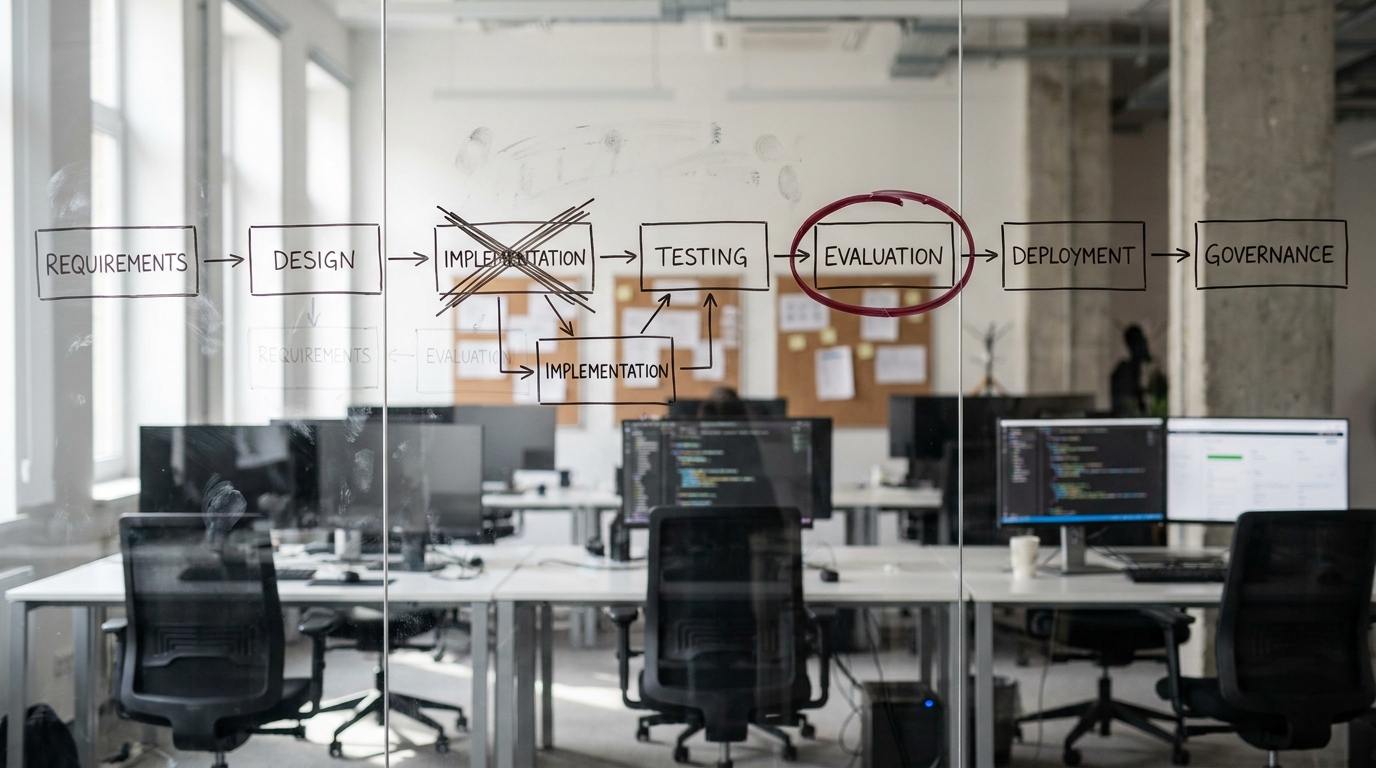
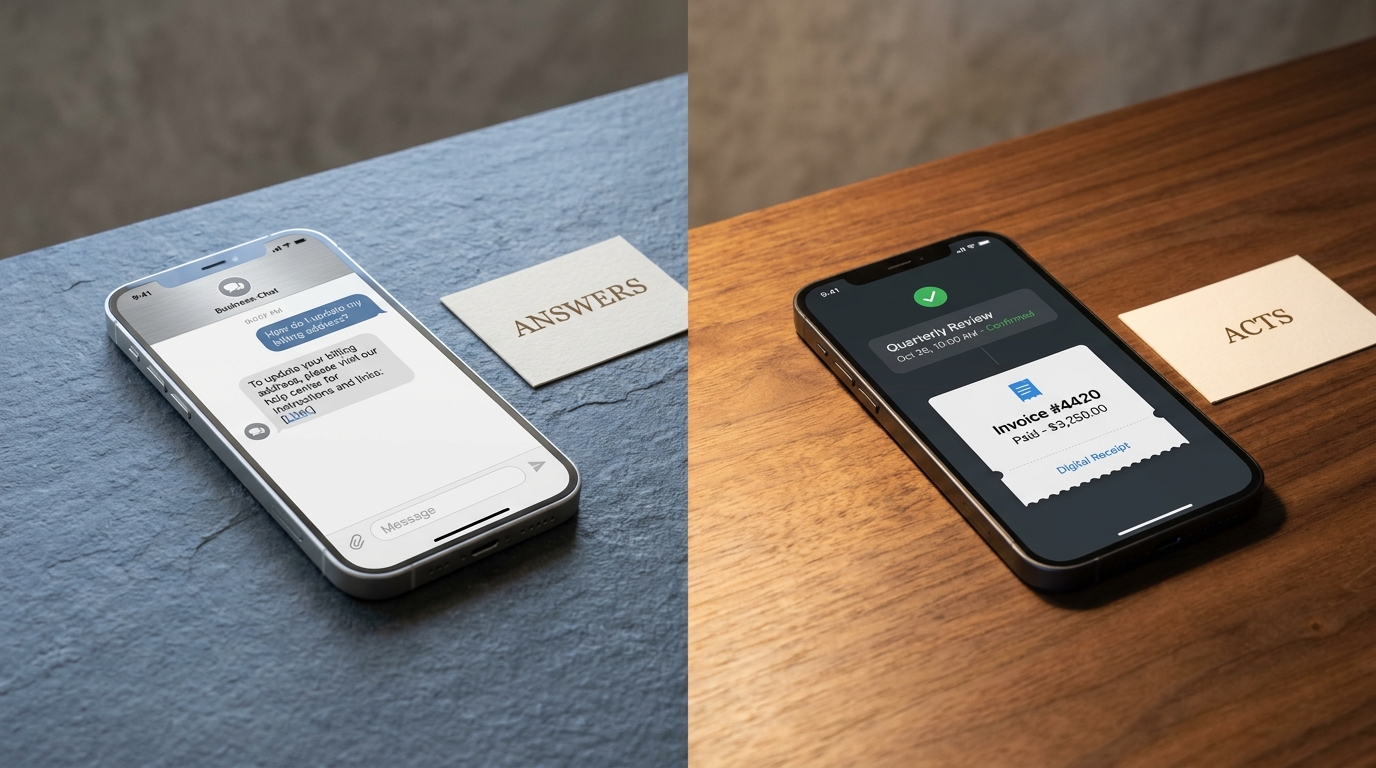
A customer messages your business at 9 p.m. to move tomorrow's appointment and clear the balance they still owe. A chatbot tells them how to do both: here is the reschedule link, here is the payment page. An agent just does it. It finds the open slot, moves the booking, takes the payment, sends the confirmation, and flags the one thing it cannot resolve to a human in the morning.
That gap between explaining and doing is the whole story. The moment software stops answering and starts acting, three things move at once: your risk, your ROI, and your operating model. Most executives have already deployed a chatbot or rolled out Copilot, and they file agentic AI in the same folder as a slightly smarter version of what they already run. It is not. Treating an agent as a chatbot upgrade is how a demo that impressed the board becomes a production system nobody is accountable for.
The one difference that actually matters
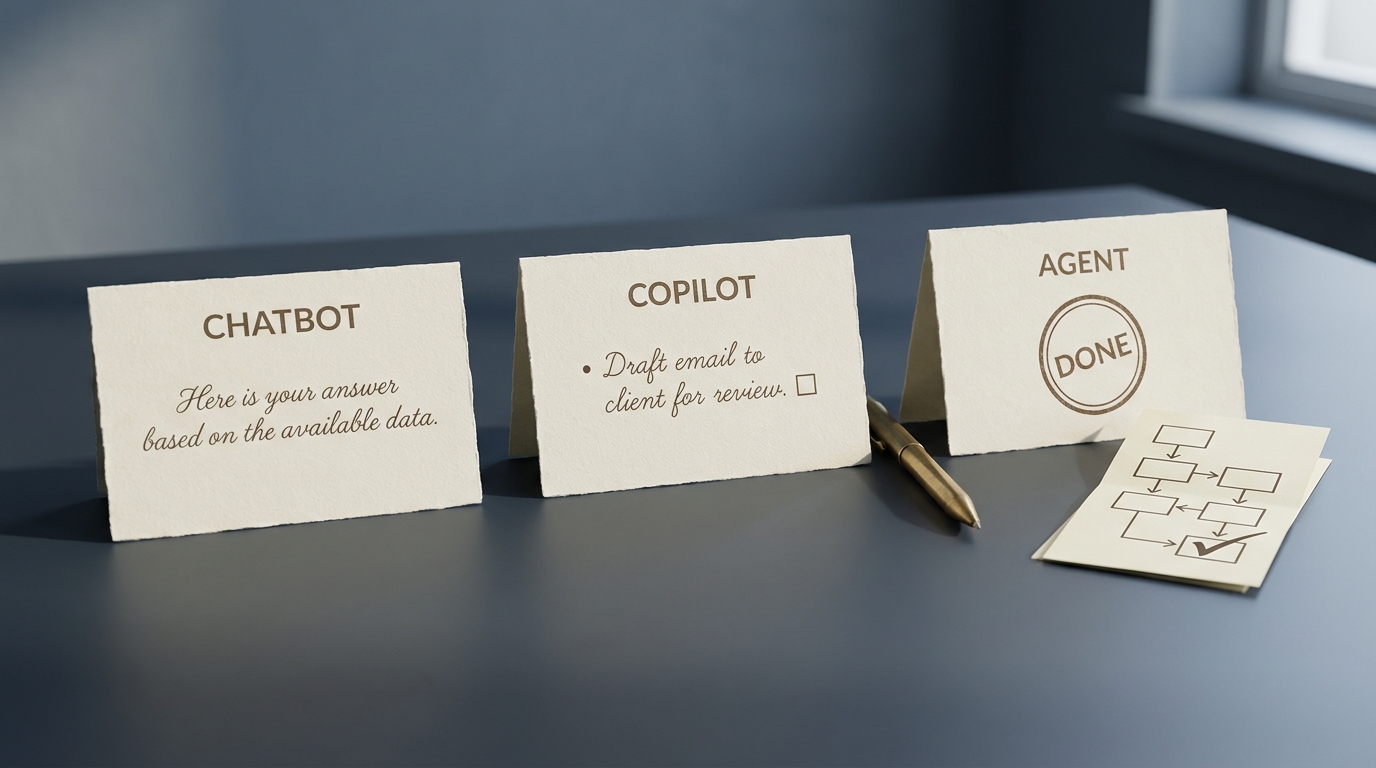
A chatbot answers. A copilot assists. An agent acts. That is the distinction, and everything else here follows from it.
Agentic AI is software that can pursue a goal across multiple steps, decide what to do next, and take real actions in your systems with limited human supervision. A chatbot returns a response and waits. An agent books the slot, moves the money, updates the record, and only stops to ask when it hits a boundary you set.
Key takeaways:
- A chatbot returns information. A copilot drafts work a human approves. An agent completes a workflow and escalates only the exceptions.
- Once software can act, the cost of a mistake changes from a bad answer to a wrong action that moves money, data, or customer trust.
- Agent value is measured in workflows finished, not questions deflected.
- Running an agent safely takes three things a chatbot never did: decision rights, runbooks, and one accountable owner.
The three levels: chatbot to copilot to agent
The clearest way to size the shift is to walk the three levels in order. Each adds autonomy, and each moves the human to a different seat. Watch where the human sits, because that seat is the whole cost model.
Chatbot: it answers inside a script
A chatbot responds to a question with information or a scripted step. It can be genuinely useful for deflecting FAQs, routing tickets, and surfacing a link. But the human still does the doing. The bot tells your customer where the reschedule button is. Your customer clicks it. If the conversation falls outside the script, the bot stalls or hands off. Control sits entirely with the person on the other end of the chat.
Copilot: it drafts, you approve
A copilot works inside your tools and suggests. It writes the draft email, proposes the code, summarizes the thread, and recommends the next action. This is where most organizations sit today, and it is a real productivity gain. The catch is that the human stays in the loop on every output. The copilot suggests, you review, you execute. Nothing reaches a customer or a ledger without a person pressing the button.
Agent: it plans, decides, and executes
An agent takes a goal and owns the multi-step work of reaching it. It plans a sequence, calls the tools it needs, adapts when a step fails, and executes inside guardrails you define. You set the objective and the boundaries. The agent handles the middle. The human moves from doing the work, or approving each step, to setting the goal and governing the exceptions.
Here is the same three levels as a scan-in-one-glance comparison:
| Level | What it does | Who is in control | Where the human sits | Failure mode if over-trusted |
|---|---|---|---|---|
| Chatbot | Answers within a script | The human, fully | Does all the work | Stalls or misroutes, but takes no action |
| Copilot | Drafts and suggests in your tools | The human approves each output | Reviews and executes | Ships a flawed draft a human rubber-stamped |
| Agent | Plans and completes a workflow | The agent, within set boundaries | Sets the goal, governs exceptions | Takes a wrong action at scale before anyone notices |
Read the last column top to bottom. As you move down the levels, the failure mode stops being an embarrassment and starts being a liability. That escalation is the reason the rest of this article exists.
What "acting" actually looks like
Abstractions are easy to nod along to and hard to govern. So make it concrete. Meta's Business Agent is a useful worked example because it performs business actions end to end rather than just chatting: it can book appointments, take payments, finalize a sale, handle customer support, and escalate what it cannot resolve to a person.
Follow one customer journey through it. A customer asks to move an appointment and settle a balance. A chatbot version explains the two separate steps and hopes the customer completes them. The agent version checks availability, rebooks the slot, processes the payment, sends the confirmation, and, if the customer then asks for something outside its authority, such as a refund above a set threshold, routes that single exception to a human with the full context attached.
The difference is not tone or speed. It is that the agent changed the state of your business. A booking exists that did not exist . Money moved. A record updated. That is the line between a conversation and an action, and it is the line that reshapes everything downstream.
How an agent works, in plain terms
You do not need the engineering to govern the outcome, but a plain-language model helps. An agent runs a loop of four capabilities.
It plans: given a goal, it breaks the work into steps. It uses tools: it calls your booking system, your payment processor, your CRM , the same way a person clicks through apps. It keeps memory: it holds context across the steps so it does not lose the thread halfway through. And it runs a feedback loop: when a step fails or returns something unexpected, it adjusts and tries a different path instead of stopping cold.
That loop is why an agent can act instead of answer. It is also why an agent can be wrong in a more expensive way than a chatbot. A chatbot gives one bad reply. An agent can take a wrong step, feed its own output back in , and compound the error across a workflow before a human ever sees it. Understanding the loop is the point where "this is just a better bot" stops being a safe assumption.
Why this changes your risk
When software only answers, the worst case is a bad answer. When software acts, the worst case is a wrong action, and wrong actions cost money, data, or trust.
Four risks move to the front the moment you give an agent authority:
- Hallucinated actions. A chatbot can state something false. An agent can do something false, such as booking the wrong slot, charging the wrong amount, or updating the wrong record, and treat it as done.
- Unbounded scope. Without explicit limits, an agent will try to complete the goal by whatever path it finds, including paths you never intended it to take.
- Auditability. If you cannot reconstruct what the agent did and why, you cannot defend the decision to a regulator, a customer, or your own board.
- Brand and compliance exposure. An agent acting in your name is your company acting. A misstep is not a support-bot glitch, it is a business action you are on the hook for.
None of this makes agents too dangerous to use. It makes them software you govern rather than software you switch on. OpenAI's 2023 "Practices for Governing Agentic AI Systems" and Microsoft's guidance on guardrails for autonomous agents in Copilot Studio both point the same direction: constrain scope, keep a human in the loop at the right points, and log everything. The risk is manageable. It is not automatic.
Why this changes your ROI
The economics move too, and this is where the chatbot mental model quietly misleads you.
A chatbot's return is measured in deflection: how many tickets it kept off a human's desk, at what cost per conversation. That math is real but small. It shaves cost off an existing process.
An agent's return is measured in outcomes owned: how many complete workflows it finished without a human touching them, at what cost per completed workflow. That is a different order of value. You are not deflecting a question about rescheduling. You are eliminating the labor of the reschedule, the payment, and the confirmation entirely, for the cases that fall inside the agent's authority.
The practical implication for how you judge a pilot: stop counting conversations handled and start counting workflows completed end to end. If a vendor sells you an agent and reports success in messages answered, they have sold you a chatbot with a new label.
Why this changes your operating model
This is the part almost every competing article skips, and it is the part that actually lands on your desk. A chatbot was a tool you bought. An agent is a role you have to run. Three things an agent needs that a chatbot never did:

Decision rights
You have to decide, explicitly, what the agent is allowed to do on its own and what requires a human. Can it issue a refund? Up to what amount? Can it change a booking, waive a fee, close a ticket as resolved? Decision rights are the difference between an agent that helps and an agent that surprises you. Left undefined, they default to whatever the model decides in the moment, which is not a decision your business made.
Runbooks
The agent owns a workflow, so that workflow has to be documented: the normal path, the exception paths , and the escalation rules. A runbook is what turns "the agent handles support" into a specific, auditable set of behaviors. It is also what you hand to the agent's owner when something goes wrong at 2 a.m. If you cannot write the runbook, the workflow is not ready for an agent, and finding that out on paper is far cheaper than finding it out in production. This is often where a lean, embedded Fractional Agentic Team earns its keep, by writing the runbook and standing up the guardrails before anything goes live.
Measurable workflow ownership
Every agent workflow needs one accountable human owner, a clear set of KPIs, and a way to audit what the agent did. Not a committee. An owner. The owner defines success, watches the metrics, and answers for the exceptions. This is the single most common gap between "we bought an agent" and "we can run one." The software is the easy part. The accountability structure is the work.
Where a chatbot is still the right call
Restraint is credibility. An agent is not the answer to every problem, and pretending otherwise is how you over-engineer a simple job and inherit risk you did not need.
A chatbot or a copilot is the better tool when:
- The task is purely informational. If the job is to answer "what are your hours" or "where is my order," you want a fast, cheap answer, not an autonomous actor.
- The action is high-stakes and rare. For a decision that happens twice a year and carries real consequences, a human with a copilot beats an agent you would have to govern heavily for almost no volume.
- The workflow is not yet documented. If you cannot write the runbook, you are not ready to let software own the workflow. Start with a copilot and learn the process first.
- The cost of a wrong action exceeds the cost of the manual work. When a mistake is more expensive than just doing it by hand, keep the human doing it.
Knowing where an agent is overkill is exactly the judgment that separates a real transformation from a pile of pilots.
A readiness checklist before you deploy an agent
Before you let an agent own a live workflow, you should be able to check every one of these. If you cannot, you have not found a blocker. You have found your pre-work.
- Data access is scoped. The agent can reach exactly the systems it needs, and nothing more.
- Guardrails are defined. Explicit limits on what it can decide, spend, or change without a human.
- Human-in-the-loop points are chosen. You have named the moments where the agent must stop and ask.
- Audit logging is on. Every action the agent takes is recorded and reconstructable.
- Rollback exists. When the agent gets something wrong, you can reverse it.
- There is a named owner. One accountable person, with KPIs, who answers for this workflow.
This list is the gap between a slide and a system. Deloitte's 2025 analysis of autonomous generative AI agents makes the same point from the other direction: the capability is arriving faster than most organizations' ability to adopt it responsibly. The constraint is rarely the model. It is the readiness.
What to do next
The question in front of you is not "should we get an agent." It is "which single workflow do we let software own first, and are we ready to govern it."
Pick one workflow. Not the whole support desk, not every booking, one workflow with real volume and a documented process. Define the decision rights, write the runbook, name the owner, and set the KPIs before a line of it goes live. Prove you can govern one agent well, then expand. Boiling the ocean is how pilots stall. Owning one workflow end to end is how transformation starts.
If you want a structured way to find that first workflow and pressure-test whether you are ready to run it, book an AI Transformation Discovery (Discovery Sprint) . It is a focused engagement to scope one agent-ready workflow, map the decision rights and runbook it needs, and give you a clear answer on where an agent earns its risk and where a chatbot still wins.
A chatbot answers. An agent acts. Once you have decided which of your workflows is ready to be owned rather than merely assisted, you are no longer evaluating a feature. You are redesigning how the work gets done.