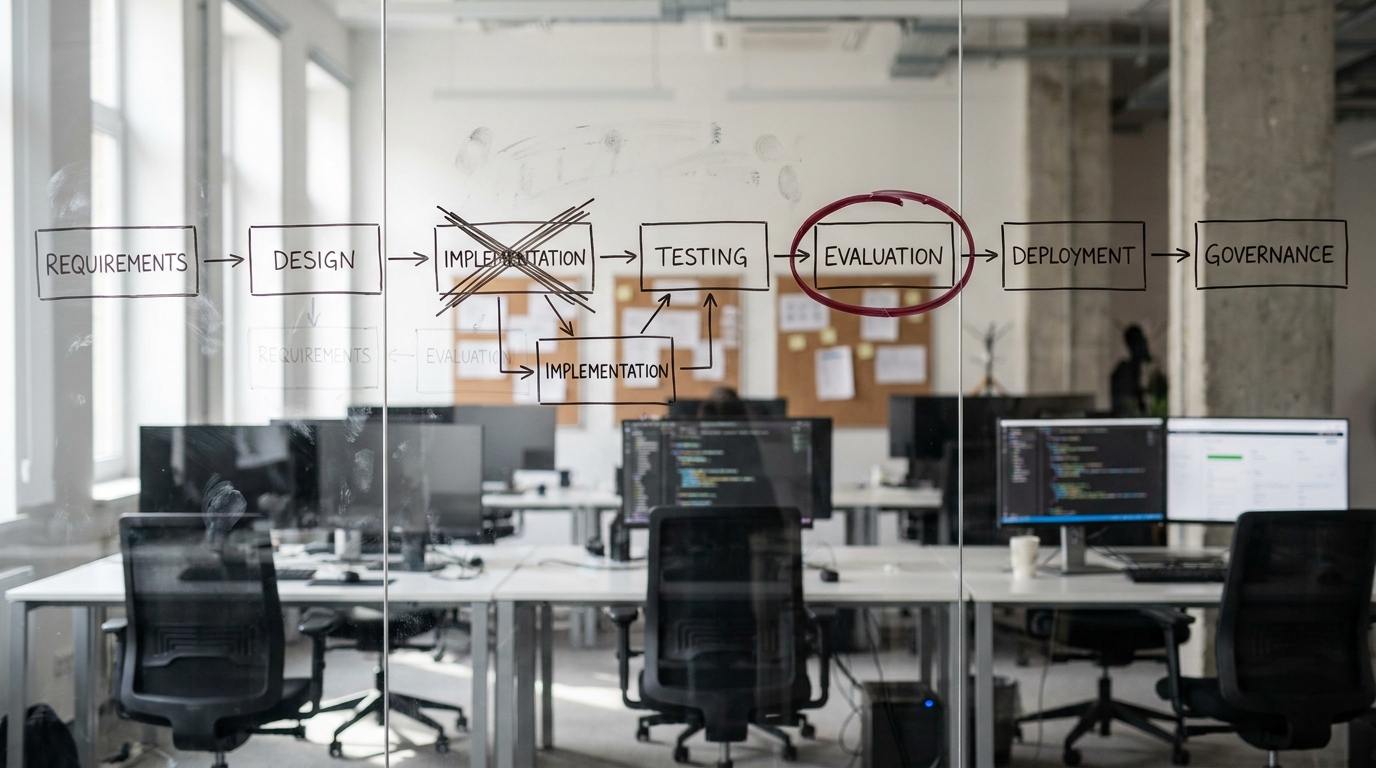
A human clicking "approve" on every agent action was never a safety feature. It was a stopgap, borrowed from an era when software waited for people and the volume of decisions stayed small enough to read one at a time. That era is closing. As AI agents take on more work, the approval click stops keeping you safe and starts doing something else: capping your throughput and wearing down your best reviewers.
Look at how the question itself has changed. The old one was simple: should a human be in the loop? For anything that mattered, the answer was yes, and the design followed from there. A person sat inside the workflow and signed off before the system moved. The newer question is harder, and more useful. Not whether a human belongs in the loop, but where in it, and doing what. One analyst supervising one process could reasonably approve each step. Ask one person to oversee dozens of agents running at once , and signing off on every action is neither realistic nor, most of the time, the control it claims to be.
There is a name for the change. Human-in-the-loop is becoming human-on-the-loop. The person who needs to understand it is not an ML engineer tuning a data-labeling pipeline. It is the CIO who answers for the architecture, the head of Risk who designs the controls, the General Counsel who carries the liability, and the COO who measures the throughput. The move costs each of them something different, and that is what the rest of this piece is about.
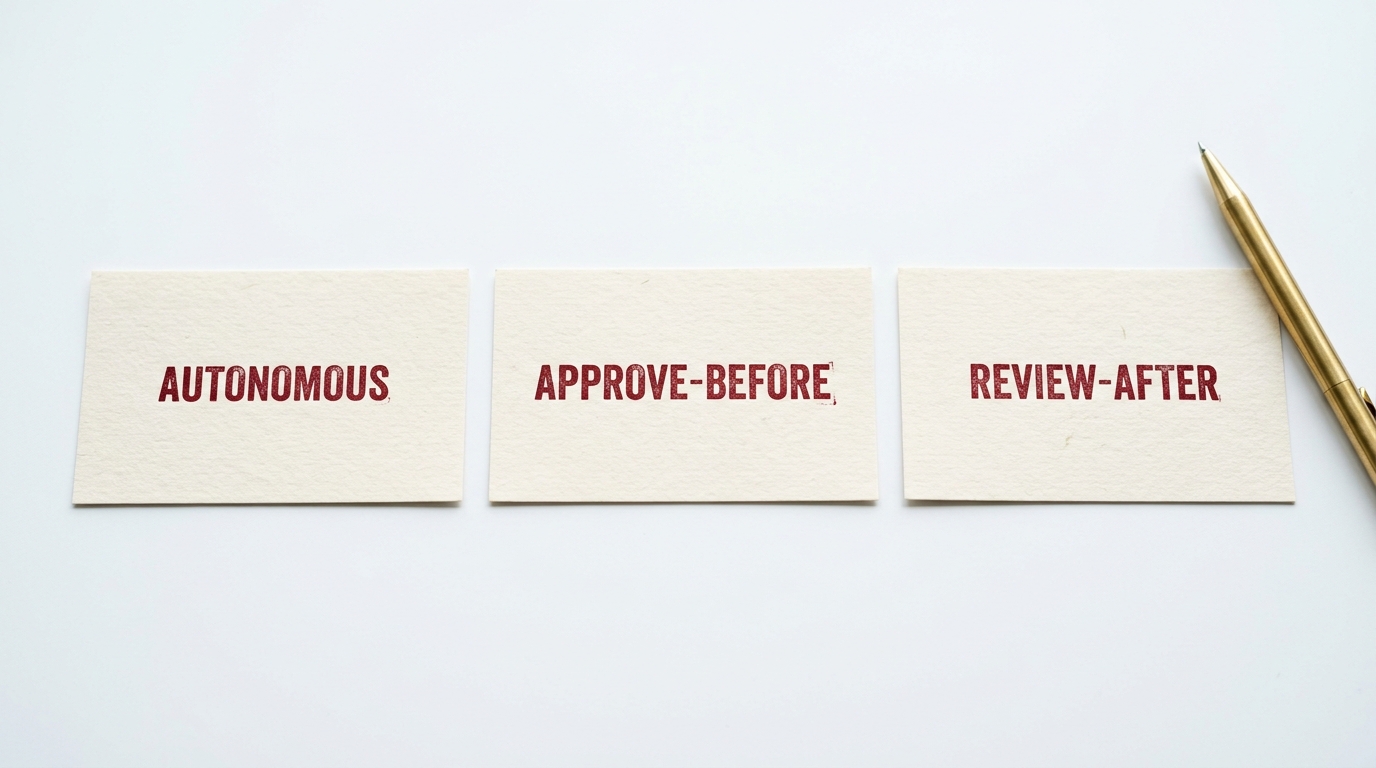
Quick answer: Human-in-the-loop (HITL) means a person approves or decides inside the workflow before the system acts. Human-on-the-loop (HOTL) means a person supervises the system, handles exceptions, and sets the boundaries while the agent acts on its own. The practical move is not to pick one for your whole company. It is to assign an oversight mode - Autonomous, Approve-before, or Review-after - to each decision type, based on how much damage a wrong call does, whether you can undo it, and whether it is regulated.
Human-in-the-loop vs human-on-the-loop: what actually changed
Both phrases describe how a person and an automated system share control. The whole difference comes down to where the person stands relative to the work.
Human-in-the-loop puts the person inside the workflow. The system pauses, presents a proposed action or a decision, and waits for someone to approve, reject, or edit before anything happens. The human is a gate. Nothing moves without them. IBM's explainer on human-in-the-loop (2024) frames it this way for machine learning: the model defers to a person at the points where its judgment is weakest.
Human-on-the-loop puts the person above the workflow. The agent acts on its own, inside limits the human has set. Rather than approving each action, the human watches the system, steps in on exceptions, reviews samples after the fact, and adjusts the boundaries when behavior starts to drift. Supervisor, not gate.
Two neighboring terms are worth pinning down so the vocabulary stays clean:
- Human out of the loop is full autonomy. No routine human involvement in the decision at all. Reserved for the lowest-stakes, most reversible actions.
- AI-in-the-loop is the mirror image of HITL. A human runs the process and the AI assists, suggests, or drafts. The person is still the one acting.
Why is the line moving now? Arithmetic, not ideology. A single agent can take thousands of actions in the time a person reviews a handful. The n8n comparison of human-in-the-loop and human-on-the-loop (2025) puts the trade-off plainly: in-the-loop buys maximum control at the cost of latency and scale, on-the-loop buys scale and speed at the cost of per-action certainty. Back when agents were rare and slow, the cost of the in-the-loop gate was invisible. Now that agents are many and fast, that same gate becomes the ceiling on everything automation can actually deliver.
Why "approve every step" stops scaling
Put a human approval on every agent action and you have not built a control. You have built a queue. And queues have a throughput limit, set by the speed of your slowest reviewer on their worst afternoon. That is the first hidden cost: the whole system now moves at human pace, which was the exact thing you were trying to escape.
The second cost is latency. An agent that could settle a customer request in seconds instead waits minutes, or hours, for someone to notice the approval sitting in their inbox. Multiply that across every action and the "efficiency" of automation quietly drains away into wait states.
The third cost is the worst, because it looks like nothing is wrong. When a reviewer faces a hundred near-identical approvals a day, attention collapses. People start clicking "approve" on pattern recognition instead of judgment. The gate still exists on the org chart. In practice it has turned into a rubber stamp, which is worse than no gate at all, because it manufactures a paper trail of human sign-off on decisions no human actually examined. When something goes wrong, the record says a person approved it. That is a governance liability wearing the costume of a control.
None of which makes approval obsolete. It makes approval expensive. And like any expensive control, it should be spent where it changes the outcome and withheld where it does not. A human gate on a refund above a threshold earns its cost. A human gate on an agent tagging internal documents does not. Treat every action as if it carries the same risk and you have found the exact mechanism by which oversight turns from a safeguard into a bottleneck.
A model for oversight: Autonomous, Approve-before, Review-after
Human-on-the-loop is not one setting you flip on. It is a small set of oversight modes you assign per decision type. Three of them cover the field.
Autonomous. The agent acts without waiting. Oversight happens after the fact, through monitoring, sampling, and alerts on anomalies. The human sets the boundaries and watches the aggregate rather than the individual action.
Approve-before. The agent proposes, a human approves, and only then does the action execute. This is classic human-in-the-loop, now deployed on purpose rather than by default. It is the right mode for a minority of high-stakes decisions, and the wrong standard for all of them.
Review-after. The agent acts immediately, and a human reviews a sample or the flagged exceptions afterward. Speed survives. Control comes from spot-checks and an audit trail instead of a pre-execution gate.
The table below lays the three modes side by side.
| Mode | What the human does | When oversight happens | Best for | Not for | Example |
|---|---|---|---|---|---|
| Autonomous | Sets limits, monitors the aggregate, investigates anomalies | After the fact, by sampling and alerting | High-volume, low-blast-radius, reversible actions | Anything regulated or hard to undo | An agent categorizing and routing internal documents |
| Approve-before | Reviews and signs off on each proposed action before it runs | Before execution | High-stakes, hard-to-reverse, or regulated actions | High-volume routine work where the queue would stall throughput | An agent issuing customer refunds above a set amount |
| Review-after | Reviews a sample or exceptions after the action has executed | After execution, on a sample or on flags | Medium-risk actions where speed matters and a paper trail plus spot-checks satisfy control owners | Irreversible actions where a bad call cannot be walked back | An agent updating CRM records and correspondence |
The thesis lives in how you use the table. You do not pick one row for the entire company. You look at each type of decision your agents make and give it the row that fits. What most organizations find is that the large majority of agent actions belong in Autonomous or Review-after, and only a thin slice genuinely needs Approve-before. That distribution is the whole reason oversight can scale from in the loop to on the loop.
How to choose the mode: blast radius, reversibility, regulatory exposure
Assigning a mode to a decision type does not take a committee. It takes three questions, asked in order.
How bad is it if the agent is wrong? Call this blast radius. A mistagged document affects one search result. A wrongful account closure affects a customer, a support queue, and possibly a regulator. The wider the blast radius, the stronger the case for a human gate before the action rather than after it.
Can you undo it? Call this reversibility. Editing an internal draft is fully reversible. Sending a payment or a legally binding notice is not. Reversible actions tolerate Autonomous or Review-after, because a mistake can be caught and corrected. Irreversible ones push toward Approve-before, since after-the-fact review cannot unspill what was spilled.
Is it regulated? Call this exposure. Some decisions must carry a documented human decision-maker by law or contract, no matter how confident the model is. Credit decisions, certain healthcare and legal actions, anything touching regulated disclosures - these often have to stay Approve-before whether or not the economics argue for it.
Run those three questions against a decision and the mode usually falls out on its own. An agent drafting internal meeting summaries scores low, reversible, and unregulated, so it lands in Autonomous. An agent issuing refunds above a threshold scores high-blast-radius and hard-to-reverse, so it lands in Approve-before. An agent updating CRM records scores medium and reversible, with a useful audit trail, so it lands in Review-after. The specific answers are not the point. The point is that you now have a repeatable rule where you used to have a reflex to gate everything.
What human-on-the-loop oversight actually requires
Moving from the gate to the supervisory position is not a matter of pulling out the approval step and hoping for the best. On-the-loop oversight only works if the machinery underneath it exists. Microsoft's guidance on when an AI agent should ask for help (2026) and AWS's patterns for human-in-the-loop confirmation (2025) both land on the same underlying point: the system has to know its own limits and route the hard cases to a person. That routing is the whole game.
Before an agent runs in anything other than Approve-before, you want these in place:
- Monitoring. A live view of what agents are doing, with the volume and type of actions visible in aggregate, not buried in logs no one reads.
- Exception and escalation queues. A defined path for the cases the agent flags as uncertain or out of policy, routed to a named human rather than a shared inbox that fills and empties at random.
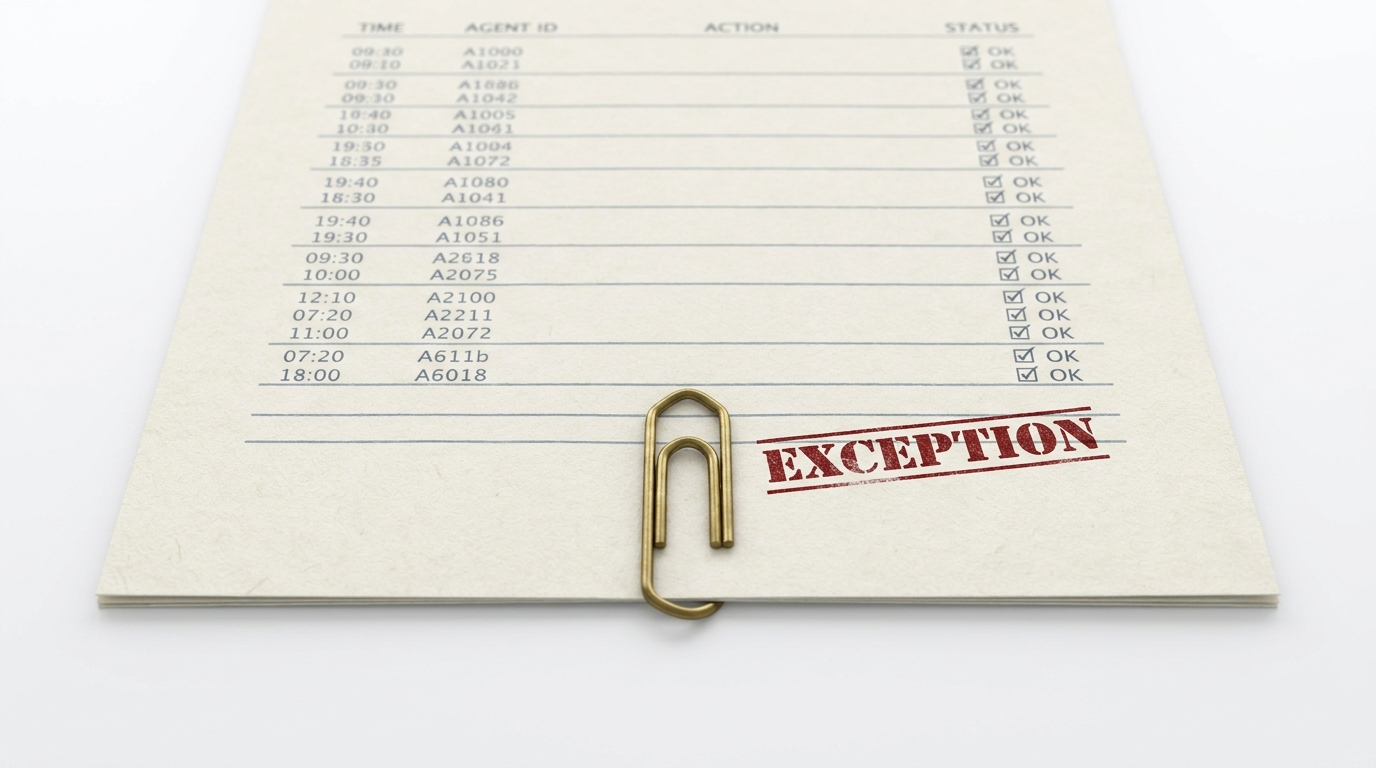
- Audit logs. A durable, queryable record of every action, its inputs, and its outcome, so a Review-after sample is possible and a regulator's question has an answer.
- Clear ownership. A named person or team accountable for each agent's behavior. "The system did it" is not an owner.
- Rollback and kill switches. The ability to reverse a class of actions, and to stop an agent the moment its behavior drifts. Without a stop, autonomy is a one-way door.
This machinery is where most oversight programs are thin, and it is often where the in-house team runs short on capacity. Standing up monitoring, exception routing, and audit infrastructure for a fleet of agents is real engineering work. Organizations without the bench for it frequently bring in an embedded agentic team to build and run the oversight layer alongside the agents themselves, rather than leaving supervision as an afterthought bolted on after something has already gone wrong.
What this means for you: CIO, Risk, Legal, COO
The shift lands differently on each executive who owns a piece of it.
CIO. Your concern is architecture and observability. On-the-loop oversight is only ever as good as the monitoring, logging, and ownership model underneath it . You are the one who has to make agent behavior visible and attributable, and to prove the kill switches and rollbacks actually work when tested rather than existing on a slide. If the platform cannot show what an agent did and let you stop it, no oversight policy above it is real.
Risk. Your concern is control design and assurance. You set the sampling rates for Review-after, the thresholds that push a decision into Approve-before, and the assurance model that tells the board the controls are working. Your sharpest task is telling a control that changes outcomes apart from one that only produces a comforting record. Rubber-stamp approval is your enemy, because it reports as control while delivering none.
Legal. Your concern is liability and the regulated core. You are the one who marks the decisions that must stay Approve-before regardless of efficiency, and who defines what the record has to contain to defend a decision later. Precision is your value here: gate what the law and the contracts require, and resist gating everything else out of caution, because over-gating breeds the reviewer fatigue that hollows out the gates that do matter.
COO. Your concern is throughput and where human capacity goes. As approval moves from every step to exceptions only, you are the one who redirects reviewer time from clicking sign-off toward handling the hard cases and sharpening the boundaries. Done well, this is where the capacity dividend of agents finally shows up. Done badly, the exception queue becomes the new bottleneck and nothing has changed but the label.
Common failure modes and how to avoid them
The move from in-the-loop to on-the-loop fails in fairly predictable ways. Naming them is most of the defense.
- Rubber-stamp approvals. A gate everyone clicks through without reading. Remove the gate where it adds nothing, and reserve Approve-before for the thin slice of decisions that genuinely warrant a pause.
- Alert fatigue. Monitoring that fires so often people mute it. Tune what escalates, so an exception queue carries real exceptions instead of noise.
- Unclear ownership. Every agent needs a named owner. When something breaks and the answer to "who is accountable" is a shrug, the oversight model has already failed.
- No rollback path. Autonomy without a way to reverse a class of actions is a bet you cannot hedge. Build the undo before you grant the autonomy.
- Oversight as a checkbox. Treating "human in the loop" as a compliance phrase to satisfy an auditor rather than a control to right-size. The label on the org chart is not the control. The machinery underneath it is.
How to start: pilot, instrument, promote
You do not rebuild your oversight model in one motion. You earn the shift, one workflow at a time.
Pick a single workflow where an agent is already doing useful work, and start it in Approve-before. Nothing moves without a human sign-off. This is the conservative setting, and it is the right place to begin, because it generates the evidence you need.
Then instrument it. Log every proposed action, every approval, every override. Watch the override rate: how often the human actually changes or rejects what the agent proposed. A high override rate says the agent is not ready and the gate is doing real work. A low one says the gate is mostly rubber-stamping, and the decision type is a candidate for promotion.
Then promote it. As the evidence accrues, move the decision type from Approve-before to Review-after, and eventually shift its reversible, low-blast-radius parts to Autonomous. Each promotion is a decision backed by data, not a leap of faith. Over time the thin slice that genuinely needs Approve-before comes into focus, and everything else moves to supervision.
Mapping your decisions to the three modes and standing up the oversight machinery is the work we do with clients in an AI Transformation Discovery . If you want a structured pass at which of your agent decisions belong in Autonomous, Approve-before, or Review-after - and what monitoring, exception handling, and audit trail each one needs - book a Discovery Sprint . Teams still early in this can start with a lighter-touch AI Readiness Snapshot before scoping the full engagement.
Key takeaways
- Human-in-the-loop (approve every step) is becoming human-on-the-loop (supervise the system, handle exceptions, set boundaries). The human's job moves from operator to orchestrator.
- "Approve every step" does not scale. It caps throughput at human pace, adds latency, and breeds rubber-stamping that looks like control while providing none.
- Assign an oversight mode per decision type, not one for the whole company: Autonomous, Approve-before, or Review-after.
- Choose the mode with three questions: how bad if wrong (blast radius), can you undo it (reversibility), is it regulated (exposure).
- On-the-loop oversight requires real machinery: monitoring, exception queues, audit logs, named ownership, and rollback and kill switches.
- CIO owns observability, Risk owns control design, Legal owns the regulated core, COO owns throughput and where reviewer capacity goes.
The human is not leaving the loop. The human is moving above it - from clicking approve on every action to setting the boundaries, watching the system, and deciding which decisions still deserve a pause. That is what oversight looks like once automation scales: not a safety feature you inherited, but a design choice you make on purpose, decision type by decision type, before your approval queue makes it for you.