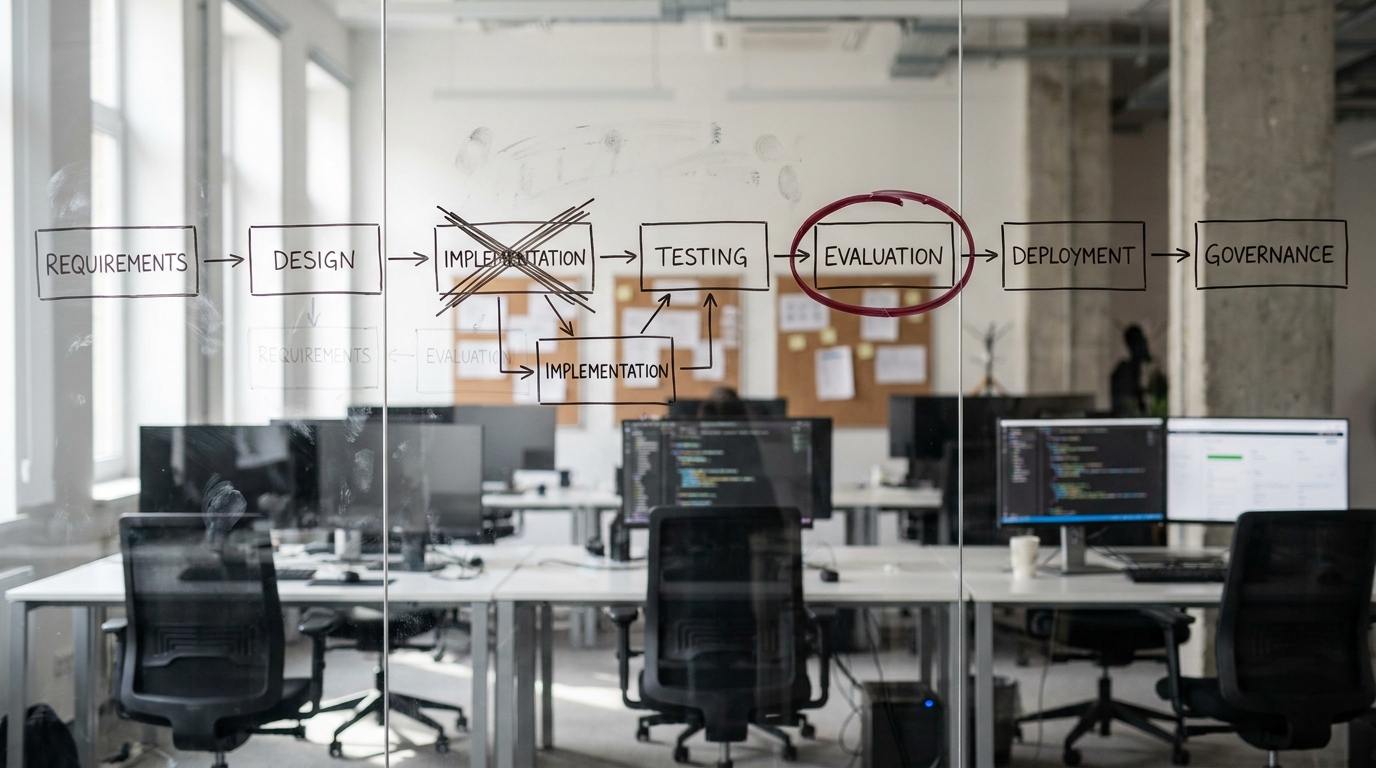

Walk into most mid-market companies right now and you find the same scene. Three or four AI pilots that dazzled in a demo. A slide deck full of "productivity gains." And almost nothing that has actually changed how the work gets done. The chatbot answers questions. The copilot drafts emails. Meanwhile the finance close still takes eleven days, the support queue still backs up every Monday, and the sales team still rekeys the same data into three systems.
That gap, between the impressive demo and the unchanged operation, is the real story of AI in 2026. The consultancies and hyperscalers have each shipped their version of the fix. Rewire your operating model. Become a "frontier firm." Move from experimentation to enterprise scale. None of it is wrong. It is just written from the mountaintop, on Fortune 500 budgets and proprietary research, for readers who do not have a dedicated AI team, a clean data estate, or a McKinsey retainer.
So this is the version nobody wrote for the rest of us. One argument sits underneath everything, and it cuts against most of what a vendor will tell you: AI transformation is not an AI problem. It is an operating-model and data-readiness problem that AI happens to make urgent. The tools are the easy part. Companies stall because they bolt AI onto workflows that were already broken, then wonder why the demo never became a result. What follows is an honest map. What the term actually means, why efforts stall, what has to change, and a path a normal-sized company can actually sequence .
What AI business transformation actually means (and what it doesn't)
Start with a clean definition, because the whole conversation runs aground right here.
AI business transformation is the redesign of how a business operates - its workflows, decision rights, and data - so that AI systems compound value across the organization rather than sitting on top of it as a feature.
Read that again. The operative word is operates. Transformation changes the machine that produces the work. Everything short of that is something else.
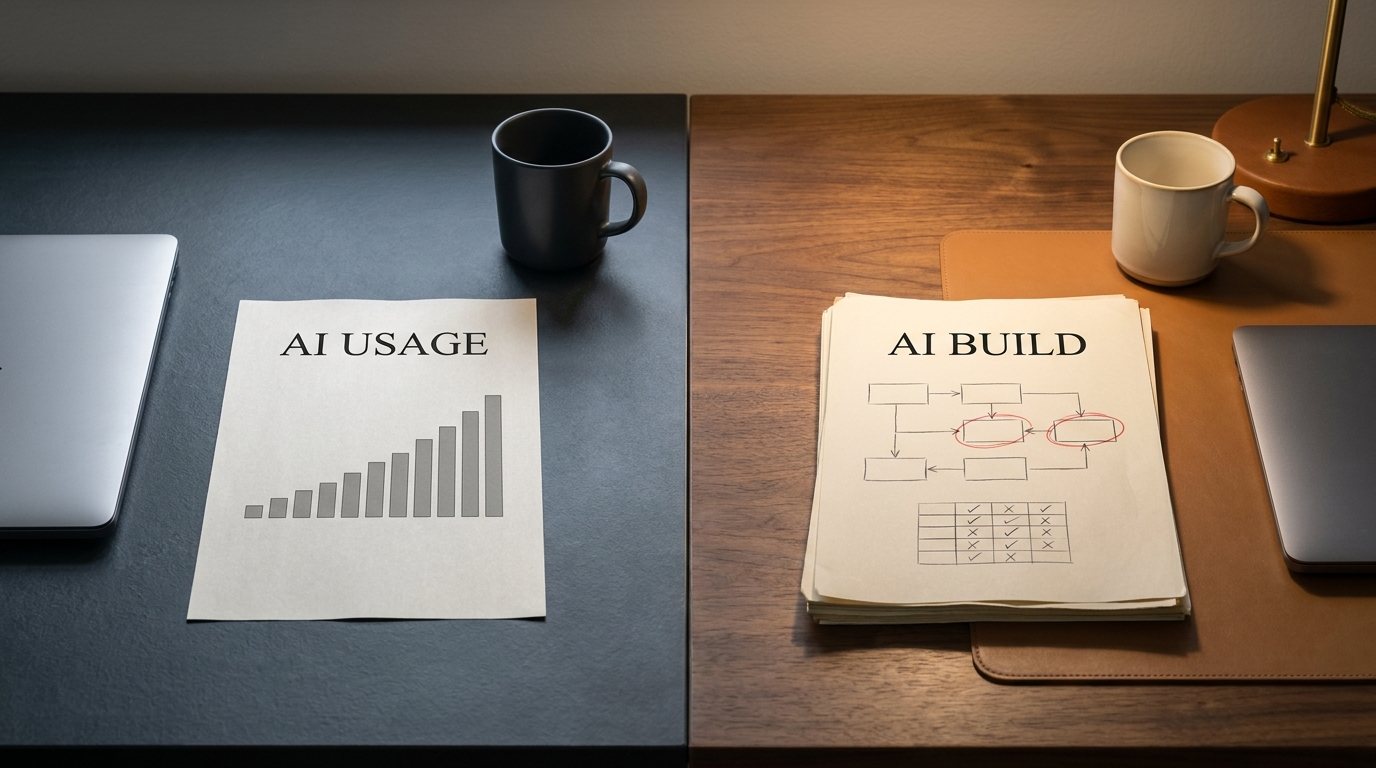
The distinction almost every competitor blurs is between adoption and transformation:
- AI adoption is people using AI tools. Your team has Copilot licenses, a couple of analysts prompt a chatbot, someone rigged a clever automation for their own inbox. Real and useful, but additive. The underlying process is untouched. Pull the tool out and the workflow reverts.
- AI transformation is changing how the business runs so the AI is load-bearing. The finance close gets redesigned around an agent that reconciles accounts continuously instead of in a month-end scramble. The support workflow gets rebuilt so an AI triages and resolves tier-one tickets while humans own the exceptions. Pull the tool out now and the process breaks, because the process was built around it.
There is a simple test hiding in that contrast. Pull the AI out. If the work carries on unchanged, you adopted a tool. If the work breaks, you transformed the business . Adoption asks, "how can this tool help me do my job?" Transformation asks, "how should this job be done now that this capability exists?" One is a purchase. The other is a redesign.
It also helps to separate AI transformation from digital transformation, the wave before it. Digital transformation mostly moved analog processes onto software. Paper to cloud, filing cabinets to databases, phone orders to e-commerce. AI transformation assumes the software is already there and changes who or what does the reasoning inside those processes. Digital transformation digitized the steps. AI transformation reassigns the judgment.
Two terms show up throughout this piece, so let me define them once. A large language model (LLM) is the underlying system that generates text or reasoning from a prompt. Agentic AI is AI that does not just answer but takes multi-step actions toward a goal - retrieving data, calling tools, finishing a task with little human prompting. Agentic AI is where most of the operating-model change is heading, and it is also where the data foundation stops being optional.
Why does the definition matter this much? Because if you think you are transforming when you are only adopting, you measure the wrong things, celebrate the wrong wins, and end up genuinely baffled that none of it shows up in the P&L. Which is exactly where most companies are stuck.
Why most AI efforts stall at the pilot stage
Here is the uncomfortable pattern. Most companies are experimenting. Far fewer have scaled anything. Google Cloud's 2026 work on AI ROI describes a large majority of organizations actively piloting or using AI agents, while only a minority have moved those pilots into production at scale (Google Cloud, 2026). BCG's analysis of AI leaders tells the same story from the other end: only a small share of companies - on the order of one in twenty in their framing - are capturing outsized value, while the rest see modest or no return (BCG analysis, 2026).
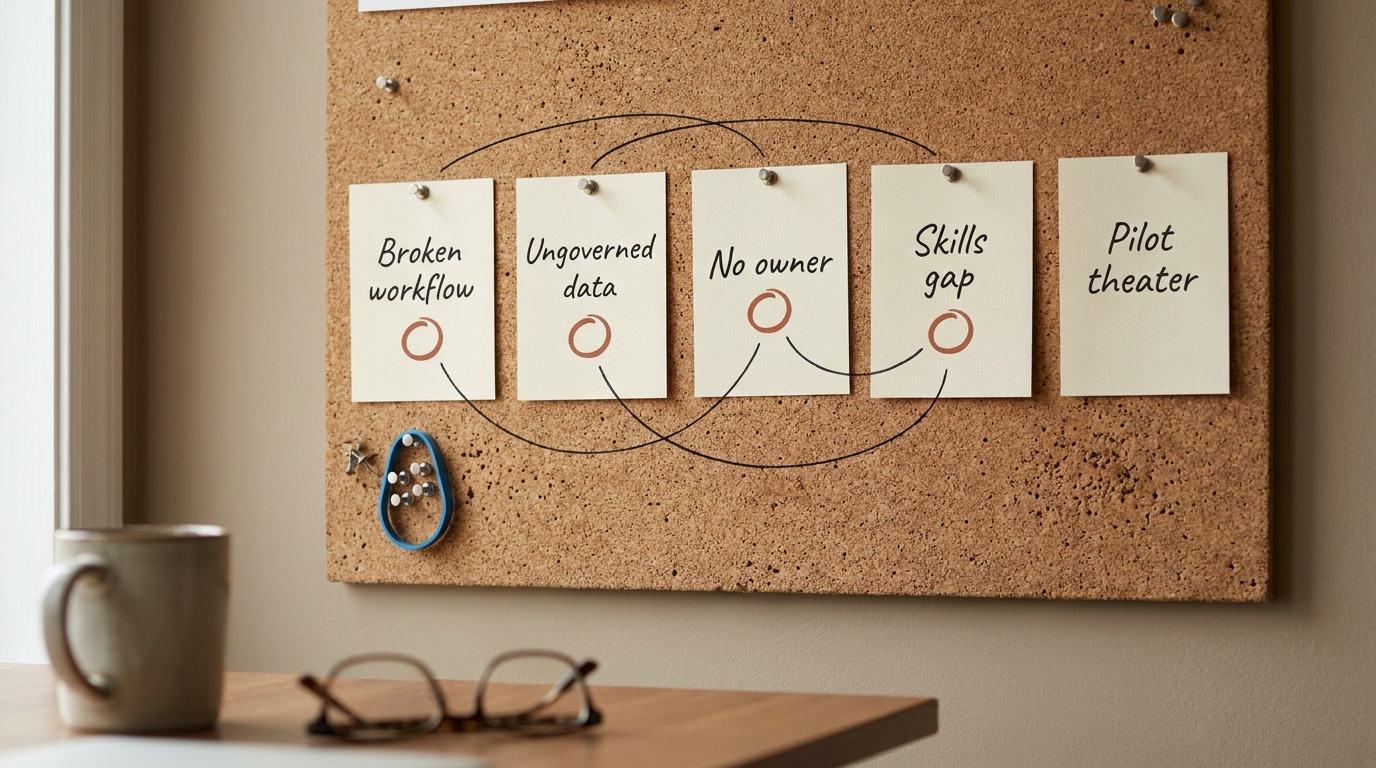
The reflex is to blame the technology. The technology is almost never the problem. Look at where pilots actually die and the same five root causes keep surfacing, and four of them have nothing to do with AI. This section is the spine of the whole article, so let me be specific about each.
1. AI bolted onto broken workflows. The most common failure by far. A team automates a step inside a process that was already slow, unclear, or riddled with manual exceptions. Now the AI does the broken thing faster. Nothing downstream shifts, so nothing compounds. What good looks like: redesign the workflow first, decide where a human still owns judgment, then insert the AI where it removes real friction.
2. Fragmented and ungoverned data. The pilot worked because someone hand-fed it clean inputs. In production the data lives in six systems, three definitions of "customer," and a spreadsheet only one person understands. The agent cannot reason over data it cannot reach or trust. What good looks like: the specific data the use case depends on is connected, defined, and governed. Not the whole estate, just the slice this workflow touches.
3. No clear owner or decision rights. The pilot was a side project. Nobody owns the production version, nobody can say when the AI is allowed to act versus escalate, and nobody is accountable for the outcome . It stalls in a committee. What good looks like: a named owner for the workflow, explicit rules for what the AI decides alone and what it hands to a person, and one accountable leader.
4. The skills gap. The people who could redesign the workflow are busy running the current one, and the people with time do not have the context. Meanwhile junior staff, who used to learn by doing the tasks the AI now handles, are losing their training ground. What good looks like: a small number of people with real authority and real time, backed by outside capacity where the internal bench is thin.
5. Pilot theater. The pilot gets measured on activity. "We ran 400 queries." "We saved 12 hours a week." Not on a business outcome anyone cares about. Time saved that never turns into faster cash, lower cost to serve, or more capacity is a vanity metric. What good looks like: every pilot is tied to a specific operational metric before it starts, and it either moves that number or it dies.
Now count them. Four of the five have nothing to do with AI. They are operating-model and data problems. AI did not create them, it exposed them, because AI is unusually unforgiving of process ambiguity and data mess. A human muddles through a vague workflow. An agent stops. That is why transformation feels harder than the demo promised. The demo hid the mess, and production does not.
If you recognize your own organization in that list, the fastest way to find which of the five is actually blocking you is to have someone map it against your real pilots. Get an AI Readiness Snapshot - a free 30-minute call that maps where AI will have the most immediate operational impact and where your current efforts are stuck.
The real shift: rewiring the operating model, not layering AI on top
The companies pulling ahead are not the ones with the most tools. They are the ones who changed how the work runs. Microsoft's 2026 framing of "execution as the new differentiator" and BCG's work on how AI leaders create competitive advantage land on the same finding: the winners redesign the organization around AI rather than sprinkling AI on the existing org chart (Microsoft, 2026; BCG analysis, 2026).
"Rewire the operating model" sounds abstract, so make it concrete. Three things change, and the middle one is the one almost everybody skips.
Workflow ownership changes. In the old model a process was a chain of human handoffs, each department owning its link. In the new model someone owns the whole workflow end to end, including the parts an agent now handles. The question shifts from "did my team do its step?" to "did the outcome happen, and where did it break?"
Decision rights change. This is the part most companies skip, and it matters most. You have to decide, explicitly and in advance, what the AI is allowed to decide. Can the agent issue a refund under a certain amount without a human? Can it reconcile an account and post the entry, or only propose it? Can it close a low-value ticket, or must a person confirm? These are not technical questions. They are governance questions about risk, authority, and where a human stays in the loop.
Team structure changes. Roles reorganize around exceptions and judgment rather than throughput. The support agent who used to answer 60 tickets a day now owns the 8 hard ones the AI escalated, plus the quality of the AI's answers on the other 52. The analyst stops assembling the report and starts interrogating the report the AI assembled.
Two plain examples make the pattern visible, and in each one the number moves only after the process changes.
The finance close. Layer AI on top: an analyst uses a chatbot to write variance commentary faster. The close still takes eleven days. Rewire it: reconciliation runs continuously through the month via an agent that flags anomalies as they happen, a named controller owns the exception queue, and the AI is authorized to auto-match transactions under a defined threshold. The close drops from eleven days to three, and it dropped because the process changed, not because someone typed faster.
The support queue. Layer AI on top: a copilot suggests reply text to human agents. Handle time dips a little. Rewire it: incoming tickets are triaged and resolved by an agent for defined categories, humans own the exceptions and the edge cases, and the "resolve versus escalate" decision right is written down and tuned weekly. Now capacity scales without adding headcount, because the workflow was rebuilt rather than accessorized.
In both cases the difference is not the model. It is that someone was willing to redesign the work and reassign the decisions. That is the whole game, and it is why transformation is an organizational act, not a software purchase. It is also why the next section matters, because none of this redesign works if the agent cannot reach or trust the data underneath it.
The foundation: governed data and the technical groundwork agentic AI needs
Every serious source lands on the same unglamorous precondition, the one buyers least want to hear: agentic AI cannot function without governed, connected data. TechRadar's 2026 pieces on connecting technology to operational reality put it bluntly - an agent is only as capable as the data and systems it can actually reach and trust (TechRadar, 2026).

But the usual advice, "clean all your data first," is both wrong and paralyzing. Wait for a pristine, enterprise-wide data estate and you will wait forever and transform nothing. Here is the honest version.
You do not need perfect data. You need governed, connected data for the specific use cases you are scaling. That is a far smaller, far more achievable job. Break it down:
- Connected means the agent can actually reach the data it needs - the CRM, the ERP, the ticketing system - through a real integration, not a nightly export someone forgets to run.
- Governed means the data has an agreed definition, an owner, and access controls. Everyone means the same thing by "active customer." Someone is accountable when a field goes wrong. The agent is not reading records it should not see.
- Scoped means you do this for the workflow you are transforming right now, not the whole company. Governing the data behind your support workflow is a project. Governing all data everywhere is a decade.
As deployment scales, two more realities show up, and both argue for scoping tight rather than stalling. Security widens: an agent that can act, not just answer, is a bigger attack surface and a bigger liability if it acts on bad or exposed data. Control gaps appear: the more autonomy you grant, the more you need logging, audit trails, and the ability to see what the agent did and why. None of this is a reason to stall. It is a reason to scope tightly and expand deliberately. Govern the slice, prove it is safe, then widen.
The practical takeaway: data readiness is not a gate you clear once before you are "allowed" to transform. It is work you do use-case by use-case, in lockstep with the workflow redesign. The data foundation and the operating-model shift are the same project seen from two angles, which is exactly why you sequence them together, one workflow at a time.
A realistic path from pilot to production (sequencing for the rest of us)
Consultancies love a horizons framework. McKinsey's "three horizons of AI transformation" moves from adoption to reinvention to new business models (McKinsey, 2026). Good map for a company with the scale to run all three at once. For a mid-market operator with three pilots and no dedicated AI team, it needs translating into something you can actually sequence. Call it Prove, Wire, Scale. In order. No skipping.
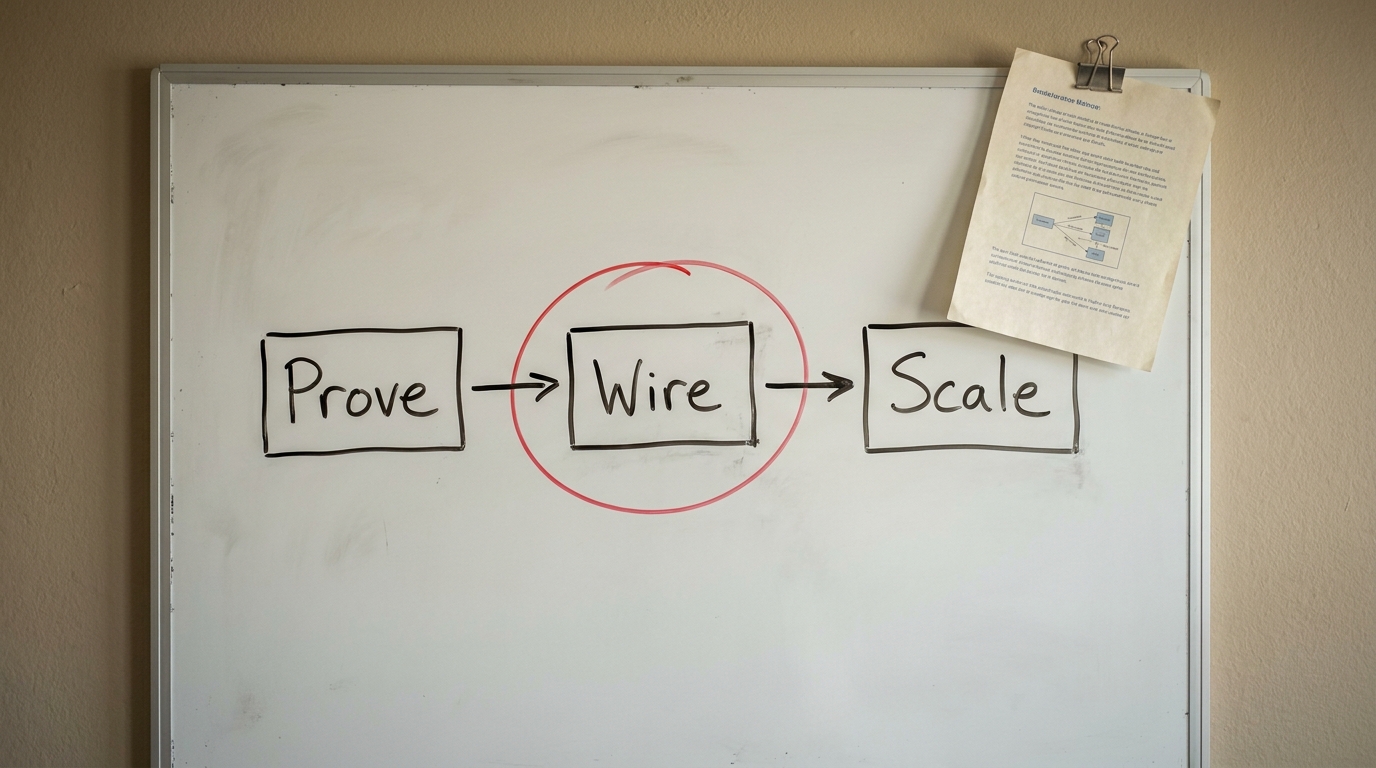
Phase 1 - Prove (one narrow, high-value use case).
- The goal: show that AI moves one specific operational metric in one real workflow. Not five workflows. One.
- What to build: the smallest end-to-end slice that produces a real outcome - a single agent doing a single defined job on connected, governed data for that job.
- The trap to avoid: boiling the ocean. Picking a use case so broad it needs the whole data estate cleaned first, or so trivial that winning proves nothing.
- How you know you are done: a business metric you named in advance moved, measurably, in production, not in a demo. Cost, cycle time, capacity, error rate. Something on the P&L or one step from it.
Phase 2 - Wire (embed it into the workflow with an owner and metrics).
- The goal: turn the proven slice from a project into part of how the work actually runs, every day, without heroics.
- What to build: the decision rights (what the AI decides versus escalates), the human-in-the-loop checkpoints, the monitoring, and the named owner accountable for the outcome.
- The trap to avoid: leaving it as a fragile pilot that only works when its champion is watching. If it needs a hero, it is not wired.
- How you know you are done: the workflow runs on the new design as the default, the owner reviews the AI's decisions on a regular cadence, and the metric holds when nobody is watching.
Phase 3 - Scale (turn it into a repeatable system across adjacent workflows).
- The goal: take the pattern that worked and apply it to neighboring workflows, the ones that share data, teams, or logic with the first.
- What to build: a repeatable playbook - the governance model, the integration approach, the ownership structure - that you can apply to the next workflow in weeks, not quarters, because you are reusing the foundation.
- The trap to avoid: scaling the technology without scaling the operating-model discipline. Copy the agent, forget the decision rights, and you have just mass-produced pilot theater.
- How you know you are done: a second and third workflow are running on the same pattern, and each took less time and less custom work than the last. That declining cost per workflow is the signal you built a system, not a series of pilots.
The reason to sequence this way is risk. Prove limits your exposure to one use case. Wire forces the organizational change while the stakes are still small. Scale only spends real money once the pattern is proven and the discipline is in place. Companies that invert this, buying a platform and scaling before they have proven or wired anything, are the ones who end up in the "no measurable return" statistics.
And here is where almost everyone gets stuck. Most companies do not stall for lack of a framework. They stall on Phase 1 to Phase 2, the jump from a pilot that worked to a workflow that runs. If you want a concrete, sequenced roadmap for your own workflows instead of a generic model, Book a Discovery Sprint - a one-week engagement that produces a real transformation roadmap: the use case to prove first, the data to connect, and the operating-model changes to make.
Your people, and how to know it's working
Two questions get waved away in most transformation content, and they are the two operators actually lose sleep over. What happens to my people, and how will I know if any of this is working.
On your people. The honest framing is not "AI replaces jobs" or "AI replaces no jobs." BCG's 2026 work suggests AI will reshape a large share of roles - on the order of half of current job activities being significantly changed - rather than simply eliminating them wholesale (BCG, 2026). Reshaped means the tasks inside a job change, not that the job vanishes. The support agent, the analyst, the controller all still exist. They spend their day on exceptions, judgment, and quality instead of throughput.
There is a real risk buried in this, and it gets ignored: the nurturing gap. Junior staff have always learned the business by doing the routine tasks that AI now absorbs. Remove the routine work and you remove the training ground, and in a few years you have no seniors, because nobody grew into the role. Operators who handle this well redesign how junior people learn on purpose. Pairing them with the AI on exceptions, rotating them through the judgment-heavy work earlier, treating capability-building as a design choice rather than an accident of doing grunt work.
And you rarely need to hire a full AI team for any of this. The skills gap is real, but for a mid-market company the answer is usually not a permanent, expensive build-out. It is targeted capacity. A small amount of senior expertise to design the workflow, set the governance, and train your people, applied where your internal bench is thin. That is exactly the case for a Fractional Agentic Team : embedded AI expertise that closes the talent gap for the length of the work without committing you to permanent hires you may not need once the pattern is established.
On measurement. The most common mistake is stopping at "time saved." Time saved is an input, not an outcome. Twelve hours a week freed up means nothing unless those hours turn into something the business values. More deals worked, faster collections, lower cost to serve, more capacity absorbed without new headcount. If the freed-up time just evaporates, you did not create value. You created slack.
Measure the outcome, not the activity. For each transformed workflow, name the business metric before you start - cycle time, cost per unit, error rate, revenue per rep, capacity - and track that. Accenture's 2024 research found that companies with fully modernized, AI-led processes reported materially higher revenue and productivity growth than peers, in the range of a 2.5x revenue-growth advantage in their study (Accenture research, 2024). Treat a number like that as a directional signal about what full transformation can be worth, not a promise for your own P&L. Your ROI depends on your workflows, your margins, and your discipline.
That is the honest way to reason about return. Use the headline studies to understand the shape of the opportunity, then model your own numbers against your own baseline. A pilot that cuts your finance close from eleven days to three has a value you can calculate. A "2.5x" borrowed from a consultancy deck does not.
The bottom line
The companies pulling ahead in AI are not the ones with the most demos, the biggest model, or the most licenses. They are the ones who changed how the work actually runs. Who treated AI as a reason to redesign the operating model and govern the data, not as a feature to bolt on.
The takeaways worth keeping:
- Adoption is not transformation. Using AI tools is additive and reversible. Transformation redesigns the workflow so AI is load-bearing. Know which one you are doing.
- Most pilots stall for non-AI reasons - broken workflows, ungoverned data, no owner, no decision rights, activity-based metrics. Fix those and the technology works fine.
- The real shift is organizational. Workflow ownership, decision rights, and team structure change. That is the hard part and the whole point.
- Data readiness is scoped, not total. Govern and connect the data behind the one workflow you are transforming, not the entire estate.
- Sequence it: Prove, Wire, Scale. Prove one metric moves, wire it into the daily workflow with an owner, then scale the pattern to adjacent workflows.
- Measure outcomes, not time saved, and reason about ROI from your own baseline, not a borrowed headline stat.
None of this requires a hyperscaler budget. It requires picking one workflow, being honest about why your pilots stalled, and being willing to change how the work runs. That is a decision, not a purchase. And it is available to a $200M company just as much as a $200B one.