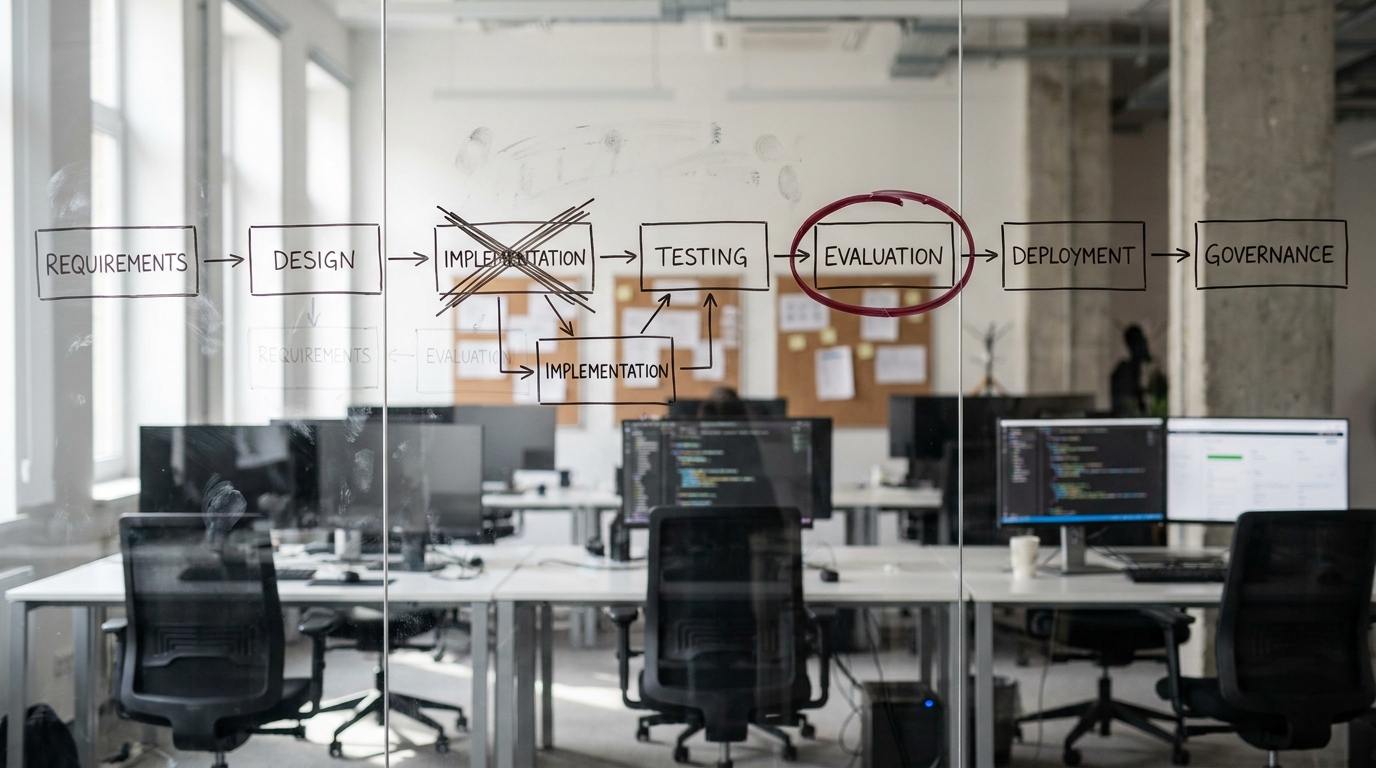

AI Strategies for Business Transformation: Executive Guide
As a business leader, you are likely overseeing dozens of AI pilots, but only a fraction have reached production. The risk isn't just wasted IT spend—it's the cost of falling behind competitors who have already achieved "extreme productivity" through agentic scale. Gartner had predicted that at least 30% of generative AI projects would be abandoned after proof of concept by the end of 2025; the figure came in above 50%. McKinsey's 2026 global survey puts the other half of the picture in place: 88% of organisations now use AI, and 6% can attribute an EBIT impact of 5% or more to it — a share that has not moved since 2025. That gap between activity and result is the whole problem.
AI Strategies for Business Transformation involve shifting focus from isolated tools to a secure, agentic digital core that prioritizes people and process redesign over mere algorithm selection. These strategies move organizations from simple task automation to autonomous workflow orchestration. Leaders must align AI investments with specific EBIT outcomes to ensure every implementation drives measurable revenue or cost reduction.
The Pilot Purgatory Trap: Why Most AI Strategies Stall
The path from digital transformation to enterprise AI transformation framework success is usually blocked by "Pilot Purgatory" — that state where innovation teams run endless experiments that produce compelling demos and fail to move a single EBIT line. Executives often find themselves managing fragmented "Shadow AI," where employees use unauthorized tools and quietly create data leakage risks.

The core issue is rarely the technology. It's the "nurturing gap" — internal teams lack the specific skills to supervise and refine AI outputs. Without a centralized orchestration layer, those disconnected tools accumulate technical debt and security exposure faster than any pilot can justify. Leadership has to treat AI as a business redesign project rather than a tech upgrade.
| Symptom | Root Cause | Transformation Risk |
|---|---|---|
| Stalled Pilots | Treating AI as a tech project, not business redesign | Wasted investment & cultural skepticism |
| AI Sprawl | Disconnected tools without a central orchestration layer | High technical debt & security exposure |
| Skill Decay | Failure to upskill employees into "AI Generalists" | Resistance to adoption & operational bottlenecks |
The 10-20-70 Rule of AI Transformation
To build a genuine AI-first operating model, executives need to internalize the 10-20-70 rule. The framework, developed by BCG, breaks AI effort into three buckets: 10% algorithms, 20% data and technology stack, and 70% people and process.
Most failed strategies invert this. They spend 70% of the budget on license fees and model selection while the cultural work quietly falls off the roadmap. The real ROI comes from reshaping how work is done — not from buying a faster way to write emails.
The 10%: Selecting the Right Algorithms
The choice between a frontier model like GPT-5.6 or Claude Opus 5 and an open-weight Llama 4 deployment matters, but it rarely determines who wins — and whatever you pick will be superseded inside a year regardless. The algorithm is the commodity; the orchestration is the value.
The 20%: Data and Technical Core
A unified data fabric is non-negotiable. Data trapped in legacy siloes produces AI that is "confidently wrong." Legacy system modernization with AI means those older systems can communicate with modern models through natural language interfaces — turning static databases into something that actually responds.
The 70%: People and Process Redesign
This is where the transformation happens. Upskilling employees into "AI Generalists" who can manage and audit agentic outputs. Refactoring workflows from scratch. The better question isn't "How can AI help this person do their job?" It's "How should this workflow be redesigned if the AI could handle the first 80% autonomously?"
The Three Horizons of an Agentic AI Roadmap
Strategic growth through AI doesn't happen in one move. Three distinct horizons carry the enterprise from efficiency to invention — and organizations that skip Horizon 1 tend to discover their foundations won't hold when agentic workloads hit .
Horizon 1: Deploy for Efficiency
Off-the-shelf tools deliver immediate productivity gains of 10-15%. Meeting summaries, first-draft code, standardized customer support responses. This horizon is about doing existing tasks faster, not reimagining them.
Horizon 2: Reshape for Extreme Productivity
Here is the agentic AI roadmap shift. Instead of chatbots, you're building multi-agent systems that can research, draft, audit, and publish a report with minimal human intervention. This horizon drives 30-50% efficiency gains.
If your pilots are running but you need a concrete roadmap for scaling them into autonomous workflows, an AI Transformation Discovery sprint identifies the high-impact orchestration points.
Horizon 3: Invent for New Revenue
The third horizon is AI-native business models — customer-facing agents providing personalized advisory services that premium tiers previously couldn't scale. At this stage, AI creates revenue rather than simply cutting costs.
Moving Toward an Agentic Digital Core
The defining shift of 2026 is moving from a "System of Record" to a "System of Intelligence." ERPs and CRMs spent years as passive repositories of information. An agentic core turns them into active participants in the business.
Scaling generative AI at this level requires modular architecture. Instead of one massive, brittle AI application, you build a library of reusable "utility agents" — one for procurement data, one for legal compliance, one for customer sentiment. They work under a central orchestration layer to handle complex business objectives together.
This modularity protects against technical debt in a way monolithic builds can't. If a better model ships tomorrow, you swap the "brain" of one utility agent without rebuilding the whole process. That's what a durable digital core actually looks like.
The Agentic Operating Model, and Its Four Pillars
Moving from chat to execution is a structural change in how work is delegated between humans and machines. An agentic operating model treats AI agents as actors with specific roles, permissions, and accountability, the way a hiring plan treats new headcount. Four pillars carry it.
- Specialized intelligence. Instead of one monolithic model doing everything, a set of domain-specific agents: a finance agent that knows GAAP, a legal agent that knows contract liability. Specialized agents are more accurate and less prone to the uncoordinated AI noise that plagues generic deployments.
- Coordination architecture. How agents interact. A hub-and-spoke model has a central orchestrator delegating to specialists; a swarm model has agents communicating peer to peer to resolve complex problems.
- Real-time control. The shift from human-in-the-loop to human-on-the-loop governance. Agents execute the bulk of the work autonomously while people supervise, intervene on edge cases, and approve high-stakes transactions.
- Accountability. Named ownership for each agent, its permissions, and the workflow it affects — because an agent nobody owns is an exposure nobody is managing.
The Agentic Reality Gap: Three Roadblocks
The road to multi-agent orchestration is rarely linear, and Gartner has projected that over 40% of agentic AI projects will be cancelled by the end of 2027 on escalating costs, unclear business value, and inadequate risk controls. Three roadblocks account for most of it.
Legacy integration and API maturity. Most existing software was never built to talk to an AI . Closing that gap needs a deliberate API strategy so agents have the hands to move data at all, and it is often the largest line item nobody scoped.
The implementation lift. A common misconception is that prompt engineering is the main work. In reality the majority of effort sits in data engineering, security, and governance — and it needs roles most teams are not staffed for: someone to wire agents together, someone to keep them running, and someone who can produce the audit artifact when legal asks.
The accountability question. When an agent makes a mistake, who is liable? The 2024 Moffatt v. Air Canada ruling settled the direction of travel: the airline argued its chatbot was a separate entity, the tribunal disagreed, and the airline was ordered to honour the refund the bot had promised. Human-on-the-loop governance is now a legal control, not only an operational preference.
The Governance Deadlines Moved in June 2026
Anyone who set a governance roadmap before this summer is working from the wrong dates. On 29 June 2026 the Council of the EU gave final approval to the Digital Omnibus on AI, published as Regulation (EU) 2026/1744 and in force since 27 July. It pushed the Annex III high-risk obligations — conformity assessments, CE marking, the full provider and deployer regime — from 2 August 2026 out to 2 December 2027.
The reprieve is narrower than it reads. Article 50 transparency duties held their original 2 August 2026 date, so the obligation to tell people they are dealing with an AI system, and to label AI-generated content, is already live; only the watermarking requirement for systems deployed before that date got a short extension, to 2 December 2026. A customer-facing agent of the kind described later in this guide is in scope today. What moved was the certification burden, not the disclosure one.
For a transformation roadmap the practical read is that the extra sixteen months are working time. Readiness surveys in April 2026 put 78% of organisations with no meaningful compliance work underway. Teams that treat December 2027 as the moment to begin will be reconstructing audit trails across agents already running in production, which costs considerably more than instrumenting them on the way in.
Bridging the AI Talent Gap
Every executive's strategy eventually runs into the same wall: specialized AI talent is scarce , and neither waiting months to hire nor overloading an already-stretched IT team is a real answer.

The "AI Generalist" has emerged as a workable middle path — employees who understand business logic and can build AI solutions without being data scientists. Getting them right still requires high-level architectural guidance. If you're short on specialized AI engineers to build that foundation, a Fractional Agentic Team can cover the gap — senior expertise without the lead time or overhead of a permanent hire.
Evidence of Success: Case Examples in Agentic Scale
Several global organizations have already moved past the pilot phase and shown what a mature AI strategy produces. The pattern in each case: value comes from the "System of Intelligence," not from the AI tool itself.
IBM: The "Client Zero" Model
IBM applied AI across HR, finance, and legal as its own first client. It set out in 2023 to find $2 billion in productivity gains and has since booked $4.5 billion in annualised savings, with roughly another billion expected through 2026. Their orchestration layer let different departments share AI resources while maintaining strict data governance — which is the part most pilot programs skip entirely.
Air India: Automating the Customer Experience
Air India deployed an agentic system that resolved 13 million conversations at a 97% success rate, and now fields roughly 40,000 queries a day across more than 1,300 distinct question types. These weren't basic FAQ responses — the agents handled rebooking and baggage tracking by integrating directly with back-end logistics systems. Only 3% of contacts reach a human. A clean Horizon 2 execution.
Mercedes-Benz: Multi-Agent Defect Management
Mercedes-Benz built a suite of agents for defect management during vehicle testing, where an engineer behind the wheel cannot stop to write up what just went wrong. One agent handles quality assurance at intake, a second pulls the log data and telemetry for that specific vehicle and event, a third checks whether the same defect could affect other model lines sharing the component or software, and a fourth supplies the regulatory and safety context. The engineer describes the problem once; assembling the evidence around it happens without them.
None of these three companies looks like a mid-market business, and that is worth naming rather than glossing over. IBM, Air India and Mercedes-Benz can fund an orchestration layer as infrastructure and wait for it to pay back. A 400-person company cannot, and the mistake it usually makes is commissioning a scaled-down version of the same architecture. The transferable part isn't the architecture — it's the sequencing. Each of these started by instrumenting one workflow well enough to produce a defensible number, then reused the plumbing underneath it. At mid-market scale that means choosing a single process with a measurable cost per transaction, running it to production with real governance attached, and treating the second workflow as the test of whether any of what you built was actually reusable.
Avoiding the Pitfalls of Rapid Adoption
Even well-designed ai strategies for business transformation can break on execution. Speed and security pull in opposite directions, and getting that balance wrong is more common than most organizations admit.
Shadow AI and Data Security
When official tools feel too slow or locked down, employees go around them. That "Shadow AI" — personal accounts, browser extensions, consumer LLMs — is where corporate IP leaks. The answer isn't blocking AI entirely; it's building sanctioned platforms that are as fast and frictionless as the consumer tools people are already using.
The Trap of Over-governance
Security matters, but rigid one-size-fits-all governance stalls innovation. Effective governance is "automated and invisible" — security built into the agentic workflows themselves , not a stack of manual approval checkboxes that add days to every deployment.
The "Nurturing Gap"
Nobody hires a senior executive and expects peak performance without onboarding. AI agents are no different. They need the right context, brand voice, and operational constraints fed through structured fine-tuning or RAG (Retrieval-Augmented Generation) — and treating that work as optional is how pilots fail in month three.
Strategic Checklist: What Good Looks Like in 2026
Before locking your 2027 investment roadmap, run through these:
- Leadership-led Focus: Are the priority areas coming from the C-suite based on EBIT impact, or are they being "pushed up" by IT as tech experiments?
- Unified Data Fabric: Is your data ready for AI, or are you trying to build a mansion on a swamp of disconnected spreadsheets?
- Human-in-the-loop Oversight: Do you have clear protocols for who is responsible when an AI makes a mistake?
- Modular Agentic Architecture: Are you building reusable utility agents that can adapt as the technology changes?
Regulatory Sequencing: Do you know which of your agents fall under Article 50 transparency duties today, and which sit in the Annex III set that now lands in December 2027?
AI transformation isn't about replacing your workforce. It's about achieving "extreme productivity" by orchestrating a hybrid team of humans and agents. The organizations that win the next decade are those that move from managing a tech stack to running a System of Intelligence.
Next Steps for Your Transformation
Pilot to production requires more than better software. It requires someone who understands the gap between technical possibility and business reality.
If you're not sure where to start, an AI Readiness Snapshot will evaluate your current data maturity and surface the most immediate EBIT opportunities.
Fractional Agentic Team — Access specialized AI engineers and architects to build your agentic digital core without the lead time of traditional hiring.