
Six months after a mid-market lender signed a $280,000 AI engagement, the whole deliverable sat untouched in a shared drive: a 90-slide strategy deck, a maturity assessment, and a roadmap with three horizons. Not one model was in production. Not one workflow had changed. The consultants had done exactly what the statement of work asked for, and the buyer was left holding nothing a customer would ever touch.
The uncomfortable part is that you could have called this outcome before anyone signed. Every signal that separates a firm that ships from a firm that decks was sitting right there during evaluation. The buyer just did not know which signals to weigh, what to ask, or what a fair price even looked like. This guide fixes that.
Quick answer: Choosing an AI and machine learning consulting partner comes down to four things you can verify before you sign: a real production track record in your domain, honest pricing tied to outcomes rather than slideware, a plan to transfer capability to your team, and a willingness to start small with a paid proof of concept. Everything else here is how to check those four without taking a vendor's word for it.
The market works against you. Every generalist agency, staffing shop, and boutique has rebranded around AI, so the search you just ran returns a hundred firms describing themselves in identical language: enablement, transformation, partnership, outcomes. What follows is a repeatable way to tell capability from marketing, a real cost range, the questions that expose a weak vendor, and an honest answer to whether you need a consultant at all.
What an AI and ML consultant actually does
Vendors blur three terms on purpose, and the blur is where that $280,000 deck came from. Get the categories straight before you evaluate anyone .
Artificial intelligence (AI) consulting is the broad practice of helping a company apply machine intelligence to a business problem, from strategy through delivery. Machine learning (ML) consulting is narrower and more technical: building, training, and deploying models that learn from your data. MLOps consulting (machine learning operations, the discipline of running models reliably in production) is what keeps those models working after launch, through monitoring, retraining, and versioning. A firm that sells the first without the second and third can hand you a strategy and never ship a thing. That gap has a price tag, and you already saw it.
Within those disciplines, real engagements come in four archetypes. Knowing which one you are actually buying is half the battle.
1. Strategy and roadmap. A short, senior engagement that produces a prioritized use-case portfolio, a readiness assessment, and a sequencing plan. Right for a leadership team with budget but no direction. Wrong for a company that already knows its first use case and just needs it built, where a roadmap is expensive procrastination.
2. Implementation and build. Hands-on delivery: data pipelines, model development, integration, and a working system in production. Right for a defined problem with a clear owner. Wrong for an organization that has not yet decided what to build, where a build team will happily build the wrong thing, on time and on budget.
3. Managed services and MLOps. Ongoing operation of models in production, including monitoring, retraining, and incident response. Right for teams running live models without the in-house platform maturity to keep them healthy. Wrong for a one-off pilot that will never see real traffic.
4. Team augmentation and fractional. Embedded specialists, from a fractional ML lead to a full pod, who work inside your team and transfer skills as they go. Right for a company scaling AI faster than it can hire, given the well-documented shortage of senior ML talent. Wrong for a project that needs clear external accountability for a fixed deliverable.
Most serious problems need two or three of these in sequence, usually strategy into a scoped build into managed operations. A partner who only sells one archetype will quietly reshape your problem to fit it. Watch for the moment that happens. It tells you whose interest the engagement really serves.
Do you actually need a consultant
Here is the section most vendor guides skip, because the honest answer sometimes costs them the sale. Hiring a consulting firm is one of three real options, and it is not always the right one.
Build in-house when the capability is core to your competitive advantage, you have or can hire the talent, and the problem will recur for years. If AI is going to sit at the center of your product, renting that muscle forever is a strategic mistake. Own it.
Hire a single person when you have one well-defined, ongoing need and enough surrounding engineering maturity to support them. A strong senior ML engineer or an applied scientist can outperform a firm on a narrow, persistent problem, and a full-time salary often beats consulting day rates over a year. The risk is a key-person dependency and a long, uncertain hiring cycle in a thin talent market.
Bring in a consulting partner when you need to move faster than hiring allows, the problem spans strategy and delivery , you lack the in-house platform maturity to run models safely, or you want an outside team to de-risk a first project before committing to permanent headcount. A good partner compresses the learning curve and leaves your team more capable than it found them. That second part is the one to hold them to.
Four questions settle most of it:
- Is this a one-time capability build or a permanent, evolving need? One-time or bounded favors a consultant. Permanent and core favors building.
- Do you have engineering leadership who can evaluate technical work? If not, a consultant who commits to knowledge transfer partly fills that gap. A lone hire will not.
- How fast do you need results? Hiring a senior ML lead can take three to six months. A partner can start in weeks.
- Can you clearly define success? If not, start with a short paid strategy or discovery engagement before any build, from anyone.
If those answers point toward augmenting your team rather than outsourcing a black-box project, an embedded model is worth a look. Ascendix runs this as a Fractional Agentic Team : specialists who work inside your team and hand the capability back rather than holding it hostage.
The evaluation criteria that actually predict success
This is the spine of the decision. Vendors sound alike in a pitch, so evaluate them against criteria that correlate with shipping, not with polish. The table below is the one to bring into every vendor conversation. Score each firm honestly, and treat the red-flag column as a stop sign, not a talking point.

| Criterion | Why it matters | What "good" looks like | Red-flag answer |
|---|---|---|---|
| Production track record | Anyone can run a notebook. Running a model in production is the hard part. | Names specific systems they put into production, with the business metric each moved. | Only pilots, demos, and proofs of concept. Nothing live. |
| Domain fit | Your data and constraints are industry-specific. Generic ML misses them. | Prior work in your industry or a closely adjacent one, with the regulatory reality named. | "AI is domain-agnostic, we can figure out your industry." |
| Data and MLOps maturity | Most of the effort in an ML project is data and operations, not modeling. | A concrete plan for data readiness, pipelines, monitoring, and retraining. | Talks only about models and accuracy, silent on data and upkeep. |
| Technical depth vs slideware | Strategy without engineering produces the deck that never ships. | Practitioners in the room who can discuss architecture, not just outcomes. | Every technical question routes to "our delivery team will handle that." |
| Delivery model | How they work determines whether you get a system or a report. | Iterative delivery with working software at each milestone. | A single big-bang deliverable at the end, no interim proof. |
| Security, compliance, governance | Regulated data and the EU AI Act make governance a hard requirement. | Names their security posture and how they handle model risk and compliance. | Governance treated as your problem, not part of the engagement. |
| Pricing transparency | Opaque pricing hides scope games and change-order traps. | Clear scope, clear price, clear assumptions, willing to fix a PoC price. | "It depends," with no ranges and no fixed-scope option. |
| Knowledge transfer | A partner who ships and leaves you dependent has not helped you. | Documentation, pairing, and a plan for your team to own the system. | No handover plan. Retention depends on you not learning. |
| References | Past clients tell you what the pitch cannot. | Reachable references who will speak to production outcomes and problems. | No references, or only logos with no contact. |
Weight these to your situation. A regulated healthcare buyer should push governance and domain fit to the top. A company with a strong engineering org but no ML experience should weight knowledge transfer and MLOps maturity. Two criteria never move, though. Production track record and pricing transparency belong near the top for everyone, because they are the two most reliable predictors that a firm will ship and that you will not get surprised on cost.
What AI and ML consulting costs in 2026
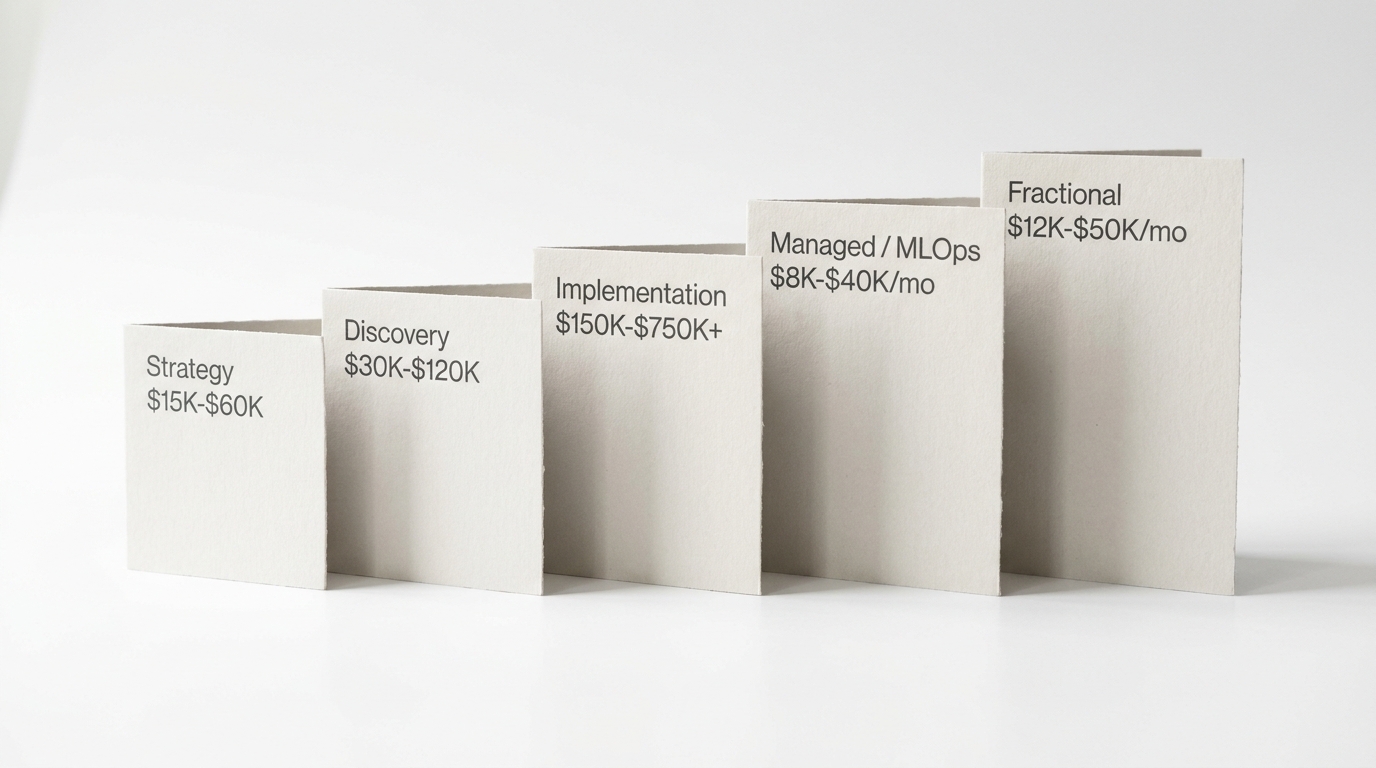
Pricing is where good vendors get specific and weak ones hide. Nobody can quote your exact number without scope, but honest firms give you ranges, and those ranges cluster. Treat everything below as planning estimates, not fixed quotes. Actual cost swings with data readiness, integration complexity, and how much of the work your team absorbs.
| Engagement type | Typical scope | Ballpark range (2026) | Common pricing model |
|---|---|---|---|
| Strategy and roadmap | 3 to 8 weeks, senior-led, produces a prioritized plan | $15,000 to $60,000 | Fixed fee |
| Discovery or proof of concept | 4 to 10 weeks, one bounded use case to a working prototype | $30,000 to $120,000 | Fixed fee, sometimes milestone-based |
| Full implementation | 3 to 9 months, production build and integration | $150,000 to $750,000+ | Fixed-scope phases or time-and-materials |
| Managed services and MLOps | Ongoing operation, monitoring, retraining | $8,000 to $40,000+ per month | Monthly retainer |
| Team augmentation and fractional | Embedded specialists, fractional lead to full pod | $12,000 to $50,000+ per month | Monthly, per role |
Three pricing models dominate, and the shift between them tells you something. Hourly or time-and-materials is flexible but transfers all overrun risk to you. Fixed-scope caps your exposure and forces the vendor to define the work, which is why a firm that refuses to fix the price of a small proof of concept is telling you, plainly, that it cannot scope its own delivery. Outcome-based pricing, where fees tie to a measurable business result, is a growing preference among mature buyers because it aligns incentives, though it only works when the outcome is cleanly attributable to the AI work. The market has broadly been moving toward outcome-linked and fixed-scope arrangements and away from open-ended hourly billing, mostly because buyers got burned by the latter.
Now the planning reality that catches most first-time buyers off guard: the modeling is rarely the expensive part. Industry research has consistently found that data collection, cleaning, and preparation, not model building, consume the majority of the effort in an AI or ML project, commonly cited at 50 to 80 percent of project time (industry data-science surveys, 2023-2025). Budget for that split up front, and be suspicious of any quote that treats data work as a rounding error.
The questions to ask before you sign
Run the finalists through an interview whose only job is to convert vague confidence into specific, checkable claims. Two lists. What to ask the vendor, and what to ask your own team first.
Ask the vendor:
- Walk me through a system you put into production. What did it do, what metric moved, and what broke along the way?
- Who specifically will do the technical work, and can I talk to them before signing?
- What does the data look like for a project like ours, and how much of the timeline is data preparation?
- How do you handle monitoring, retraining, and failures after launch?
- What is your plan to transfer this capability to my team, and what does documentation and handover include?
- How do you price a proof of concept, and will you fix that price and scope?
- How do you handle security, model governance, and compliance for regulated data?
- Can you give me two references I can call who ran your work in production?
Ask yourself and your team first:
- Can we state the business outcome this project must produce, in a number?
- Who internally owns this system after the consultants leave?
- Is our data accessible and in good enough shape, or is that the real first project?
- Do we have executive sponsorship and a budget for maintenance, not just the build?
- What happens to this initiative if the one internal champion leaves?
If you cannot answer the second list, you are not ready to hire a build team yet. You are ready for a short discovery engagement, which is a feature, not a failure.
Red flags that should stop a hiring decision
Competitors name these vaguely. Here they are plainly. Any one of them is a reason to slow down. Several together is a reason to walk.

- No production references. Only pilots and demos. The single most reliable predictor of another pilot that never ships.
- Jargon over specifics. Every question about how gets answered with what and why. Depth hides behind vocabulary.
- Refuses to fix scope or price on a proof of concept. A firm that cannot bound a small first project cannot bound a large one.
- Silent on data and security posture. No plan for data readiness, model governance, or compliance means those risks land on you.
- No knowledge-transfer plan. The business model depends on you never becoming self-sufficient.
- One vendor as a silver bullet. Reselling a single platform as the answer to every problem is a license quota, not a strategy.
- AI bolted onto a generalist shop. A staffing or web agency that added an AI page last year is selling the search term, not the capability.
- Guarantees without scope. Anyone promising a specific accuracy or ROI before seeing your data is guessing or lying.
How to structure the engagement so it actually succeeds
Choosing the right partner is half the work. Structuring the engagement is the other half, and it is the half you fully control. The same firm can ship or flounder depending on how the deal is shaped, so shape it deliberately.
Start small and paid. Insist on a scoped, fixed-price discovery or proof of concept before any large build. A short paid engagement reveals more about how a firm works than any pitch, and it caps your exposure while you learn whether they deliver. A vendor confident in their work will welcome this. One that pushes straight for a six-figure build is managing their pipeline, not your risk.
Define success in a number up front. "Improve efficiency" is not a target. "Cut claims-processing time by 30 percent" is. Agree on the metric, the baseline, and how you will measure it before work starts, so the final review is arithmetic, not opinion.
Demand knowledge transfer in the contract. Documentation, pairing sessions, and a handover plan should be deliverables with dates, not good intentions. If your team cannot operate the system after go-live, you have bought a dependency, not a capability.
Plan for MLOps and maintenance from day one. Models drift as the world changes. A system without monitoring and a retraining plan degrades quietly until it fails loudly. Make operations part of the scope, not an afterthought discovered in month four.
Keep a human in the loop where it counts. For any decision with real financial, legal, or safety stakes, design the workflow so a person can review and override before consequences land. It is both a governance requirement and a trust builder.
Structure the engagement this way and you convert a leap of faith into a series of small, checkable steps. If you want an outside team to run that first bounded step with you, that is exactly what a scoped discovery sprint is for. Ascendix offers a paid one-week Discovery Sprint that produces a scoped plan and a go or no-go recommendation, so your first real commitment is small and evidence-based.
[Get an AI Readiness Snapshot](https://advantageworks.com/#contact) if you want a faster read before any of that. It is a free 30-minute readiness call to pressure-test where you actually are and what a sensible first project looks like.
What a good engagement looks like
Here is an illustrative composite, not a real client, showing the shape of a healthy engagement end to end. Watch what structure does to the same starting problem.
A regional insurer wants to speed up claims triage. The messy version: they ask three vendors for a "claims AI transformation," get three six-figure proposals, and pick the most confident one. Nine months later they have a model nobody trusts and a team that cannot maintain it.
The scoped version runs differently from the first meeting. It starts with a two-week paid discovery that narrows the goal to one measurable target: reduce manual triage time on a specific claim category by 30 percent. That discovery surfaces the real first problem, which is that the claims data is scattered across three systems and needs cleanup before any model can learn from it. A scoped proof of concept follows, fixed price, delivering a working triage model on that single category with the metric instrumented from day one. It hits 27 percent, close enough to justify the next phase. Only then does a production build begin, with monitoring, a retraining schedule, and a handover plan so the insurer's own two engineers can operate it. A year in, the capability lives inside the company, not inside the vendor.
The difference between the two stories is not talent or budget. It is structure. Start small, define the number, transfer the capability, plan for operations. That is the whole method, and it is fully repeatable.
Making the final decision
Turn the criteria table into a scorecard and apply it to your shortlist. Score each finalist 1 to 5 on the criteria that matter most to you, weight the two or three that carry the most risk for your situation, and let the numbers check your gut.
| Criterion | Weight | Firm A | Firm B | Firm C |
|---|---|---|---|---|
| Production track record | High | |||
| Domain fit | High or Medium | |||
| Data and MLOps maturity | Medium | |||
| Technical depth | High | |||
| Pricing transparency | High | |||
| Knowledge transfer | Medium | |||
| Security and governance | High or Medium | |||
| References checked | Pass or fail |
The scorecard will not make the decision for you, and it should not. What it does is force the conversation past who presented best and onto who is most likely to put working software in front of your customers and leave your team able to run it. If two firms tie on the numbers, pick the one more willing to start small and prove it, because that willingness is itself the strongest signal in the whole process.
The goal was never to hire the most impressive consultant. It was to find a partner who ships to production, prices honestly, and transfers the capability back to you, then to structure the work so those things actually happen. Weigh the four signals from the top of this guide, run your shortlist through the criteria and the scorecard, and you can say yes or no to a specific proposal with real confidence instead of hope.
[Book a free 30-minute AI Readiness Snapshot](https://advantageworks.com/#contact) to pressure-test your shortlist and your first project against the framework in this guide, with no obligation to work together.