
Search the market for how to choose an AI consulting firm and the guides agree with each other almost word for word. They also share a blind spot. Each one compares consulting firms against other consulting firms, and never against the thing your operations lead is quietly piloting instead.
Read the vocabulary and you can see who they were written for. "Board-level." "Fortune 500." "Global rollout."
If your company has 400 people, none of that is written for you. Your workflows are complicated. A dozen systems, a few of them older than some of your staff, a compliance obligation nobody enjoys, and processes that live in three heads and one spreadsheet. What you do not have is a transformation budget with a comma in the right place.
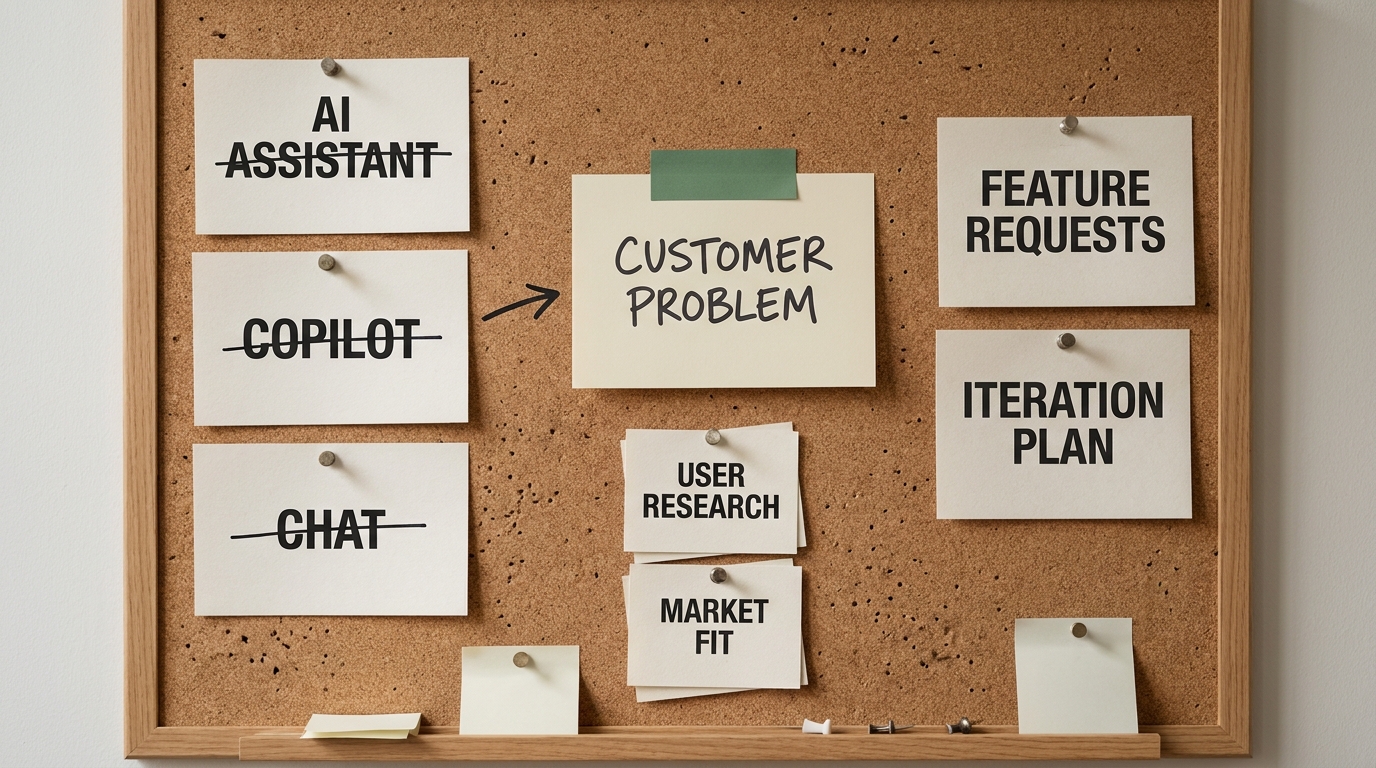
So the buying decision you face is not the one those guides describe. Yours runs across categories, not inside one: a large consultancy, a no-code automation platform your ops lead can put on a card , or something structurally different that sits between them. Picking the wrong category costs more than picking the second-best firm inside the right one. Most of the money wasted in this market is spent by companies who chose well inside the wrong door.
The three doors, and why you only ever get shown two
There are three ways a mid-market company can buy AI capability today.
The first is a large consultancy. Big Four advisory arms, the Tier 1 strategy houses, the global systems integrators. They bring method, scale, and regulatory defensibility. They also bring engagement economics built for organizations several times your size.
The second is no-code and low-code automation. Zapier, Make, Power Automate, the AI features already sitting inside your CRM. Cheap, fast, useful. Your team can start on Tuesday without asking anyone for approval.
The third has no settled name yet. Embedded team, fractional team, pod. The shape is senior AI capability working inside your operation on a subscription instead of a program budget, with the people who design the thing also building and running it.
Here is why you rarely see all three on one page. Consultancies publish guides comparing consultancies. Tool vendors publish guides comparing tools. Each category writes content aimed at winning inside its own bracket, which means the cross-category comparison, the one you actually need, is nobody's marketing job.
So the next three sections do the thing nobody selling into this market has an incentive to do. They take each door in turn and say where it breaks.
Why the Big Four quote does not fit a 600-person company
Start with the honest part. Large firms are very good at a specific kind of work: multi-year programs, multi-country rollouts, anything with audit exposure or a regulator on the other side of it. If your board needs a name it recognizes on the cover of the risk assessment, that is a real thing you are buying and it has real value.
The mismatch is structural, not qualitative.
Large firms staff in a pyramid. A partner sells, a senior manager shapes, and the daily work is done by consultants several years into their careers. That model needs volume to function, which is why engagement minimums exist. Published rate data puts Big Four advisory work in the range of $300 to $1,200 or more per hour, against roughly $150 to $600 per hour for independent and boutique providers (Palavir, 2026). The same analysis notes that most small and mid-sized companies do not need a firm at that tier.
Discovery is the other place the fit breaks, and it is the expensive one. A discovery phase priced for a company with forty business units, eleven ERP instances, and a global compliance matrix does not shrink proportionally when it meets a company with one ERP and four departments. You end up paying enterprise assessment costs to learn things your own operations manager could have told the team in an afternoon.
What you get for the premium is real. Scale when you need dozens of people at once. Regulatory depth in hostile jurisdictions. A name that de-risks the decision politically, which matters more in some boardrooms than anyone admits out loud. Buy it when you need those things. Do not buy it because it was the only serious-looking option in the room.
Where no-code automation stops
No-code deserves more credit than it usually gets in vendor content. For a bounded, single-system, low-risk workflow, it is often the correct answer, and a consultant would be an expensive way to reach the same place. Routing form submissions. Drafting first-pass replies. Moving records between two systems that already talk to each other. Build it in-house, keep the money.
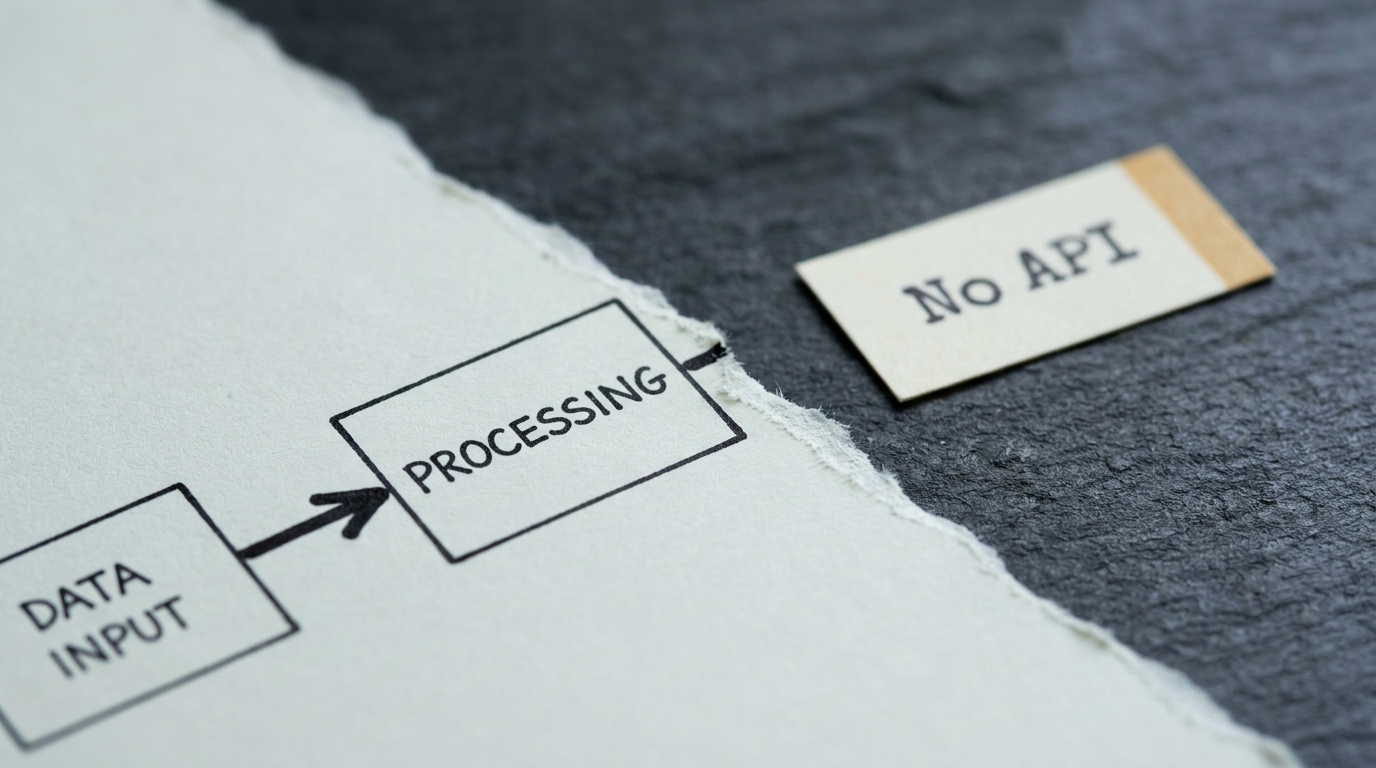
The ceiling is real, though, and it shows up in four predictable places. Every one of them is invisible on day one and obvious by month six.
Integration depth. The workflow that matters usually crosses systems, and at least one of them has no clean API. Your practice management system from 2011 does not have a modern connector. The moment a process needs to read from that system, apply judgment, and write back somewhere else, the platform runs out of road.
Data readiness. This is the most-skipped step in every implementation guide worth reading. No-code tools assume your data is where you think it is, shaped the way you think it is. In most mid-market companies it is neither, and nobody finds out until a workflow has been producing wrong answers for six weeks.
Governance. Once an automated decision touches a customer, a payment, or a regulated record, somebody has to be able to explain how it was made. Most no-code builds have no audit trail worth the name and no versioning of the logic.
Ownership. The automation was built by one enthusiastic person in operations. That person is now on a different team, or at a different company, and the flow is a canvas of forty boxes nobody else can read.
None of that makes no-code the wrong purchase. It makes it the wrong purchase for the specific workflow that is costing you real money, which is usually the complicated one.
What a fractional team actually is, and what it is not
The term gets used loosely enough to be nearly meaningless, so here is a precise version.
A fractional AI team is a small group of senior people who work inside your business on an ongoing basis at less than full time. Strategy, engineering, and operations sit in the same team instead of being sold as three separate engagements. You pay a monthly fee, not a program budget.
It is not staff augmentation. Staff augmentation gives you bodies who take direction from your architecture and your roadmap. If you already know exactly what to build and just need hands, that is a fine purchase, but it is a different one. A fractional team is expected to bring the judgment about what to build.
It is not project consulting either. A project engagement has a fixed scope, a deliverable, and an end date, after which the team leaves. That works when the problem is fully understood on day one. AI work rarely is. The scope you write in January is usually wrong by March, and not because anyone planned badly. The data assessment teaches you something.
What the model solves for a mid-market company comes down to three things. Senior capability without a permanent hire, which matters when the person you would need to recruit costs more than the engagement and takes five months to find. Continuity past go-live, so the system has an owner in month thirteen. And a scope that can move as you learn, without a change order for every adjustment.
It has a precondition, and a vendor with an incentive would not lead with it. A fractional team needs someone internal to hold the relationship. Not a project manager, not a full-time counterpart, but one person with authority who can answer questions about how the business actually works and make a decision inside a week. If nobody at your company can play that role, this model will underperform and you should fix that before you buy anything.
If that shape fits, the Fractional Agentic Team engagement is built exactly along these lines: embedded, senior, strategy and build in one team, from $8,000 per month.
Eight criteria that separate delivery from a deck
Most buyer guides give you criteria for comparing consultancies to each other. These eight are scored across all three doors, because that is the comparison you are actually making.
| Criterion | Large consultancy | No-code tooling | Fractional team |
|---|---|---|---|
| Production evidence | Strong, though often at enterprise scale you cannot replicate | You are the evidence, for better or worse | Ask for it by name, it varies enormously by provider |
| Integration reach | Deep, with the budget to match | Stops at the first system without a clean API | Deep where it matters, scoped to your stack |
| Data and MLOps maturity | Assessed thoroughly, billed thoroughly | Assumed, rarely assessed | Assessed early, usually in the first month |
| Domain depth | Broad industry practice, thin on your specific operation | Not applicable, you supply it | Learned by sitting inside your business |
| Team composition | Consultants, with engineers behind them | Your ops lead | Consultants and engineers in the same small team |
| Governance and compliance | Best in class, audit-grade | Weak, usually no audit trail | Adequate to good, worth verifying specifically |
| Pricing transparency | Opaque until proposal, high floor | Fully transparent, low | Published monthly rate, mid |
| Handover and ownership | Documented, then the team leaves | You own it, ready or not | Ongoing, which is the point of the model |
Three of those rows decide most engagements. Here is what they look like in a real conversation.
Production evidence is the criterion that filters hardest . Ask any provider to name a system they built that is still running, and to say who runs it now. A reference that ends at a strategy document is not a reference. McKinsey (2025) found 88% of organizations now use AI regularly in at least one business function, up from 78% a year earlier, while most remain stuck in pilot mode without enterprise-wide financial impact, and IDC (2025) found 88% of AI proofs of concept never reach widescale deployment . Adoption is close to universal. Production is not, and the gap between the two is where most engagements die.
Domain depth has a tell you can read in the first meeting. A good provider asks about your business before proposing technology. A weak one arrives with a solution looking for a place to apply it. Several of the better buyer guides in this space name the same signal independently: if they lead with their stack, they are not trying to understand your problem.
Handover is the criterion mid-market buyers underweight most. Ask what month thirteen looks like. If the answer is a documentation package and a training session, price in the cost of the person who will read that documentation, because you do not currently employ them.
What this actually costs at mid-market scale
Published pricing in this market is wide, and the width is honest, not evasive. The number depends on how many systems the work touches, how ready your data is, and whether you are buying advice or a working system.
Here is what the public ranges look like, all of them as ranges, not quotes.
| What you are buying | Typical shape | Published range | Usually excluded |
|---|---|---|---|
| Advisory hours | Hourly, no build | $150 to $600 per hour, or $300 to $1,200+ at Big Four tier (Palavir, 2026) | Everything after the recommendation |
| Fixed-scope project | One defined deliverable | $2,500 to $25,000 (Palavir, 2026) | Data prep, integration work, maintenance |
| ML or AI engagement, end to end | Build and deploy | $25,000 to $250,000 or more (Spearhub, 2026) | Ongoing model monitoring |
| First pilot | One use case, proof of value | $15,000 to $250,000 depending on size and stage (Iternal, 2026) | Scaling costs |
| Production deployment | Live, supported, monitored | $150,000 to $1.5 million (Iternal, 2026) | Change management |
| Fractional team | Embedded, ongoing | From $8,000 per month (Advantage Works, 2026) | Third-party licence costs |
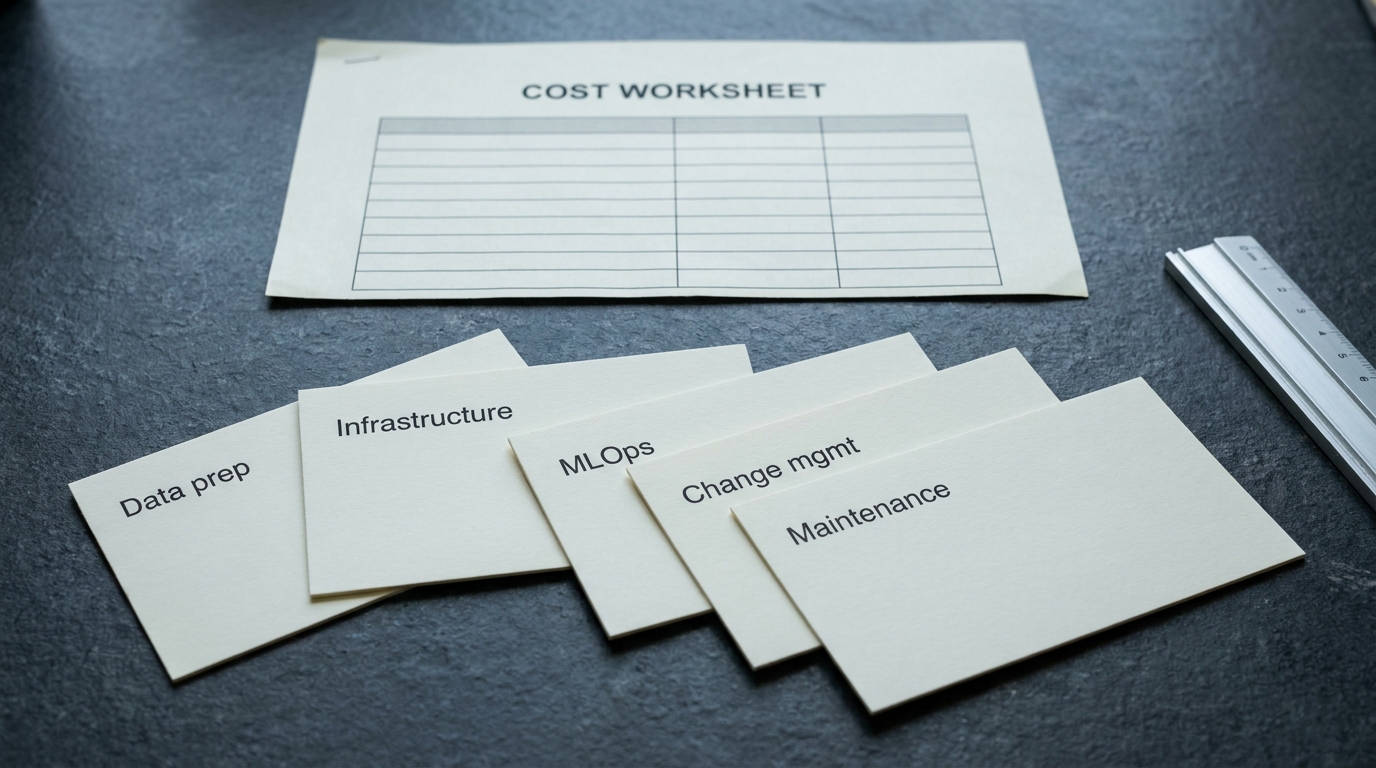
The part that causes budget overruns is not in that table, and that is the point. Cost analysis of AI projects from proof of concept through to production finds the same five line items missing from the original quote: data preparation, infrastructure, MLOps tooling, organizational change management, and ongoing maintenance (ARDURA, 2026). Most organizations budget for model development and treat the rest as incidental. It is not incidental. On a lot of mid-market projects the work around the model costs more than the model.
So when a proposal lands, ask which of those five are inside the number. If the answer is vague, the number is not a number. It is an opening position.
Match the option to your situation
Criteria are useful. A recommendation is more useful. Here is how the three doors map onto situations mid-market companies actually arrive in.
One bounded workflow, one system, no compliance exposure. Buy the no-code tool. Do not hire anyone. If your ops lead can describe the whole process in four sentences and it lives inside one platform, a consultant is an expensive way to reach the same outcome.
A complex workflow crossing several systems, no internal AI capability, and a quarter-shaped deadline. This is the fractional case. You need people who can assess the data, build against your real stack, and stay long enough to see whether it worked. A fixed-scope project will deliver something and leave before you know if it holds.
A regulated multi-year program with board visibility and an approved budget. Buy the large consultancy. The premium here is scale, method, and defensibility, and in this scenario you need all three. Do not talk yourself into a leaner option because the quote was uncomfortable.
A strong internal engineering team missing only AI-specific judgment. Buy advisory hours and keep the build in house. Your engineers do not need help writing software. They need someone who has already made the mistakes that AI systems make in production.
No internal owner and no clear first use case. Buy nothing yet. Run a readiness assessment first, decide what problem is worth solving, and identify who will own the result. Skipping this is how companies spend six figures and end up with a pilot nobody adopted. If that describes where you are, the free AI Readiness Snapshot is a 30-minute version of that conversation.
That fifth case is not a throwaway, and it is the one a vendor is least likely to raise. On the evidence of how often AI projects stall before production, a meaningful share of mid-market companies shopping for a provider right now would get a better return from spending nothing this quarter and fixing their data ownership question instead.
Questions to ask them, and questions to ask yourself
Every buyer guide gives you the first list. The second one matters more and almost nobody publishes it.
Ask any provider:
- Name a production system you built that is still running. Who runs it now?
- What happens if the data assessment says we are not ready?
- Who is actually on this team, and how many of them write code?
- What does month thirteen look like after you leave?
- Which of data prep, infrastructure, MLOps, change management, and maintenance are inside this number?
- What would make you tell us not to do this project?
Then ask your own team:
- Who internally owns this after go-live, by name?
- What number are we trying to move, and what is it today?
- Which system holds the data this depends on, and who administers it?
- What is our answer if the first use case fails?
- Are we buying a capability or buying a result? The right provider differs.
If your side of that list has more blanks than theirs, the problem is not vendor selection yet. It is that you are not ready to be a good client.
Red flags worth walking away from
Short list, all of them observed repeatedly across the providers in this market.
- The first meeting is a demo rather than questions about your operation.
- No named production reference, only anonymized "a Fortune 500 client."
- Scope that ends at model delivery, with deployment listed as a future phase.
- A proposal that arrives before anyone has looked at your data.
- Pricing that only becomes visible after a contract is in motion.
- No answer to who owns and runs the system after the engagement.
- Criteria in their own buyer guide that map suspiciously well onto their own strengths.
That last one applies to this article too, which is why the criteria table above scores the fractional model as "worth verifying specifically" on governance and "varies enormously by provider" on production evidence. Those are honest weaknesses of the category, and you should hold them against us the same way you would hold them against anyone else.
What a good first ninety days produces
Almost nobody in this market commits to a shape for the first engagement. Here is one, and you can hold any provider to it.

Weeks 1 and 2, problem definition. Pick one workflow. Write down the number it should move and what that number is today. If you cannot state it, you have picked the wrong workflow.
Weeks 3 and 4, data and integration audit. Find out where the data actually lives, what condition it is in, and which systems will need to be touched. This is the step that kills projects when it is skipped, and the step that saves budget when it is not.
Weeks 5 to 8, build one workflow end to end. Not a demo. A working path from input to output, running against real data, with a human in the loop wherever a wrong answer would be expensive.
Weeks 9 to 12, measure and decide. Compare against the number you wrote in week one. Then make an explicit decision: scale this, fix this, or stop. All three are acceptable outcomes. Drifting into month four without deciding is not.
What you should hold at the end of ninety days is one workflow in production, one measured result, and one documented decision. If a provider cannot describe how their engagement produces those three things, keep looking.
Key takeaways
- Your choice is three-way, not one-way. Large consultancy, no-code tooling, or an embedded fractional team, and the category matters more than the firm inside it.
- Big Four economics are built for organizations with far more surface area than a 400-person company. Buy that tier when you need scale, method, or regulatory defensibility, not because it looked serious.
- No-code stops at integration depth, data readiness, governance, and ownership. Those four limits are where the expensive workflow usually lives.
- Published AI project costs range from roughly $15,000 for a small pilot to $1.5 million for a full production deployment (Iternal, 2026). Ask which of data prep, infrastructure, MLOps, change management, and maintenance are inside any quote.
- If nobody internally can own the result, fix that before you buy anything. It is the cheapest decision on this page.
Working out which door you are standing in front of is usually a 30-minute conversation, not a procurement exercise. The AI Readiness Snapshot maps where AI would have the most immediate effect on your cost and reliability, at no charge. If you already know the workflow and need senior people to build and run it inside your business, the Fractional Agentic Team is the engagement built for that.