
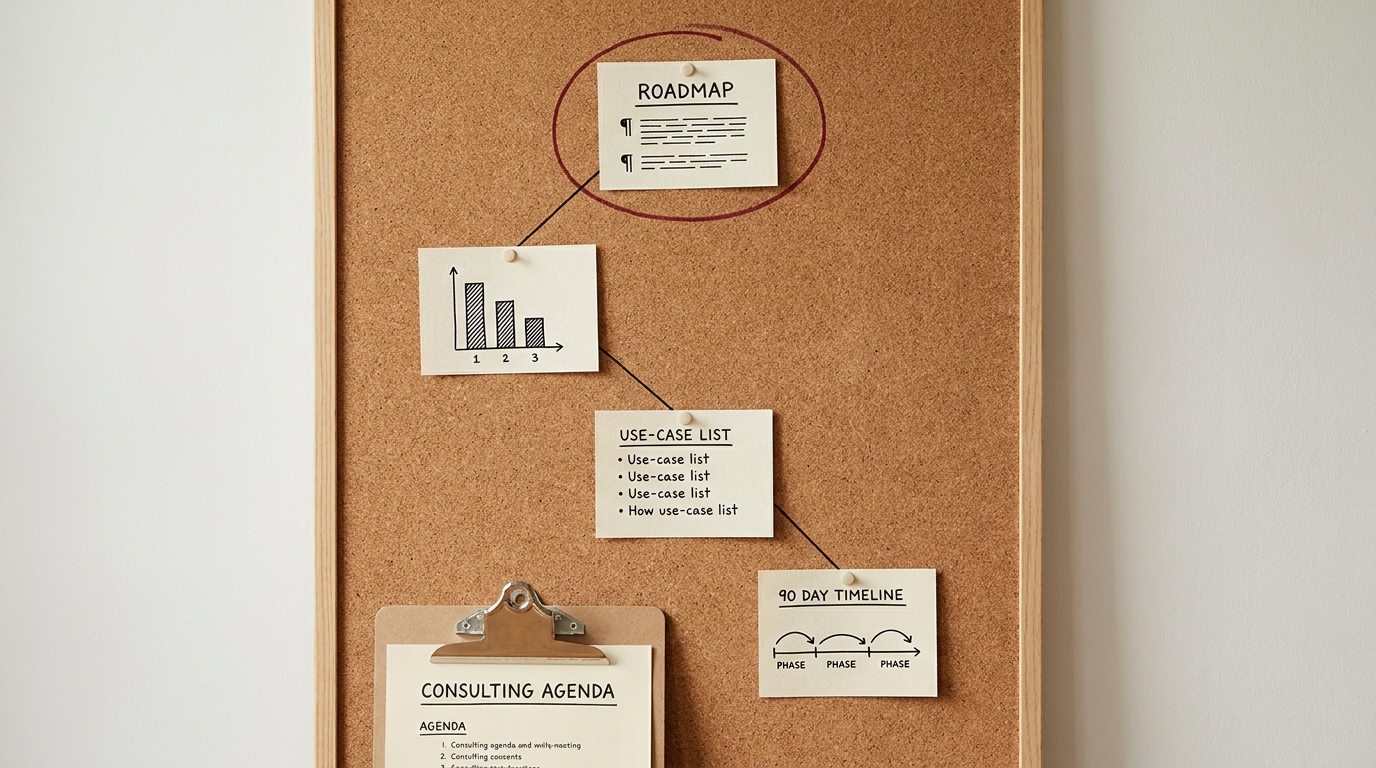
Two documents can share the title "AI Strategy" and almost nothing else. One is sixty slides of ambition that stops at the recommendation. The other is twenty pages that name which use case ships first, what it should return, who owns it, and what the next ninety days look like. The distance between those two documents is where most of the money in AI gets won or lost, and closing it is the whole job of AI strategy consulting.
The gap is not subtle, and the evidence says so. Research from MIT's NANDA initiative found that roughly 95 percent of enterprise generative AI pilots delivered no measurable return (MIT NANDA, 2025). The blocker is almost never the technology. Adoption is already everywhere. What separates the companies capturing value from the ones stuck in pilot purgatory is a strategy behind the tools, a decision about where AI actually pays and how to capture it. This article covers what AI strategy consulting services deliver, what they cost, and how to tell a real engagement from a slide deck.
AI strategy consulting services help an organization decide where AI creates real value and how to capture it. A good engagement produces a prioritized roadmap, an ROI model, a data and readiness assessment, a governance plan, and a concrete execution path, not just a recommendation deck. The output is a decision you can act on, not a thesis about the future.
What AI strategy consulting services actually are
AI strategy consulting is the work of turning a vague mandate ("do something with AI") into a ranked, funded, owned plan. It sits above tooling and below the boardroom. A consultant here is not there to build a model on day one. They are there to answer four questions before you spend real money: where does AI create value in your specific business, which use cases are worth doing first, what will it take to deliver them, and how do you govern the whole thing so it does not create new risk.
Two terms in this field get used loosely, and it helps to pull them apart. An AI strategy is the set of choices about where you will and will not apply AI, tied to business outcomes and sequenced by value. A roadmap is the artifact that makes that strategy executable, a time-phased plan of specific initiatives with owners, dependencies, and success measures. The strategy is the thinking. The roadmap is the thing you hand to the people who build.
How an engagement actually works
Most credible engagements move through five phases, though good firms compress or reorder them to fit your situation.
- Assess readiness. A structured look at your data, systems, talent, and processes to find what is ready for AI and what has to be fixed first. This is where teams discover their data is scattered across systems that do not talk to each other.
- Prioritize use cases. Every function will have ideas. The consultant scores them on value and feasibility, then ranks them, so you start with something that pays back rather than something that demos well.
- Build the roadmap. The prioritized use cases become a sequenced plan, usually spanning two to four quarters, with the first initiative defined in enough detail to start immediately.
- Set governance. Policies for data use, model oversight, risk, and responsible AI so the program scales without a compliance surprise later.
- Execute or hand off. The better engagements either help deliver the first use case or hand the roadmap to a team that can, rather than leaving it on a shelf.
The order matters less than the discipline. What defines the category is that decisions get made in sequence, on evidence, before capital is committed, not after a tool has already been bought.
What a good engagement actually delivers
Here is the part big firms rarely put in writing, which makes it the fastest way to judge whether you are buying strategy or theater. A real AI strategy engagement produces artifacts you can act on. Ask any prospective partner to show you redacted versions of each before you sign.
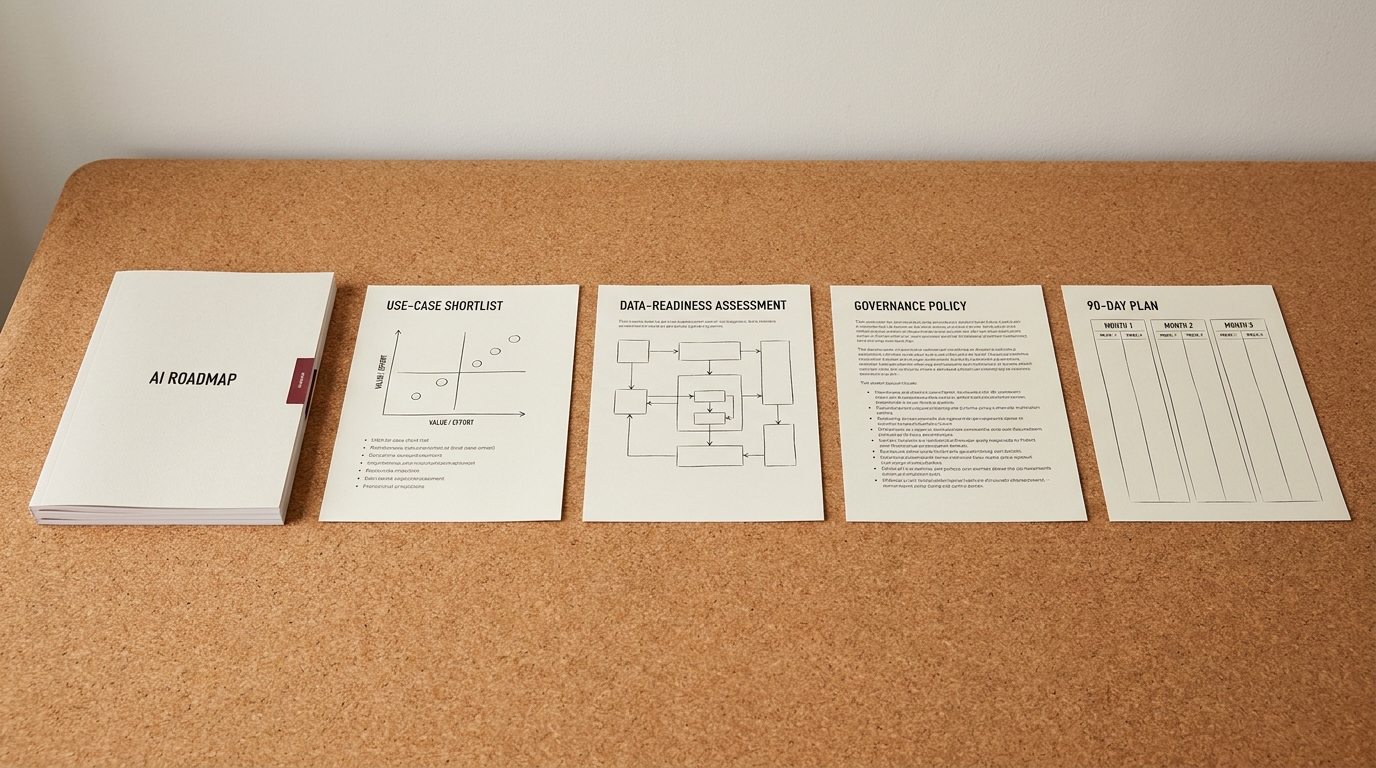
- A written roadmap, 15 to 25 pages, not 60 slides. Prose and tables that a new hire could read and understand what to build, in what order, and why. Slides are for the readout. The roadmap is the deliverable.
- An ROI-ranked use-case shortlist. Usually 5 to 15 candidate initiatives, each with an estimated value range, an effort estimate, and a feasibility note. The ranking is the strategic core, because choosing what to do first is most of the value.
- A data and readiness assessment. An honest map of what your data and systems can support today and what has to change. This is the section that separates a plan from a wish.
- A governance and responsible-AI plan. Who approves models, how data is handled, where humans stay in the loop, and how you stay on the right side of emerging regulation like the EU AI Act and the NIST AI Risk Management Framework.
- A 90-day execution plan. The first initiative broken into weeks, with owners named and a success metric defined before work starts.
Contrast that with the anti-pattern, what you might call transformation theater. It looks impressive in a boardroom and produces nothing you can build from: a maturity-model quadrant, a list of trends, a "north star" vision, and a call to "embrace the AI journey." If the deliverable does not name a specific first use case with an owner and a number attached, you did not buy a strategy. You bought a very expensive opinion.
Why most AI initiatives stall, and how strategy fixes it
The failure numbers get quoted so often they have lost their sting, so it is worth restating what they actually mean. Adoption is nearly universal, with most organizations now using AI in at least one function (McKinsey, 2024). And still, the MIT NANDA research found roughly 95 percent of generative AI pilots produced no measurable financial return (MIT NANDA, 2025), while BCG has reported that around three-quarters of companies struggle to scale AI into real value (BCG, 2024). Put those together and the picture is clear. The problem is not access to AI. The problem is what happens after access.
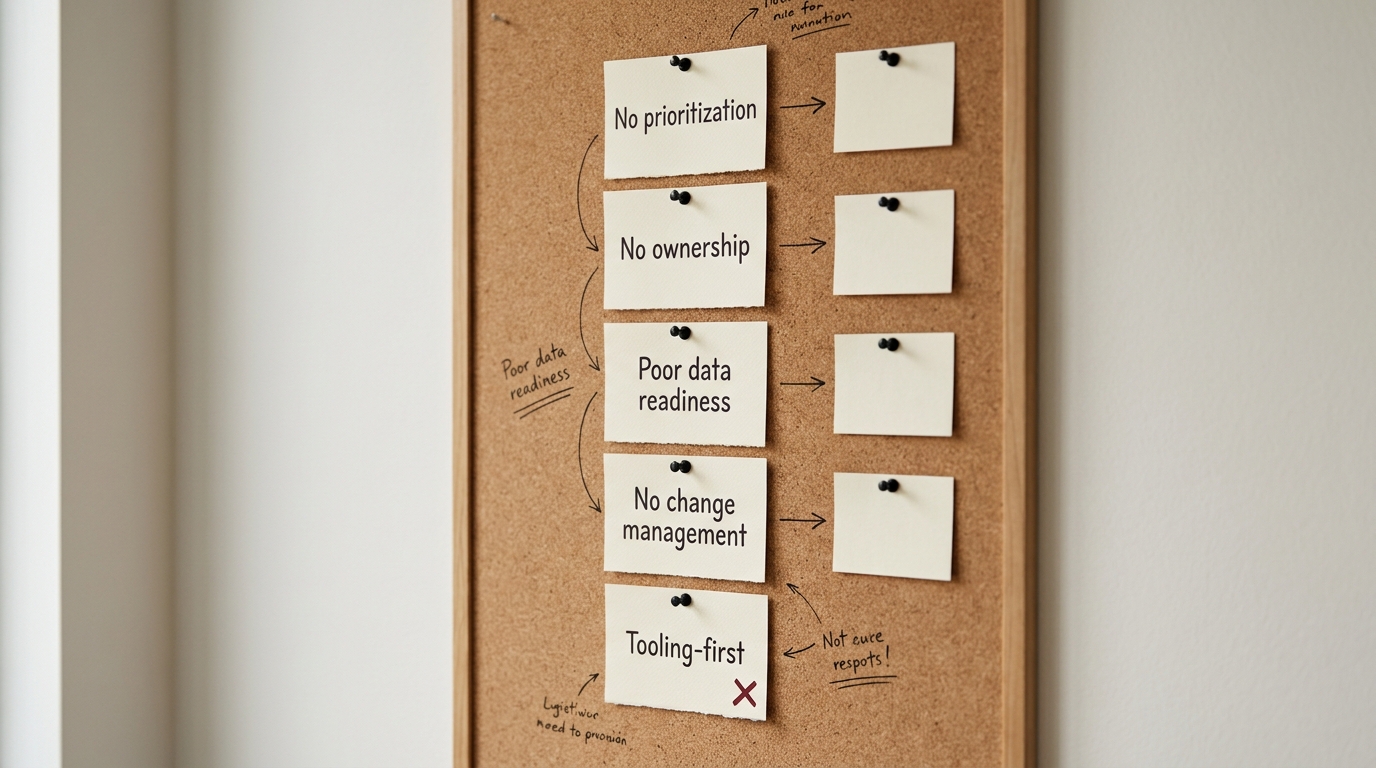
Five root causes account for most stalled programs, and each has a strategic countermove.
- No prioritization. Teams try to boil the ocean, running ten shallow experiments instead of one deep one. The fix is ruthless ranking, funding the one or two use cases with the clearest payback and killing the rest for now.
- No ownership. A pilot with no named owner has no one to carry it into production. Strategy assigns an accountable owner to each initiative before it starts, not after it stalls.
- Poor data readiness. The model works in the demo on clean sample data, then meets the reality of your actual systems. A readiness assessment surfaces this before you commit, not six months in.
- No change management. The technology ships and no one changes how they work, so usage quietly decays. A real plan budgets for adoption, training, and workflow redesign as first-class work.
- Tooling-first thinking. Buying the platform before defining the problem is the most expensive mistake of all. Strategy inverts the order, deciding the problem and the value first, then choosing the tool to fit.
Notice the pattern. None of these is a technology failure. Each is a decision that never got made, or got made in the wrong order. That is exactly the gap AI strategy consulting exists to close, and it is why a plan with owners, ROI, governance, and sequencing beats a bigger model or a better vendor almost every time.
Who AI strategy consulting is for, and who should wait
AI strategy consulting is not right for everyone, and an honest partner will tell you when to skip it. The value scales with the breadth of the decision you are facing.
You are a strong fit if:
- You have run one or two pilots that stalled and you are not sure why.
- Multiple functions want AI and you have no way to decide what comes first.
- You are under board or investor pressure to have "an AI strategy" and need a defensible plan, not a guess.
- You lack an internal AI leader or team to set direction.
- You are mid-market or lower-enterprise, roughly 50 million to 2 billion dollars in revenue, big enough for the stakes to be real but without a dedicated AI function.
You should probably wait, or skip it, if:
- You have exactly one narrow, well-understood use case. In that case, hire a builder, not a strategist.
- You already have strong internal AI leadership that has done the prioritization work. You may need execution help, not strategy.
- You have not yet defined any business problem worth solving. Fix that first, cheaply, before paying for a roadmap.
The mid-market is the sweet spot precisely because it is underserved. Enterprises have internal strategy teams and the budget for a big firm. The smallest companies do not need a formal engagement. The organizations in the middle, with real complexity and no internal AI function , are the ones a focused strategy engagement helps most, and the ones the largest firms are least interested in serving well.
How to choose a partner: boutique, fractional, or big firm
There are three broad ways to buy AI strategy help, and the right one depends on your size, budget, and how much execution you need afterward.
The big firm (McKinsey, BCG, Accenture, Deloitte, IBM) brings brand, scale, deep research, and a large bench. That is worth a lot to a Fortune 500 board managing a nine-figure transformation. For a mid-market buyer, it often means paying enterprise rates for a generalized playbook, with the senior people who sold the work handing delivery to junior staff. Price bands run roughly 50,000 to 500,000 dollars and up, over two to six months.
The boutique or independent consultant trades brand for focus and speed. A specialist firm can deliver a sharp, mid-market-fit roadmap in weeks rather than months, at a fraction of the cost, typically in the range of 5,000 to 25,000 dollars for a scoped strategy engagement of two to four weeks. The tradeoff is less bench depth and brand cover, which matters less when you want a plan you can act on than when you want a name to show the board.
The fractional or embedded team goes a step further, providing not just the strategy but the people to execute it. This model answers the question the other two leave hanging, and it is the one most mid-market firms actually need. If you want a scoped, fixed-price way to get the roadmap this article describes, an AI Transformation Discovery sprint produces exactly that, a prioritized roadmap and ROI model in about a week for a fixed 5,000 dollars, without the multi-month enterprise engagement.
Whatever you choose, watch for the red flags that signal transformation theater rather than strategy.
- Deck-only deliverables. No written roadmap, no execution plan, just slides.
- No ROI model. If no one will attach numbers to the use cases, no one has done the hard prioritization.
- No execution plan. A strategy that ends at "here is what you should do" and never says how, in what order, or by whom.
- No data-readiness step. A roadmap built without checking whether your data can support it is a fantasy.
- Vague pricing. A partner who will not give you a range before you sign is a partner who will surprise you after.
Where AI strategy creates the most leverage
Strategy is choosing where to point AI first, so it helps to know where the value tends to concentrate. Across mid-market engagements, a few use-case patterns recur because they combine clear payback with manageable risk.
- Workflow automation. The repetitive, rules-heavy processes that quietly consume staff hours, in finance, operations, and back office. Often the fastest, most measurable return.
- Decision support and agents. Systems that surface the right information or take bounded actions inside a defined process, compressing work that used to take a person hours into minutes.
- Knowledge retrieval. Making an organization's scattered documents, policies, and history instantly searchable and usable, which pays back across every function that answers questions for a living.
- Customer operations. Support triage, response drafting, and case routing, where volume is high and the cost of slow answers is real.
The point is not to do all of these. It is to choose the one or two where your specific business has the most to gain and the fewest blockers, then sequence the rest . That is what prioritization means in practice.
Here is the gap that trips up most mid-market companies, and the one competitors rarely name. You finish the engagement, you have a strong roadmap, and then you look up and realize you have no team to build it. The roadmap assumes an execution capacity you do not have. This is the "you got the plan, now who ships it?" problem, and it is why the strategy and the delivery increasingly need to come from the same place. A fractional AI team embeds the engineers and operators who turn the roadmap into shipped systems , so the plan does not die the moment the consultant leaves. Strategy without an execution path is just a better-informed version of the same stall.
The bottom line
The technology is rarely the bottleneck. Nearly every stalled AI program failed on a decision that never got made, an unowned pilot, an unranked backlog , a data gap no one checked, a tool bought before a problem was defined. AI strategy consulting exists to make those decisions in the right order, on evidence, before the money is spent. A real engagement gives you a ranked roadmap, an ROI model, a governance plan, and a first ninety days you can start on Monday, not a slide deck about the future.
If you are weighing whether you need it, start smaller than a full engagement. A short, honest read on where you actually stand costs you nothing and tells you whether you are ready to prioritize or still need to fix the foundations first. Get an AI Readiness Snapshot with a free 30-minute readiness call, and you will at least know which of the two documents you are trying to write.
Key takeaways
- AI strategy consulting turns a vague AI mandate into a ranked, owned, funded plan. The output is a decision you can act on, not a recommendation deck.
- A real engagement delivers five things: a written roadmap, an ROI-ranked use-case shortlist, a data-readiness assessment, a governance plan, and a 90-day execution plan.
- Most AI programs stall on decisions, not technology, no prioritization, no ownership, poor data readiness, no change management, and tooling-first thinking.
- Match the partner to the need: big firms for enterprise scale, boutiques for a fast mid-market roadmap (roughly 5,000 to 25,000 dollars), fractional teams when you also need execution.
- The most-missed risk is the execution gap, having a roadmap and no team to build it. Plan for who ships the work before the engagement ends.