
Two consulting proposals can land on the same desk and read almost the same. Both promise an AI transformation. Both lean on "roadmap," "innovation," and "scale." Both quote a number that makes the CFO wince. The words will never separate them, because the words are always polished. One thing will: whether the firm can tell you, phase by phase, the exact thing you will be holding at the end of each one. One of them can. The other is selling slides.
That gap is what this whole article is about. A machine learning ambition with real budget behind it is a genuine opportunity and a genuine way to set money on fire, and which one it turns into depends far less on the model than on whether the engagement has a spine. Here is the reassuring part. You do not need to be a data scientist to feel for that spine. You need to know what a serious engagement is supposed to produce, and to catch the exact moment a partner cannot name it.
In plain terms: AI/ML consulting services are structured engagements where an outside team helps you scope, build, deploy, and maintain machine learning systems that run inside real products, not proofs of concept that stall in a notebook. A good engagement leaves you with three things: working software in production, documentation that explains it, and a team that can operate it after the consultants leave. If a firm cannot name the deliverable at each stage of that path, you are buying advice, not a system.
Why so many enterprise AI initiatives stall
Walk through the graveyard of failed AI projects and the headstones all read the same, and almost none of them say "the algorithm was wrong." The model is rarely the cause of death. The cause is structural, and it turns up in a handful of recognizable shapes.
The work started before anyone had defined the problem. A team got excited about a capability, built something clever, and only afterward asked which business decision it was supposed to change. Nothing did.
Nobody checked whether the organization was ready. The data lived in five systems with three definitions of "customer," half of it was unlabeled, and no owner could say what "good" even looked like. The project spent its first two months learning this the hard way instead of asking up front.
Success was never defined, so the pilot could neither pass nor fail. It just kept going, then quietly stopped when the budget ran dry or the sponsor changed jobs.
The pilot never left the notebook. It produced an impressive demo, a chart, a round of applause in a conference room, and then hit the wall that separates a script on a laptop from a service other systems depend on. That wall is where most AI initiatives die, and getting across it is real engineering work a demo never has to do.
And when something did ship, there was no plan to keep it breathing. Models decay. The world they were trained on drifts away from the world they run in. Without monitoring and retraining, an accurate model quietly turns into a confidently wrong one, and nobody notices until a decision goes badly.
Read that list again and the pattern is hard to miss. Every failure is a missing piece of structure, not a missing piece of math. Structure is exactly what you are paying for when you hire a consulting partner worth the money. The rest of this article is about what that structure looks like and how to tell whether a firm actually has it.
What "AI/ML consulting services" actually means
The phrase covers a lot of ground, and that range is where buyers get burned, so it is worth cutting it in two.
On one side sits strategy and advisory work. A firm assesses your opportunities, ranks use cases, sketches a roadmap, and hands you a deck. This has real value early on, when you honestly do not know where to point. It also has a failure mode: the engagement ends at the deck. You paid for a map and traveled no distance.
On the other side sits hands-on build and deploy. A team scopes a specific use case, checks whether your data can support it, builds a model, wires it into a real product or workflow, deploys it behind an interface other systems can call, and stands up the operations to keep it alive. This is the point where machine learning stops being a slide and starts being software.
Most serious engagements blend the two, and the blend is fine. What matters is that the hands-on half exists somewhere in the plan. Quick glossary for the terms you will hear along the way: ML (machine learning) is the model itself, the thing that learns patterns from data. MLOps (machine learning operations) is everything that keeps that model running reliably in production. A PoC (proof of concept) is a small build meant to prove an idea works before you commit to the full thing.
Consulting fits well when you need working AI inside a real product and you do not have the specialized team to get it there and keep it there. It fits badly when all you actually want is a one-off model tossed over a wall with no operations, no integration, and no ownership plan, because that model will be dead inside a year and nobody will know why.
Two concrete examples make the shape clearer. A demand-forecasting model wired straight into an existing ERP, so purchasing decisions use it automatically, is a build engagement. An LLM-powered document pipeline that reads incoming contracts, pulls out the key terms, and routes anything ambiguous to a human reviewer is another. Both are systems that change a daily decision. Neither is a demo.
The phases of a real engagement, and the deliverable from each
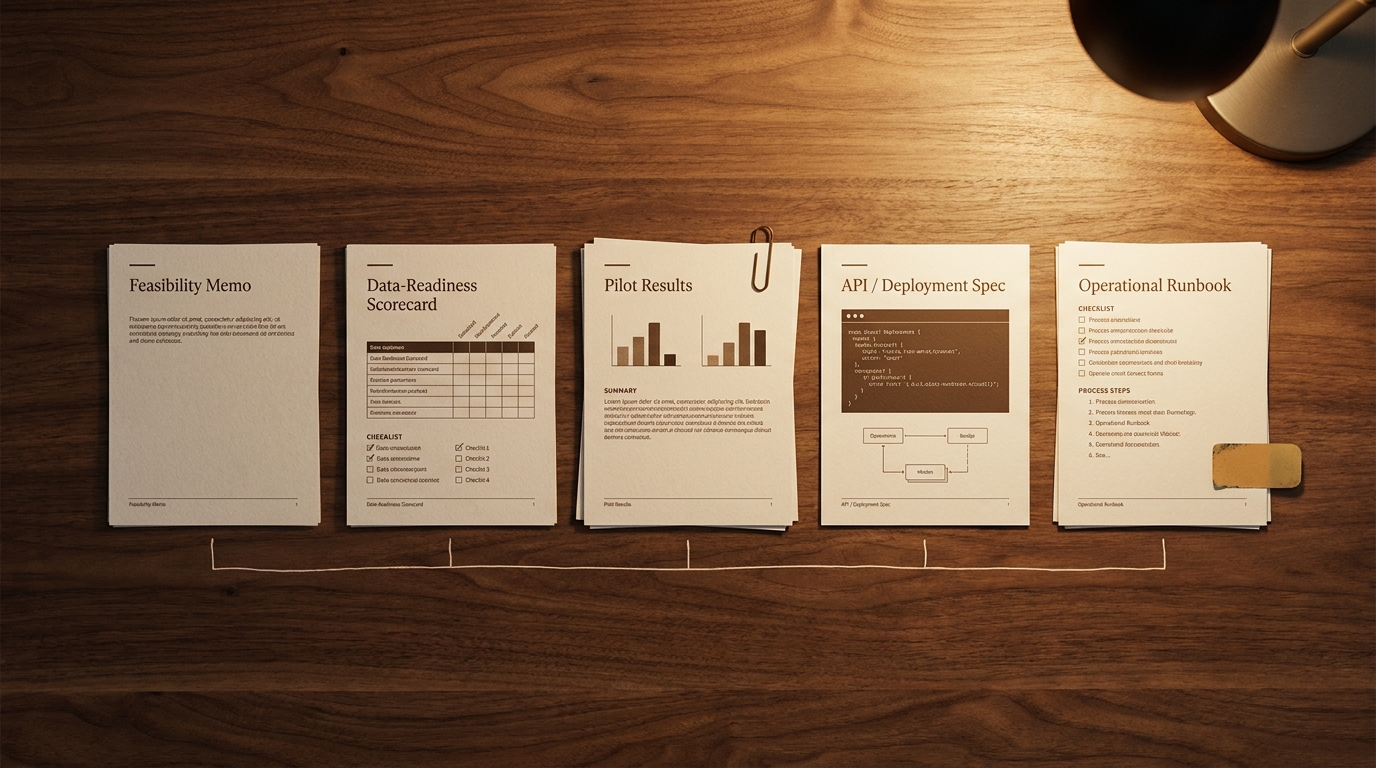
This is the spine, so read it as a checklist you can hold a partner to. A real engagement moves through phases, and each phase should hand you a specific artifact. If a firm describes its work as one undifferentiated blob of "we will build your AI," that is the first red flag, because it means there is no point at which you can stop, inspect what you got, and decide whether to keep going.
Use-case framing and feasibility. The engagement opens by picking the right problem and testing whether machine learning can actually solve it. Not every problem should be an ML problem. The deliverable here is a short feasibility memo: the business decision the system will change, why ML is the right tool for it, what data it would need, and an honest read on whether the effort is worth it. A partner that jumps straight to building has skipped the one step that heads off the most expensive kind of failure.
Data readiness assessment. Before anyone trains anything, someone has to look hard at your data. Is it available, is it clean, is it labeled, can the team even reach it, and does it carry the signal the model would need. The deliverable is a data-readiness scorecard that names the gaps plainly and says what it would take to close them. This is the step most vendors rush, and rushing it is why so many pilots discover halfway through that the data was never going to support the goal.
Pilot or proof of value. Now a small, real build tests the idea end to end. The point is not a polished demo. The point is evidence. The deliverable is a working pilot with actual evaluation results: how accurate it was, on what data, measured against the success criteria you agreed on up front. A pilot with no numbers attached is theater.
Production build. If the pilot earns it, the system gets built for real, which is a different and harder job than the pilot. It has to handle messy inputs, run reliably, integrate with your existing systems , and stay secure. The deliverable is a deployed system that other software can call, usually behind an API, doing the job inside your actual product or workflow rather than on a data scientist's laptop.
MLOps and post-launch maintenance. The last phase is the one buyers forget and good partners insist on. A deployed model needs monitoring, alerting, and a plan for retraining as the data drifts. The deliverable is the operational layer plus a runbook: how to watch the model's health, what to do when it degrades, and who owns that. Skip this and you have bought a system with a hidden expiration date.
Notice that every phase produces something you can see and evaluate . That is the test. A capable partner can name the artifact for each phase before the work starts. A firm selling slides will talk about phases in the abstract and go quiet the second you ask what, exactly, you will receive at the end of each one.
Is your data and organization actually ready for ML?
Readiness is the question buyers ask last and should ask first, and it is the one competitors cover least, so give it real weight. The most common reason a project stalls is not a weak model. It is that the organization was never in a position to support one, and nobody checked before the money was committed.
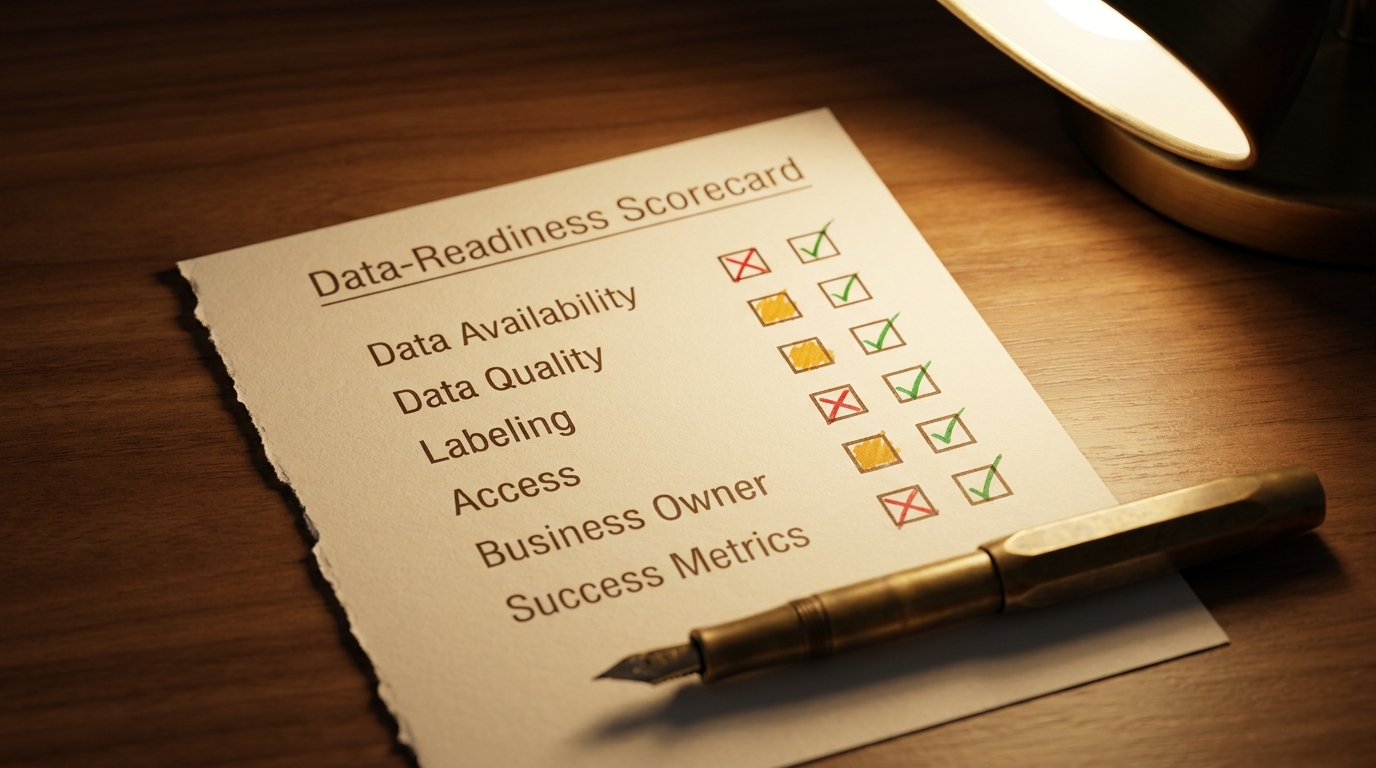
You can run a rough self-check before any consultant walks in the door. Ask yourself, honestly:
- Data availability. Does the data the system would need actually exist somewhere you can reach, or is it aspirational?
- Data quality. Is it consistent, reasonably complete, and trustworthy, or is it riddled with duplicates, gaps, and three definitions of the same field?
- Labeling. For the problems that need labeled examples, do you have them, or would you have to build them from scratch?
- Access. Can the people doing the work actually get to the data without a three-month permissions fight?
- A named business owner. Is there one person who owns the outcome and can decide what "good" means, or is it a committee that will never converge?
- Clear success metrics. Do you know the number that would tell you this worked, set before the build starts rather than negotiated after?
If most of those answers are shaky, that is not a reason to drop the idea. It is a reason to start with a readiness step rather than a full build, and to be wary of any partner willing to quote a production price before they have looked at your data.
That is also the honest place to take the first small step. If you want an outside read on where you actually stand before committing budget, Get an AI Readiness Snapshot is a free 30-minute call built for exactly this question.
What it should cost and how long it should take
Nobody can give you a real price without knowing your scope, and any firm that quotes a firm number before it understands your data and goal is guessing or anchoring. What you can have is a way to sanity-check a proposal, which beats a fake figure anyway.
Cost tracks scope, and scope tracks phase. A feasibility sprint or readiness assessment is the cheapest and shortest piece of work, often a small number of weeks, because it is investigation, not construction. A pilot costs more and runs longer because someone is building and evaluating something real. A full production build with integration and operations is the largest line by a wide margin, because it is the phase where the hard engineering lives.
The practical move is to insist a proposal break cost down by phase rather than handing you one lump sum. A phased quote lets you spend a little to learn whether the bigger spend is justified, and it forces the partner to be specific about what each stage buys. Treat any single all-in number, presented before feasibility, as an estimate at best and a warning sign at worst. Ask what it assumes about your data, because that assumption is usually where the real cost is hiding.
Timelines follow the same logic. Feasibility and readiness are short. Pilots are medium. Production and the operational layer are the long tail, and the maintenance phase does not really end at all, because a model in production is a system you keep running, not a project you finish.
In-house build vs. consulting partner vs. freelance hire
The SERP is oddly quiet on the decision buyers actually face, which is not "should I do AI" but "who should do it," so this section earns its place. There are three real options, and each one wins under different conditions.
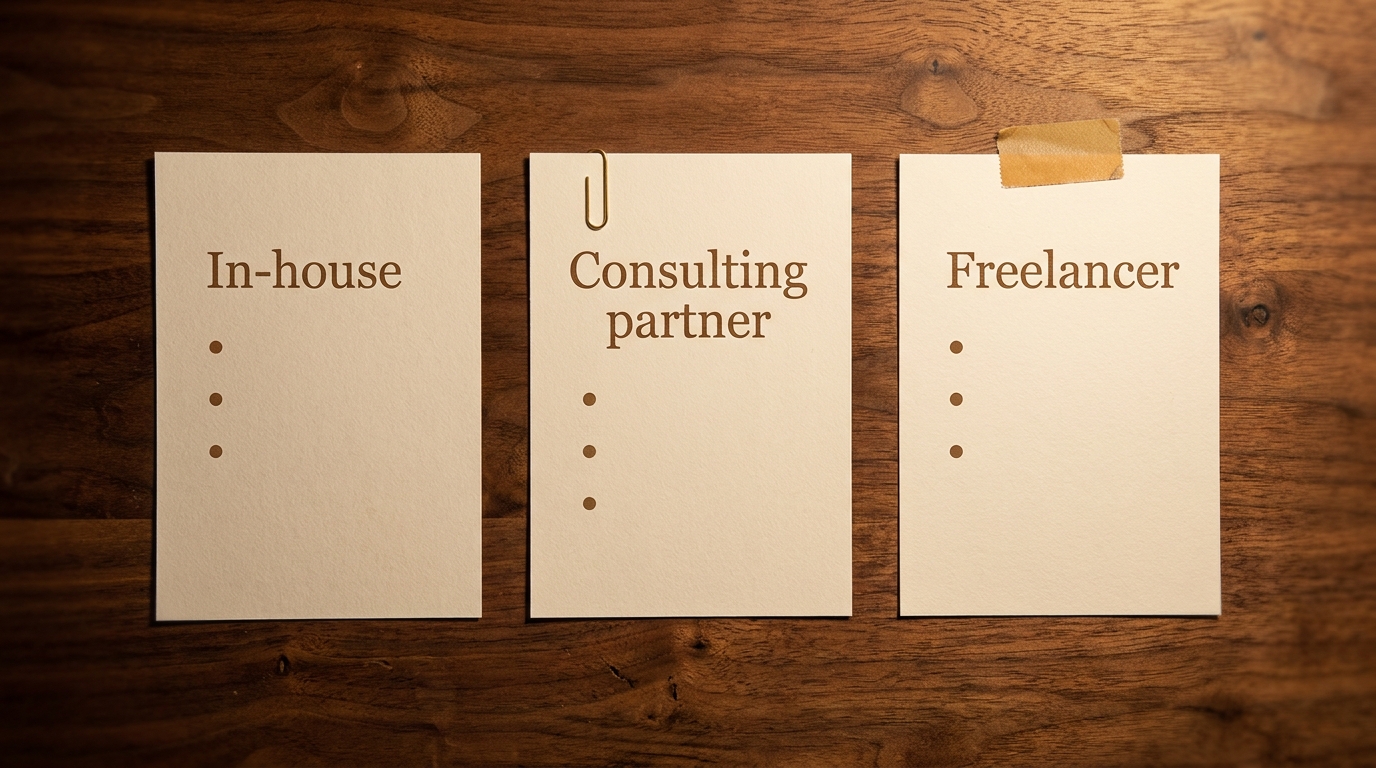
Build in-house when the capability is core to your business, you plan to keep investing in it for years, and you can attract and hold onto the specialized talent. The upside is retained knowledge that compounds. The cost is that hiring a capable ML team is slow and expensive, and a half-built team on its first project tends to make every expensive mistake in this article's first section.
Hire a consulting partner when you need working AI in production faster than you can staff for it, you want the risk of the first build carried by people who have done it before, and you value a team that can also set you up to operate the result. The upside is speed and experience. The thing to watch is knowledge transfer, so make sure "your team can run this after we leave" is an explicit deliverable and not an afterthought.
Hire a freelancer when the task is narrow, well defined, and short, like a single model or a specific analysis, and you already have the surrounding engineering and operations to absorb it. The upside is flexibility and cost. The limit is that one freelancer rarely covers the full path from data to a maintained production system, so this option fits a piece of the work, not the whole of it.
There is also a middle path worth knowing about. If your constraint is talent and capacity rather than strategy, an embedded fractional AI team gives you experienced hands working inside your organization without the multi-year commitment of building the team yourself.
How to tell a capable partner from slideware
By now the evaluation almost writes itself, but it helps to have the flags spelled out, because in the room, under a good pitch, they are easy to miss.
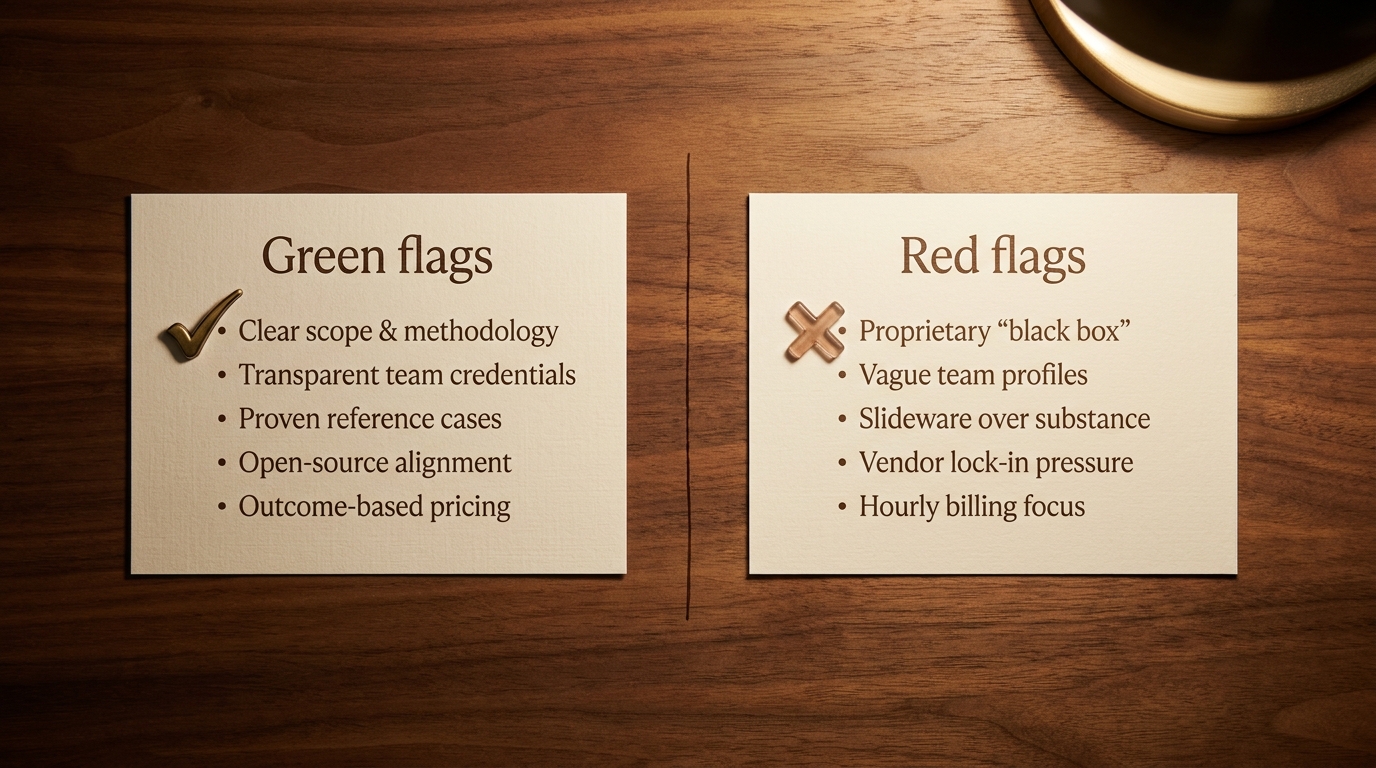
The green flags are concrete and a little unglamorous. A capable partner names the deliverable for each phase without being pushed. They ask about your data before they quote anything. They bring up maintenance and operations unprompted, because they know that is where value is kept or lost. They can point to systems they actually shipped into production, not just pilots they demoed. And they are comfortable telling you a use case is a bad fit, which is the surest sign they are optimizing for your outcome rather than the sale .
The red flags are the mirror image. The pitch leads with "transformation" and never comes down from that altitude. There is no operations or maintenance plan, as though the work ends at launch. The track record is all proofs of concept and no production. Success criteria are vague, or they show up only after you ask twice. And a firm price appears before anyone has looked at your data, which means the number is decoration.
A short list of questions cuts through most of it. Ask a prospective partner: What will I be holding at the end of each phase? What happens to this model six months after it ships? Can you show me something like this running in production today? What would make you tell me not to build this? How does my team operate this after you leave? The answers, and the comfort level behind them, tell you almost everything.
What changes after launch: industrializing and maintaining ML
Launch is a milestone, not a finish line, and this is the theme the strongest competitors converge on, so it deserves a clear treatment. A model in production lives in a moving world. Customer behavior shifts, data pipelines change upstream, the categories the model learned drift out from under it. This is model drift, and it is not a bug. It is the default fate of every deployed model nobody maintains.
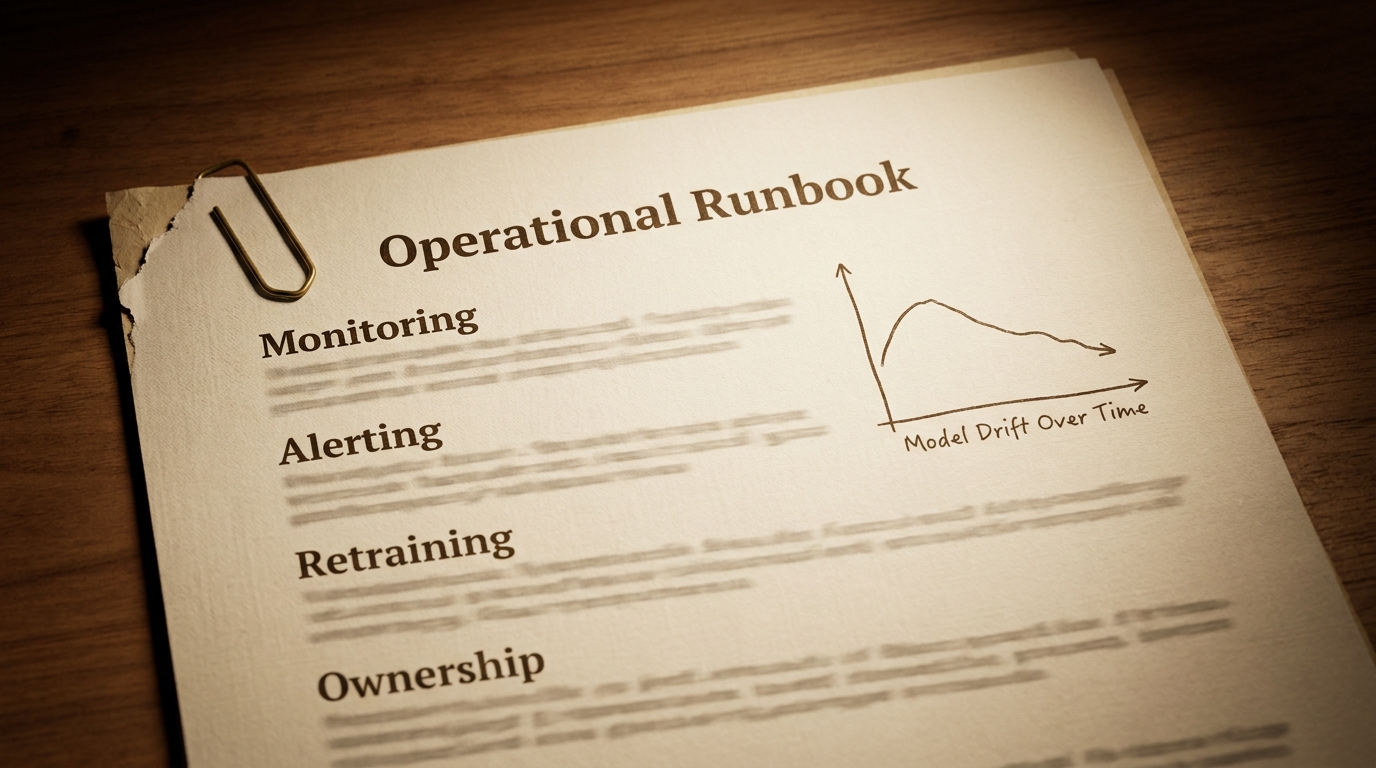
Industrializing machine learning means building the layer that keeps the system honest over time. Monitoring watches the model's inputs and outputs for signs it is slipping. Alerting tells someone before a quiet failure becomes a costly one. Retraining refreshes the model on new data on a schedule or a trigger. And ownership names the person or team responsible for all of it, because a monitoring system no one is accountable for is just another dashboard nobody reads.
A partner that treats this as optional is handing you a liability dressed up as an asset. The deliverable that protects you is the operational runbook: a plain description of how the system is watched, what the warning signs are, what to do about them, and who does it. Ask for it by name. Its absence is one of the most reliable signals that an engagement was built to impress at launch rather than to last.
When you are ready to turn a proven idea into a system that reaches production and stays there, a Discovery Sprint is a one-week paid engagement that produces a concrete, phased roadmap you can act on or take elsewhere.
Key takeaways
- The failure of most AI initiatives is structural, not mathematical. The model is rarely the problem. The missing structure is.
- Judge an engagement by its deliverables. A capable partner can name the specific artifact you will receive at the end of every phase, from feasibility memo to operational runbook.
- Ask about readiness before anything else. If your data and organization are not ready, start with a readiness step, not a full build, and distrust any partner who quotes production before seeing your data.
- Expect ranges, not false precision. Insist on a phased quote so you can spend a little to learn whether the larger spend is justified.
- Plan for life after launch. A deployed model decays without monitoring, retraining, and a named owner. If maintenance is not in the plan, the value will not last.
The whole judgment reduces to one habit. When a firm describes what it will do, keep asking what you will be holding at the end. If the answer stays specific, you are looking at a real engagement. If the answer keeps dissolving into adjectives, you are looking at slideware, and the most expensive mistake you can make is confusing one for the other.