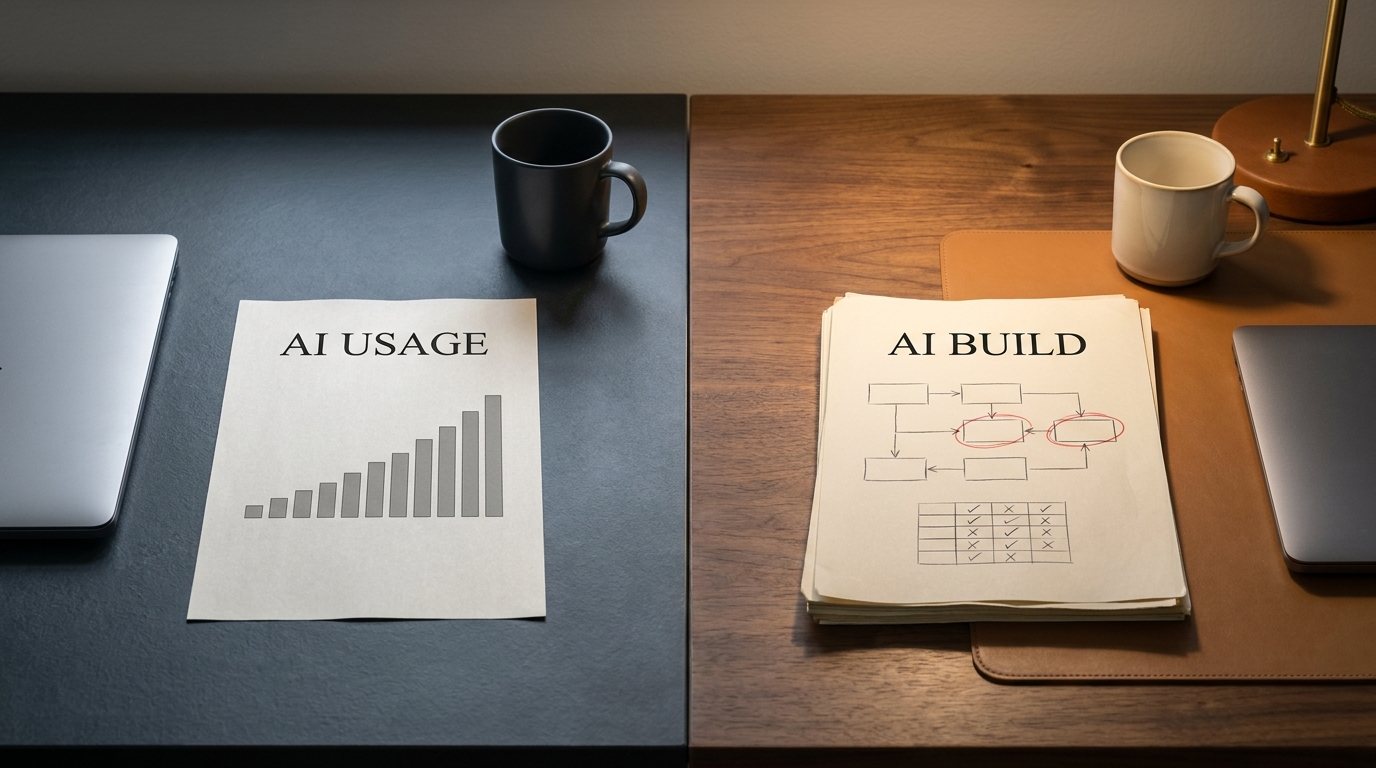

A senior engineer toggles Copilot on for the morning standup dashboard, then turns it off and writes the function by hand. The adoption metric climbs. The actual work does not change. That gap, between the number leadership watches and the behavior on the keyboard, is where most AI rollouts quietly stall.
The reflex is to read that resistance as fear of change. It almost never is. The pushback is usually rational, and the way most teams force AI is the thing creating it.
AI in software development means using machine-learning tools, from autocomplete assistants to autonomous coding agents, to write, review, and ship code. Developers resist it less because they fear the technology and more because mandated rollouts shift review burden onto them, produce output they distrust, and measure usage instead of outcomes.
This piece is for engineering leaders who were handed an "adopt AI" directive and are watching their best people disengage. It is also for the individual contributors doing the resisting, because their concerns deserve to be named precisely rather than dismissed. The goal is not to talk you out of AI. It is to separate the legitimate objections from the bad rollout practices that create most of them, then lay out an adoption path your engineers will actually walk.
What "agentic development" actually means, and why the mandate version backfires
Agentic coding is not the same thing as an ai code assistant, and conflating the two is the first place rollouts go wrong. An assistant suggests the next line or block while you type, and you accept or reject it in real time. An agentic ai coding tool works a step removed. You give it a goal, and it plans, writes, runs, and iterates across multiple files on its own, then surfaces a finished change for review. The security firm Apiiro frames the distinction as augmenting a developer's keystrokes versus delegating a whole unit of work to an autonomous process.
That difference is not academic. It changes who carries the risk. Accepting an autocomplete suggestion is a small, reversible decision. Approving an agent's multi-file pull request is a much larger act of trust, and the reviewer absorbs the cost of any mistake.
So when a leader announces "we're adopting agentic AI," most engineers hear a vague directive bolted to an unbounded promise. The phrase blurs the safe, incremental tooling many already use with the autonomous workflows they have good reason to scrutinize. The mandate version backfires because it asks for blanket buy-in to a category, not informed adoption of a specific tool for a specific job. Resistance to a fuzzy directive is not irrational. It is the right response to being asked to trust something nobody has scoped.
The symptoms: how developer resistance actually shows up
Resistance rarely arrives as open revolt. It shows up as a set of quieter signals, and a leader can learn to read them on their own team. When several appear together, the rollout has a problem the dashboard is not reporting.

- Flat or gamed adoption metrics. Engineers enable the tool for the usage report, then work the way they always have. The number looks healthy. The behavior has not moved.
- "It's faster to write it myself" in standups and retros. This is not laziness. It is a measured claim that the review-and-correct loop costs more time than it saves for the work in front of them.
- Rising review and pull-request friction. Reviewers spend more time scrutinizing generated code for subtle errors than they would have spent writing it, and reviewer fatigue climbs.
- Quiet disengagement from AI initiatives. Nobody argues. People just stop participating, and the vocal skeptics move their objections to internal channels where leadership is not watching.
- Trust complaints in the open. Hallucinated APIs that do not exist, plausible-looking bugs that pass a glance, and security findings traced back to generated code.
None of these are character flaws. Each one is a rational reaction to a specific, fixable problem with how AI was introduced. Which raises the real question. What is each symptom actually pointing at?
The root causes: why the resistance is rational
The most useful thing a leader can do is separate what a developer feels from the legitimate concern underneath it, and then from the thing actually causing it. In most cases the cause is the rollout, not the tool. The table below maps the pattern.
[table]
Read down the right-hand column and the pattern is hard to miss. Almost none of these are objections to the technology itself. They are objections to being handed a tool without guardrails, without a say, and without honest framing. The developer who says "I don't trust the output" is not being a Luddite. They are telling you the review process has not caught up to the volume of code now arriving for review.
The trust concern deserves particular weight, because generated code fails in a way human-written code rarely does. It invents function signatures, leans on deprecated patterns, and produces work that reads as correct until it breaks somewhere the reviewer did not expect . Push that code through review faster under throughput pressure, and the defect rate engineers worried about becomes the defect rate the team ships.
Two honest examples
Patterns are easier to act on with concrete cases. These two are composite and anonymized, drawn from the common shapes these rollouts take rather than any single named team.
The forced rollout that backfired. An engineering org set an "AI usage" target tied to quarterly reviews. Every developer was expected to show a minimum share of commits touched by an AI tool. Within a month the dashboard was green and the engineering reality was worse. People generated boilerplate they would have written anyway just to clear the threshold, then burned review cycles cleaning it up. The metric measured a behavior, not a benefit. Reviewer fatigue rose, trust in the initiative fell, and the most experienced engineers, the ones whose judgment the rollout most needed, were the first to check out. The tool was capable. The mandate broke it.
The skeptic who came around on their own terms. A senior developer who had publicly dismissed agentic coding started using it quietly, on a narrow slice of work: scaffolding tests, drafting migrations, exploring an unfamiliar library's surface area. The common thread was control. They chose the scope, kept a human in the loop on every change, and never let the agent near the parts of the system where a subtle error would be expensive. Within a quarter they were one of the tool's more effective users. Not because anyone told them to be, but because they got to define how it fit their work. The resistance was never about whether to use AI. It was about how.
The two arcs sit at opposite ends of the same axis. The first removed control and measured compliance. The second preserved control and earned adoption. The technology was identical. The rollout set the outcome.
What good looks like: leading AI adoption without forcing it
The resolution follows straight from the root causes. If the rollout creates most of the resistance, then changing the rollout removes most of it. A non-coercive adoption model rests on five moves.

Make it opt-in with strong defaults, and measure outcomes rather than usage . Give teams good tooling and a clear default workflow, then let them choose where it helps. Track cycle time, defect rate, and developer experience. Never track raw "AI usage," because the moment usage becomes the target, engineers optimize for the number and the signal dies.
Put guardrails before scale. Generated code needs the same or stronger review discipline than handwritten code, not less. Set review standards specifically for AI output, run security scanning on it, and gate it behind tests before it merges . Red Hat's "trusted software factory" framing and the maintainability patterns CodeScene documents point the same way. Trust is a function of the controls around the code, not the source of the code.
Address the skill and career fear out loud. The anxiety that AI will rot a developer's craft or take their job does not disappear because nobody mentions it. Name it. Frame AI as leverage that lets senior engineers do more of the work only they can do, and as a supervised tool for juniors that still makes them build judgment. The unspoken fear is corrosive precisely because it stays unspoken.
Start with a readiness assessment, not a mandate. Before rolling anything out, diagnose where AI actually helps this codebase, this team, and this workflow. A blanket directive assumes the tool fits everywhere equally. It does not. Knowing where it earns its place, and where it does not, is what turns a mandate into a plan.
Leaders who run the rollout this way tend to see less of the pushback that flat-mandate teams treat as inevitable. The difference is not the tool. It is whether the people using it had a hand in deciding how.
Not sure where AI actually helps your team? Book a free 30-minute AI Readiness Snapshot and start with diagnosis instead of a directive.
Will AI replace developers? A short, honest reality check
The fear that fuels much of the resistance is the quiet one. That adopting these tools is the first step toward not being needed. A clear-eyed look at the evidence defuses it.
Current research points to augmentation, not replacement. MIT's 2025 work on the roadblocks to autonomous coding found that fully autonomous agents still stumble on the parts of software work that define real engineering: understanding sprawling legacy systems, holding long-range context, and weighing trade-offs. The tools are genuinely useful for bounded, well-specified tasks. They are nowhere near owning the ambiguous, high-context work that senior engineers spend most of their time on.
That reframes the career question. The skill that compounds in value is not raw code production, which is exactly what these tools accelerate. It is the judgment to scope a problem, review a change critically, and decide what should and should not be automated. Leaders who say this plainly take the existential charge out of the conversation, and a team that is not bracing against replacement has far more room to adopt a tool on its merits.
Key takeaways
- Developer resistance to AI is usually rational, not a fear of change. It tracks specific, fixable problems with how the tool was introduced.
- The rollout, not the technology, creates most of the pushback. Top-down mandates and usage KPIs are the common culprits.
- Measure outcomes such as cycle time and defect rate, never raw AI usage. The moment usage is the target, engineers game it.
- Put guardrails, review standards, and test gates in place before scaling, because trust is a function of the controls around generated code.
- Lead with a readiness assessment and opt-in defaults instead of a mandate. Diagnose where AI helps this team before rolling anything out.
Scope a rollout your engineers won't resist
The teams that adopt AI well do not start with a directive. They start by understanding where it fits, then build the guardrails and the buy-in before they scale.
AI Transformation Discovery — ready to scope a rollout your engineers won't resist? Book a Discovery Sprint and design an adoption path around your team's real work, not an adoption quota.
If the constraint is capacity rather than willingness, a Fractional Agentic Team can bring agentic capability into the work without forcing it onto an already-stretched team.