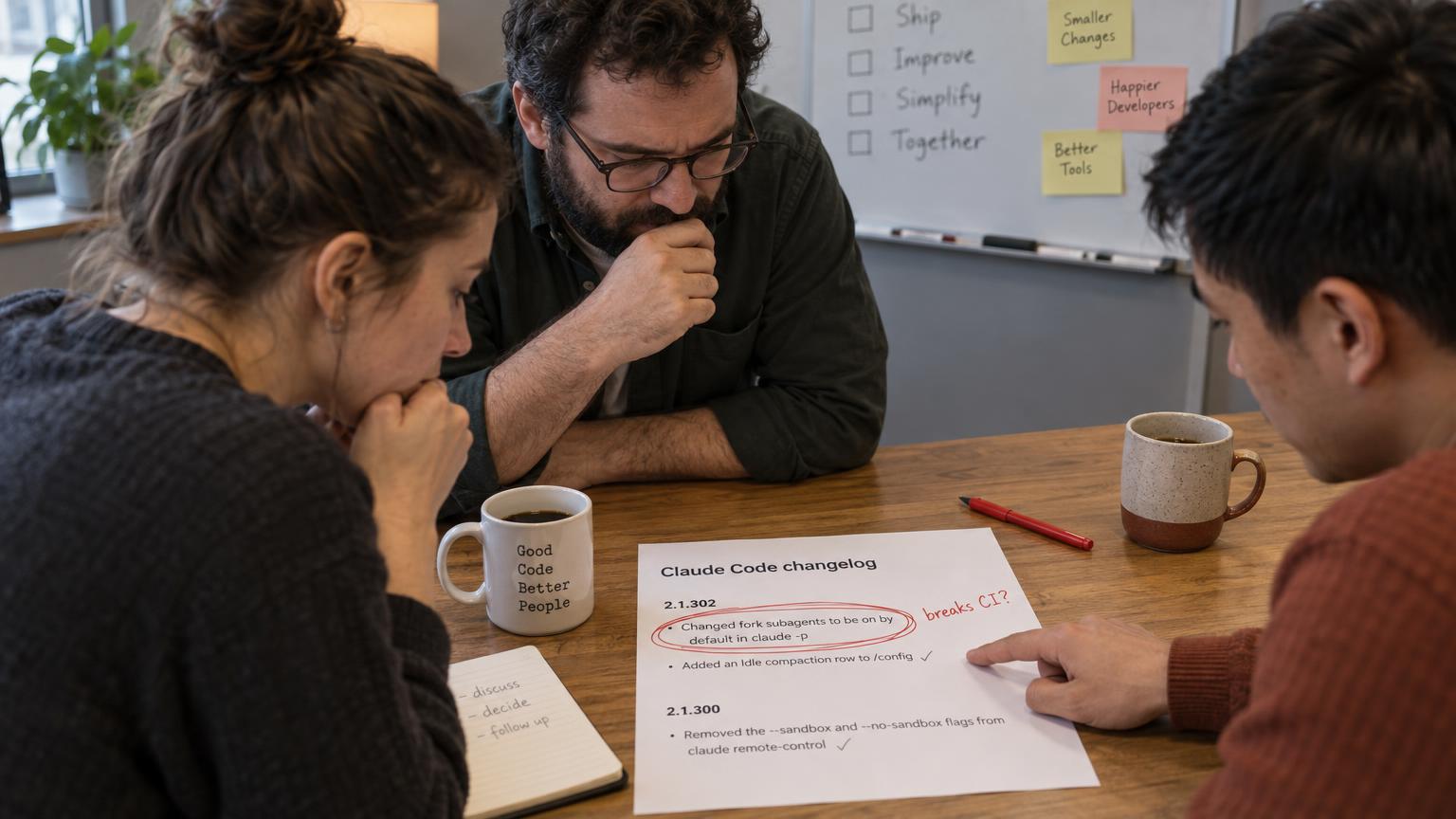
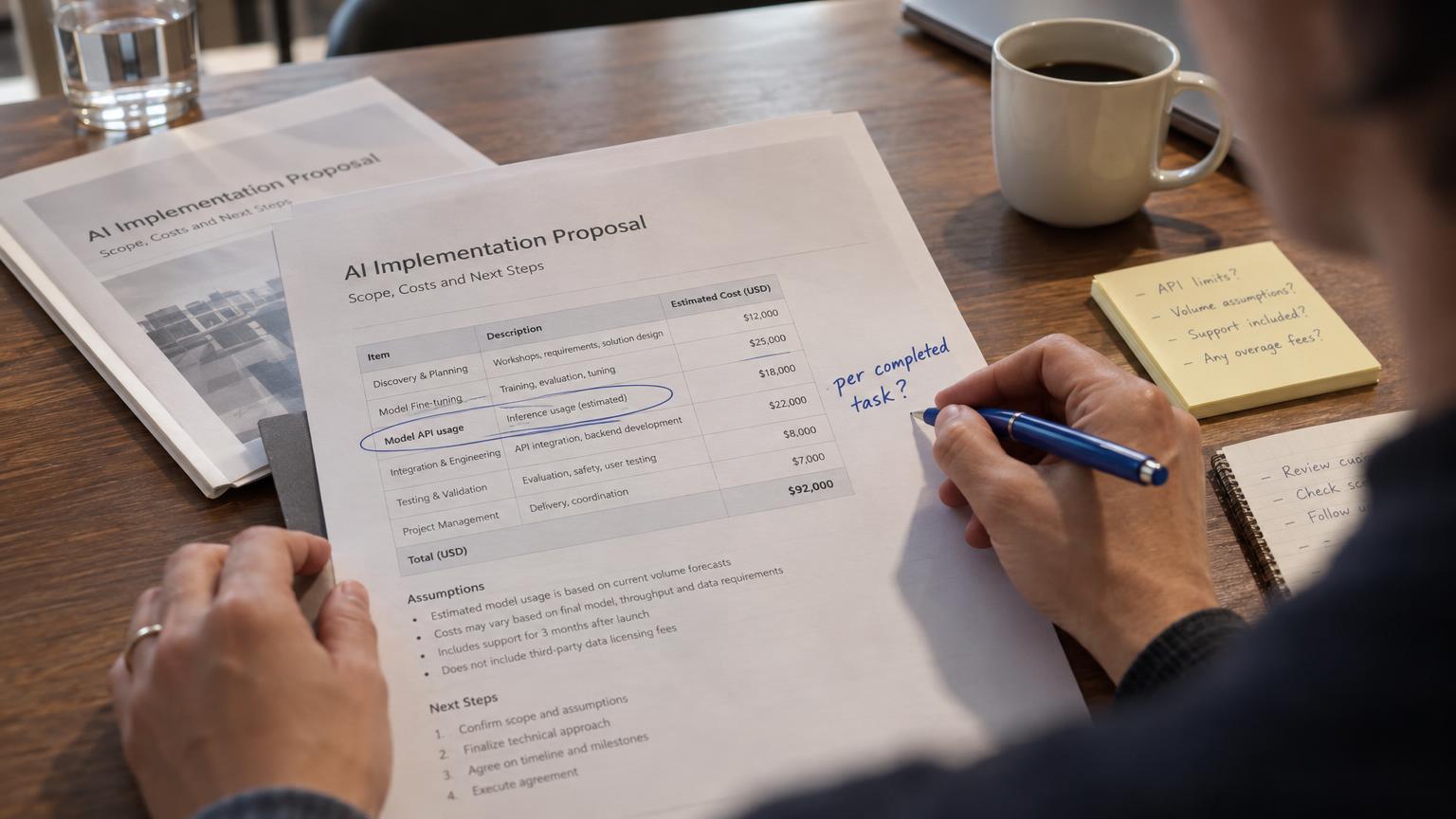
An AI configuration that costs three times as much per model call can cost less than half as much per month. That is not a pricing trick. It is what happens when you count the work the per-call price leaves out.
A demo has to answer one question: can the model respond? Production has to answer several harder ones. Did the feature use the right information? Did it miss a requirement? Did it show a user data they were not allowed to see? Can it recover when a request fails halfway through? And will next month's change break what worked yesterday?
Those questions shape the budget for an AI feature far more than the price of a model API call does. The per-call price is the easiest number to find and the least useful one to plan around. If you are reviewing an AI implementation proposal, the number that matters is what it costs to get one task done correctly, for a real user, every time, and how the team will know when that stops happening.
This article breaks down what actually drives AI implementation cost for products built on existing generative models: knowledge assistants, document generation, and workflow automation, not training foundation models. It covers the work that turns a convincing demo into a feature people can rely on, how to keep that work proportionate to the task, and the arithmetic behind a configuration that costs more per call and less per month.
A working response is not a finished feature
Three illustrative scenarios show the gap. They are composites for explanation, not Advantage Works incidents.

The knowledge assistant. An employee asks about the travel reimbursement policy. The assistant returns a fluent answer with a citation. The cited document is last year's policy, and the answer leaves out the exception that applies to international trips. Nothing errored. The answer was simply wrong in a way that looks right.
The document generator. A team uses AI to draft client reports. The output is polished and well formatted. It is also missing a section the contract requires, and it includes one figure that appears in none of the source files. A reviewer who skims will approve it.
The workflow agent. An agent processes a refund request and reports "done." It updated the wrong customer record. Or a network timeout triggered a retry, and the refund went out twice.
In all three cases, the API call succeeded. The HTTP status was 200, the JSON was valid, the latency was fine. OpenAI's own documentation makes the point directly: model outputs are nondeterministic, and even Structured Outputs can contain mistakes, so a response that matches the schema is not the same as a response that contains correct information (OpenAI, 2025).
So the API working tells you almost nothing. What you have to evaluate is different. Was the answer supported by the right evidence? Did the content meet the requirement? Did the real-world outcome actually happen? Each of those checks has a cost, and that cost is where most of the budget goes.
What actually adds cost: build, operate, change
A useful way to read any AI budget is in three phases. Build is the work to make the feature correct the first time. Operate is the work to keep it correct, fast, and affordable under real load. Change is the work to keep it correct when the data, the requirements, or the model itself moves.
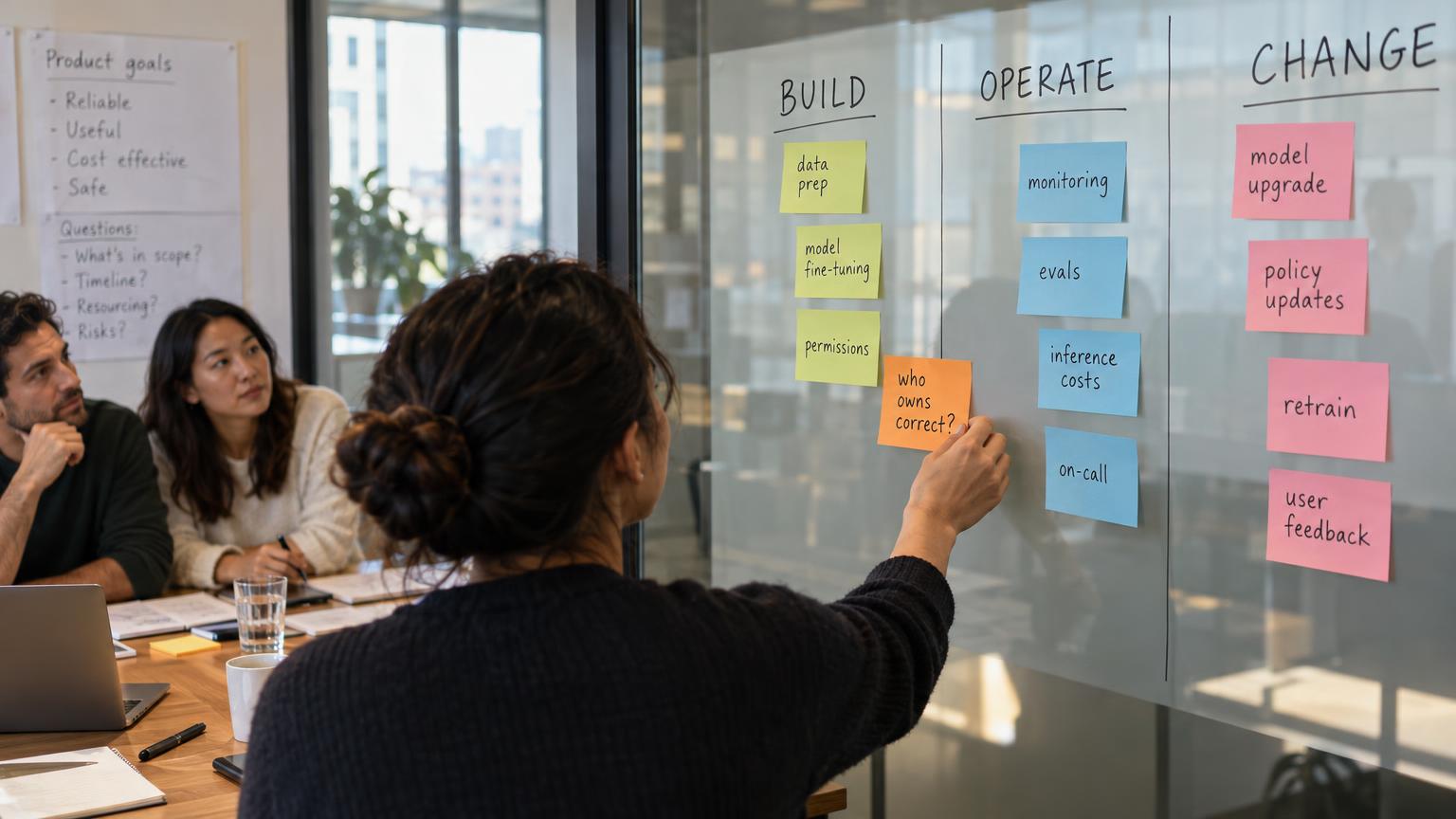
| Cost driver | What it covers | Question to ask the vendor |
|---|---|---|
| Data preparation and retrieval | Getting current, permitted, relevant content to the model | How will you measure whether retrieval finds what the answer needs? |
| Defining acceptable behavior | Required facts, acceptable omissions, refusal conditions, evidence standards | Who owns the definition of a correct answer? |
| Integrations and workflow execution | State, partial failures, confirming an action completed | How does the system know an action actually happened? |
| Security and permissions | Who can see what, what the model is allowed to do | Where is authorization enforced? |
| Production operations | Capacity, monitoring, latency, errors, spend limits | What alerts fire when cost or error rates drift? |
| Evals and QA | Test sets, graders, regression cases | What is the release threshold, and who set it? |
| Ongoing change | Model upgrades, data updates, new requirements | What happens when the model version changes? |
Data preparation and retrieval. Most business AI features depend on retrieving the right content before generating anything. Microsoft's evaluation guidance for retrieval-augmented generation treats retrieval quality as a separate measurement from answer groundedness and completeness (Microsoft, 2025). That separation matters for your budget: a system can retrieve the right policy and still misstate it, or retrieve the wrong one and summarize it perfectly. Google's reference architecture for RAG likewise splits data ingestion, serving, and quality evaluation into distinct subsystems (Google Cloud, 2025). Each is real engineering work.
Defining acceptable behavior. Someone has to write down what a correct answer contains, what it may leave out, when the system should refuse, and what evidence it must show. LangChain's evaluation guidance recommends explicit success criteria and a domain expert who owns quality (LangChain, 2025). This step is cheap in hours and expensive to skip, because every later check depends on it. (It produces a document rather than a demo, which is exactly why it gets postponed.)
Integrations and workflow execution. Once AI takes actions, the system needs to track state, handle a request that fails halfway, and verify that the action completed. "The agent said done" and "the record changed correctly" are different facts.
Security and permissions. OWASP's guidance on excessive agency is blunt: limit the functionality, permissions, and autonomy you give an LLM-based system (OWASP, 2025). The assistant should never retrieve a document the user could not open directly .
Production operations. Capacity, monitoring, latency, error handling, and spend controls all apply, same as for any other service your team runs.
Evals and QA. Every new failure found in testing or production becomes a regression case. Automated scoring needs to be checked against human judgment before anyone trusts it.
Ongoing change. OpenAI notes that model behavior can change between snapshots and model families (OpenAI, 2025). A prompt tuned for one version is not guaranteed to behave the same on the next, so every upgrade needs a re-check.
Security, integrations, and operations are not costs that AI invented. Any production software needs them. The new part is controlling model-driven behavior inside those systems, where the same input can produce different outputs and "success" is a judgment rather than a status code.
Architecture choices multiply usage cost quickly . In Anthropic's June 2025 engineering report on its multi-agent research system, agents used about 4 times the tokens of chat interactions, and multi-agent systems about 15 times (Anthropic, 2025). Those figures describe the workloads Anthropic observed. They are not universal multipliers or dollar ratios. The practical takeaway still holds: before estimating usage cost, count the calls, searches, checks, retries, and review steps that one completed task needs.
Stability is more than uptime
Every driver above exists to keep one promise: the feature keeps working. But "working" hides three different questions. When a vendor says a feature is "stable," ask which kind of stability they mean.
Functional stability is whether the feature does the job. Measure task success rate, coverage of required information, the share of claims supported by a source, and consistency across repeated runs of the same task.
Operational stability is whether the feature runs reliably. Measure error rate, completion rate, recovery from partial failures, and p95 latency (the time within which 95 percent of requests finish). A feature with a fast average and a slow p95 will feel broken to a meaningful share of users.
Economic stability is whether the cost of delivering the outcome stays predictable. Measure cost per completed task, tool calls per task, retry frequency, and human review time per task.
Two clarifications save a lot of wasted effort. First, different wording across runs is not instability. If two answers phrase the same correct facts differently, the feature is behaving fine. Second, an agent reporting "done" is not a verified outcome. Anthropic's guidance on evaluating agents recommends checking the actual end state and running repeated trials, because a single pass hides variance (Anthropic, 2026).
A worked example: cost per completed task
Here is the configuration from the top of this article, the one that costs three times as much per call, worked through. The numbers are illustrative assumptions, not market pricing and not Advantage Works results. They exist to show the arithmetic.

Assume a feature handles 10,000 tasks per month. When an output is wrong, a person spends 5 minutes correcting it, at $30 per hour, so each correction costs $2.50. Both configurations eventually succeed on every task, so the only difference is how often a human has to step in.
| Configuration A | Configuration B | |
|---|---|---|
| Model cost per task | $0.02 | $0.06 |
| Monthly model cost | $200 | $600 |
| Share of tasks needing correction | 10% (1,000 tasks) | 2% (200 tasks) |
| Monthly correction cost | $2,500 | $500 |
| Combined monthly cost | $2,700 | $1,100 |
Configuration B costs three times as much per model call and less than half as much per month once corrections are counted.
This is a partial view. It excludes development, retrieval infrastructure, eval infrastructure, routine review, and other operations. And the correction rates are assumptions. In a real project they have to be measured, not guessed.
The lesson fits in one line: optimize cost per successfully completed task , not cost per generated response. Evals are what give you the evidence to compare A and B. They do not make either configuration better. They tell you which one is.
Why evals should be a mandatory delivery standard
That comparison only works if someone measured the correction rates. That is the job of an eval: a repeatable check on representative tasks. It can be scored by code, by a model, by human judgment, or by a mix. Asking another LLM whether an answer "was good" does not count on its own.
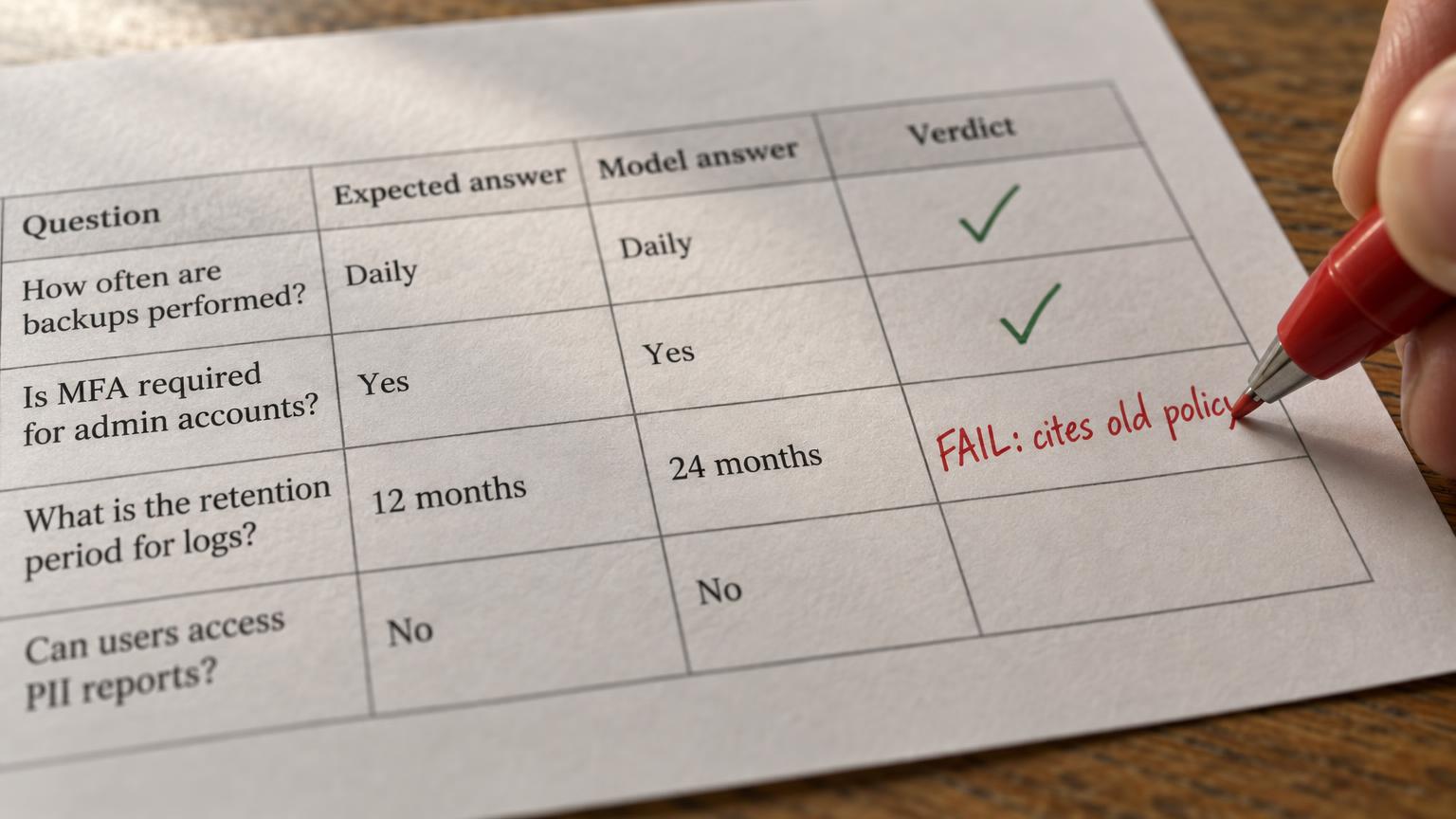
The principle is simple: a production AI feature is not complete until the team can show what acceptable performance means, measure it, and detect when it regresses. That is an engineering standard, like requiring tests before a release. It does not mean buying a heavyweight evaluation platform for every experiment.
Three layers are worth keeping distinct:
- Pre-release evals run against a fixed dataset before each change ships.
- Runtime safeguards check or block outputs inline, while the user waits.
- Production evaluation and monitoring score samples of live traffic and watch for drift.
LangSmith's documentation draws the same lines between offline and online evaluation, and between evaluators and inline guardrails (LangChain, 2025).
A proportionate setup has three parts.
A trustworthy dataset. Use real tasks, known failures, and reviewed examples. Historical outputs are not automatically correct references, because some of them were wrong. Anthropic suggests that 20 to 50 tasks is a reasonable initial eval set in early agent development (Anthropic, 2026). A set that size finds big problems. It is not proof that rare failures cannot happen.
The right grader for each requirement. Use code for objective checks: a required field is present, a figure matches the source, the right record was updated. Use model-based grading for meaning, and calibrate it against human judgment, because judges can be wrong. OpenAI's evaluation guidance recommends task-specific evals, representative datasets, human calibration, and continuous evaluation, and it warns against relying on informal, vibe-based checks before shipping (OpenAI, 2025).
A release decision. Set quality, latency, and cost thresholds before the eval runs, not after you see the results. Track critical failures separately, so a high average cannot hide one dangerous answer. Authorization is enforced by the application, not by an eval score.
A real example makes the distinction concrete. On the Knowledge Base project at Advantage Works, the team kept functional smoke tests separate from a retrieval-evaluation dataset prepared for peer review. The smoke tests answered one question: does the endpoint respond? The retrieval dataset answered a different one: does the system retrieve what is needed to answer correctly? Treating those as separate acceptance criteria meant a working endpoint could not be mistaken for a working feature.
Evals reduce uncertainty. They do not replace security controls, tests, or production monitoring .
Controlling cost without removing the checks
Evals have a cost of their own, which tempts teams to trim them first. That is the wrong place to cut. Once you can measure cost per completed task, you can cut cost without cutting quality.
Simplify the workflow first. Use deterministic code for deterministic rules. If a discount applies above a fixed threshold, write an if-statement, not a prompt. Use a fixed workflow instead of an agent when a fixed sequence of steps is enough. Anthropic's guidance on building agents recommends starting with the simplest solution and adding agentic complexity only when the benefit justifies the extra cost and latency (Anthropic, 2024).
Measure before choosing a cheaper model. OpenAI's cost guidance is to make fewer requests, use fewer tokens, and use smaller models where accuracy holds (OpenAI, 2025). The phrase "where accuracy holds" is doing the work. You only know it holds if you ran the eval.
Match validation effort to risk and timing. Enforce inline where a wrong output causes real harm, such as permissions or payments. Sample and review asynchronously where the risk is lower. Run non-urgent eval jobs in batch: OpenAI's Batch API is currently advertised at a 50 percent discount with a 24-hour completion window (OpenAI, 2025).
The rule of thumb: remove unnecessary work, not evidence of quality.
What to ask before you sign an AI proposal
Before you approve an AI implementation budget, ask the team or vendor five questions:
- What does a successful task look like, in writing?
- How will quality be measured before launch, and who owns that definition?
- What does one completed task cost, including corrections and human review?
- What happens when a request fails halfway through?
- How will we detect a regression after a model or data change?
A proposal that can answer those questions is pricing the feature. One that cannot is pricing the demo.
At Advantage Works, we treat AI implementation as a measurable product-engineering problem: define the outcome, connect the right data and systems, evaluate the behavior, and control the cost of delivering it.
Planning an AI feature? Start by defining what a successful task looks like, and how you will measure quality, operating cost, and failure recovery before launch. Book a free AI Readiness Snapshot to map it out with our team.