
The phrase "AI agent development solutions" hides a decision most vendors would rather you did not notice. Behind those four words sit three very different paths - build the capability in-house, buy a platform, or hire a partner - and each one commits you to a different mix of cost, control, and time-to-value. Pick wrong and you get the familiar result: an agent that dazzles in a demo, then stalls the moment it meets real data, real edge cases, and a real budget.
This is a definition-first explainer, but it is built around that decision. First it lays out what an agent solution actually is: the parts, the lifecycle, the failure modes. Then it gives you the honest build-versus-buy-versus-partner frame the rest of the market skips. By the end you should be able to describe an agent solution in plain terms and know which delivery model fits your constraints, so your next project ships to production instead of dying in a slide deck.
The short answer: what "AI agent development solutions" means
An AI agent development solution is the full set of software, infrastructure, and practices used to build, run, and maintain AI agents - systems that use a language model to plan and complete multi-step tasks by calling tools, keeping state, and acting with limited autonomy under guardrails. You do not buy it off a shelf. You assemble it.
That capability usually arrives through one of three delivery models:
- Build in-house: your own engineers assemble agents from models, frameworks, and infrastructure you operate.
- Buy a platform: a managed cloud service handles orchestration, tools, and scaling, and you configure agents on top of it.
- Hire a partner: an external team designs and delivers the agents, with or without handing the keys back to you.
Everything that follows is about choosing well between those three, and building whichever you choose so it survives contact with production. Start with the piece everyone assumes they already understand: the agent itself.
What an AI agent is, and what it is not
An AI agent is a program that pursues a goal across several steps, deciding along the way which actions to take. The language model is the reasoning core, but the agent is the whole loop around it: read the goal, plan a step, call a tool, observe the result, decide what to do next, and repeat until the task is done or a guardrail stops it.
That loop is what separates an agent from the three things people confuse it with.
Agent versus chatbot, RPA, and a bare model call
A chatbot answers. Ask it a question and it returns text. It takes no actions in other systems , and it carries no task forward on its own.
Robotic process automation (RPA) follows a fixed script. It clicks the same buttons in the same order every time, and it breaks when the screen changes. Deterministic and brittle by design.
A single model call is one request and one response. Useful, but it remembers nothing about the last step and cannot run the next one.
An agent sits above all three. It decides what to do, uses tools to do it, remembers what happened, and keeps going until the job is finished. A support agent does not just draft a reply. It looks up the order, checks the refund policy, issues the credit, and logs the case.
What "agentic" actually adds
The word "agentic" points to four capabilities layered on top of a language model:
- Planning: breaking a goal into steps and adjusting the plan as results come in.
- Tool use: calling APIs, databases, search, and code so the agent can act, not just talk. This often runs over function calling or a protocol like the Model Context Protocol (MCP), a standard way to expose tools and data to models.
- Memory: holding context within a task and, when needed, across sessions, frequently backed by retrieval-augmented generation (RAG), where the agent pulls relevant documents into context instead of leaning on the model's training alone.
- Bounded autonomy: acting on its own within limits you set, with a human in the loop for the decisions that carry real risk.
Strip these away and you are back to a chatbot. Add them carelessly and you get an expensive system nobody can trust. The rest of this article is about adding them well, starting with the parts every real agent is made from.
The anatomy of an agent solution
Every production agent, whoever builds it, is assembled from the same building blocks. Knowing them is what lets you read a vendor pitch or a project plan and spot what is missing.

- Model: the language model that reasons and generates. Bigger is not always better, and many tasks run cheaper and faster on a smaller model.
- Instructions and policy: the system prompt, rules, and constraints that define the agent's job, tone, and hard limits on what it may and may not do.
- Tools and function calling: the connections to the outside world - APIs, databases, search, code execution - that let the agent take action.
- Memory and state: short-term context for the current task and, where the use case needs it, longer-term stores plus RAG for grounding answers in your own data.
- Orchestration: the control loop that decides the order of steps, handles retries, and, in multi-agent designs, routes work between agents.
- Guardrails: input and output filters, permission checks, spending caps, and human approval gates that keep the agent inside safe bounds.
- Observability: logging, tracing, and dashboards that show what the agent did, why, and at what cost, step by step.
- Evaluation: test sets and scoring that measure whether the agent actually completes tasks correctly before and after you ship changes.
Here is the split that matters. The first four blocks get an agent working in a demo. The last four - orchestration, guardrails, observability, evaluation - are what make it safe to run in production. Solutions that skimp on the second half are the ones that stall.
What AI agent development looks like end to end
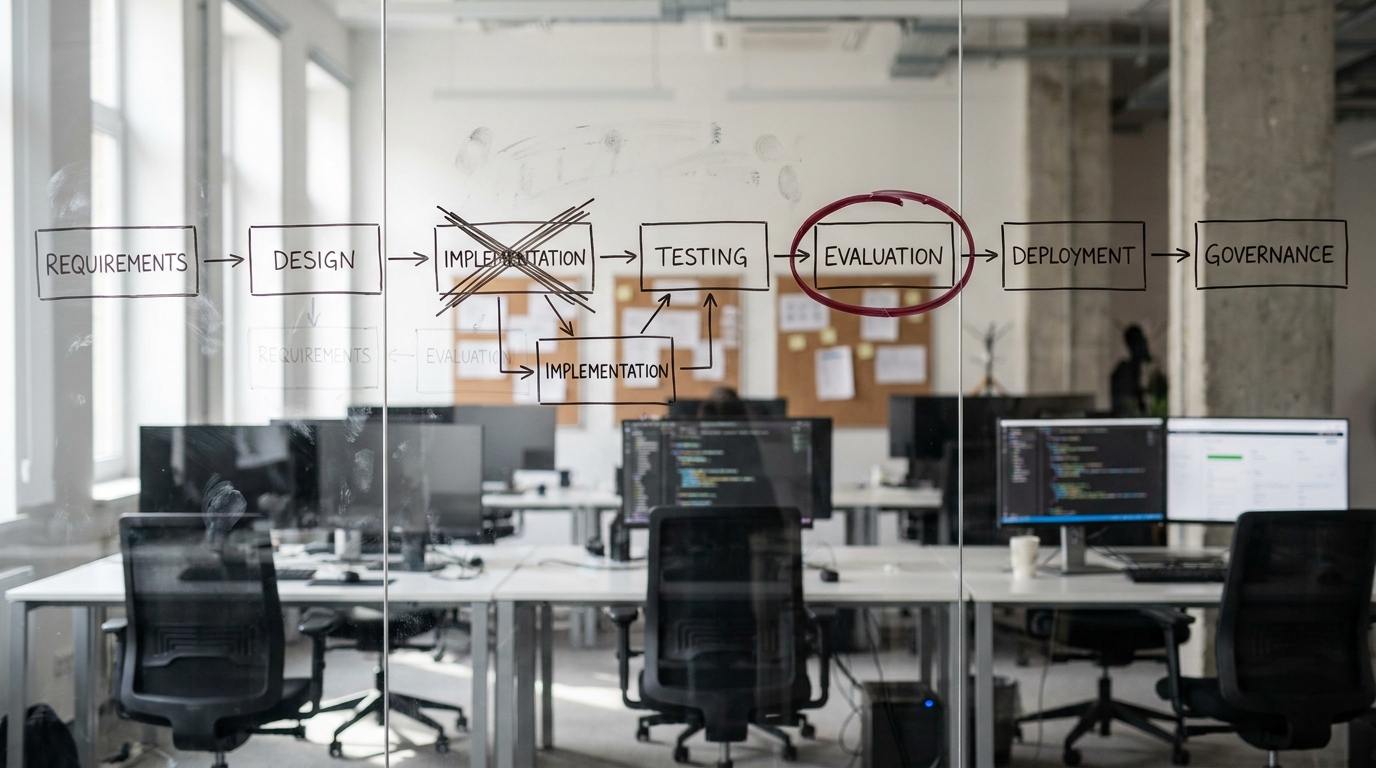
AI agent development is a lifecycle, not a one-time build. Skipping stages is the most common way a promising pilot fails to become a dependable system. A realistic version looks like this:
- Use-case selection: pick a narrow, valuable, well-bounded workflow. Good looks like a task with clear success criteria and tolerable failure costs. Bad is "automate everything."
- Design: define the agent's goal, the tools it needs, the data it touches, and the guardrails. Decide up front where a human stays in the loop.
- Data and tool integration: connect the APIs, databases, and knowledge sources. This is usually the largest and least glamorous chunk of the work.
- Build: assemble the agent, its instructions, and its orchestration. Start with the simplest design that could work before adding agents or steps.
- Evaluate: run the agent against a test set of real tasks and score it. Good looks like measurable task completion, not a handful of impressive one-off runs.
- Deploy: release behind guardrails, often to a limited audience or with human approval on consequential actions.
- Monitor and iterate: watch traces, cost, and error rates in production, then tighten prompts, tools, and limits. Agents drift as data and usage change, so this stage never really ends.
Notice how little of the lifecycle is model work. Integration, evaluation, and monitoring are where solutions are won or lost, and they are exactly what a demo hides. Which brings you to the decision that shapes all of it.
Build, buy, or partner: choosing a delivery model
This is the decision the phrase "agent development solutions" is really asking you to make. There is no universally right answer, only a right fit for your constraints: how much AI talent you have, how fast you need value, how much control you require, and how you want your costs shaped.
Build in-house
You assemble agents yourself from models, frameworks, and infrastructure you operate.
- Best for: teams with real ML and platform talent, a need for deep control, and workflows tied closely to proprietary systems.
- Tradeoffs: maximum control and no per-seat platform markup, paid for with the slowest time-to-value and a heavy, ongoing talent load. You own every failure mode.
- Not for: teams without in-house AI engineers or the appetite to hire and retain them.
Buy a platform
A managed cloud service provides orchestration, tool integration, scaling, and often guardrails, and you configure agents on top.
- Best for: teams that want speed and a supported path, and whose use cases fit standard patterns.
- Tradeoffs: fastest time-to-value and less infrastructure to operate, traded against platform constraints, ongoing usage costs, and a degree of lock-in to that vendor's way of doing things.
- Not for: highly unusual workflows the platform cannot express, or organizations that cannot send the relevant data to that cloud.
Hire a partner
An external team designs and delivers the agents, ideally teaching your people along the way.
- Best for: teams that need production agents now but lack the in-house capacity to build them, or want to move fast without a permanent hiring commitment.
- Tradeoffs: you get experienced delivery and speed without carrying the full team cost, in exchange for coordination overhead and the need to plan knowledge transfer so you are not dependent forever.
- Not for: teams that already have strong AI engineering in place, or work so sensitive that no external party can touch it.
Most organizations end up blending these. A common pattern is to buy a platform for the plumbing, partner to get the first agents into production and upskill the team, then gradually build more in-house as capability grows. If the honest read on your constraints is "we have the mandate but not the team," a Fractional Agentic Team gives you senior agent builders on demand without a full hiring cycle.
Single-agent versus multi-agent systems
Not every problem needs a committee of agents. One well-scoped agent with good tools handles a surprising range of tasks, and it is far easier to debug, secure, and afford.
Reach for a multi-agent system only when the work genuinely splits into distinct roles or the context outgrows what a single agent can hold. A typical shape is an orchestrator that decomposes a task and hands sub-tasks to specialist agents - one for research, one for drafting, one for review - then assembles the result. Vendors including OpenAI, Anthropic, and Google describe orchestrator-and-specialist patterns like this in their own agent guidance.
The cost of multi-agent designs is real: more moving parts, more places to fail , more latency, and more spend as agents call each other. The rule of thumb that keeps solutions sane is to start with one agent, prove it, and add agents only when a specific limitation forces the issue.
The tooling and platform landscape
The market has organized itself into a few categories. Treat them as categories, not a ranking, and match the tool to the job rather than the loudest brand.
- Managed cloud agent platforms: services like Amazon Bedrock AgentCore, Microsoft Azure AI Foundry Agent Service, and Google Vertex AI Agent Builder handle orchestration, tool integration, memory, and scaling so your team configures rather than operates the plumbing. Good for teams that chose "buy."
- Code-first agent frameworks and kits: tools like Google's Agent Development Kit and open-source frameworks give engineers direct, programmatic control over agent logic. Good for teams that chose "build" and want to own the internals.
- Model-provider guidance and primitives: providers such as OpenAI and Anthropic publish practical patterns, plus the function-calling and protocol primitives (including MCP) that most agents are built on. Useful whichever model you standardize on.
The point is not which vendor wins. Your delivery-model choice narrows the tooling category, and the category narrows the shortlist . Decide build-buy-partner first, and the tooling question gets much smaller.
Where AI agents create the most value
Agents pay off fastest on workflows that are repetitive, multi-step, and bounded by clear rules. A few areas where teams are seeing real traction:
- Customer support: an agent that reads a ticket, pulls the customer's history, applies policy, resolves routine cases end to end, and escalates the rest with a clean summary.
- IT and cloud operations: an agent that triages alerts, runs standard diagnostics, and either remediates known issues or hands engineers a fully-scoped incident.
- Software delivery: agents that draft code, write tests, review diffs, and open pull requests, with human approval before anything merges.
- Sales and revenue operations: an agent that researches accounts, keeps CRM records current, drafts tailored outreach, and preps briefs before calls.
- Finance and back office: an agent that matches invoices, flags anomalies, and prepares reconciliations for a human to approve.
The pattern across all of them is the same. The agent handles the high-volume, rule-bound middle of the work, and a human owns the judgment calls at the edges. That division is where the value sits, and it is also what keeps the system safe. It also explains why so many agents that look impressive never make it that far.
Why agents fail in production, and how good solutions prevent it
The gap between a demo and a dependable system is a short list of well-understood failure modes. Good agent development solutions design against every one of them from the start.

- Infinite loops: an agent retries the same failing step forever. Prevented with step limits, loop detection, and timeouts.
- Hallucinated tool calls: the agent invents an action or supplies bad arguments. Prevented with strict tool schemas, input validation, and confirmation on high-stakes actions.
- No observability: when something goes wrong, nobody can see why. Prevented with step-level tracing and logging built in from day one, not bolted on after an incident.
- Unbounded cost: token and API usage spiral quietly. Prevented with per-task and per-day spending caps, smaller models where they suffice, and cost dashboards.
- Stale knowledge: the agent answers from outdated data. Prevented with RAG against current sources and a plan to refresh them.
- No human in the loop: the agent takes a consequential action nobody reviewed. Prevented with approval gates on anything that moves money, touches customers, or changes production.
Read that list again and notice it maps almost one-to-one onto the "second half" building blocks - orchestration, guardrails, observability, evaluation. Failure in production is nearly always a failure to invest in those four. When you evaluate any solution, built or bought or delivered by a partner, ask specifically how it handles each item above. Vague answers are the tell.
The eight criteria that predict whether an agent reaches production
Vendor portfolios are a weak signal. Demos are cheap and every shop has a reel. Evaluation sets are expensive, which is exactly why asking about one separates the two kinds of vendor in a single question. Score any shortlist on these eight, and pay attention to the weak-answer column — it is the useful half.
- Evaluation harness. Strong: "We build a test set of real cases with expected outcomes before we write agent code, and we report against it." Weak: "We test thoroughly before release."
- Integration depth. Strong: "We have written against this CRM's API, and here is what its rate limits do to a retry loop." Weak: "We integrate with all major platforms."
- Human-in-the-loop design. Strong: "The agent stops and asks when confidence drops below the threshold you set, and here is where that boundary sits." Weak: "There's always a human in the loop."
- Observability. Strong: "Every tool call, input, output, and cost is logged from day one, and you get the dashboard." Weak: "We monitor performance."
- Failure handling. Strong: "When a tool call fails twice the agent escalates with the partial state attached, rather than guessing." Weak: "We handle errors gracefully."
- Model portability. Strong: "The prompts and tool definitions are separated from the model client, so swapping takes a day of re-evaluation." Weak: "We use the best model available."
- Ownership and handover. Strong: "You get the repository, the prompts, the evaluation sets, and a runbook." Weak: "We maintain everything for you."
- Post-launch model. Strong: "Here is the month-four operating cost and who does the work." Weak: "Support is included."
Two notes on using this. A vendor who answers the left column fluently has run engagements to production before, because those answers are expensive to fake. And if every criterion happens to map neatly onto one vendor's product strengths, you are reading marketing dressed as evaluation. Run the same eight past all three shortlisted vendors in the same week; the variance in the answers will usually be wider than the variance in their prices.
What the vendor should be asking you
Every buyer guide publishes questions to ask vendors. The more diagnostic list runs the other way. A partner who does not ask these is going to build something plausible and wrong.
- What does this workflow cost you today, in hours or in dollars? A vendor who never asks cannot tell you whether the agent is worth building.
- Who currently does this work, and what happens to their time afterwards? The answer determines whether anyone will adopt the thing.
- What does success look like as a number, and how often will we check it?
- What data does the agent need, who owns it, and can we get read access in week one? If access takes six weeks, the timeline is six weeks longer and everyone should know that on day one.
- What is an acceptable failure rate, and what should happen on a bad output?
- Who inside your company owns this after launch?
- What have you already tried that did not work?
One useful test costs nothing. Describe an ambiguous case from your workflow, the kind your own staff argue about, and ask how the agent would handle it. Vendors who have shipped will talk about escalation and confidence thresholds. Vendors who have not will talk about prompt quality.
Warning signs a build is going sideways
Quiet degradation after launch is the second-worst outcome. The worst is a build that never launches at all, and it announces itself early if you know the tells. All of these are visible from the buyer's chair, without reading any code.
- Week four and there is still no evaluation set. The highest-signal warning on this list. Recovery: stop feature work, build the set from twenty real cases, accept a week of delay.
- Demos always use the same three inputs. Ask for a live run on a case you supply. If the request causes visible discomfort, you have learned something.
- The agent has no defined stopping condition. Nobody can tell you when it hands back to a human. That is a design gap, not a tuning issue.
- Nobody on your side can explain what the agent does at a decision point. If your own team cannot narrate the logic, they cannot defend it when it errs, and they will stop using it after the first bad outcome.
- Scope has grown to a second workflow before the first reaches production. Almost always a sign the first one is stuck and expansion is being used to change the subject.
- The conversation has become about frameworks. You ask about outcomes and hear about orchestration libraries. The mismatch is the finding.
The recovery move is the same in nearly every case: narrow scope to one workflow, force an evaluation set into existence, and put a real user in front of the agent within two weeks . Projects that do this recover. Projects that add scope instead do not.
Contracts, IP, and getting out
Short section, high stakes, and almost entirely absent from other guides on this topic.
Name the deliverables explicitly. The source code is obvious. The parts people forget are the prompts, the tool definitions, the evaluation sets, and any fine-tuned artifacts. Those hold most of the accumulated knowledge in an agent build, and a contract that transfers "the software" may not transfer them.
Say where the data lives, who can access it during the engagement, and what happens to it at the end. If the vendor's evaluation infrastructure holds copies of your production data, that needs to be written down.
Establish that you can take the system to another partner. Ask whether the agent runs on anything proprietary to the vendor. A dependency on a vendor-hosted orchestration layer is fine if you know about it and expensive if you find out during a transition.
Ask for a transition-out clause with a defined notice period and a documented handover. Vendors who intend to earn renewals agree to this readily. The reaction to the question is informative whatever the answer turns out to be.
How to measure success, and how to start
You cannot manage what you do not instrument, and "it feels smarter" is not a metric. Decide what success means before you build, and label every number honestly as a measured range or an estimate rather than false precision.
Instrument at least these:
- Task completion rate: the share of tasks the agent finishes correctly without human rescue.
- Escalation rate: how often it hands off to a person, and whether that trend is improving.
- Cost per task: total model and tool spend divided by tasks completed, watched over time.
- Latency: how long a task takes end to end, since a correct answer that arrives too late still fails the user.
- Human-review load: the time people spend checking or correcting the agent's work.
To get started without betting the company, keep the first project deliberately small:
- Pick one narrow, high-volume workflow with clear success criteria.
- Keep a human in the loop from day one and design the approval gates in.
- Instrument the metrics above before launch, not after.
- Ship to a limited audience, watch the traces, and tighten.
- Expand scope only once the numbers hold.
If you would rather pressure-test that plan before committing engineering time, get an AI Readiness Snapshot - a short call to sanity-check the use case, the delivery model, and what to measure. Teams weighing a broader rollout can book a Discovery Sprint to map the roadmap and organizational readiness first.
Key takeaways
- "AI agent development solutions" is not one product. It is a capability delivered through three models: build in-house, buy a platform, or hire a partner.
- Every agent is assembled from the same parts. The half that gets skipped - orchestration, guardrails, observability, evaluation - is exactly what separates a demo from production.
- Choose your delivery model from your real constraints: talent, time-to-value, control, and cost shape. Most teams end up blending all three.
- Start with a single agent on one narrow workflow, keep a human in the loop, and add agents or scope only when the metrics justify it.
- Instrument task completion, escalation, cost per task, latency, and review load from day one, and label every figure as a range or estimate.
The organizations that win with agents are not the ones with the flashiest demo. They are the ones that matched the solution to their constraints, started narrow, and instrumented from the first day. Define the job, pick the delivery model that fits, and build against the failure modes on purpose. That is what turns an AI agent from a slide into a system.
- Score vendors on eight criteria, not portfolios: evaluation harness, integration depth, human-in-the-loop design, observability, failure handling, model portability, ownership and handover, post-launch model. The weak-answer column is the diagnostic half.
- Watch what the vendor asks you. A partner who never asks what the workflow costs today, or who owns it after launch, will build something plausible and wrong.
- Name prompts, tool definitions, and evaluation sets as deliverables in the contract. A clause transferring "the software" may not transfer the parts that hold the accumulated knowledge.