
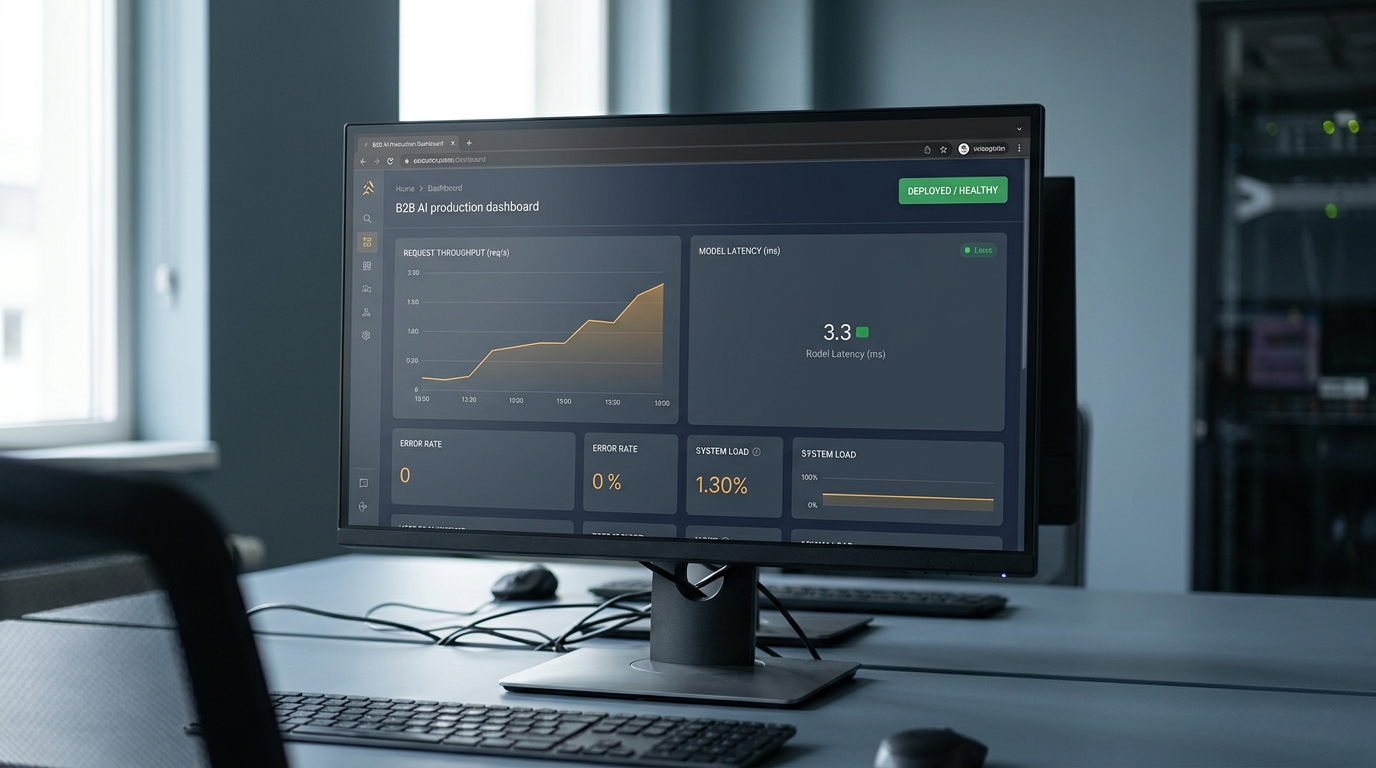
The advice sells. The system rarely gets built. That is the quiet pattern under most AI consulting, and it is why a budget approved once so often gets spent twice - first on the strategy that ends at a slideshow, then on the rebuild when the pilot never reaches a real user.
AI consulting, in plain terms, is outside help that takes a business from "we think AI could pay off here" to a system that runs in production and moves a real metric. Done well, it covers the whole path: finding where AI actually earns its keep, building the model or workflow, wiring it into your stack, and getting your team to trust and run it. Done badly, it stops at the slideshow. And the slideshow is where the money quietly leaves the building.
If you are reading this, one of three things is probably true. A pilot stalled and never reached real users. A roadmap exists on paper but nobody can say what ships first. Or leadership has started asking for return numbers instead of experiments. This page is about closing those gaps with senior delivery you can measure, and it answers the practical questions along the way: what an AI consultant does, how engagements work, what they cost, and how long they take. The through-line is simple. Everything here is built to get a system into production and to prove it moved a number you agreed on before the work started.
What AI consulting actually gets you
Skip the abstractions. Here is what a good AI consulting engagement should leave behind, whether the label on the invoice says strategy, implementation, or both:
- A prioritized use-case map. A short, ranked list of where AI will pay off first in your business, scored on value and feasibility, so you are not chasing the flashiest idea instead of the profitable one. The map matters because most teams do not fail for lack of ideas. They fail by starting with the wrong one and burning their first budget before they learn anything.
- A shipped pilot. One real workflow running against real data, not a sandbox demo. Something a team can use on Monday, with its accuracy and its limits stated out loud so nobody mistakes a promising prototype for a finished product.
- An integration and rollout plan. How the pilot becomes a production system inside your existing tools, with the data plumbing and access controls named, not hand-waved. This is the deliverable competitors most often skip, and it is the one that decides whether the pilot ever earns anything.
- Team enablement. The people who own the workflow after handoff know how to run it, extend it, and spot when it drifts. A model that only the vendor understands is a dependency, not a capability.
- Governance guardrails. Clear rules for data handling, model behavior, and human review, so the system passes legal and security before it passes to production. In regulated industries this is not paperwork. It is the difference between launching and being blocked at the last gate.
An AI consultant, then, is not one role but a small set of them working together. A strategy lead finds and sequences the opportunities. A data and machine learning engineer builds the model or the agentic workflow. An integration engineer connects it to your systems. And someone owns change management, because a tool nobody adopts returns nothing. The strongest engagements put those hats on the same senior team rather than handing you off from a strategist to a bench of juniors. When the roles are split across people who never spoke before the kickoff, the seams between them become the places the work falls apart.
AI consulting versus AI implementation
These two terms get used interchangeably, and the blur is expensive. Knowing the difference is the first filter when you compare firms, because it tells you exactly what you are paying for: a decision, a system, or both.
AI consulting is the broader activity. It includes the thinking work: where to apply AI, whether your data is ready, what the business case looks like, and how to sequence a program. A consulting-only engagement can end with a roadmap and no code. That is fine when you have a strong internal build team who only needed direction. It is a trap when you assumed the deck came with delivery and it did not.
AI implementation is the building work: the model, the pipelines, the integration , the deployment. An implementation-only engagement assumes someone else already decided what to build, and that the decision was correct. When the underlying strategy was thin, implementation just gets you to a working version of the wrong thing faster.
The failure pattern is predictable. Those two get split across vendors. The strategy firm hands over a deck, the implementation shop reads it differently, and the seams between them are exactly where projects stall. Each side can honestly say it did its job while the outcome never arrives. That is why our engagements keep strategy and build on one senior team. The people who decide what to ship are the people who ship it, which removes the most common handoff, the one where momentum dies and accountability quietly evaporates.
Who this is for - and who it is not
Honest fit beats a bigger pipeline. This kind of senior, delivery-focused AI consulting works best for some teams and poorly for others, and saying so up front saves everyone a wasted engagement.
Best for:
- Mid-market and enterprise teams with a real use case and an executive sponsor who wants an outcome, not a science project. Sponsorship matters because production systems cross department lines, and the crossings need someone with the authority to clear them.
- Organizations sitting on a stalled or failed pilot that need someone to get it to production or honestly kill it. A clear no is cheaper than a slow maybe.
- Teams that cannot hire senior AI talent fast enough and do not want the risk of a permanent bench for a program that is still proving itself.
Not for:
- Pure research labs chasing novel model architecture rather than business results. That is important work, but it is not what a delivery partner is built to do.
- Buyers who want a resold, off-the-shelf tool with a logo on it, not a system built around their workflow. If a product already solves your problem, buy the product.
- Anyone pursuing "AI for AI's sake" with no metric it is meant to move. Without a target, there is no way to tell success from motion.
If your project fits the second list, a delivery partner is the wrong spend, and a good one will tell you so on the first call rather than sell you an engagement that cannot succeed on its own terms.
Our AI consulting and implementation services
Everything below is delivered by the same senior team. Under each capability is the concrete thing that actually ships, not a promise of transformation.

- AI strategy and use-case prioritization. You get a ranked use-case map and a business case for the top one or two, scored on value and feasibility. The deliverable is a decision, not a workshop. We look for the use case with real value and a data path that already exists, because that combination is what ships inside a quarter instead of stalling for a year.
- Data readiness and machine learning build. We assess whether your data can support the use case, fix what blocks it, and build the model or pipeline. The output is a working model against your data with its accuracy and limits stated plainly, so you know where to trust it and where to keep a human in the loop.
- Generative and agentic AI implementation. Where the use case calls for it, we build the LLM workflow or the multi-step agent that does the task end to end, with the guardrails that keep it inside its lane. Agentic systems are powerful and easy to get wrong, so we scope them tightly and instrument them heavily before they touch anything that matters.
- Systems integration. The pilot gets wired into the tools your team already uses - the CRM, the data warehouse, the internal apps - so the output lands where work happens instead of in a demo tab. Integration is usually the largest chunk of real effort, and pretending otherwise is how timelines slip.
- Governance and responsible-AI guardrails. Data handling rules, human-in-the-loop checkpoints, and monitoring so the system clears security and compliance review. We build these in from the first phase rather than retrofitting them under deadline pressure, because a system that cannot pass review cannot go live.
- Team training and enablement. The owners learn to run and extend the workflow, with documentation and a short handover so the capability stays after we leave. The goal is to make ourselves optional on the first use case, so you can decide, on evidence, whether to bring us back for the next one.
How we deliver - our process and phases
A clear process is the difference between a program that ships and one that drifts. Ours runs in five phases, and the first two are deliberately small and fast so you can judge us before you commit real budget.

- AI Readiness Snapshot. A free 30-minute call to pressure-test the use case, the data, and the sponsorship. You leave knowing whether this is worth doing, even if the answer is not yet. Most of the value is the honesty. We would rather tell you the timing is wrong than take a project that was going to stall.
- Discovery sprint to roadmap. A focused one-week sprint that turns the idea into a prioritized use-case map and a concrete build plan, with the first pilot scoped and a business metric agreed up front. This is where the vague becomes specific, and where the number that defines success gets written down.
- Pilot build. We build the first workflow against real data and put it in front of real users, typically in four to eight weeks depending on scope. Real users matter because a pilot that only the build team ever touches has not actually been tested.
- Production integration and rollout. The pilot becomes a supported system inside your stack, with the integration, access controls, and monitoring in place. This is the phase most stalled projects never reach, and it is the phase that turns a promising demo into something that earns.
- Operate and scale. We run or hand off the system, then move to the next use case on the map once the first one is earning. Scaling only makes sense after the first workflow has proven its number, not before.
The reason it works is that value comes before the big commitment. By the end of the discovery sprint you have a plan and a metric, not a hope , and you have seen how the team actually works before signing up for a build. If AI is a fit for your team, the cleanest first step is the one that costs nothing: get an AI Readiness Snapshot and find out where it would actually pay off.
Typical project timeline
"How long does AI consulting take" has no single honest answer, so here are real ranges instead of false precision. Timelines vary with data quality and how many systems the work has to touch, and the biggest variable is almost always integration surface, not the model itself.
- Readiness snapshot: 30 minutes. Enough to know whether to proceed.
- Discovery sprint: one week, ending in a roadmap and a scoped first pilot with an agreed metric.
- First pilot: four to eight weeks is typical for a well-scoped use case with usable data. Messy or scattered data pushes the front end longer, because cleaning and connecting data is often the real work hiding behind "build a model."
- Production rollout: varies by integration surface. A workflow that touches one system moves fast. One that has to reach into several regulated systems takes longer, and any firm that quotes a fixed date before seeing your stack is guessing.
Here is the shape worth noticing. The risky, expensive part sits at the back , and the cheap, fast part sits at the front. That is on purpose. Because the front of the funnel is fast and low-risk, most teams start with discovery before committing to a build. The one-week AI Transformation Discovery sprint gives you the roadmap, the scoped pilot, and the agreed metric for a fixed 5,000 dollars, so the decision to build is made on evidence rather than a pitch.
Why most AI projects stall - and how we prevent it
Start with the number that should reset your expectations. A 2024 RAND Corporation study found that more than 80 percent of AI projects fail, roughly double the failure rate of non-AI IT projects. The causes are boringly consistent, and each has a countermeasure that costs nothing exotic to apply.
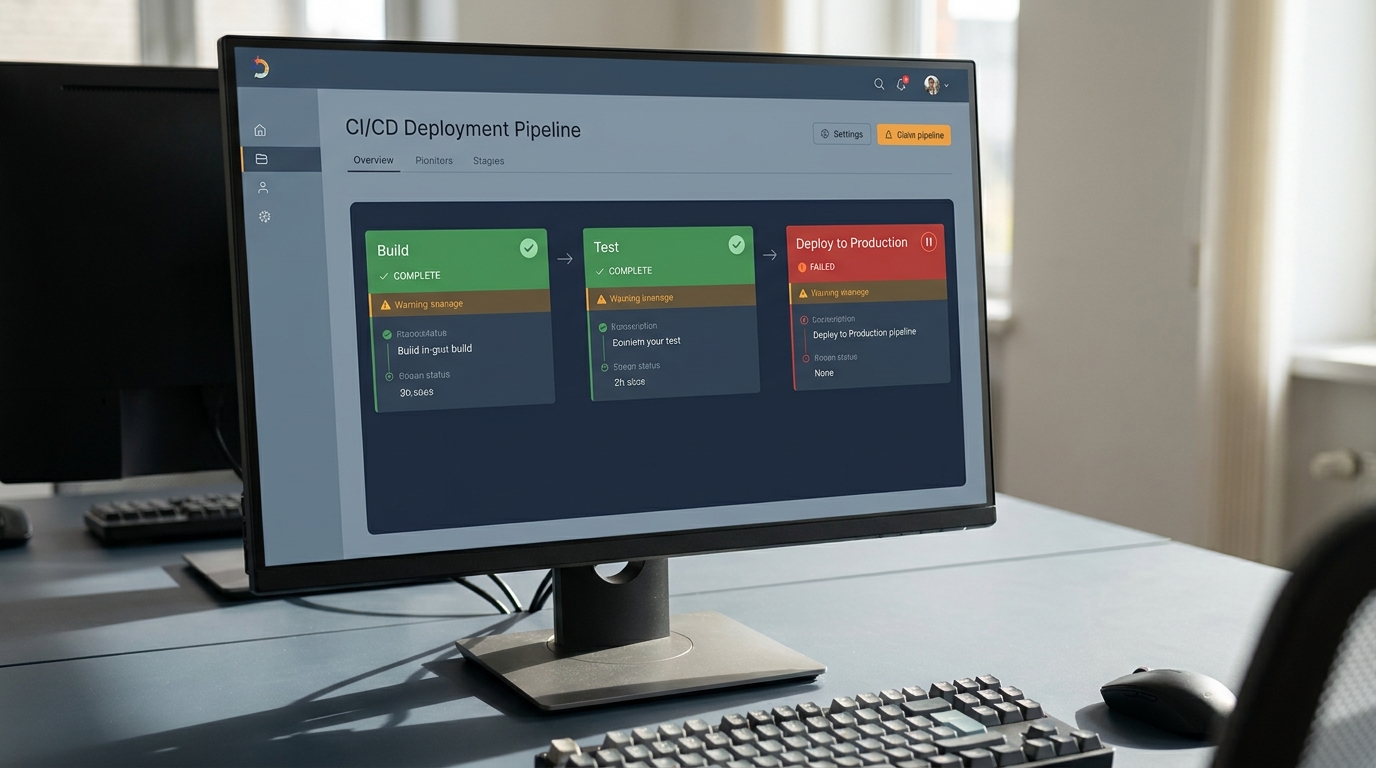
- No clear business metric. Projects launched to "explore AI" have no definition of done, so they never finish. They just lose their sponsor. We fix this by agreeing a single business metric before the build starts, in the discovery sprint, and refusing to start a build without one.
- Weak data foundations. A model is only as good as the data under it, and most organizations overestimate how ready their data is. We assess data readiness up front and treat fixing it as part of the work, not a surprise invoice halfway through.
- A pilot with no path to production. A demo that was never designed to be integrated cannot be integrated without a rebuild. We scope every pilot with its production path already named, so the thing we build in week six is the thing that goes live, not a throwaway.
- No ownership after handoff. Systems rot when nobody owns them, and a great model with no owner is a liability waiting to drift. Team enablement and a documented handover are built into the process, not bolted on at the end.
- Ignoring change management. A workflow people do not trust gets bypassed, and a bypassed system returns zero regardless of how good the model is. We involve the people who will run the system while it is being built, not after, so adoption is designed in rather than hoped for.
Notice where four of those five failures actually live: off the model, in scoping, data, ownership, and adoption . That is why picking a partner on machine learning skill alone is a mistake. The engineering is necessary and it is rarely the reason a project dies. The reasons projects die are organizational, and a partner who only knows models will step on every one of them.
Proof - how we show it works
Anyone can show logos. Fewer can show mechanism. We prove value two ways, and both are things you can check.

First, by what changes in the actual workflow. A useful before-and-after is not "we deployed a model." It is "the task that took a specialist two hours now takes ten minutes and a review, and the error rate went down." When we scope a pilot, we capture the before state - the time, the cost, the error rate, whatever the agreed metric is - so the after is measurable rather than asserted. If we cannot describe the before, we do not yet understand the problem well enough to build for it.
Second, by market evidence rather than invented client numbers. We will not put a fabricated case study in front of you, and we will not dress an illustrative example up as a named client win. Where we cite results, they are either your own measured baseline or a labelled third-party figure with its source and date, so you can check it yourself. The RAND finding above is one example. It frames the risk honestly instead of pretending failure is rare, which is the opposite of what most vendor pages do.
Underneath both is the one differentiator that is hard to fake: the delivery model. The senior people who scope the work are the ones who build it, so the proof is not a story told by an account manager who was not in the room. It is the system, running, against a number you agreed to at the start. That is a harder thing to sell than a wall of logos, and it is a far more reliable thing to buy.
Solving the AI talent gap without full-time hires
The most common reason a good AI plan sits idle is capacity, not conviction. Senior AI engineers are scarce and expensive, and hiring a permanent team for a program that is still proving itself is a real risk. Full-time hires also take months to land, by which point the window may have moved and the internal urgency may have faded.
Our answer is an embedded fractional model. The Fractional Agentic Team gives you strategy, build, and operating capacity on demand - a senior AI team that plugs into your organization from 8,000 dollars a month, without a permanent headcount commitment. It works because the same people cover the whole arc. They help decide what to build, they build it, and they keep it running, so you are not stitching together a strategist, a contractor, and an internal owner who never talked before the project started.
This is the direct fix for the two problems that stall programs most often: pilots that never ship because nobody senior owns the build, and roadmaps that never start because the team cannot hire fast enough. An embedded team removes both without asking you to gamble on permanent hires for unproven work. And because the arrangement is fractional, the cost scales with the work. You carry senior capacity while a program needs it, and you are not stuck paying for a full bench between use cases.
Where to start
If AI matters to your business but the path from idea to production is not clear, the first move is small and free. The AI Readiness Snapshot is a 30-minute call that tells you whether your use case, your data, and your sponsorship are ready, and where AI would actually pay off first. No deck, no commitment. Just a straight read on whether this is worth doing and what the fastest honest first step would be.