
The licenses are signed. The demos landed. Six months on, the work looks identical . That gap is now a board-level problem. The spend shows up on every dashboard and the return shows up on none. The reflex is to blame the model, the prompt, or the vendor and buy the next tool, and that reflex is wrong. Production AI is not a better model, a cleaner prompt, or a new platform. It is an operating model for changing how work gets done, and that is the part no purchase order can deliver.
AI Operating Model is how people, decisions, and workflows are re-wired around AI so output actually changes. A tech stack is what you buy. The operating model is what makes the tools matter.
The distinction is not academic, and there is a number that proves it. BCG's 2024 "Where's the Value in AI?" study found that only 26% of companies have moved beyond proofs of concept to generate tangible value from AI. The other 74% own the same tools. What separates the two groups is not their stack. It is whether the work itself was redesigned.
Why the tech-stack mindset stalls
Buying capability is not the same as changing behavior. A seat license gives a team access. It does not give them a reason to abandon the workflow they already trust, and it does not tell them which decisions are now safe to hand to a machine.
So the predictable symptoms set in. Seats go unused and become shelfware. Pilots impress in the demo room and never reach production , a pattern common enough to have its own name: pilot purgatory. Teams that do try the tool drift back to the old process the first time work gets busy, because the old process is the one the organization is actually built around.
One tool-first rollout we watched shows the trap in miniature. A team bought a capable assistant, trained everyone for an afternoon, and called the rollout done. Usage spiked for two weeks and then collapsed. No one had changed what the team was accountable for, who reviewed the output, or how a good result got reused. The capability was real. The operating model never moved. That is the 74%, in one team.
What an AI operating model actually is
An enterprise AI operating model re-wires four things. Tools sit underneath all of them, necessary but never enough on their own. We run each one as a named part of an operating system, not a slogan.

| Component | The question it answers | What it changes |
|---|---|---|
| Scope | Where in the workflow does AI do the work, not assist? | Cuts a task out of the human queue instead of adding a tab |
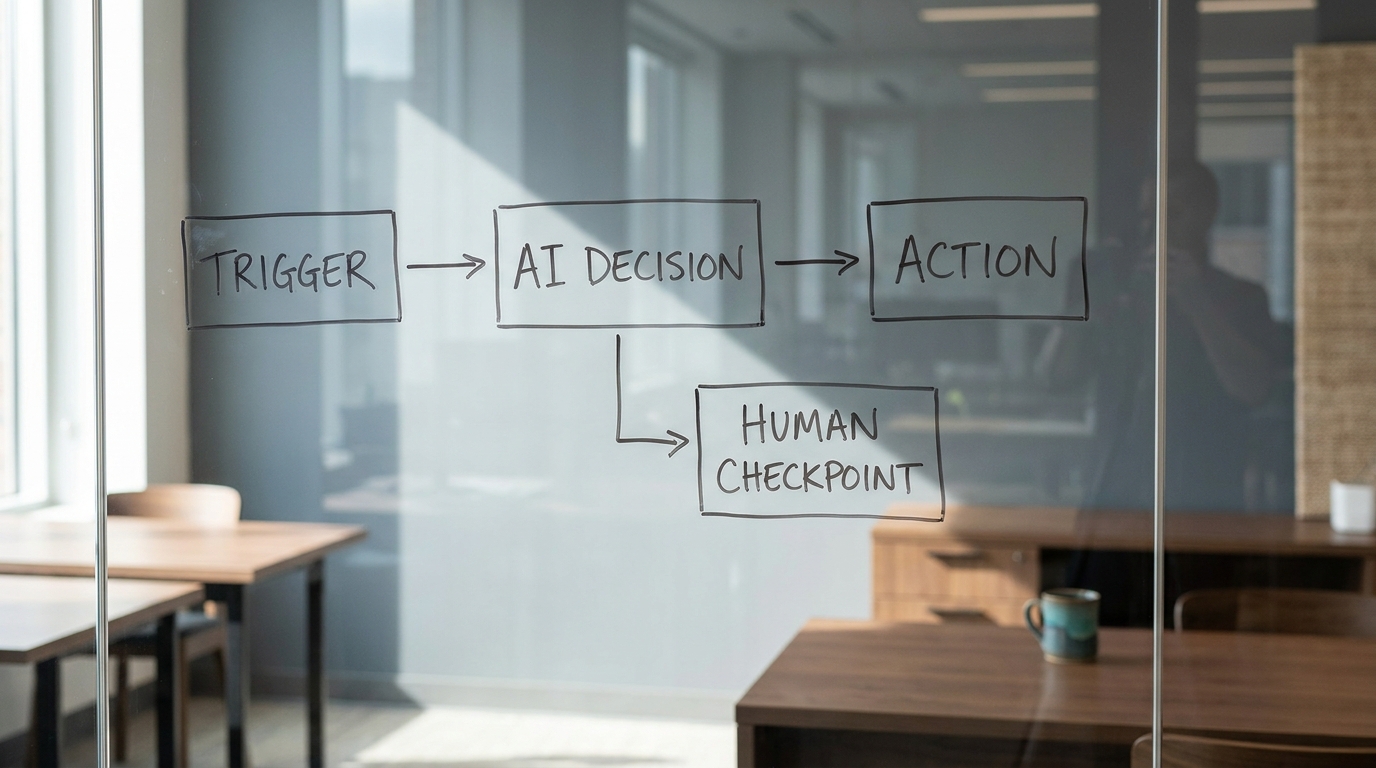
| Ownership | Who owns the human-in-the-loop checkpoint? | Names an accountable reviewer, so quality is governed, not hoped for |
| Standardization | How does one team's win become the standard? | Turns a lucky prompt into a documented, repeatable play |
| Scale | How does a proven workflow roll to the next team? | Replaces one-off enthusiasm with a deliberate rollout path |
The whole shift from operating model vs tech stack thinking lives in that second column. The tech stack answers what we can do. The operating model answers what we will now do differently, who is responsible, and how it spreads. Get the second column wrong and the first column is just inventory.
Why a demo is not proof — and an adoption number is
A demo proves the model works. It proves nothing about whether the work changed. The only honest scorecard for production AI is an AI adoption metric tied to an outcome.
In the engagements we have run, the signals that actually predict value stay consistent. Weekly active use of a redesigned workflow, not total seats sold. Cycle-time on the targeted task, measured before and against after. The share of pilots that crossed into production rather than ending as a slide. Where the operating model is set up well, we see a clear majority of the target team in weekly active use within the first quarter and a measured drop in cycle time on the one workflow we chose to rewire first. Where only tools were bought, those same numbers stay flat. The tools are identical. The result is not.
What changes for the CEO and the CIO
For the CEO, the accountability moves. The job is not procurement of AI capability. It is behavior change, owned and measured like any other operating priority, with an adoption number reported to the board instead of a license count.

For the CIO, the mandate widens past integrate-and-secure. Scaling AI in the enterprise becomes an operate-and-scale function. It standardizes the human-in-the-loop workflows that work and gives them a path to the next team, rather than just keeping the platform running.
Key takeaways
- Tools are necessary and never enough on their own. Owning the capability is not adoption.
- The unit of change is the workflow, not the license. Redesign the work, then add the tool.
- Proof of production AI is an adoption number tied to an outcome, not a demo.
- AI transformation is an operating-model problem for the CEO and CIO, not a technology purchase.
Build the team that operates the change
The hard part of production AI is not the model. It is having people who can redesign the work, own the checkpoints, and scale what works, week after week. That is operating capacity, and most organizations do not have it sitting idle.
Fractional Agentic Team is an embedded agentic team that operates the change inside your workflows, not a deck about it.