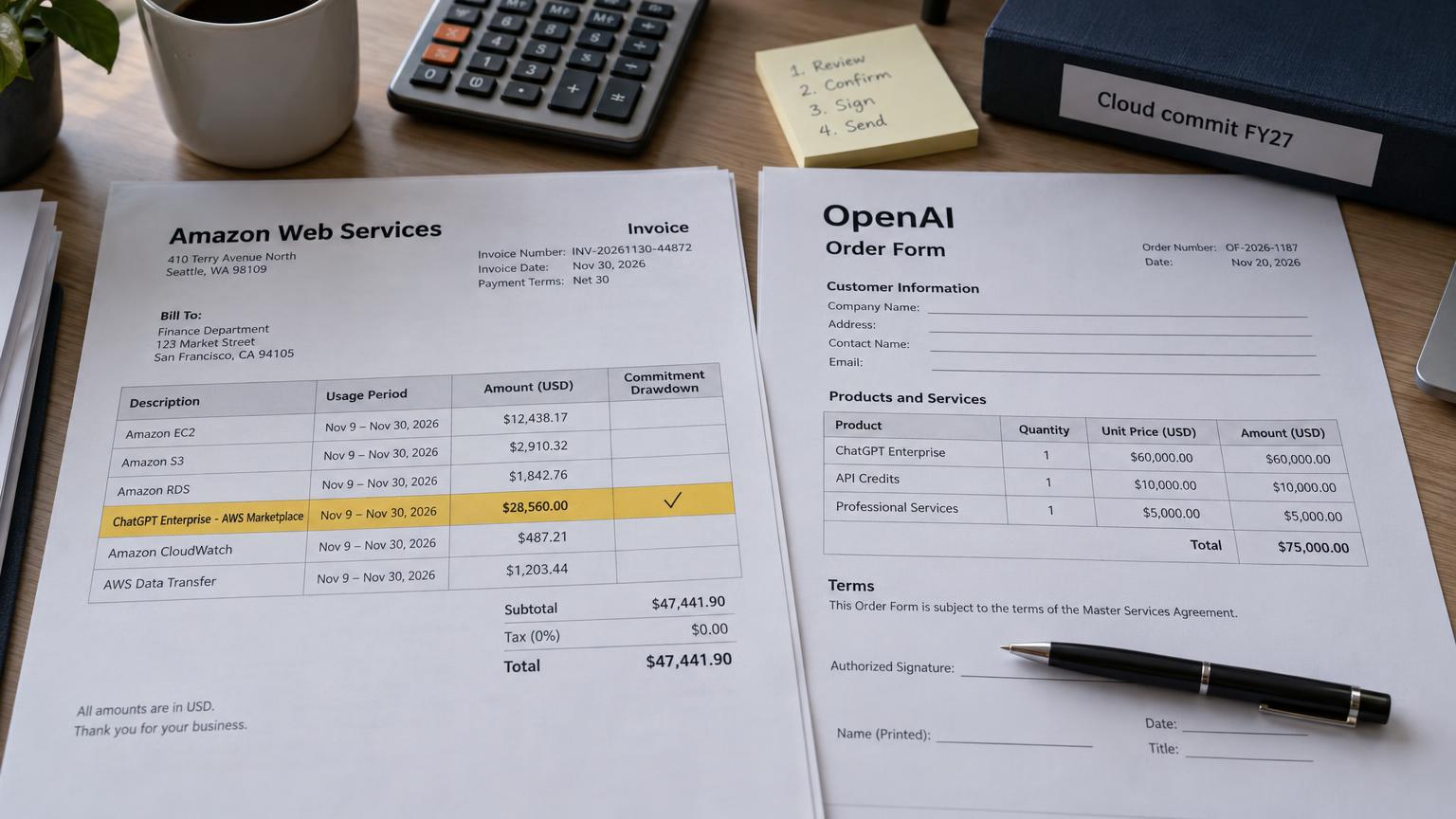
On November 9, 2026, ChatGPT Enterprise became something a company could put on its AWS bill. OpenAI (2026) said organizations can now buy it through AWS Marketplace, pay through their existing AWS billing relationship, and apply eligible spend toward their AWS commitments, with the same features released at the same time as the direct product. For a CFO staring at an AWS commitment that will not be fully consumed this year, that reads like free money.
It is not quite that. "Buying through the cloud" now covers three different arrangements, and they differ on the things that hurt later: which features you get, when new models arrive, who processes your data, and who answers the phone when something breaks. The commitment discount is real. On some routes it is paid for in features. Seats for employees and API capacity for your developers also get different answers. Below: the routes, how they compare on what procurement signs off on, three buyer scenarios, and a checklist you can send to your account teams.
What changed in November, and what was already true
The ChatGPT Enterprise listing is the newest piece, not the first. The cloud route to both major model vendors has been building all year.
- OpenAI on Amazon Bedrock. AWS (2026) announced OpenAI models, Codex, and Managed Agents on Amazon Bedrock in limited preview in April, and said usage of OpenAI models and Codex can be applied toward existing AWS cloud commitments. By July, the GPT-5.6 family was generally available on Bedrock, and AWS (2026) stated that pricing "matches OpenAI first-party rates." GPT-6.2 Astra and GPT-6.2 Sol reached Bedrock on November 18.
- The Azure exclusivity ended. Axios (2026) reported that the move to AWS came a day after OpenAI and Microsoft revised a partnership that had required developers to use Microsoft Azure to access most OpenAI services.
- Claude on AWS Marketplace. Anthropic's Claude Enterprise is sold through AWS Marketplace as a managed SaaS product, separate from the Claude models developers call on Bedrock (AWS, 2026). Anthropic also offers Claude Platform on AWS, the full Anthropic API with AWS handling sign-in and billing.
- Release timing. Anthropic's Claude Fable 5.2 was available on AWS the day it launched (AWS, 2026).
So the question for most buyers is no longer whether they can buy OpenAI or Anthropic through their cloud provider. It is which cloud route they mean, because there are three, and only one of them is the vendor's product with AWS paper wrapped around it.
"Through the cloud" means three different things
Most confusion in these conversations comes from treating every cloud option as the same product with different billing. They are not, and the difference decides who runs inference on your data.
Marketplace SaaS seats. ChatGPT Enterprise or Claude Enterprise bought through AWS Marketplace. The vendor runs the same product it sells direct. AWS provides the paper, the invoice, and the commitment drawdown.
Vendor-operated API, billed by the cloud. Claude Platform on AWS is the clearest example. AWS documentation (2026) says that unlike Amazon Bedrock, where AWS operates the inference stack, Anthropic operates Claude Platform on AWS. AWS provides authentication through IAM and billing through AWS Marketplace, and both companies act as independent data processors.
Cloud-operated managed models. Amazon Bedrock, Microsoft Foundry (which includes Azure OpenAI), and Google Cloud's Vertex AI (now branded Gemini Enterprise Agent Platform) run the models inside the cloud provider's own service. You get the provider's identity, networking, logging and regional controls . You also get the provider's implementation of the vendor's API, which is not always the vendor's full API.
Direct. A contract with OpenAI or Anthropic, their admin console, their support, their terms.
One trap catches even careful buyers: OpenAI's own documentation (2026) notes that ChatGPT Enterprise purchased through AWS Marketplace is a separate offering from pointing ChatGPT Work or Codex at models on Bedrock. Both put spend on your AWS bill. They are not the same product, and they do not carry the same data terms.
Seats and API workloads need separate decisions
The single most useful thing a buying committee can do is split the decision in two, because the CFO and the CTO are usually arguing about different products.
For seats, the route mostly changes the paperwork. ChatGPT Enterprise and Claude Enterprise through AWS Marketplace are the vendors' own products. OpenAI (2026) says the Marketplace version gets the same features at the same time. If your vendor confirms that in writing for your edition and your admin features, buying seats through the marketplace is usually the low-risk way to consume a commitment. This is the easy half of the decision.
For API workloads, the route can change the product. This is where your engineering lead needs a vote. OpenAI's developer documentation (2026) publishes a feature matrix comparing the OpenAI API with Amazon Bedrock. As of November 2026, it lists the shell tool, hosted file search, remote MCP servers, the image generation tool, multi-agent, WebSocket connections and Pro mode as not available on Bedrock. Text generation, structured outputs, function calling, prompt caching and computer use are available on both.
If your developers are building agents that rely on remote MCP servers or the shell tool, Bedrock is not a drop-in replacement for the direct API today. If they mostly call models for text, extraction and tool use, the gap may not matter at all. Ask them which list they are on before finance signs anything.
Claude takes a different shape. Claude Platform on AWS promises same-day model and feature access, because Anthropic runs it (AWS, 2026). Claude models on Bedrock are a separate, AWS-operated route, and model availability there varies by region.
How the routes compare on what procurement signs off on
The comparison below uses the criteria a CTO and CFO typically sign off on together. It is judged from public vendor documentation as of November 2026. Treat every cell as a question to confirm against your own agreement, not a promise.
| Criterion | Direct contract | Marketplace SaaS seats | Vendor-operated API via cloud | Cloud-operated managed model |
|---|---|---|---|---|
| Commit drawdown | None | Eligible spend counts, per your agreement | Billed by the cloud, counts per your agreement | Counts, per your agreement |
| Price | Vendor list or negotiated | Vendor pricing, private offers possible | Vendor pricing | OpenAI models on Bedrock match first-party list rates |
| Feature parity | Full | Same product, confirm edition | Full vendor API (Claude Platform on AWS) | Subset of vendor API, check the matrix |
| New-model timing | Day one | Same time as direct (OpenAI, for ChatGPT Enterprise) | Same day (Claude Platform on AWS) | Varies by model and region |
| Who runs inference | Vendor | Vendor | Vendor | Cloud provider |
| Data terms | Vendor DPA | Vendor DPA plus cloud paper | Vendor and cloud as independent processors | Cloud provider terms |
| Identity and governance | Vendor admin, SSO | Vendor admin, SSO | Cloud IAM | Cloud IAM, private networking, cloud audit logs |
| Support | Vendor | Vendor product, cloud billing | Split by issue type | Cloud provider first |
| Exit cost | Vendor switch | Vendor switch, commit timing | API code stays portable | Cloud-specific SDKs and controls |
Two rows deserve more than a cell.
Data residency is not the region in the URL. OpenAI's documentation (2026) states plainly that "An AWS Region is not an OpenAI data residency jurisdiction." If you have location requirements, check the destination regions of your inference profile, especially when cross-region inference is switched on, and read the applicable AWS terms. On the Anthropic side, Claude Platform on AWS follows the same data retention policy as the first-party Claude API, with zero data retention (ZDR) available on request (AWS, 2026).
Support follows the operator. The OpenAI Help Center (2026) routes Bedrock authentication, IAM permissions, quotas, billing, regional availability and request failures to AWS Support. That is reasonable, but it means your incident runbook needs two escalation paths if you run both routes.
Price parity is not the same as cost parity
On paper, the managed route does not save a cent per token. AWS (2026) says OpenAI model pricing on Bedrock matches OpenAI's first-party rates. The real saving is the commitment drawdown: spend you were going to incur anyway now retires a commitment you would otherwise under-consume.

So the CFO's first question is about the contract. The technology can wait. Whether marketplace or Bedrock spend counts toward your commitment, at what rate, and whether there is a cap on how much third-party marketplace spend can count, is set by your agreement with the cloud provider. Ask for it in writing before modeling savings.
A few cost lines change the math once you look closely:
- Routing choices. AWS (2026) says Global cross-Region inference is priced lower per token for OpenAI models than in-Region and Geo inference. Cheaper, but it can conflict with a residency requirement.
- Seat minimums and true-ups. Enterprise seat plans carry minimum commitments. Check whether the marketplace contract mirrors the direct one or adds its own term.
- Duplicate commitments. If you already have a direct OpenAI or Anthropic commitment, moving some workloads to the cloud can leave both commitments under-consumed. Anthropic markets dual commitment retirement for Claude Platform on AWS. Confirm with both account teams exactly how that applies to your contracts.
Three buyer scenarios
A large unspent AWS commitment and mostly seat demand
This is the buyer the November announcement was built for. If most of your demand is employees wanting ChatGPT Enterprise or Claude Enterprise, buy the seats through AWS Marketplace, provided the vendor confirms feature parity for your edition and the admin and SSO features your security team needs. Keep the API decision separate, and do not let the seat contract quietly decide where your developers build.
Best for: finance-led buying with a clear commitment shortfall. Not for: teams who need a vendor feature that ships only on the direct plan.
A company standardized on Microsoft
If you run Microsoft 365, sign in through Entra ID and hold a Microsoft Azure Consumption Commitment (MACC), the equivalent path for API work is Microsoft Foundry, which hosts Azure OpenAI and also offers Anthropic's Claude models. For seats, the real comparison is often Microsoft 365 Copilot against ChatGPT Enterprise or Claude Enterprise, not marketplace against direct.
Microsoft is also pushing its own models on price. Axios (2026) reported that Microsoft announced six new models at Ignite on November 17, including a coding model it says delivers most of GPT-6.1 Sol's performance at a fraction of the price. Axios noted those comparisons rely on selected benchmarks and some promotional pricing, so treat them as a reason to test, not a reason to switch.
Best for: organizations whose identity, compliance and commitment all live in Azure. Not for: teams that need the newest OpenAI tools on day one through the direct API.
An engineering team building agents on the API
Here the route decision is about capability and control, not price, and running two routes is legitimate. Use the direct API, or Claude Platform on AWS for Claude, where you need the newest models and tools as they ship . Use Bedrock, Foundry or Vertex AI where IAM, private networking, cloud audit logs and keeping traffic inside your account matter more than tool completeness.
Google Cloud shops have a version of the same choice. Claude models are available on Google Cloud's Gemini Enterprise Agent Platform (formerly Vertex AI), and AI Business (2026) reported that GPT-6 Astra, GPT-6.1 Sol and GPT-6 Luna began rolling out there in private preview in October. Check which OpenAI models and features that deal covers before planning around it, since a private preview is not a procurement option yet.
Best for: teams with both production agents and regulated data. Not for: small teams that cannot support two integration paths.
A procurement checklist for the marketplace-or-direct decision
Send these to your cloud account team and the model vendor before you sign. Get the answers in writing.
- Does this specific SKU count toward our cloud commitment, at what rate, and is there a cap on marketplace spend?
- Is the price identical to direct, and can we get a private offer?
- Which features, models and tools are missing on this route compared with direct, for the exact models we plan to use?
- Will new models arrive on this route the same day as direct? Is that in the contract or only in marketing?
- Who operates inference, and who is the data processor under which DPA?
- What retention applies by default, and is zero data retention available?
- Which regions will process our requests, including any cross-region routing?
- Does identity run through the vendor's SSO and admin console, or through cloud IAM, and does that fit our access reviews?
- Who do we call for an outage, a quota problem or a billing dispute, and what is the SLA?
- What are the seat minimums, true-up terms and renewal dates, and do they line up with our commitment term?
- If we already have a direct contract, can both coexist without leaving one under-consumed?
- What does exit look like: data export, code changes, and remaining commitment exposure?
Decide seats and API separately, then pick the route per workload
The rule fits in one line: take the commitment drawdown where the product is identical, and pay for the product where it is not. Today that mostly means enterprise seats through the marketplace, and direct or vendor-operated cloud routes wherever the managed version would cost your developers features they depend on. Revisit the decision every quarter, because release timing and feature matrices are changing faster than most contract terms.
If you want a second pair of eyes on which workloads to move onto your commitment and which to keep direct, book an AI Readiness Snapshot , a free 30-minute call that maps where AI spend will have the most impact on your cost and reliability.