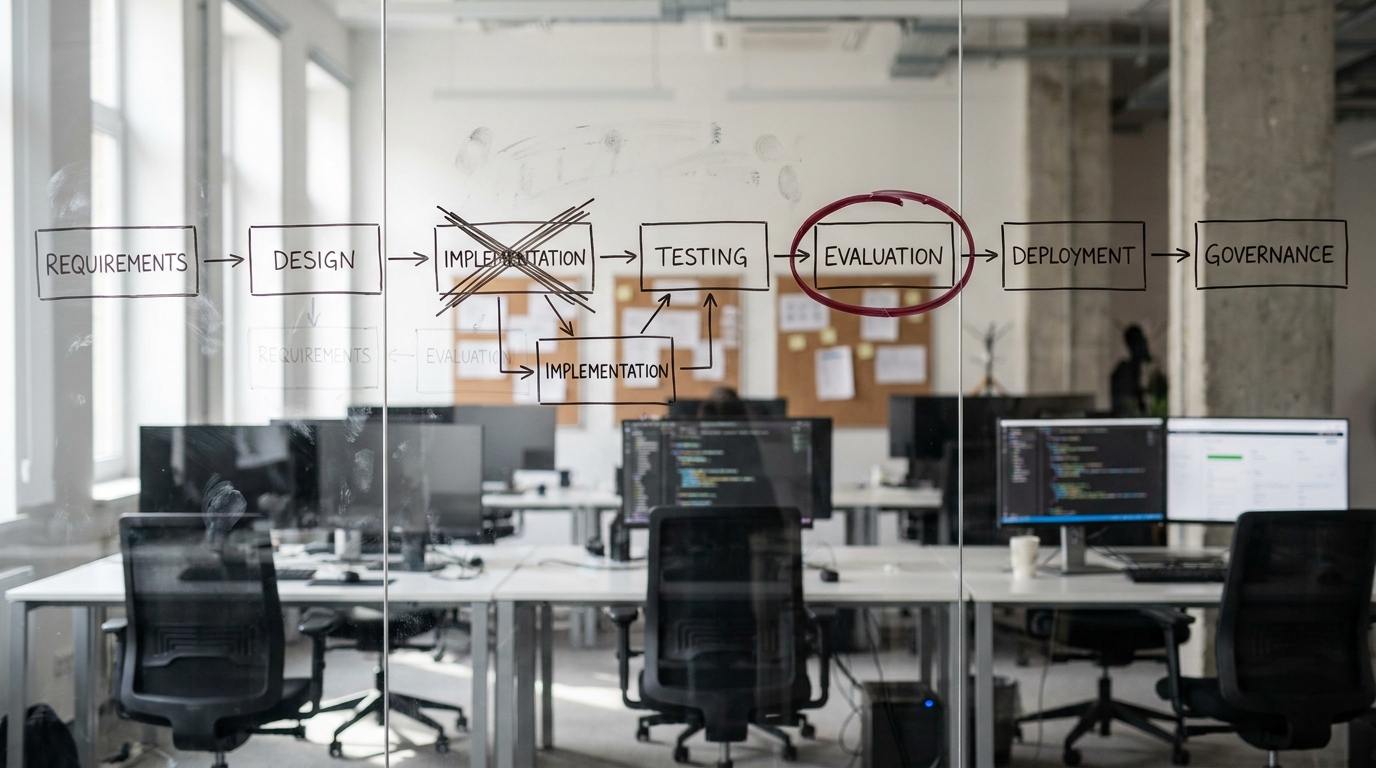

Machine Learning Consulting Services — From Data to Production AI
You have the data. You have a use case the business is excited about. What you don't have is a reliable path from a promising prototype to a model that runs in production, earns trust, and keeps working after the launch buzz fades. Most teams stall right there, and the cost is real. Another quarter goes by without the forecast, the classifier, or the recommendation engine the roadmap promised.
Machine learning consulting is hands-on, outcome-focused help that takes a defined business use case from raw data through model development, deployment, and ongoing operation. The right engagement gets a model into production and keeps it accurate after go-live, rather than handing you a notebook that never ships.
That distinction matters more than it sounds. MIT's NANDA initiative reported in its "State of AI in Business 2025" study that roughly 95% of enterprise generative-AI pilots delivered no measurable return. The pilots that fail rarely fail because the math is wrong. They fail at the seams between a working prototype and a production system nobody owns. Machine learning consultation that earns its fee is the work that closes those seams.
What you get from a machine learning consulting engagement
A good engagement covers the full lifecycle, not just the modeling. Thin providers stop at "we have data scientists." The deliverables below are what production actually requires.
- ML strategy and use-case prioritization. A ranked view of where machine learning delivers the highest ROI for your business, so you spend the first dollar on the use case most likely to pay back.
- Data readiness and feature engineering. An honest assessment of whether your data can support the model, plus the feature pipelines that feed it.
- Model development, training, and validation. The core build: candidate models, training runs, and validation against success metrics agreed up front.
- Deployment to production. Real integration through APIs, batch jobs, or edge as your architecture requires, not a model that only runs on someone's laptop.
- MLOps: monitoring, retraining, and drift detection. The part competitors gloss over. A deployed model decays as the world shifts under it. MLOps is the machinery that catches drift, retrains on schedule, and keeps accuracy from quietly eroding.
- Knowledge transfer and enablement. Your team should be able to operate, debug, and extend what we build together. We document and hand over, rather than create a dependency.
Watch for the provider who can show you the first four bullets but goes quiet on MLOps and knowledge transfer. That is a PoC factory, not a production partner .
When you need machine learning consulting
You need outside ML help when the problem stops being "can we build a model" and becomes "can we run one reliably." A few clear signals.
- Models work in experiments but never reach production, or they reach it and quietly degrade.
- There is no MLOps practice, so every deployment is a one-off heroics project.
- A single data-science hire cannot cover strategy, data engineering, modeling, and operations at once.
- Nobody is sure which use case has measurable ROI, so the team keeps prototyping instead of shipping.
- Governance, security, or compliance pressure means a model cannot just be "good enough on a slide."
If none of those apply and you have a working MLOps practice with capacity, you probably do not need a partner. That is worth saying plainly, because the most expensive engagement is the one that duplicates a capability you already had.
Strategy, data, or production: which part you are actually buying
"Machine learning consulting" covers three different purchases, and naming which one you need prevents most of the mismatch.
Strategy first. You know ML could help but not where. The work is use-case selection, data feasibility, and a sequenced plan with a success metric attached. The deliverable is a decision, not a model.
Data first. The use case is clear but the inputs are not ready. The work is pipelines, quality, labeling, and access — the part that consumes the majority of effort on most ML projects and the part that gets scoped out of optimistic proposals.
Production first. A model exists and works in a notebook. The work is deployment, monitoring, retraining, and ownership: turning an experiment into a system somebody runs.
Most engagements touch all three, but they are rarely equal. A proposal that prices them as one undifferentiated block is worth questioning, because the effort almost always concentrates in the data phase and the honest quote says so.
Best for, and not for
Honesty about fit is rare on consulting pages. It is also the fastest way to build trust with a technical buyer who has been pitched before.
Best for: companies with a defined use case and usable data that need to reach production quickly. Teams without a full in-house ML organization. Leaders who want measurable ROI rather than an open-ended science project.
Not for: pure research with no business outcome attached. Teams that want a single contractor body to fill a seat. Organizations with no data foundation yet, who are better served by a data-engineering and readiness step before any modeling begins.
If you land in the "not for" column, the most useful thing a consultant can do is tell you so before you spend the budget.
Machine learning consulting capabilities
We group capabilities by ML discipline so the engagement maps cleanly to your use case rather than to a generic pitch.

Predictive analytics and forecasting
Demand forecasts, churn prediction, risk scoring, and pricing models. If your decisions today rely on a spreadsheet and a gut feel, this is usually where the first measurable win lives for your team.
Computer vision
Image classification, object detection, defect inspection, and document understanding. We help you decide where vision earns its keep and where a simpler rule would do the job for less.
NLP, LLM, and generative AI
Text classification, entity extraction, retrieval-augmented generation, and assistants grounded in your own content. The hype here is loud, so we keep the focus on tasks where a language model measurably beats the alternative.
Recommendation and personalization
Product, content, and next-best-action recommendations that lift conversion and retention. These systems live or die on feedback loops, which is exactly why MLOps belongs in the same conversation.
MLOps and model monitoring
The connective tissue across every discipline above. Pipelines, model registries, monitoring dashboards, and retraining triggers that turn a one-time model into a system your business can depend on for years.
How the engagement works: four phases to production
Most competitors hide scope behind a "Contact us" button. We show the phases up front, because a transparent process is the single biggest trust lever for a buyer trying to plan budget and timeline.

| Phase | What happens | Output |
|---|---|---|
| 1. Discovery and use-case scoping | Prioritize use cases, define success metrics, agree on what "good" means | A scoped plan with measurable targets |
| 2. Data and feasibility | Assess data quality, run a focused PoC with a go/no-go gate | A go/no-go decision backed by evidence |
| 3. Build and deploy | Develop the production model and integrate it into your systems | A deployed, validated model |
| 4. Operate and improve | Monitor, retrain, detect drift, and hand over to your team | A maintained model plus an enabled team |
The go/no-go gate in phase two is deliberate. It protects you from sinking a full build budget into a use case the data cannot support. We would rather lose a phase-three engagement than ship you a model that was never going to work.
Typical project timeline
These are typical ranges, not promises. The actual timeline depends on data readiness and integration complexity, and we will give you a specific estimate after phase one.
| Milestone | Typical range |
|---|---|
| Proof of concept | About 3 to 6 weeks |
| First production model | About 3 to 4 months |
| Ongoing MLOps | Continuous after launch |
A PoC that takes a few weeks and a first production model inside a quarter is a realistic shape for most mid-market engagements. Be wary of any firm that promises production AI in days, or refuses to give a range at all.
Proof that production-first works
The evidence for a production-and-MLOps-first approach is in the failure data. MIT's NANDA "State of AI in Business 2025" report found that around 95% of enterprise generative-AI pilots produced no measurable financial return, and attributed much of the gap to weak integration and a lack of ownership after the pilot, rather than to model quality. Production is where value is won or lost.
In our own work, the pattern repeats. The engagements that deliver lasting ROI are the ones where monitoring and retraining were designed in from phase one, not bolted on after a model started drifting. [insert approved case study] [insert approved metric, e.g. forecast error reduction]. We use bracketed placeholders here on purpose, because inventing a client name or a metric would undermine the exact trust this page is built on.
How we compare
What sets this engagement apart is narrow and deliberate. We focus on production and MLOps, which answers the "95% fail" fear head-on. We show a transparent phase model and timeline range instead of a quote-only black box. And we offer a fractional option for teams that need ongoing ML capacity without hiring a full department. Most providers offer one of those three. Few offer all of them, and fewer still will tell you when you are not a fit.
Talk to us
If you have a use case and usable data, the lowest-risk first step is a free AI Readiness Snapshot , a 30-minute session to pressure-test whether your data and use case are production-ready, with no commitment.
When you are ready to scope the work, the AI Transformation Discovery is a one-week sprint that turns a use case into a costed, phased plan. And if the real gap is capacity rather than a single project, a Fractional Agentic Team gives you ongoing ML and MLOps expertise without the cost and lead time of building an in-house org from scratch.
Get the model into production. Keep it accurate after launch. Start with the snapshot.