
"AI automation consultant" is a job title with no bouncer at the door. The same three words describe a strategist who will tell you what not to automate, a platform reseller counting license seats, an RPA integrator rebuilding yesterday's bots, and a generative-AI agency that ships a clever demo and vanishes. They all compete for the search you just ran, and from the outside they look identical.
That is the real problem behind a simple-sounding question. Your automation cleared the easy, repetitive 20 percent of the work and then stopped paying off. Every vendor now says agentic AI will finish the job. And you cannot tell which of these people to trust with it. A widely reported finding is that most agentic AI implementations stall before they reach production, so picking wrong means a second stalled project, not just a wasted meeting.
This guide gives you the buyer's side of the table. Not "what is agentic AI" in the abstract, but what an AI automation consultant actually delivers, whether you need one at all, and how to tell the strategist from the slide deck before you sign anything.
Quick answer: what an AI automation consultant does
An AI automation consultant helps you find, build, and safely run automation that uses AI to handle the work your rule-based tools cannot: the messy, judgment-heavy tasks that stalled your first automation push. Think part strategist, part builder, part risk manager. The good ones make themselves unnecessary over time.
At a glance, the role covers:
- Opportunity assessment - finding the processes where AI automation actually pays off, and the ones where it does not.
- Prioritization and scoping - sequencing use cases so you get value early and de-risk the hard ones.
- Build and integration - designing agents, wiring them into your systems, and making them work with the software you already run.
- Governance and human-in-the-loop design - deciding where a human stays in control and how you catch mistakes.
- Change management and handover - getting your people to trust and use the system, then teaching your team to run it.
Remember one thing above the rest. A real consultant is measured by working software in production and a team that can operate it, not by a demo.
AI automation vs. traditional automation (and where "agentic" fits)
The terms get used interchangeably, which is exactly why buyers get sold the wrong thing. Three of them are worth pinning down once.
What AI automation is
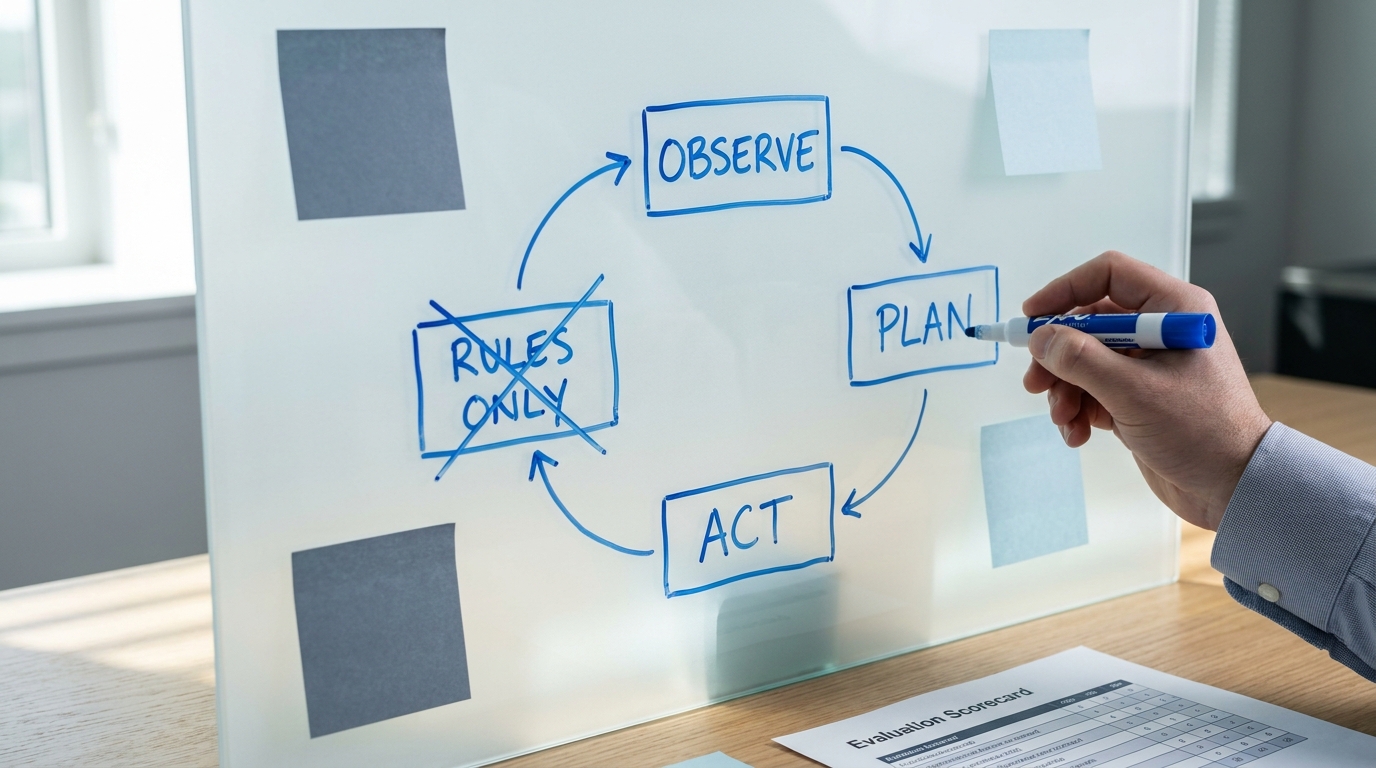
Traditional automation, robotic process automation or RPA, follows fixed rules. It clicks the same buttons, copies the same fields, and moves the same files every time. When the input is clean and predictable it is fast and reliable, and it breaks the moment something changes. That is why your rollout cleared the easy 20 percent and stalled. The remaining work involved exceptions, unstructured documents, and judgment calls that rules cannot cover.
AI automation adds the missing layer. It can read a messy email or a scanned invoice, work out what it means, make a judgment when the input does not match a template, and adapt as conditions change. RPA needs the world to hold still. AI automation is built for the world that does not.
The agentic shift
"Agentic" describes the newest step. A traditional bot executes steps you defined. An AI agent is handed a goal and works out the steps itself: it observes the situation, plans an approach, acts, and checks the result, then adjusts. The mental model that matters for buyers is simple. The agent becomes the actor that does the work, and your people move up to supervisors who set the goals , handle the exceptions the agent flags, and stay accountable for the outcome.
That shift is powerful, and it is also where projects go wrong, because handing a goal to a system that plans its own actions raises the stakes on governance. Hold that thought. It is the reason the evaluation section later matters so much.
What an AI automation consultant actually does
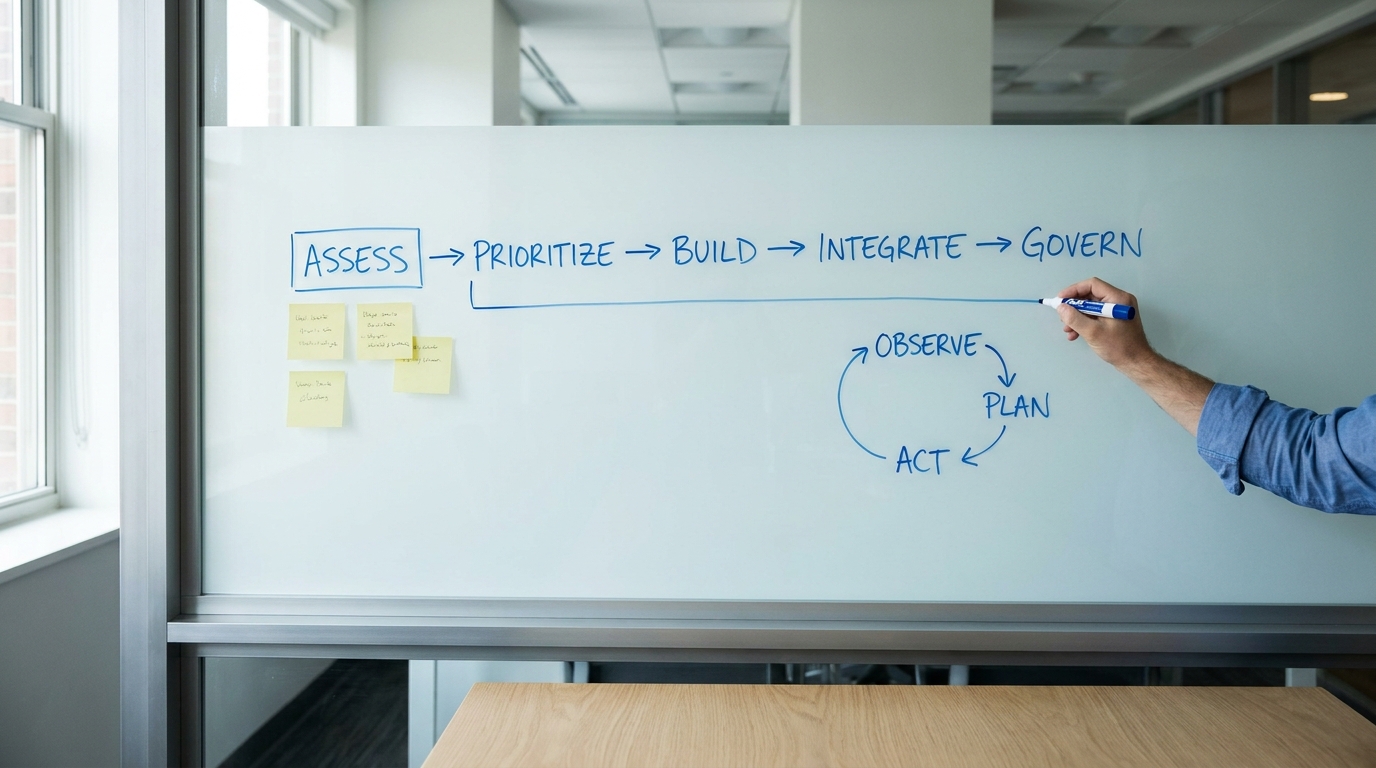
This is the part the vendor explainers skip, because they are the vendor. Across a real engagement the role maps to a lifecycle, and a good consultant walks you through most of these in roughly this order:
- Assess. Map your processes and find where AI automation creates value. That includes ruling things out. A strong consultant will tell you which of your ideas are not worth automating yet.
- Prioritize. Rank the candidates by value, feasibility, and risk. The first project should be valuable enough to matter and safe enough to survive being your learning experience.
- Design. Define how the automation works: what the agent does, what data it needs, where it hands off to a person, and what "done correctly" looks like.
- Build. Develop the agents and the supporting logic. This is real engineering, not prompt-tinkering.
- Integrate. Connect the automation to the systems you already run: your CRM, ERP, ticketing, and document stores. Integration depth is usually where the hard work hides.
- Govern. Design the controls: human-in-the-loop checkpoints, audit trails, escalation paths, and the guardrails that keep an autonomous system inside safe bounds.
- Change-manage. Bring the people who do the work along, so the system gets used instead of quietly ignored.
- Operate and hand over. Run it, tune it, and transfer the knowledge so your team can own it without the consultant on retainer forever.
Two examples make the role concrete. In finance operations, a consultant might take an invoice workflow that RPA could only handle when documents were perfectly formatted and rebuild it as an agentic exception-handler that reads non-standard invoices, matches them to purchase orders, and routes only the genuine edge cases to a human. In customer service, they might design a triage agent that reads incoming tickets, drafts responses, and resolves routine cases while flagging anything sensitive for a person to approve before it goes out. The pattern is identical in both. The agent does the volume, the human owns the judgment, and the consultant designs the seam between them.
Do you need one? Signals you do vs. signals you don't
Not every organization needs outside help. An honest answer depends on what you already have.
Bring in a consultant when:
- Your automation has plateaued and the remaining work needs judgment, not just more rules.
- You do not have people who have shipped AI automation into production before. Building a demo is not the same skill.
- You need governance and human-in-the-loop design and have no template for it.
- You have tried once, it stalled, and you cannot diagnose why.
- The integration surface is large and your internal team is already at capacity.
You can likely go in-house when:
- You have an experienced ML or automation engineering team that has shipped and operated similar systems.
- Your first use case is small, low-risk, and well understood.
- You mainly need capacity, not expertise, and can hire for it.
- You already have a working governance model you trust.
Here is the honest version. Many teams need help for the first one or two projects to build the muscle, then bring the capability in-house. Watch for a consultant angling to become a permanent dependency instead of transferring the skill. Which brings us to how you evaluate them.
Engagement models compared
"Hiring a consultant" can mean very different arrangements. Knowing the models lets you match the commitment to your need.
- One-off audit and roadmap. A short engagement that assesses your processes, prioritizes use cases, and hands you a plan. Best for getting an expert read before you commit budget. Not for teams that need someone to actually build.
- Project build. A defined scope, one or a few use cases, delivered end to end. Best for a clear, contained problem with a known outcome. Not for open-ended discovery where the scope is still fuzzy.
- Embedded or fractional team. A part-time senior team that works alongside yours over months, building and transferring skill as they go. Best for organizations that want to build internal capability while shipping. Not for one-and-done needs where ongoing involvement is overkill.
- Staff augmentation. Extra hands under your direction. Best for teams that have the expertise and plan but lack capacity. Not for situations where you need the strategy and governance thinking, not just labor.
Most buyers underestimate how much the embedded model matters when the real goal is to end up self-sufficient. If your intent is capability rather than a single deliverable, weigh it seriously.
How to evaluate an AI automation consultant
This is the section no competitor gives you, because a vendor does not teach you to judge a vendor. Use these criteria.
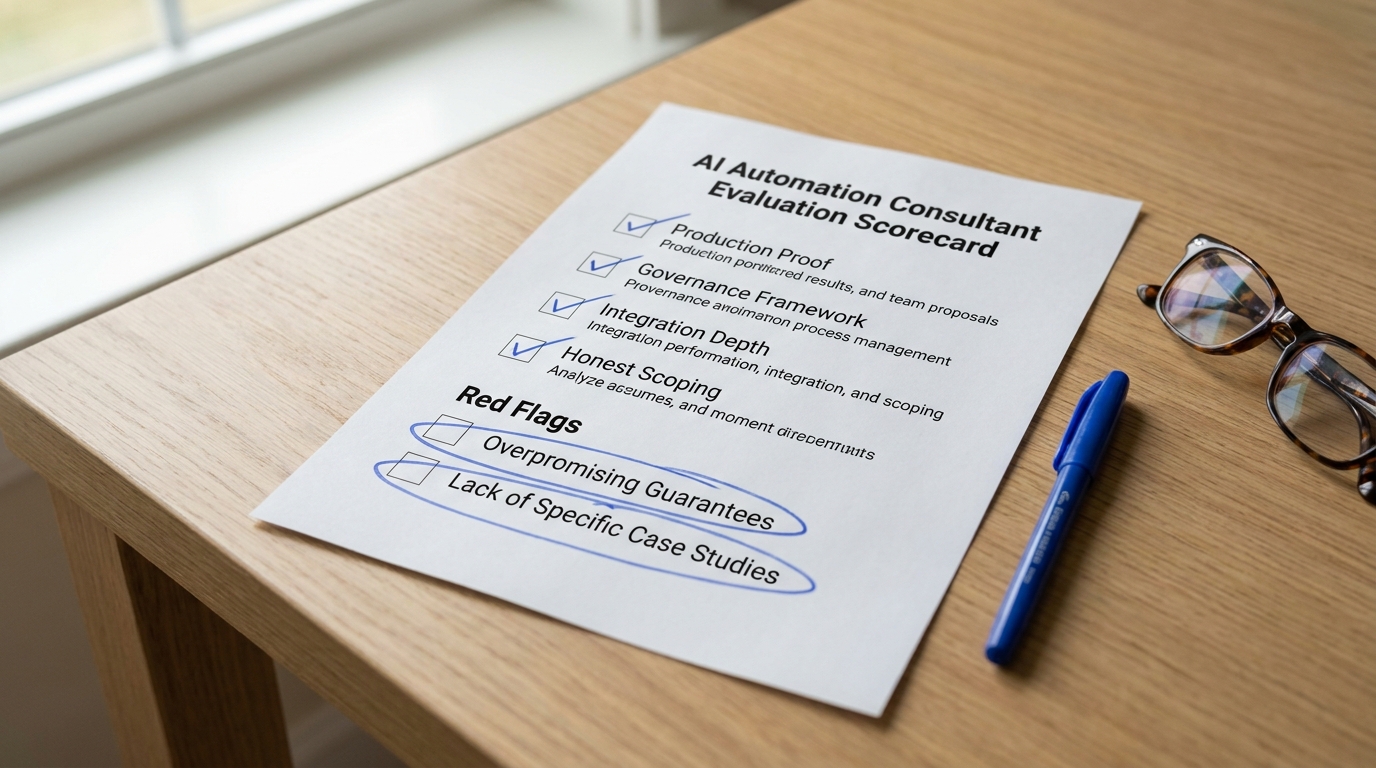
- Proof of shipped outcomes, not demos. Ask for systems running in production and the results they produced. A polished demo proves nothing about whether they can operate at scale.
- Domain and process fit. Have they worked with your kind of process: your industry, your systems, your compliance reality? Generic AI skill is not enough.
- Governance and human-in-the-loop maturity. Can they explain, without prompting, where humans stay in control and how they catch and correct agent mistakes? A missing governance story is the single biggest red flag.
- Integration depth. Do they treat connecting to your existing systems as the real work, or as an afterthought? The hard part of automation is almost always the integration.
- Honest scoping. Do they tell you what not to automate, and where the risks are? A consultant who says yes to everything is selling, not advising.
- Data-readiness realism. Do they check whether your data can actually support the automation before promising results?
- Change-management capability. Do they have a plan for getting your people to adopt the system, or do they stop at "we built it"?
- Knowledge transfer. Will they leave your team able to run and extend the work?
A short list of red flags rounds it out:
- They lead with a tool or platform before understanding your process.
- They promise full autonomy from day one, with no human-in-the-loop.
- They have no governance or risk story.
- Every reference is a proof of concept, never a production system.
- They resist scoping anything out.
Why AI automation projects fail (and what good looks like)
The uncomfortable industry finding is that most agentic AI efforts stall before production. The causes are consistent, and each has a "good" counterpart.
- Wrong first use case. Teams pick something too hard, too risky, or too low-value to prove anything. Good looks like a first project chosen for a real payoff and a survivable risk profile.
- No data foundation. The automation is only as good as the data feeding it, and the data was never checked. Good looks like a data-readiness assessment before any promises.
- Tool-first thinking. The project starts from "we bought a platform" instead of "here is the problem." Good looks like the problem and the process driving the tool choice, not the reverse.
- No governance. An autonomous system gets set loose with no checkpoints, and one bad output erodes all the trust. Good looks like human-in-the-loop controls, audit trails, and clear escalation from the start.
- No change management. The system worked but nobody used it. Good looks like the people who do the work involved early and trained to trust it.
The pattern behind every failure mode is the same. Treating AI automation as a technology purchase instead of an operating change. The consultants worth hiring treat it as the latter.
What to expect: where value lands first, timeline, and cost signals
Value tends to appear first in the same handful of places: finance operations, customer service, document-heavy processes, and IT operations. These are functions with high volume, clear rules around the edges, and lots of judgment in the middle. Read them as examples of where to look, not a fixed list.
On timeline, expect phases rather than a single go-live. A short assessment and roadmap can take a few weeks. A first production use case typically lands over a few months, not days, because integration and governance take real time. Be skeptical of anyone promising instant transformation.
On cost, treat any number as a range tied to scope. A roadmap engagement is a modest, contained spend. A full build costs more and scales with the number of use cases, the integration surface, and how much governance the work requires. The right question is not "what does it cost" but "what is the phased cost to first value , and what do I own when it is done."
Want a fast read on where you stand before committing budget? An AI Readiness Snapshot is a low-commitment way to get an expert view of your best first use case. When you are ready to scope a real engagement, a Discovery Sprint turns that read into a prioritized plan. And if your goal is to build internal capability while you ship, a Fractional Agentic Team embeds senior help alongside your own people.
Key takeaways
- An AI automation consultant finds, builds, and safely runs AI-driven automation for the judgment-heavy work that rule-based RPA cannot handle.
- The role spans a lifecycle: assess, prioritize, design, build, integrate, govern, change-manage, and hand over.
- You need one most when your automation has plateaued, you lack production experience, or you have no governance model, and less when you have a seasoned team and a small, safe first use case.
- Match the engagement model to your goal: audit for a read, project build for a contained problem, embedded team to build capability, staff aug for pure capacity.
- Evaluate on shipped outcomes, governance maturity, integration depth, and honest scoping, not on the quality of the demo.
- Most projects fail from wrong use case, weak data, tool-first thinking, or missing governance. The fix is treating AI automation as an operating change, not a purchase.