
An agent reads 400 supplier invoices, matches each to a purchase order, and queues the batch for payment. It gets 399 right. On the 400th it misreads a credit note as a new charge and schedules a $60,000 duplicate payment. Nobody caught it, because the whole point of the agent was that nobody had to. That one wrong action out of 400 is the gap between an agent that dazzles in a demo and one that is safe to run in a business that pays real invoices.
Autonomous agents are worth building because they act without waiting for a person. That is the same reason they are dangerous when they are built carelessly. Agentic AI development services exist to close that gap. We design, build, and ship agents that do real, multi-step work inside your workflows, with the guardrails that stop one mistake from snowballing into an expensive one. This page walks through what that work involves, how we run it, and how we keep your agents from going off the rails.
Do you actually need agentic AI?
Here is the question most vendors skip, because the honest answer sometimes costs them the sale. Not every problem needs an autonomous agent. Agentic AI earns its keep when the work is genuinely multi-step and reaches across several systems or data sources. It is the wrong tool for anything a simple script or a single prompt already handles.
You are likely a fit if:
- The work chains several steps, decisions, or tools together, not one lookup.
- Your team burns real hours moving data between systems, reading documents, or triaging requests.
- The process needs judgment that a fixed rules engine keeps getting wrong.
- You need the work to happen without a person babysitting every step.
You are probably not a fit if:
- A single FAQ bot or a canned reply would solve the problem.
- The task is high-stakes, one-off, and cheap to do by hand.
- You have no clean access to the data or systems the agent would act on.
Naming the "not for" cases up front is deliberate. We would rather scope a smaller engagement that works than sell you an agent that should never have been built.
What you get: end-to-end agentic AI development services
An agentic AI development engagement is not a research project with no finish line. It produces a working system your team owns, and every item below is something that runs, not a line on a slide. A typical build includes:
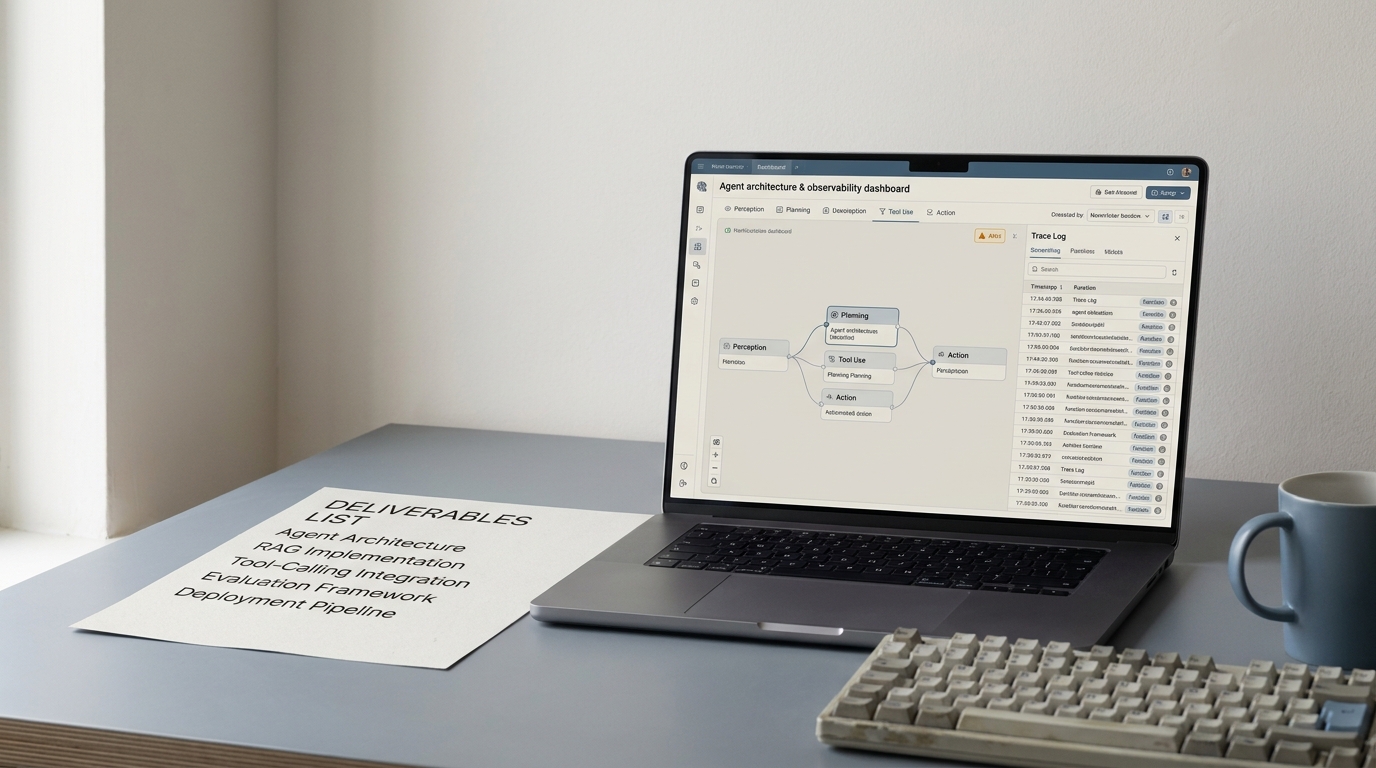
- Agent architecture and design - what the agent does, where it stops, and which actions stay under human control.
- Multi-agent systems where the work warrants it - several specialized agents that hand off to each other instead of one overloaded generalist.
- RAG and knowledge integration - connecting the agent to your documents, databases, and internal knowledge so it reasons over your facts, not a generic model's guesses.
- Tool-calling and system integrations - wiring the agent into the CRM, ticketing system, data warehouse, or internal APIs it needs to actually do the job.
- Evaluation and observability - test harnesses and tracing so you can see what the agent did, why, and where it went wrong.
- Deployment and handover - the agent running in your environment, with documentation and code your team can maintain.
Each of these is a concrete deliverable. When the engagement ends you should be able to point at what runs, say who owns it, and know how you would change it.
What agentic AI development actually involves
Agentic AI is easy to say and easy to blur, so here is the plain version that separates it from a chatbot. An agent reasons about a goal, plans the steps to reach it, calls tools to gather information or take action, and then acts, instead of only returning text for a person to act on. A chatbot answers. An agent does.
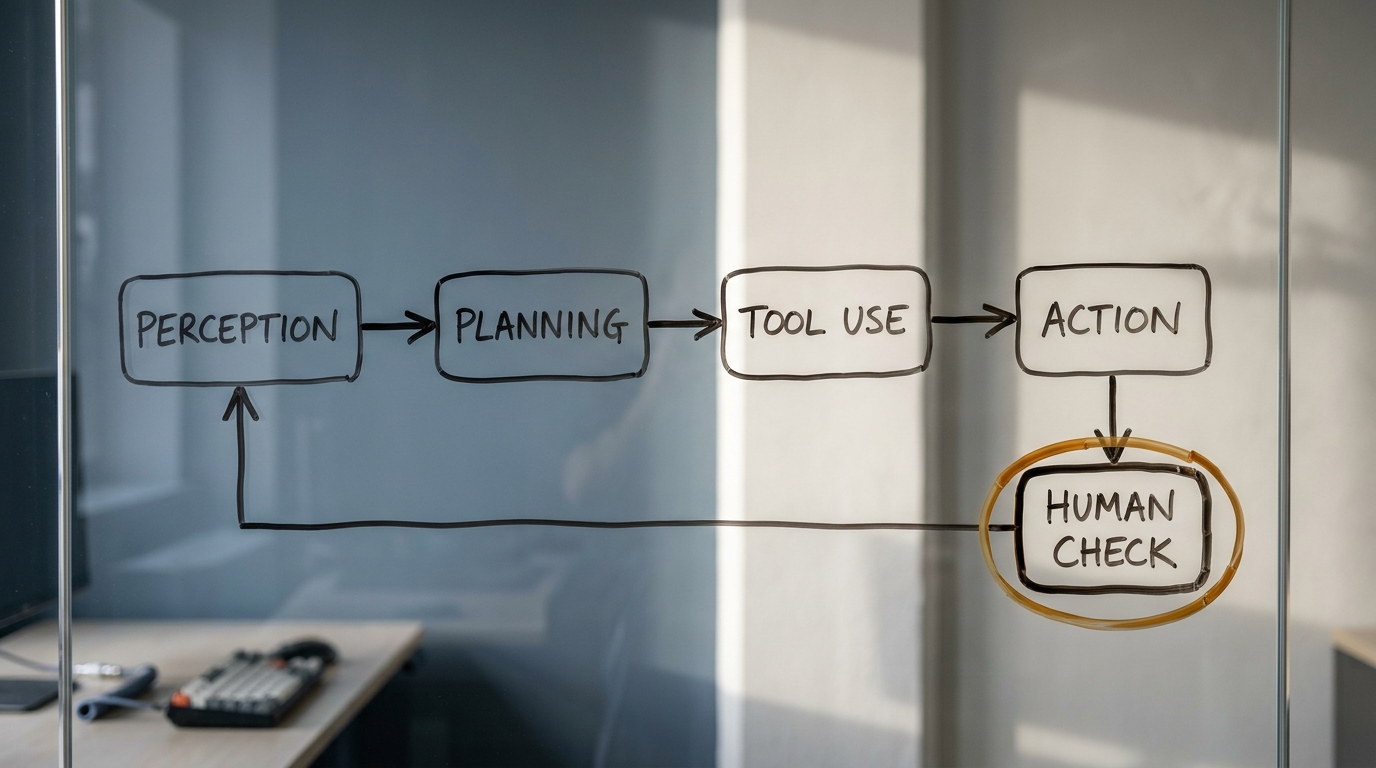
Under the surface, most production agents run a version of the same five-step loop:
- Perception - the agent takes in a request and the relevant context from your data.
- Planning - it breaks the goal into steps and decides which tools to use.
- Tool use - it calls the systems it needs, a search index, an API, a database.
- Action - it makes a change in the real world, sends a reply, updates a record, files a ticket.
- Human check - at defined points, a person reviews or approves before the agent continues.
Two examples make the loop concrete. A support-ticket agent reads an incoming request, pulls the customer's account history, drafts a resolution, then resolves low-risk tickets on its own or routes anything involving a refund to a human for approval. A document-processing agent ingests contracts, extracts key terms, flags anything outside policy, and updates the system of record, with a person signing off on the exceptions. Both agents do multi-step work. In both, a human sits at the exact point where a mistake would be expensive.
Our process: from pilot to production
We run engagements in phases with an explicit stop-gate between each one, which turns an open-ended AI initiative into a series of decisions you control. You decide whether to continue at every gate. You own the code produced in each phase whether you continue or not.
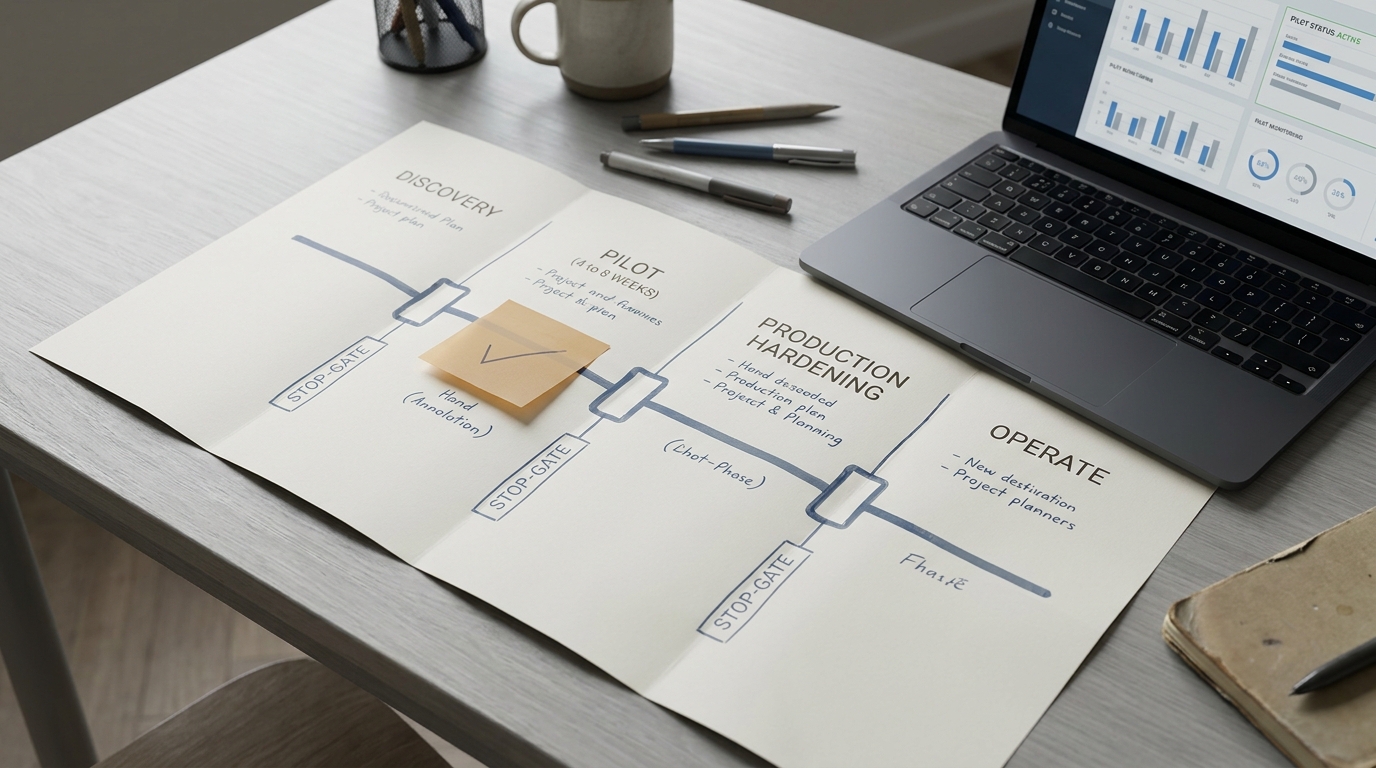
- Discovery and scoping - we map the workflow, the data, the systems, and the failure modes. The output is a concrete plan: what the agent will do, where it stops, and how we will measure whether it works.
- Pilot (typically 4 to 8 weeks) - we build a working agent against one real workflow, with real data, in a controlled setting. This is where you learn whether agentic AI actually earns its cost on your problem.
- Production hardening - we add the guardrails, evaluation, observability, and integrations the agent needs to run against live traffic without a person watching every step.
- Operate and iterate - the agent runs in production. We tune it, widen its scope where it earns trust, and hand over full operational ownership.
The stop-gates are the whole point. If the pilot shows agentic AI is the wrong fit, you stop there, having spent weeks instead of quarters .
Want to test that fit before committing to a full build? A short Discovery Sprint scopes the workflow and the risks so you know what you are signing up for.
How we prevent hallucination, compounding errors, and agent sprawl
This is the section every other service page skips, and it is the one that decides whether an agent is safe to run. Autonomous agents fail in ways ordinary software does not. They hallucinate facts. They take a small early error and compound it across a chain of actions. They multiply into a sprawl of half-owned agents no one can account for. Engineering against those three failure modes is most of the real work.
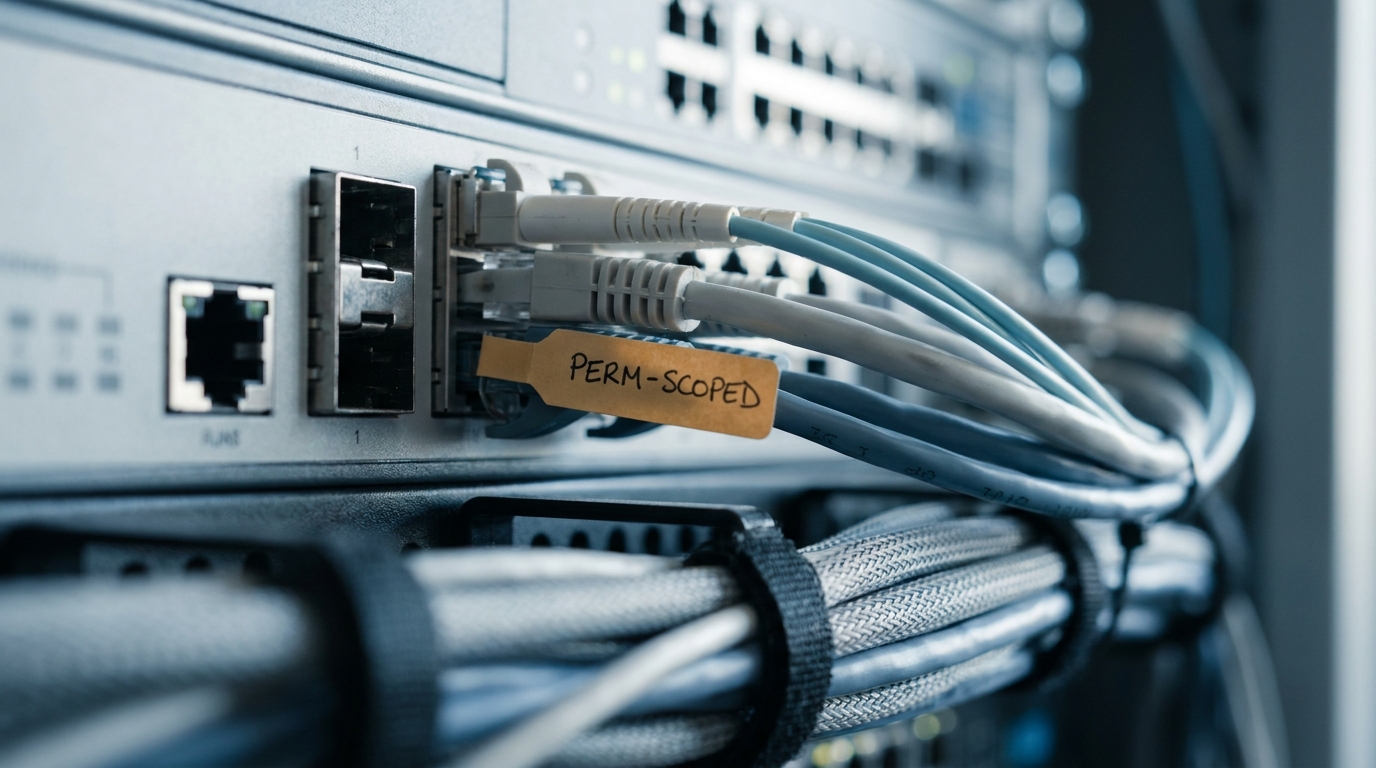
- Guardrails on actions - the agent's ability to act is scoped and permissioned. It can read broadly but take only a narrow, defined set of consequential actions, and the riskiest of those need human approval.
- Evaluation harnesses - before an agent touches production, it runs against a suite of test cases with known answers, so you measure its accuracy instead of hoping.
- Human-in-the-loop checkpoints - where a wrong action is costly, a person reviews or approves. Autonomy is earned per action, not handed over wholesale.
- Scoped tool permissions - each agent gets access only to the specific systems and operations its job requires, which keeps the blast radius of any single mistake small.
- Observability and tracing - every decision and tool call is logged, so when something goes wrong you can see exactly where and fix it, rather than guessing.
The field has converged on open standards for building agents that behave predictably, including protocols like MCP (Model Context Protocol) and A2A (agent-to-agent) for how agents connect to tools and to each other, plus a defense-in-depth posture for keeping autonomous systems contained. We build to those patterns rather than reinventing them. The goal is plain: an agent that fails safe, stays visible , and never quietly compounds one bad read into a $60,000 mistake.
Agentic AI for regulated and high-volume industries
Agentic AI pays off fastest where the work is repetitive, data-heavy, and high-volume, and where the current process already strains under manual effort. Regulated environments turn out to be a natural fit, precisely because they demand the audit trails, approvals, and controls that good agent engineering produces anyway.

A few concrete lenses. In real-estate and CRM-heavy operations, agents keep records current, enrich property and contact data, and prepare the routine work a broker or analyst would otherwise do by hand. In operations and back-office finance, they take on the invoice-matching, reconciliation, and document workflows that scale with headcount today. In customer support, they deflect the high-volume, low-risk tickets and route anything sensitive to a person. The common thread is volume plus structure: enough repetitive multi-step work that automating it frees real capacity, with clear points where a human should still decide.
Proof: what we bring to the table
We build agents across the full stack a production system needs: agent architecture, multi-agent orchestration, retrieval over your own data, tool and system integration, and the evaluation and observability layer that keeps it honest. We build to the open standards the field has settled on rather than a proprietary black box, so what you get is inspectable and maintainable by your own engineers.

We will not quote you an outcome number we never measured on your workflow. Agentic AI, engineered well, tends to move the metrics you would expect. Fewer hours lost to repetitive multi-step work. Faster turnaround on high-volume processes. Fewer errors on the tasks where a consistent process beats a tired human at 5pm. We will talk through realistic ranges for your specific workflow during scoping rather than quote a headline number that was never measured on your problem.
If your constraint is capacity rather than strategy - you know what you want to build but cannot hire agentic AI engineers fast enough - an embedded agentic team can run the build alongside your people instead of in a silo.
Best for, not for, timeline and ownership
Best for: teams with genuine multi-step workflows across several systems, a real volume of repetitive work, clean access to their own data, and a leader who wants production software rather than a demo.
Not for: single-lookup tasks a script already handles, high-stakes one-off decisions cheaper to do by hand, or organizations without access to the data and systems an agent would need to act on.
Timeline: most engagements reach a working pilot in 4 to 8 weeks, with production hardening after that depending on the number of integrations and the risk profile of the actions involved. We quote ranges, not false precision, and the stop-gates mean you are never locked into a timeline that has stopped making sense.
Ownership: you own the code and you own the models. No lock-in, no dependency on us to keep the system running. Not sure whether agentic AI is even the right move yet? Start with a free AI Readiness Snapshot and a 30-minute readiness call.
Build agents that are safe to run
Production-grade, not demos. You own the code and the models. Human-in-the-loop by default, with guardrails that keep a single wrong action from compounding into an expensive one. That is what separates an agent worth running from one that only looks good on a slide.
If you have multi-step work that agents could take off your team's plate, book a Discovery Sprint and we will scope the workflow, the risks, and the realistic path from pilot to production.